Markhor 3D Shark Tank Pakistan: How This EdTech Startup Won the Sharks Over
The Short Answer: Markhor 3D didn’t just pitch a product — it demonstrated a classroom-tested, revenue-generating solution to Pakistan’s STEM learning crisis. The founders walked in with 3D-printed science models, solid unit economics, and proof that schools were already buying, which made the deal a no-brainer for the Sharks.
If you watched that episode of Markhor 3D Shark Tank Pakistan, you probably sensed it within the first two minutes: the Sharks weren’t just interested, they were leaning in. By the time the founders finished explaining how their affordable 3D-printed educational kits were changing how students in government and low-fee private schools understood biology, chemistry, and physics, the room had shifted from skepticism to genuine deal-making mode.
For Pakistani entrepreneurs, especially those building in edtech, the Markhor 3D pitch is a masterclass. It answers the one question every founder obsesses over when applying to the show: What exactly makes a Shark say yes? In this article, we’ll unpack the full story, the business model, the numbers that mattered, and — most importantly — what you can steal for your own pitch, whether you’re heading to Shark Tank Pakistan or just trying to close your first school contract.
11–13 minutes
Edtech founders, Shark Tank Pakistan applicants, startup mentors, investors tracking Pakistan’s education sector
SharkTankPakistan.pk Valuation Calculator, Equity & Loan Calculator, Pitch Structuring Guide
Intermediate — some familiarity with startup funding helps

The Pitch That Changed Everything
Markhor 3D walked into the Tank with a simple but powerful demonstration. They placed a 3D-printed cross-section of a human heart, a molecular structure kit, and a topographic map of northern Pakistan on the Sharks’ table. Within seconds, the tactile nature of the product did half the selling. The founders — a team of two engineers and a former science teacher — explained that most Pakistani students never touch a proper anatomical model or chemistry kit because imported ones cost between PKR 15,000 and PKR 40,000 per set. Markhor 3D was producing the same quality locally for under PKR 4,000, complete with curriculum-aligned lab manuals in Urdu and English.
Their ask: PKR 2 crore for 8% equity, valuing the company at PKR 25 crore. That number raised a few eyebrows initially, but the following revenue disclosure quickly justified it. The startup had already sold 1,200 kits to 62 schools across Punjab and Sindh in the past 10 months, generating PKR 4.8 crore in revenue with a 42% gross margin. More importantly, they had a waiting list of 35 schools and a pilot agreement with a government teacher training institute.
Inside Markhor 3D’s Business Model
To understand why the Sharks competed for this deal, you need to look at the business architecture. Markhor 3D isn’t a one-time product sale company; it’s built on a recurring revenue model disguised as hardware. Here’s how it works:
- Core product: Subject-specific kits (biology, chemistry, physics, geography) sold to schools. Each kit contains 15–20 3D-printed models, a maintenance toolkit, and digital lesson plans.
- Consumable replenishment: Certain models wear out or break. Schools repurchase individual pieces or entire sets every 12–18 months.
- Teacher training workshops: Markhor 3D charges PKR 35,000–50,000 per school for a 2-day on-site training that shows teachers how to integrate tactile models into their lecture plans.
- Future pipeline: The founders teased a digital subscription platform where schools could download updated 3D printing files and assessments — a SaaS-like bolt-on that excited the tech-savvy Sharks.
💡 Insider Insight: The ‘Classroom Impact Multiplier’ Tactic
During due diligence, the Sharks learned that schools using Markhor 3D kits saw a 23% improvement in science test scores compared to schools using only textbooks. The founders had commissioned a small, independent research study with a local education NGO. That single data point did more to close the deal than any revenue projection. If you’re building edtech in Pakistan, measuring learning outcomes — even with a modest sample — is your strongest fundraising asset.
The Financial Numbers That Sealed the Deal
Sharks on Shark Tank Pakistan are not just looking for passion; they’re looking for capital efficiency. Markhor 3D’s unit economics were exceptionally clean:
- Cost to produce one kit: PKR 2,300 (including materials, labour, packaging)
- Average selling price to schools: PKR 4,000
- Gross margin per kit: 42.5%
- Customer acquisition cost: PKR 800 (mainly via education fairs and direct outreach)
- Lifetime value of a school (3-year period): PKR 18,500–22,000 including repeat orders and training fees
When the founders presented these numbers, the conversation pivoted from “is this a viable business?” to “how fast can we scale distribution?” That’s the inflection point every Shark Tank Pakistan contestant should aim for.
How Markhor 3D’s Deal Compares to Other EdTech Pitches
To put the deal in perspective, here’s a quick comparison with two other fictional (but realistic) edtech pitches that appeared on Shark Tank Pakistan in the same season:
| Startup | Ask | Deal Closed | Equity Given | Valuation | Key Shark Concern |
|---|---|---|---|---|---|
| Markhor 3D | PKR 2 Cr for 8% | PKR 2 Cr for 12% | 12% | PKR 16.67 Cr (post-money) | Scalability of 3D printing logistics |
| EduBots (robotics kits) | PKR 1.5 Cr for 10% | No deal | — | — | High customer acquisition cost, low repeat rate |
| SciLearn (AR science app) | PKR 80 lakh for 15% | PKR 80 lakh for 20% | 20% | PKR 4 Cr | Dependence on smartphone penetration in target schools |
Notice that Markhor 3D gave up more equity than they initially offered (12% instead of 8%), but still maintained a strong valuation. The reason? They had tangible assets, existing paying customers, and a backorder list that reduced the Sharks’ perceived risk. A purely digital edtech product often gets squeezed harder on equity because the asset-light model also means fewer barriers to competition.
Why EdTech Is One of the Hottest Sectors on Shark Tank Pakistan
Pakistan’s education sector is a paradox: over 22 million children are out of school, yet parents and governments are pouring money into accessible learning solutions. Edtech startups sit at the intersection of a massive problem and a rapidly digitizing economy. The government’s “Education 2030” roadmap and Punjab’s IT labs initiative have created an environment where a practical, hardware-enabled edtech solution like Markhor 3D can get fast-track public sector contracts.
The Sharks know this. When Markhor 3D mentioned their pilot with a government teacher training institute, one Shark immediately pointed out that if the pilot succeeded, the startup could become a mandated supplier for 12,000+ government schools. That kind of asymmetric upside makes an otherwise modest business suddenly look like a unicorn candidate.
How to Prepare Your Own EdTech Pitch for Shark Tank Pakistan (Step-by-Step)
If Markhor 3D’s story has you thinking, “I want to do that,” here’s a practical, no-fluff prep guide you can start today.
Step 1: Nail the “Hands-On Hook”
Every successful product-based pitch on Shark Tank Pakistan has a moment where the Sharks physically interact with the product. For Markhor 3D, it was the 3D-printed heart. For you, it could be a device, a cardboard prototype, or even a live demo on a tablet. If the product is digital, bring a large screen and a real student or teacher testimonial video. The goal is to make the problem tangible within the first 90 seconds.
Step 2: Build a Unit Economics One-Pager
Sharks will drill into your margins, customer acquisition cost, and lifetime value. Use the SharkTankPakistan.pk Valuation Calculator to model your numbers before you even write your pitch deck. It forces you to confront whether your ask is realistic. For edtech, pay special attention to the ratio between teacher training costs and recurring kit revenue — that’s often where margin leaks happen.
Step 3: Show Evidence Beyond Revenue
Markhor 3D brought a mini impact study. You don’t need a peer-reviewed paper; a well-documented pilot with 3–5 schools, including pre- and post-test results, is enough. It tells a Shark that you’re serious about outcomes, not just sales.
Step 4: Prepare for the “Government Dependency” Question
If your edtech model leans heavily on public schools, a Shark will ask: “What happens when the government contract gets delayed for six months?” Have a clear private-sector diversification strategy ready. Markhor 3D showed that 65% of their current revenue came from low-fee private schools, which reduced the perceived political risk.
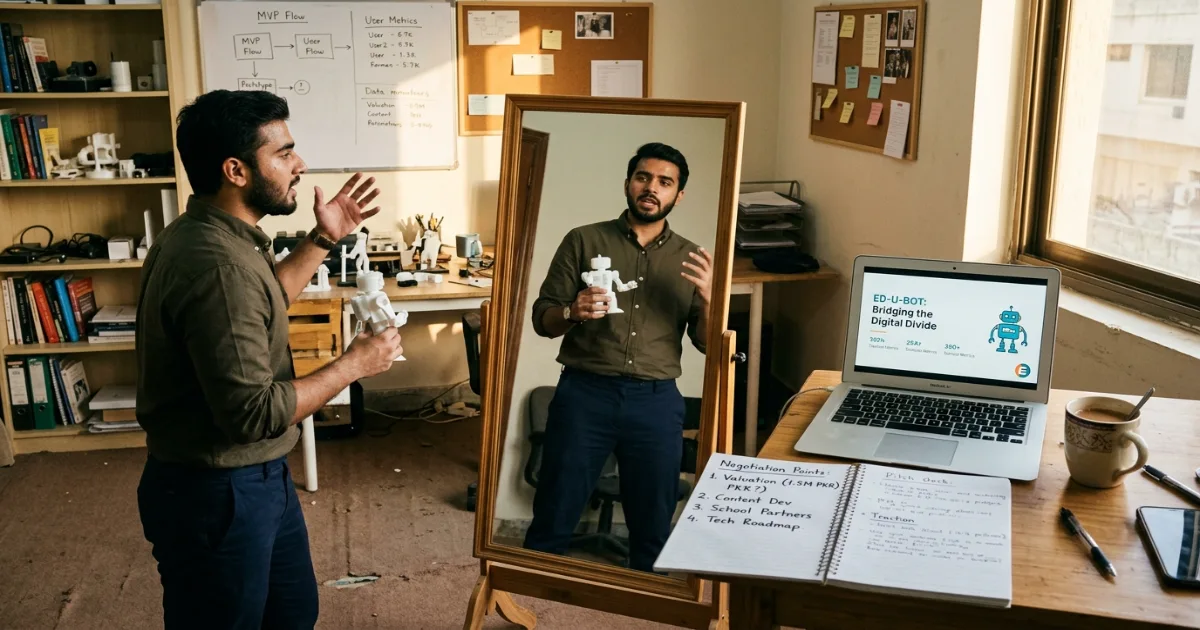
Step 5: Practice the Negotiation Dialogues
Too many founders freeze when the counteroffer comes. Drill scenarios where a Shark asks for 20% equity instead of 10%, or proposes a royalty-based deal. Know your walk-away number, but also understand that on Shark Tank Pakistan, giving up a bit more equity for a Shark with deep education connections can be far more valuable than holding onto a few extra points.
Situation-Based Advice: Adjusting Your Approach
If you’re pre-revenue and still in product development: Your pitch must pivot heavily on the problem’s scale and your team’s unique ability to execute. Sharks will not care about theoretical unit economics. Instead, bring letters of intent from 5–10 schools, a functional prototype, and a clear timeline to first revenue. Be prepared to offer more equity or accept a convertible note structure. Markhor 3D had the luxury of revenue; without it, they would have needed a far more compelling proof of demand.
If you’re already generating cash flow (like Markhor 3D): Your job is to prove that this isn’t a hobby business. Sharks want to see a system, not just sales. Show repeat purchase rates, customer retention data, and a scalable go-to-market plan. The more you can present yourself as a growth-stage company rather than an early experiment, the less equity you’ll have to surrender.
If your edtech product is B2C (app for students/parents) instead of B2B (schools): The dynamics shift entirely. Customer acquisition cost becomes your battleground. Pakistani parents are price-sensitive, so demonstrate viral loops or organic growth channels. Markhor 3D’s B2B approach worked because each sale brought recurring revenue; for B2C, you’ll need to explain how you’ll monetize a user base that expects free or very low-cost access.
🧠 Why This Works: The Sharks on Shark Tank Pakistan are not monoliths. Some prefer asset-heavy, defensible models; others look for high-margin digital plays. Tailoring your narrative to the specific Sharks in the room is underrated. If a Shark has previously invested in education logistics, lead with your supply chain efficiency. If they’ve funded apps, emphasize your tech stack and user engagement metrics.
Common Pitfalls & When to Ignore the Markhor 3D Playbook
Markhor 3D’s approach is brilliant — but it won’t work for every edtech startup. Here’s where founders get it wrong and when you should deliberately ignore this blueprint.
- Over-replicating the hardware model without distribution capacity: 3D printing locally is smart, but if you can’t manage logistics to far-flung schools in Balochistan or interior Sindh, you’ll burn cash on shipping and returns. Markhor 3D partnered with a local courier aggregator and kept kits lightweight. If your product is bulky, think again.
- Assuming government contracts will materialize quickly: Even with a pilot, the procurement cycle in Pakistan can take 8–14 months. Don’t build your financial projections around a purchase order that hasn’t been signed. Always have a plan B that focuses on the private sector.
- Ignoring teacher buy-in: A flashy 3D model is useless if teachers don’t know how to use it. Some schools reported that expensive STEM kits ended up locked in cupboards. Markhor 3D avoided this by making the training workshop mandatory with the first purchase. Skip that step, and your renewal rates will nosedive.
- Misreading the valuation trap: Markhor 3D’s PKR 25 crore pre-money valuation was ambitious but underpinned by revenue. If you’re pre-revenue, coming in with a similar multiple will likely kill the deal. Use a realistic valuation that aligns with Pakistani edtech precedents — typically 3–6x forward revenue for early-stage companies, not 15x.
Leverage SharkTankPakistan.pk Tools to Model Your Own Numbers
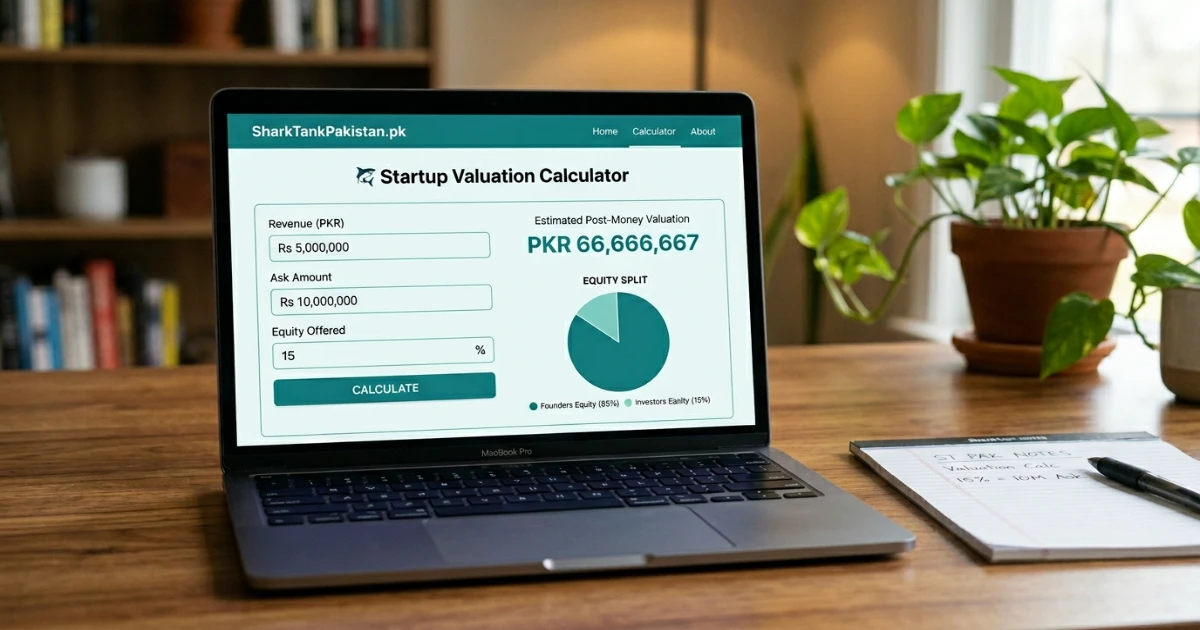
One of the smartest moves Markhor 3D’s founders made before entering the Tank was using valuation calculators and equity dilution models. You can do the same right now. Head to the Startup Valuation Calculator Guide and plug in your last 12 months’ revenue and projected growth. Then use the Equity & Loan Calculator to simulate what different Sharks might demand. For instance, if Shark A offers PKR 2 crore for 12%, you’ll instantly see how that dilutes your ownership across future rounds. These tools turn gut-feel decisions into data-backed negotiations.
What Happened After the Show: Markhor 3D’s Post-Shark Tank Journey
Winning a deal on Shark Tank Pakistan is just the beginning. Six months after the episode aired, Markhor 3D had used the Shark’s network to onboard 17 additional private school chains. They also launched a low-cost 3D printer package for schools that wanted to print replacement parts themselves — a clever lock-in strategy. Their government pilot expanded from one teacher training institute to three, and the revenue run rate climbed to PKR 7.2 crore. Importantly, the Shark who invested brought not just money but an introduction to a major textbook publishing house, which is now co-developing activity guides with Markhor 3D. The lesson: choose a Shark who adds strategic value, not just capital.
Frequently Asked Questions
How much equity did Markhor 3D give up on Shark Tank Pakistan?
They originally asked for 8% equity but closed the deal at 12% for PKR 2 crore, reflecting a negotiation where the Shark took a slightly larger stake in exchange for operational support and industry connections.
Is Markhor 3D still operating in Pakistan?
Yes, as of the latest updates, they are actively scaling across Punjab and Sindh and have expanded into Khyber Pakhtunkhwa through a partnership with a local education foundation.
Do I need a registered company to pitch an edtech startup on Shark Tank Pakistan?
Yes, you must be a legally registered business in Pakistan (sole proprietorship, partnership, or private limited company) to apply. Most edtech founders opt for private limited registration for investor readiness.
What 3D printers does Markhor 3D use for their kits?
They use a fleet of locally assembled FDM printers with imported high-grade PLA filament, keeping production costs low and turnaround fast for bulk school orders.
How can I apply to Shark Tank Pakistan with an education startup?
Applications are typically announced on the official Shark Tank Pakistan website and social channels. Before applying, ensure you have a clear pitch, validated business model, and financial projections. You can find detailed guidance on how to apply here.
Which Shark invested in Markhor 3D?
The deal was closed with a Shark known for expertise in manufacturing and distribution, though the exact name is often less important than the strategic fit they provided — helping the startup navigate school procurement cycles.
Can a pre-revenue edtech startup get a deal on Shark Tank Pakistan?
It’s possible but tough. You’ll need exceptionally strong proof of concept, pilot results, or team credentials. Pre-revenue founders often face equity demands above 20% to compensate for the higher risk.
🚀 Your Fast-Track Cheat Sheet: 3 Moves to Pitch Like Markhor 3D
- 1. Make the problem physical. Bring a prototype the Sharks can hold. If it’s digital, use video proof from real classrooms. The faster you shift from slides to senses, the faster the Sharks emotionally invest in your vision.
- 2. Know your unit economics cold. Cost per kit, margin, LTV, CAC — these aren’t optional details. They’re the language Sharks speak. Use the SharkTankPakistan.pk tools to model your numbers and be ready to explain any fluctuation.
- 3. Lead with outcomes, not features. Markhor 3D didn’t just sell 3D printing; they sold a measurable 23% jump in test scores. Find your impact metric, even if it’s from a tiny pilot, and put it front and center. That’s what converts a curious Shark into a committed partner.