Profit Margin Calculator Pakistan: How to Price Your Product Correctly for Investors and Real Profit
The short answer for every Pakistani founder: Pricing isn’t about picking a hopeful number. A profit margin calculator Pakistan entrepreneurs actually use shows whether your product covers every cost — including invisible ones like electricity, delivery delays, and currency shifts — and still leaves a margin that investors, including Shark Tank Pakistan judges, will take seriously.

Why Pricing Correctly Is the First Profit Decision You Make
Walk through any Karachi wholesale market or scroll through a Lahore e‑commerce group and you’ll hear the same story: “I sold 200 units and still ended up with nothing.” The culprit is almost never the product — it’s the pricing model that ignored real profit margins.
If you’re preparing to pitch on Shark Tank Pakistan, this is the first number the sharks will probe. Before they ask about your “ask,” they’ll want to know: What’s your gross margin? What’s your net after all Pakistani taxes and operational friction? If you don’t know, you’ll lose credibility in seconds.
Our profit margin calculator Pakistan tool isn’t just a spreadsheet — it’s built with the cost realities of doing business in Pakistan in mind. Whether you manufacture lawn suits, run a cloud kitchen, or sell tech subscriptions, pricing without a margin‑first approach is like driving without a fuel gauge.
What Exactly Does a Profit Margin Calculator Tell You?
At its core, a profit margin calculator shows the percentage of revenue left after deducting specific costs. But for Pakistani founders, three types matter more than anything:
- Gross profit margin — Revenue minus direct product costs (materials, production labour, packaging).
- Operating profit margin — After operating expenses like rent, utilities, staff salaries, and delivery.
- Net profit margin — The final number after tax, interest, and every hidden rupee you spent.
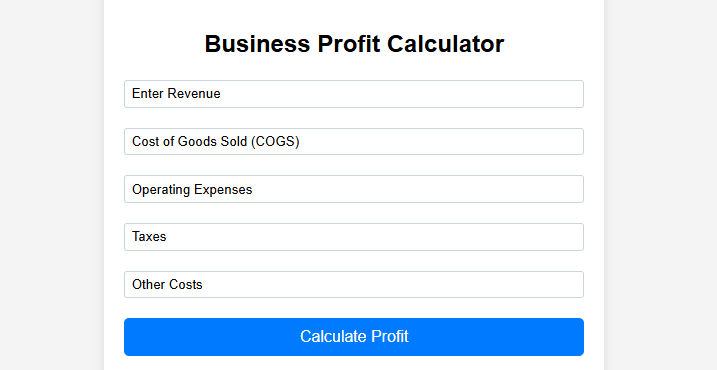
The calculator on SharksTankPakistan.pk lets you plug in cost components (including things like fuel surcharge on deliveries or SECP compliance costs) and instantly see whether your current price leaves a sustainable margin — or if you’ve been unconsciously working for free.
Profit Margin Calculator Pakistan: How to Use It to Set the Right Price
Most people reverse the process. They set a price, then later discover the margin. Professional founders do the opposite: they define the margin first, then back‑calculate the price. Here’s the step‑by‑step workflow the calculator supports:
Step 1: List every direct cost — even the ones you forget
Pakistani startups often omit: packaging tape, poly bags, courier fuel surcharges, platform commission (Daraz, Foodpanda), bank transaction fees, and the cost of returns. A single return can wipe out the profit on three orders.
Step 2: Choose your target gross margin
For physical products, Shark Tank Pakistan judges typically expect at least a 40–50% gross margin unless you’re building a massive volume play. Tech and service businesses can aim higher, but need to justify customer acquisition costs.
Step 3: Let the calculator reverse‑engineer the price
Enter total unit cost and desired margin percentage. The tool instantly shows the minimum selling price — and how much every extra 5% of margin improves your bottom line.
Step 4: Test against what the local market actually pays
If the calculator says you need to sell at PKR 1,800 but your target customer will only pay PKR 1,200, you have a cost problem — not a pricing problem. That’s when you re‑negotiate supplier contracts, reduce packaging frills, or tweak the product size.
Step 5: Build the narrative for investors
Use the calculator output to show not just numbers, but your plan to improve margins over time through scale, supplier leverage, or automation. Sharks respond to clarity, not hope.
💡 Insider Insight from Shark Tank Pakistan
During season 1, a food entrepreneur confidently quoted a 35% margin — until one shark asked if that included delivery and platform commission. It didn’t. The real margin was below 12%. Had they used a proper profit margin calculator Pakistan scenario, they’d have entered the tank with a defensible figure and a plan to improve it.
Comparison: Gross Margin vs Net Margin vs Markup
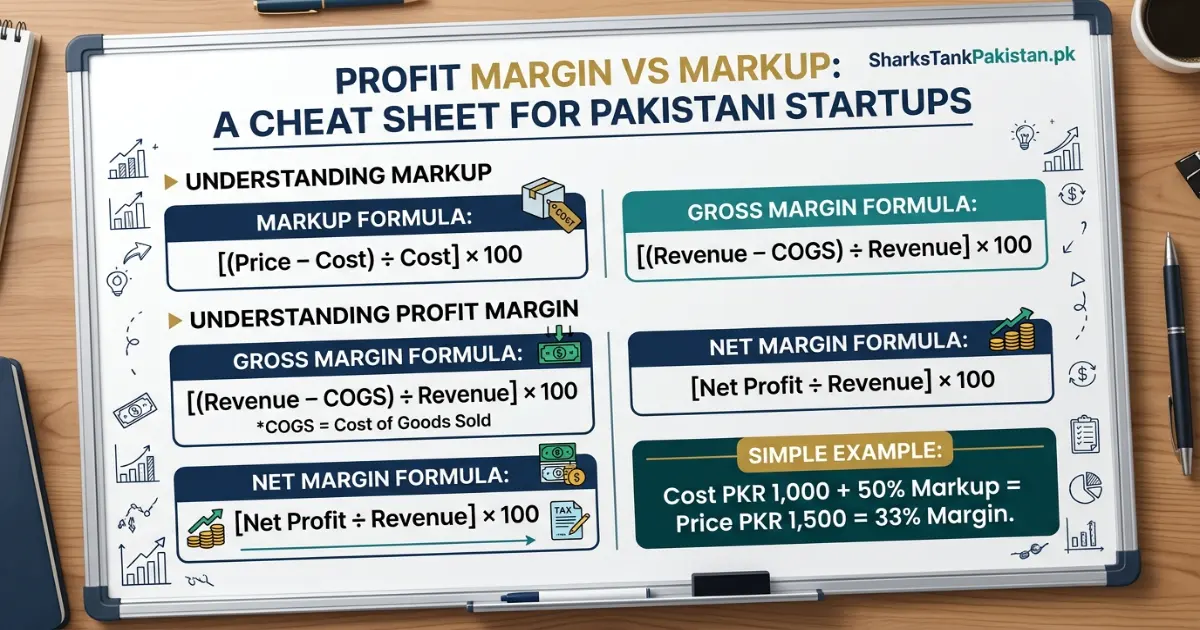
Confusing margin with markup is one of the most expensive mistakes a founder can make. Here’s the crystal‑clear difference:
| Metric | What it measures | Formula | When it matters most |
|---|---|---|---|
| Markup | How much you increase cost to get selling price | (Price – Cost) / Cost × 100 | Setting shelf price quickly |
| Gross Margin | Profit as % of revenue after direct costs | (Revenue – COGS) / Revenue × 100 | Pitch decks, investor Q&A |
| Net Margin | What you actually keep after everything | Net Profit / Revenue × 100 | Long‑term sustainability |
A 50% markup does not give a 50% margin. A product costing PKR 1,000 with a 50% markup sells for PKR 1,500 — that’s only a 33% gross margin. The sharks know this. You need to know it too.
What Pakistani Entrepreneurs Usually Get Wrong About Profit Margins
We see five patterns again and again — and they’re amplified by local realities:
- Ignoring currency risk on imported raw material. If your cost is in dollars and your revenue is in rupees, a 15% PKR depreciation can destroy your margin overnight. The calculator can help you model a buffer.
- Under‑pricing to “capture the market” without a timeline. This works if you have venture capital to burn. For a bootstrapped founder, it’s a slow death.
- Calculating margin only after a sale, not before. You must price proactively — the way the calculator forces you to think.
- Forgetting the cost of capital. If you invest your own savings, you’re giving up interest or alternate income. That’s a real cost.
- Assuming all units will sell at full price. Discounts, promo codes, and negotiation culture shrink actual selling prices. Factor that in.
Situation‑Based Pricing Adjustments for Different Founders
If you’re pre‑revenue vs generating consistent sales
Pre‑revenue, you’re estimating costs and guessing conversion rates. The profit margin calculator becomes a scenario planner: “What if my cost per unit drops by 20% at 500 units?” Run multiple versions. Once you have real sales data, refine religiously. Never let the initial projection become a permanent assumption.
If you sell a physical product vs a service
For physical goods, inventory holding cost, shrinkage, and delivery returns are margin‑killers. The calculator should include a line for average return cost per unit. For services, the biggest hidden cost is your time — under‑quoting a month‑long project at a fixed price without calculating effective hourly rate is disastrous.
If you’re pitching on Shark Tank Pakistan vs selling online
On the show, you need to present margins as they stand today, plus a credible path to improvement. For direct‑to‑consumer online sales, you have more pricing freedom but must account for ad spend. The calculator can separate channel‑specific costs.
Common Pitfalls & When to Ignore the Profit Margin Calculator’s Advice
The calculator is a decision‑support tool, not a dictator. There are rare moments when you deliberately price below full‑cost margin:
- Loss‑leader strategy for a limited time to acquire high‑lifetime‑value customers. But you must know exactly when you’ll turn profitable, and the sharks will demand that timeline.
- Economies of scale pivot: if your cost halves at 10,000 units, you might price for that future cost today, but you’d better have purchase orders to back it up.
- Clear competitive necessity with a plan B. If the market price is fixed and you can’t lower costs, then your margin is a signal to change the business model, not to ignore it.
Ignoring the calculator output without a data‑backed rationale is how most under‑funded startups fail. The tool’s real value is highlighting uncomfortable truths early, when you still have time to adjust.

Real‑World Example: A Lahore‑Based Skincare Brand
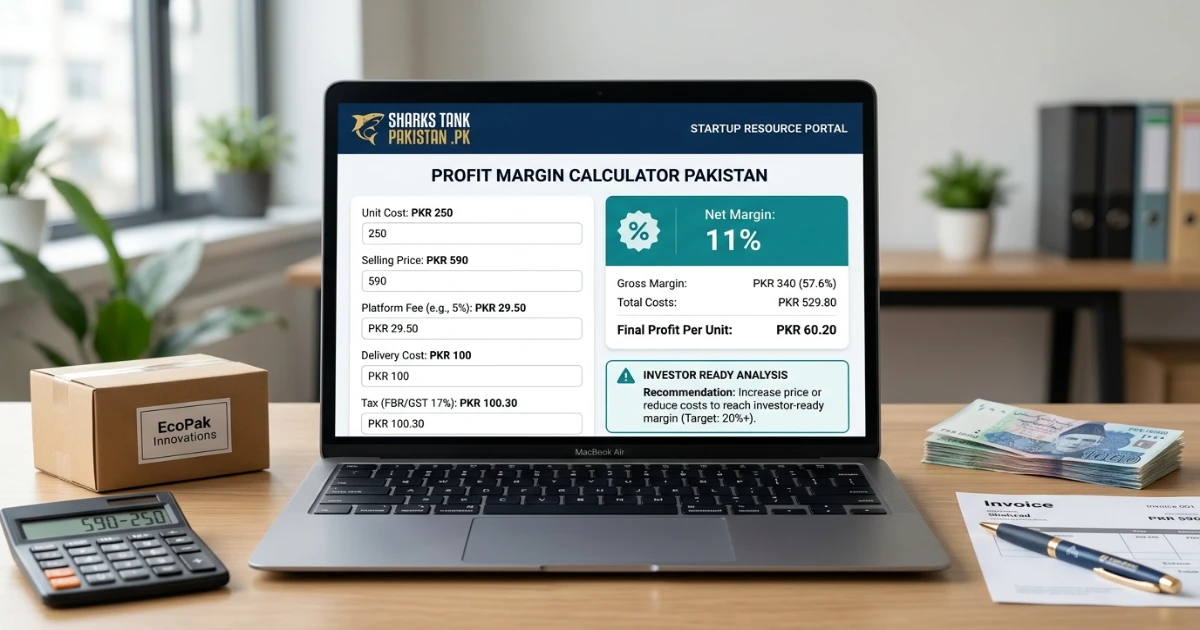
Consider a local brand selling handmade soaps. Raw material cost per unit: PKR 120. Packaging: PKR 40. Labour: PKR 35. Platform fees and shipping subsidy: PKR 55. Total direct cost: PKR 250. They were selling at PKR 590, thinking they had a huge margin — but when they ran the profit margin calculator Pakistan edition and factored in monthly kitchen rental, electricity, marketing, and a small salary for the founder, the net margin was just 11%.
Instead of cutting quality, they created a subscription box, increased average order value, and re‑priced the premium line to PKR 850 after validating demand. Within three months, net margin climbed to 26%. That’s the power of starting with a calculator and not opinions.
Put This into Practice: Try the Calculator Yourself
Open the Profit Margin Calculator on SharksTankPakistan.pk and enter your real numbers. Don’t guess. Pull your last 30 days of receipts, invoices, and bank statements. The exercise alone will change how you think about your business. If you’re preparing a Shark Tank Pakistan application, this single action could be the difference between a shark leaning forward or leaning back.
FAQs: Profit Margin & Pricing for Pakistani Founders
What is a good profit margin for a startup in Pakistan?
Gross margins above 40–50% are generally expected for product‑based startups. Tech and service businesses can aim for 60%+ gross. Net margins vary widely but anything below 10% net raises sustainability questions — especially with inflation.
How do I calculate profit margin before launching my product?
Use the SharksTankPakistan.pk profit margin calculator with estimated costs, then add a 10–15% buffer for unforeseen expenses. Validate with a small test batch and adjust before scaling.
Does the profit margin calculator include Pakistani taxes?
The calculator allows you to input tax percentages (sales tax, income tax withholding) separately, so you can see both pre‑tax and post‑tax margins. Always model with the final tax burden.
Why do Shark Tank Pakistan judges care so much about margins?
Margins prove you have a viable business, not just a good idea. They indicate pricing power, cost control, and whether the business can scale without constant cash injections.
Is markup the same as profit margin?
No. Markup is the percentage added to cost; margin is the percentage of selling price that is profit. A 50% markup yields only a 33% margin. Confusing the two can make your business appear healthier than it really is.
How often should I re‑calculate my profit margins?
At least monthly, and immediately after any major cost change (fuel price hike, PKR devaluation, supplier price increase). For e‑commerce, monitor per channel quarterly.
Can I price below my calculated margin to beat competitors?
Only with a documented strategy and an exit plan. Sharks will ask how you’ll eventually make money. Temporary loss‑leader pricing works if you can prove customer lifetime value, but don’t do it blindly.
🔑 Your Fast‑Track Cheat Sheet — Top 3 Actions
1. Stop guessing and calculate backwards. Decide your required net margin first, then feed all costs into the profit margin calculator Pakistan tool to find the price that makes the business viable — not the other way around.
2. Build a “margin bridge” for investors. Show exactly how you’ll improve margins over the next 12–18 months through volume discounts, process efficiency, or value‑added features. Every shark wants to hear this story.
3. Revisit your calculator monthly. The Pakistani market shifts fast. What looked profitable in January can be underwater by April. Treat pricing as a living discipline, not a one‑time setup.