First-Time Founder Survival Guide: From Idea to First Investment
⚡ The Short Answer: This first time founder guide Pakistan cuts through the noise: validate your idea with paying customers before you build anything elaborate, register your company correctly from day one, and learn to pitch a defensible valuation — not a dream. The founders who make it to the Shark Tank Pakistan stage and actually close funding are the ones who treat the journey as a series of small, measurable wins, not a lottery ticket.
You’ve got a notebook full of ideas, maybe a prototype that a handful of friends have clicked through, and a growing conviction that you could be the next founder to walk into the Shark Tank Pakistan tank and walk out with a deal. That fire is real. But so is the gap between raw ambition and a funded startup. Most first-time founders in Pakistan don’t fail because their idea was bad. They fail because they burn through time and money on the wrong things, misunderstand how early-stage investment actually works, and walk into investor conversations without a defensible answer to the simplest question: “What’s your company worth?”
This guide is built to close that gap. It’s grounded in the real dynamics of Pakistan’s startup ecosystem — where SECP registration has quirks, where angel investors still rely heavily on personal references, and where a 10-minute pitch on Shark Tank Pakistan can change your trajectory if you’ve done the homework. Whether you’re pre-revenue, tinkering with an MVP, or already generating cash flow but unsure how to structure your first raise, the following pages will give you a step-by-step survival map.
Phase 1: Idea Validation — The Step Most Pakistani Founders Skip
Excitement is a terrible filter. In Pakistan’s close-knit social circles, it’s easy to get ten friends and family members saying your idea is brilliant. That’s not validation; it’s politeness mixed with love. Real validation comes from strangers — ideally, strangers willing to pre-pay or at least pre-register with their phone number and a genuine intent to use your product.
Before you spend a single rupee on an app developer or a fancy logo, do this: identify 50 potential customers in your target market and have a 10-minute conversation with each. Don’t pitch. Ask questions. What do they currently do about the problem you’re solving? How much does it cost them — in time, money, or stress? What would make them switch to something new? In Pakistan, these conversations work best when you tap into existing communities — WhatsApp groups of small business owners, Facebook communities of moms in Lahore, or LinkedIn networks of IT professionals. The patterns you hear will either sharpen your idea or mercifully kill it early before you’ve sunk in significant capital.
Only when at least 20 of those 50 conversations produce a clear “Yes, I need this, when can I try it?” should you proceed. That’s your first real data point, and it’s more valuable than any market-size slide you could ever put in a pitch deck.

Phase 2: Legal Setup — Your First Investor’s First Question
In Pakistan, the moment you decide this is a real business and not a side project, register it. The most common structure for tech startups is a private limited company with the Securities and Exchange Commission of Pakistan (SECP). It protects your personal assets, lets you issue shares, and signals to any investor — especially sharks — that you’re serious. The process takes roughly 2–4 weeks and costs a few thousand rupees if you work with a decent company registrar or use the SECP’s online portal.
Too many first-time founders delay registration, running their startup out of a personal bank account. Then an investor asks to see the cap table, and you have to sheepishly explain that there isn’t one. That’s an instant credibility loss. A clean, simple registration with clearly defined founder equity is the foundation of every investment conversation you’ll ever have. For a step-by-step walkthrough, review the Shark Tank Pakistan application guide, which covers the legal prerequisites the show expects from contestants.
Phase 3: The MVP and Revenue — Traction That Talks
Investors in Pakistan, including the sharks, have developed a finely tuned scepticism for “future projections.” What moves them is traction. The MVP (minimum viable product) doesn’t need to be beautiful; it needs to demonstrate that someone will pay for it. A simple WhatsApp-based ordering system that processes PKR 50,000 in transactions is more investable than an unfinished app with a PKR 5 crore projection.
Focus on collecting two numbers obsessively: customer acquisition cost (CAC) and average revenue per user (ARPU). Even if these are rough early estimates, they form the backbone of your valuation story. When you eventually sit across from an investor or a shark, you’ll be asked about unit economics. Founders who can answer with specific, real-world data — “It costs us PKR 300 to acquire a customer, and they spend PKR 1,200 on average over six months” — are the ones who get nods, not eye rolls.
💡 Insider Insight from Shark Tank Pakistan: Several sharks have publicly said they’re willing to invest in a ‘boring’ business with excellent unit economics over a ‘sexy’ idea with fuzzy numbers. One shark noted that a Karachi-based laundry service startup that showed detailed cost-per-order and repeat-customer rates got more respect in the tank than a hyped AI platform with no paying users. In Pakistan, execution evidence beats idea glamour every time.
Phase 4: Understanding Your First Funding Options
Not all money is equal, and the source you choose shapes your company’s future in ways you might not realise. Here’s a comparison of the four most common routes for Pakistani first-time founders.
| Funding Source | Typical Amount | Equity Dilution | Best For | Watch Out For |
|---|---|---|---|---|
| Friends & Family | PKR 5 lakh–PKR 30 lakh | Often none initially, may convert | Pre-revenue, prototype stage | Strained relationships if the business struggles |
| Pakistani Angel Investors | PKR 50 lakh–PKR 3 crore | 10%–25% | Early traction, proven MVP | May demand board seats or heavy involvement |
| Shark Tank Pakistan Deal | PKR 50 lakh–PKR 5 crore | 5%–30% | Startups with revenue and a TV-friendly story | Due diligence after the handshake can renegotiate terms |
| Venture Capital (Local or Regional) | PKR 3 crore+ | 15%–35% | Proven growth, scalable model | Long lead times, heavy reporting requirements |
How to Calculate Your Valuation Without Embarrassing Yourself
This is the single most common anxiety point for first-time founders, and it’s also where the SharkTankPakistan.pk tools become your lifeline. Too high, and you look disconnected from reality; too low, and you give away too much of your company for too little capital.
There are several methods, but for Pakistani startups, two work best. The revenue multiple method: take your annualised revenue (or a realistic projection grounded in current traction) and multiply it by a factor that reflects your sector and growth rate — in Pakistan, 3x to 8x is common for tech-enabled businesses depending on profitability. The comparable transactions method: look at what similar companies in the region have raised at similar stages. Then test your assumptions in the Startup Valuation Calculator. It forces you to be honest about your inputs and gives you a defensible range to walk into any meeting with.
Don’t skip this step. We’ve seen founders on Shark Tank Pakistan lose deals because they named a valuation, and when asked how they arrived at it, they had no answer. The calculator gives you that answer — and the confidence that comes with it.

Situation-Based Advice: Your Path Depends on Where You Stand
If you’re still in the idea stage with no product and no customers…
Your immediate priority is not funding. It’s building a minimum viable test, getting those first 50 conversations, and finding even one person willing to pay a small amount. Don’t waste time cold-emailing investors. Instead, find a technical co-founder if you’re non-technical, or build the simplest version yourself with no-code tools. Many Pakistani founders have started with a Google Form and a WhatsApp group before writing a single line of code. The Shark Tank Pakistan application window will still be there in six months — but only if you’ve validated your idea before applying.
If you have an MVP and a handful of paying users…
You’re at the stage where a compelling story starts to emerge. Document everything: revenue, user feedback, retention. Use the Equity-Loan Calculator to model what your cap table looks like after a raise of, say, PKR 1 crore at 15% dilution. This is the moment to begin building relationships with angel investors, attending startup events, and seriously reviewing the Shark Tank Pakistan application requirements. A funded friend of mine used to say: “If you have 10 paying customers, you don’t have a startup problem — you have a marketing problem.” That’s a good place to be.
If you’re generating consistent revenue but haven’t raised…
You now have leverage. Investors chase traction, and you have it. Before you raise, get your legal structure audit-ready. Ensure your SECP filings are up to date, your intellectual property is properly assigned to the company, and your financials are clean enough to share. Then use the Valuation Calculator to set a floor price for your round. You can also consider applying to Shark Tank Pakistan from a position of strength — the sharks respect founders who don’t need their money but welcome it for acceleration.
📊 Data Point: A survey of Pakistani startups that successfully raised seed rounds found that the average time from idea to first investment was 14 months. The founders who moved fastest weren’t necessarily the smartest — they were the ones who spent the least time building features nobody asked for and the most time talking to customers and preparing their financial narrative.
Common Pitfalls & When to Ignore This Guide Entirely
Pitfall 1: Building too much before proving demand. The instinct to make the product perfect before showing it to anyone is strong in Pakistan’s engineering-heavy founder community. Fight it. The first version of Bazaar was not the polished platform you see today. Startups win by learning fast, not by building long.
Pitfall 2: Mistaking a Shark Tank Pakistan appearance for a strategy. The show is a platform, not a business plan. Some founders spend months perfecting their pitch while their product stagnates. A memorable TV moment might open doors, but only a real business walks through them. The sharks will ask operational questions that a week of rehearsed answers can’t fake.
Pitfall 3: Raising money too early at a poor valuation. Taking PKR 1 crore for 30% equity to fund an unvalidated idea puts you on a difficult path. You’ll have less equity to offer future investors and less control over your decisions. Exhaust free or cheap ways to validate before you sell a chunk of your company.
🧠 When to Ignore the ‘Slow and Steady’ Advice: If you’re operating in a land-grab market — say, a logistics network where the first mover locks in drivers, or a marketplace where supply-side exclusivity matters — speed matters more than perfect unit economics at the seed stage. In those cases, raising quickly to capture market share can be the smarter move, even if the valuation isn’t ideal. Just be clear-eyed about the risk and have a plan for Series A before you take the seed cheque.
How to Use SharkTankPakistan.pk Tools to Build Your Founder Journey
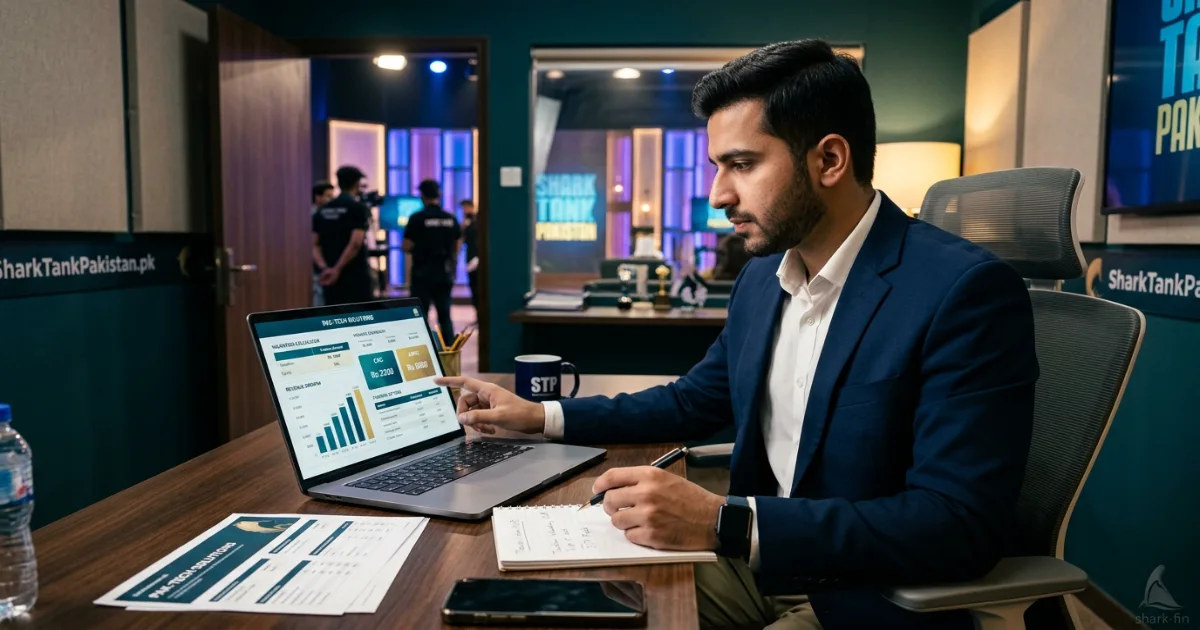
The site’s calculators aren’t just for the final pitch — they’re for every stage of your evolution. At the idea stage, use the simple revenue projection sheet that accompanies the Valuation Calculator to test assumptions. Once you have revenue, run the full model and compare your output to recent deals in your sector. When you’re ready to structure a round, the Equity-Loan Calculator shows you exactly what dilution looks like across multiple scenarios.
These tools give you the language investors speak. Instead of saying “I think we’re worth X,” you can say, “Based on a 5x revenue multiple adjusted for Pakistani market risk and our 20% month-over-month growth, our valuation range is Y to Z.” That sentence alone puts you ahead of 80% of first-time founders.
Frequently Asked Questions About Being a First-Time Founder in Pakistan
- Do I need a registered company before applying to Shark Tank Pakistan?
- Yes. Shark Tank Pakistan requires a legally registered Pakistani business, typically a private limited company with SECP. The show’s legal team verifies incorporation documents before you enter the tank. A sole proprietorship or an unregistered partnership won’t qualify.
- How much equity should I give up in my first funding round?
- Typically 10% to 20% for a seed round in Pakistan, depending on your traction and the cheque size. Avoid giving more than 25% in your first round; future dilution will compound, and you need to retain enough equity to stay motivated and attract later investors.
- What’s the biggest mistake first-time founders make when pitching?
- Overemphasising the idea and underemphasising execution evidence. Investors and sharks want to know what you’ve done, not what you plan to do. Show customer traction, unit economics, and a clear understanding of your risks — not just a grand vision.
- Can I raise money if I’m pre-revenue?
- Yes, but it’s harder. Angel investors or friends and family are your most likely sources. You’ll need an exceptional team, a compelling prototype, and clear evidence of demand (waitlist, letters of intent) to convince institutional investors without revenue.
- How long does it take to get first investment in Pakistan?
- On average, 12 to 18 months from idea to first cheque. Founders who are disciplined about customer validation and financial preparation tend to close faster. Expect at least 6 months of active fundraising once you start formally reaching out to investors.
- What should I never say in a pitch meeting?
- “We have no competitors.” It signals either naivety or poor market research. Every business has competition, even if it’s the manual, offline way people currently solve the problem. Acknowledge competitors and explain your genuine edge.
- Is Shark Tank Pakistan a good route for a first-time founder?
- It can be, provided you’re ready. The exposure is massive, and the sharks bring more than money — they bring networks and operational wisdom. But you must have a real business, not just a concept, and your valuation must be defensible. Use the tools on this site to prepare thoroughly before applying.
- How do I find the right angel investor in Pakistan?
- Start with your network: university alumni, industry contacts, and startup events in Lahore, Karachi, and Islamabad. Pakistani angel groups like Pak Angels and regional networks are also active. A warm introduction from a mutual contact carries far more weight than a cold email.
📋 Your Fast-Track Cheat Sheet: Top 3 Actions to Take
- Validate before you build. Talk to 50 strangers in your target market. If at least 20 genuinely need your solution, proceed. If not, iterate or pivot. This single step saves more founder time and money in Pakistan than any other advice.
- Get your legal and financial house in order now. Register your private limited company, separate your business finances, and use the Valuation Calculator to establish a defensible number. When an investor says yes, you want to be ready to close, not scrambling.
- Treat Shark Tank Pakistan as a milestone, not the destination. A great pitch on the show can accelerate your journey, but the business must already be fundable. Focus on building something real, and the right stage — whether it’s the tank or a private boardroom — will become a natural step in your growth, not a Hail Mary.