Break-Even Analysis Pakistan: The Micro-Business Owner’s Roadmap to Real Profit
⚡ The Short Answer: A proper break-even analysis in Pakistan is not about guessing when you’ll stop losing money. It’s a formula that forces you to price for profit, factoring in erratic utility costs, currency fluctuations on raw materials, and the hidden cost of “thehri” or commission-based sales channels. For any micro-business hoping to pitch on Shark Tank Pakistan, knowing your exact unit break-even is the difference between looking like a hobbyist and a serious founder.
Most Pakistani micro-business owners I advise don’t fail because they run out of passion. They fail because they run out of cash while running on hope. You launched your home-based clothing line in DHA or your cloud kitchen in Gulshan-e-Iqbal with a dream. You track sales in a notebook or a WhatsApp group. But when the electricity bill spikes in summer or the raw material bhai jacks up his price, you make a rough mental calculation and pray you’re still making something. That’s not a business. That’s a bet.
Break-even analysis Pakistan entrepreneurs need isn’t the dry corporate exercise you read about in international textbooks. It’s a survival tool adapted for our local reality. You cannot copy-paste a Western break-even template when your biggest variable cost is fuel for a generator, or when you pay a monthly “monthly” to the local union. This guide will strip away the jargon and give you a framework that actually works in Gulberg, PECHS, Tariq Road, or Saddar. This is the financial discipline that sharks like Junaid Iqbal or Rabeel Warraich would expect you to have memorized before you even set foot on the Shark Tank Pakistan stage.
The Real-World Math Most Pakistani Founders Skip
We’ve normalized a dangerous phrase in Pakistan’s small business circles: “chalti hai.” We know the business is running, but we rarely know if it’s sprinting or crawling off a cliff. Break-even analysis is simply asking: “How much do I absolutely need to sell just to survive this month, without a single rupee of profit, and without borrowing from my khala?” The core formula is universal, but the inputs are uniquely Pakistani.
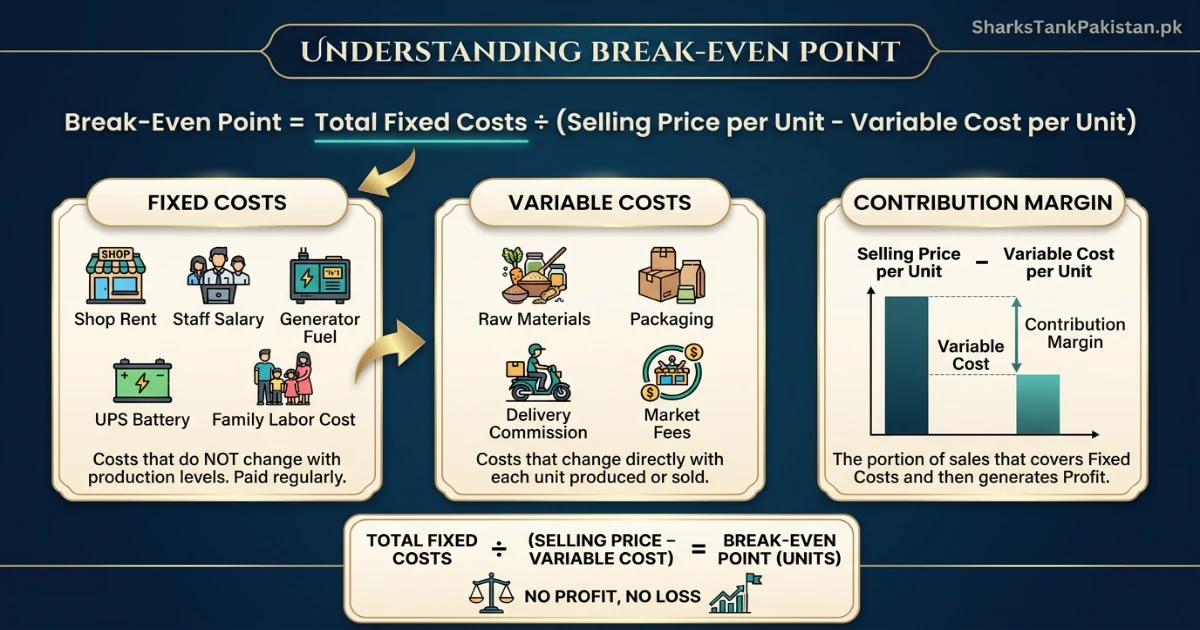
The academic formula states: Break-Even Point (Units) = Total Fixed Costs ÷ (Selling Price per Unit – Variable Cost per Unit). Clean and simple. But defining “fixed cost” in Lahore or Karachi means including things a Silicon Valley startup wouldn’t dream of. Your fixed costs don’t just stop at rent and salaries. They include the physical security guard you’re forced to hire for the shop, the annual “donation” drives, and the predictable bribe or facilitation fee to keep the supply chain moving.
Fixed Costs: The Silent Killers in Pakistan
Internationally, rent is a fixed cost. Here, it’s a variable-leaning beast. Commercial rents in Karachi’s Saddar or Lahore’s Hall Road often operate on a key-money system followed by monthly rent. But the fixed component is the electricity backup. You must treat generator maintenance, fuel, or UPS battery replacement as a fixed overhead. If you are running a small textile unit in Faisalabad, your fixed cost isn’t just the machine loan; it’s the “load-shedding allowance” you build into your timeline. I’ve seen excellent food businesses in Islamabad collapse not because the food was bad, but because the fixed cost of delivering orders through “own riders” during protests and road closures was never calculated.
Variable Costs: The Currency Trap
Variable costs for a Pakistani micro-business are rarely stable. If you import fabric, chemicals, or even packaging from China, your variable cost fluctuates with the dollar rate even within the same month. A break-even analysis Pakistan business owners can rely on must include a buffer band. You calculate your break-even at the current dollar rate, and then you recalculate it at a 10% devaluation scenario. If that second calculation pushes your break-even point 40 units higher, you already know the storm is coming before the currency collapses.
Why Break-Even Analysis Pakistan Startups Use Fails Them
There’s a common disease in the Islamabad startup bubble: the spreadsheet fantasy. Founders build beautiful projections using USD-based SaaS metrics. But if you’re a micro-business selling physical products, your break-even model probably ignores three critical layers that are distinctly Pakistani.
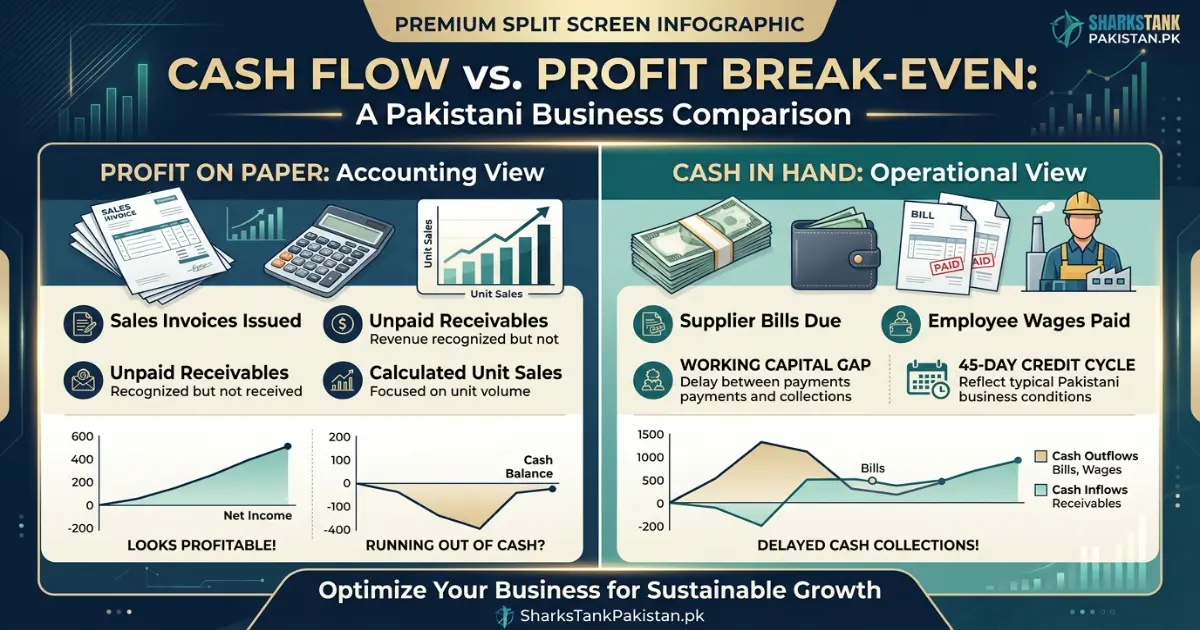
1. The Credit Cycle Abyss. In Pakistan, most B2B micro-businesses survive on credit. You supply garments to a boutique, and they pay you after 60 days, sometimes after the season ends. Your break-even formula looks at unit sales, not cash timing. You might hit your break-even volume on paper in October, but the cash from those sales doesn’t arrive until December. In the interim, you need working capital to survive. Your break-even analysis must evolve into a cash-flow break-even. Sharks on Shark Tank Pakistan respect a founder who says, “We break even on unit 200, but due to market credit norms, we need working capital to bridge a 45-day gap.” That is real command of your numbers.
2. The Unpaid Family Labor Variable. Your wife packs the boxes. Your younger brother handles social media. You don’t pay them a formal salary. So your fixed costs look artificially low. This is the most dangerous type of denial. If your business cannot break even while paying a market salary to that family member, you haven’t built a business; you’ve built a family chore. The moment you scale or try to hire an outsider, the business collapses. For a defensible break-even calculation, always impute a fair market salary for yourself and family members. The sharks will definitely do this math in their heads while you’re pitching.
3. The “Miscellaneous” Black Hole. Look at the ledger of a thriving general store in Peshawar or a kiryana in Quetta. You’ll see deductions for the street sweeper, the parking valet, or the local police “welfare fund.” These are technically illegal but operationally mandatory. Labeling them as “miscellaneous” is lazy. They are legitimate operational friction costs. Include a fixed percentage of your expected revenue (typically 3% to 7% depending on the industry) as a risk buffer to cover these opaque operational drains.
Segmenting Your Analysis: Trading vs. Manufacturing vs. Services
Your approach must shift depending on whether you’re selling, making, or fixing. Here’s how I break it down for founders I mentor preparing for Shark Tank Pakistan auditions.
| Business Type | Primary Cost Driver | Break-Even Pitfall in Pakistan | Ideal Monitoring Interval |
|---|---|---|---|
| Retail / Reselling | Inventory holding & shop rent | Ignoring “dead stock” (seasonal unsold items) as a cost | Weekly |
| Micro-Manufacturing | Raw material & electricity | Unplanned machine downtime due to voltage fluctuation | Daily/Shift-wise |
| Home-Based Food | Perishable ingredients & gas | Overestimating shelf life of prepped ingredients | Weekly + Order-based |
| Digital Freelancing | Internet & device depreciation | Treating client acquisition time as “free time” | Monthly |
The Unit Economics Reality Check
Let’s stop talking in abstracts. Imagine “Karachi Chai Club,” a hypothetical cloud kitchen concept that might appear on Shark Tank Pakistan. They sell a premium cup of chai for PKR 250. Many would calculate cost as just milk, patti, and sugar. Let’s do an honest break-down.
- Selling Price (Revenue per unit): PKR 250
- True Variable Cost: Milk + Leaves (PKR 60), Cup + Lid (PKR 40), Sugar + Masala (PKR 15), Delivery Partner Commission (PKR 45). Total Variable: PKR 160.
- Contribution Margin: PKR 90 per cup. Not bad.
- Monthly Fixed Costs: Cloud kitchen rent (PKR 40,000), Chef salary (PKR 35,000), Electricity/Gas (PKR 25,000), Marketing spend (PKR 15,000). Total Fixed: PKR 115,000.
Standard Break-Even: PKR 115,000 ÷ PKR 90 = 1,278 cups per month. That’s about 43 cups a day. Seems easy. But now add the Pakistan factor. The cloud kitchen zone has a “wheeling” charge on electricity, adding PKR 5,000. The delivery riders demand an incentive tip during rush hour, adding PKR 5 per cup variable. Suddenly, your margin shrinks to PKR 85, and your break-even jumps to 1,411 cups. When you apply for Shark Tank Pakistan, walking the judges through this second, “stress-tested” scenario proves your business can survive a crisis. It is the single most impressive thing you can do with a break-even analysis.
Situation-Based Strategy: Which Lens Should You Use?
If You Are Pre-Revenue (Just an Idea)
You lack real data, so your analysis is entirely assumptions. That’s dangerous. Do not just Google “average rent in Karachi.” You must physically drive to the area, ask three shops about their actual electricity bill, and ask a raw material supplier for a quote in cash. Then build a “worst-case” break-even model. If the worst-case break-even point is still achievable within a normal month, you have a business. If not, you have a donation project. When you’re writing your pitch for Shark Tank Pakistan, anchoring your ask to this validated worst-case number makes you stand out from the dreamers.
If You Are Generating Consistent Cash Flow
Stop looking at monthly averages. They lie. Look at seasonal break-even. If you sell lawn in March, your fixed costs in January and February are bleeding you. You must calculate an annualized break-even that front-loads the inventory financing cost. For cash-flow-heavy businesses, your break-even shouldn’t just be units; it should be “days to break even” in cash terms. “We turn over inventory and hit our cash recovery point by Day 55 of the cycle.” This language lands beautifully with commercial bankers and angel investors here.
When Pitching on Shark Tank Pakistan vs. to an Angel Investor
On camera, the sharks value speed of thought. Don’t bog them down with a 12-sheet Excel model. Tell them: “Our unit break-even is X units per day. Our current average is Y units per day. We’re seeking capital to cover the fixed cost expansion so that Y becomes 2Y.” An independent angel investor might want to see the detailed fixed cost schedule and debate the salary line items. Be ready for both depths. Never confuse broadcasting a pitch for a public audience with the granular negotiation in a private boardroom.

Common Pitfalls & When to Ignore This Advice
Even the best analysis is useless if applied incorrectly. Here are the most frustrating patterns I see repeating across Pakistan’s micro-business landscape.
Pitfall 1: The “Zero Salary” Founder. As mentioned before, if the business only breaks even because you work 80 hours a week for free, you are the subsidy keeping the business alive. When to adjust: Always include a nominal salary line for yourself. Equal to what you’d pay a competent manager.
Pitfall 2: Mixing Gross and Net Margins. In trading, your gross margin might be 40%, but after paying shop rent (fixed), net margin is 10%. You break even on net margin coverage, not gross profit generation. When to adjust: If you’re a high-volume, low-margin trader (e.g., wholesale grains), ignore per-unit net break-even as a daily decision; focus on total tonnage break-even.
Pitfall 3: Ignoring the “One-Time” Start-up CapEx. You spent PKR 500,000 on a refrigerator for the shop. That’s not a monthly fixed cost; it’s an asset you need to recover. Amortize it over its useful life and add it to your break-even as a non-cash fixed cost. If you don’t, you will be very surprised when the fridge dies in year three and you have no cash to replace it. When to adjust: For asset-heavy micro-businesses, use EBITDA break-even for daily ops, but maintain a separate CapEx recovery calculator.
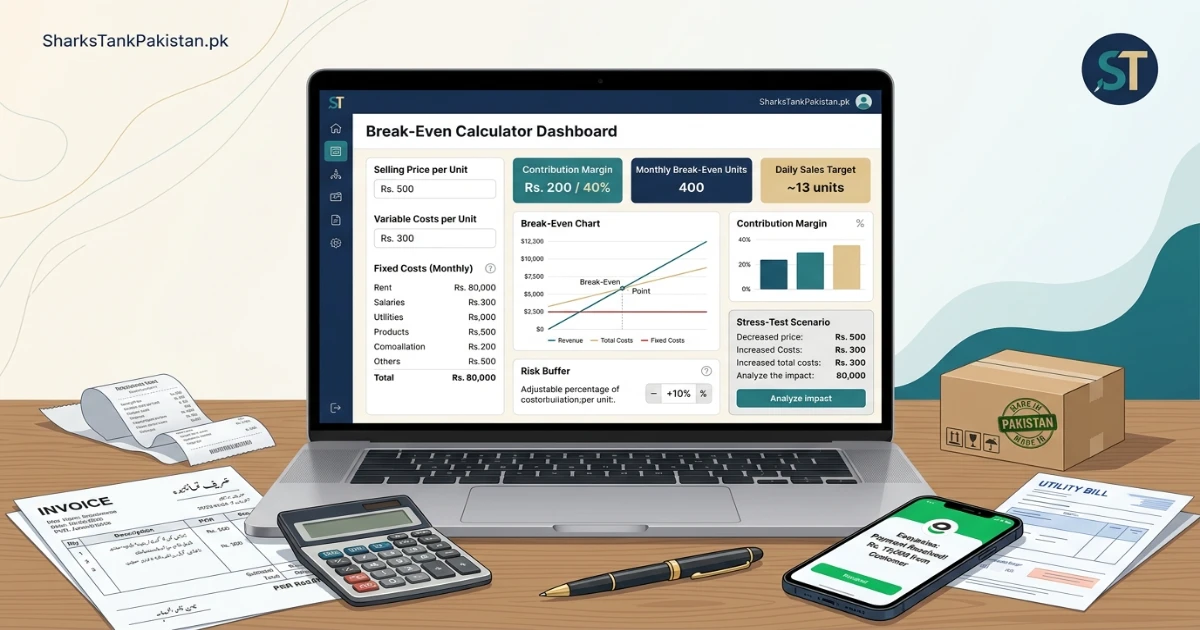
Put This Into Practice: Using the Calculators on SharkTankPakistan.pk
You don’t need a finance degree to get this right. You need a simple tool that forces you to list the ugly expenses. We’ve built an ecosystem of calculators specifically because Pakistani founders tend to underestimate costs in the face of high ambition. Before you set your final price list for the month, head over to the resources below. Open the valuation calculator and the equity loan calculator. Plug your break-even numbers in.
If your break-even is 3,000 units a month, and you’re currently selling 1,500, what is the valuation you’re asking for? If you tell a shark you’re valued at PKR 5 crore, but your unit economics suggest you’ll be negative for 18 months without a miracle, you’ve lost the deal. The calculators help bridge the disconnect between the break-even reality and the valuation fantasy. Do this exercise tonight. It will force you to either lower your valuation expectations or increase your price.
Real-World Example: The Home Chef’s Dilemma
Let’s talk about “Sara’s Cakery,” a home-based baker in Lahore who started taking orders on Instagram. Sara believed her break-even was low because “milk, eggs, maida, and butter” were cheap. She priced a premium pound cake at PKR 1,800. But she forgot the following: the dedicated fridge electricity (PKR 3,500/month), the cost of her imported vanilla essence sourced from a premium mall, and the 10% commissions on Instagram food groups. Worse, she didn’t account for the “missing serving spoils” or the free samples she sent to bloggers.
When we sat down and divided her total spend over three months by the number of cakes, her actual variable cost was nearly double her initial guess. Her fixed cost structure included a “baking assistant” (her younger cousin, who took a cut from each cake). The real break-even was 63 cakes a month at PKR 1,800. She was selling 48. She wasn’t losing cash dramatically, but she wasn’t covering her depreciation and mobile bill. She was treading water. This is the reality for thousands of home-based businesses in Pakistan. The numbers don’t lie, but you have to write them all down.
Adapting the Model for Seasonal Highs and Lows
Ramadan and Eid create massive spikes for food and apparel. But a sensible break-even analysis doesn’t celebrate a good week in Ramadan as the new normal. For Pakistani retail, I recommend running two parallel models. Your “Ramadan Model” handles the high-volume, variable-cost spike of extra staff and raw material. Your “Off-Peak Model” determines if you can keep the lights on in Muharram or the slower winter months. If your off-peak break-even exceeds off-peak sales, you must either build a massive reserve during the high season or create a secondary product line that fills the quieter months.
Textile exporters in Sialkot understand this. They break even on the export order itself, but the domestic left-over fabric sales determine the ultimate profitability. How does this relate to Shark Tank Pakistan? When sales drop in a slow month, don’t panic and slash prices below your variable cost just to “generate cash flow.” You’re not breaking even; you’re accelerating your death. The sharks have seen countless founders destroy their brand value by doing exactly this. If your contribution margin is intact, protect the price point. If it’s not, close the shop for a holiday instead of selling at a loss.
Your Fast-Track Cheat Sheet: Top 3 Actions to Take
✅ The Real Takeaway
1. Build a “Pakistani” Cost Ledger. Stop using the international template that says “rent + salaries.” Add columns for “fuel for generator, local union dues, supply chain bribes, and family labor market rate.” Only compute your break-even after these.
2. Always Stress-Test for Currency and Climate. If you import anything, run a Dollar +10% model. If you manufacture anything, run a load-shedding +20% model. The base case break-even is a fairy tale. The adjusted break-even is your business plan.
3. Speak in Units per Day, not per Month. A monthly break-even of 3,000 sounds distant. A daily break-even of 100 units sounds urgent and controllable. Frame your entire Shark Tank Pakistan pitch around the small, tangible daily target, not the massive monthly mountain.
Frequently Asked Questions About Break-Even in Pakistan
How do I handle informal “bribe” costs in my break-even analysis?
Create a separate line item titled “Facilitation Expenses” or “Operational Overheads.” Allocate a realistic fixed percentage (such as 2-4%) of your monthly revenue to it. Never bury it in miscellaneous or it will disrupt your cash planning.
Is break-even analysis different for a tech startup vs. a traditional micro-business?
Yes. Tech startups have low variable costs but high fixed costs of development and payroll. A traditional shop has high variable costs (inventory). For tech, break-even relies on reaching a massive subscriber count quickly; for retail, break-even relies on consistent unit margins.
Can I use break-even analysis to set my price for a new product?
Absolutely. Start with the price you think the market will bear. Deduct your known variable costs. See if the remaining contribution margin covers your fixed costs at a realistic sales volume. If not, your prices are too low or your cost structure is too heavy.
What if my family member gives me the rent-free space? Do I still count it?
Yes, you must include an “imputed rent” at fair market value. This protects you from future shocks if you lose that space. If you can’t break even after imputing market rent, the business is not independently viable.
How often should I recalculate my break-even point in Pakistan’s economy?
Ideally, every time you receive a new shipment or the utility bill spikes. At a minimum, conduct a full recalculation once a month. Any pause in analysis will lead to margin erosion without you noticing.
Why do Shark Tank investors ask for unit break-down instead of big-picture profit?
Because big-picture profit can be manipulated by cutting marketing or salaries. Unit economics prove that the core business model works. If you break even on every single cup or shirt sold, scaling up just repeats a winning formula.
What is a “risk buffer” margin in break-even analysis?
It’s an extra 5-10% of variable costs added to your calculation specifically to cover unforeseen local shocks, such as a sudden ban on a raw material ingredient or a sharp weekly currency decline.
Should I include my own salary in break-even, even if I don’t take one yet?
Definitely. If the business cannot afford to pay you a basic living wage after hitting the break-even point, you don’t have a scalable company. You have a self-employed gig that cannot be handed off or sold.
👉 Ready to stress-test your numbers? Open the Valuation & Break-Even Calculator on the site right now and feed your real bills into the grid.