Shark Tank Pakistan Season 2 Changes: What the Sharks Actually Learned — and What It Means for Your Pitch
The Shark Tank Pakistan Season 2 changes reflect a sharper, more scrutinizing panel — the Sharks walked away from Season 1 having seen too many inflated valuations, underprepared founders, and deals that looked great on camera but fell apart in due diligence. Season 2 means tougher questions, smarter deal structures, and a genuine premium placed on founders who know their numbers cold.
Season 1 of Shark Tank Pakistan was a debut — a bold, messy, energetic first chapter in the country’s reality investment television story. Founders brought passion. Some brought brilliance. Others brought PowerPoint slides and dreams held together with optimism. The Sharks, for their part, were navigating unfamiliar terrain: a live investment show in a market where the startup ecosystem is still finding its footing, valuations lack standardised benchmarks, and founders often have no prior exposure to professional investors.
Now Season 2 is here — and it’s a different show. Not because the format changed dramatically, but because everyone in that room learned something the first time around. The Sharks learned what they should have probed harder. Founders who watched Season 1 have a clearer picture of what works. And the Pakistani startup community is more alert to the patterns that lead to a handshake versus a polite pass.
This guide breaks down the real Shark Tank Pakistan Season 2 changes — the strategic, procedural, and psychological shifts that matter — and translates each one into practical guidance for anyone stepping into that pitch room, or thinking about it.

Why Season 1 Was a Trial Run for Everyone
Pakistan’s Shark Tank debut drew enormous public attention — and rightly so. The show brought investor-founder dynamics into mainstream Pakistani entertainment for the first time. But “first time” carries a cost. Sharks had to calibrate their expectations to a market where many promising startups operate informally, where IP protection is still patchy, and where a founder’s “revenue” might include projections dressed up as current numbers.
What became clear by the end of Season 1 was this: the gap between what founders believed their business was worth and what investors were actually willing to pay was enormous. Deals were made on the show that later ran into post-deal due diligence complications. Founders came in asking for valuations that would make a Series A VC in Karachi raise an eyebrow. Some got deals; some didn’t deserve the ones they got. Some who deserved a deal walked away empty-handed because they couldn’t articulate their own numbers.
That’s not criticism — it’s the honest reality of a first season. Every successful Shark Tank franchise globally goes through this learning curve. Season 1 was the necessary rough draft. Season 2 is the revision.
Across multiple investor conversations and public statements following Season 1, a recurring theme emerged: Sharks were most frustrated not by businesses that lacked revenue, but by founders who couldn’t explain why their business would be more valuable in three years than it is today. Traction matters — but a coherent growth thesis matters more.
The Core Shark Tank Pakistan Season 2 Changes You Need to Understand
1. Valuations Are Being Stress-Tested in the Room
Season 1 revealed a consistent pattern: founders would walk in with a valuation number they felt was justified by their ambition. Sharks would counter, the gap would be wide, and negotiations would either collapse or produce awkward compromises. Season 2 changes this dynamic — the Sharks are now asking for the valuation methodology upfront. Not just “what are you asking?” but “why is your business worth that, and how did you calculate it?”
If you’re applying for Season 2 or preparing for a similar investor conversation, you need to know how you arrived at your number. Is it a revenue multiple? An asset-based approach? A discounted cash flow? Or — and this is what gets founders eliminated quickly — is it just a gut feeling dressed up as strategy?
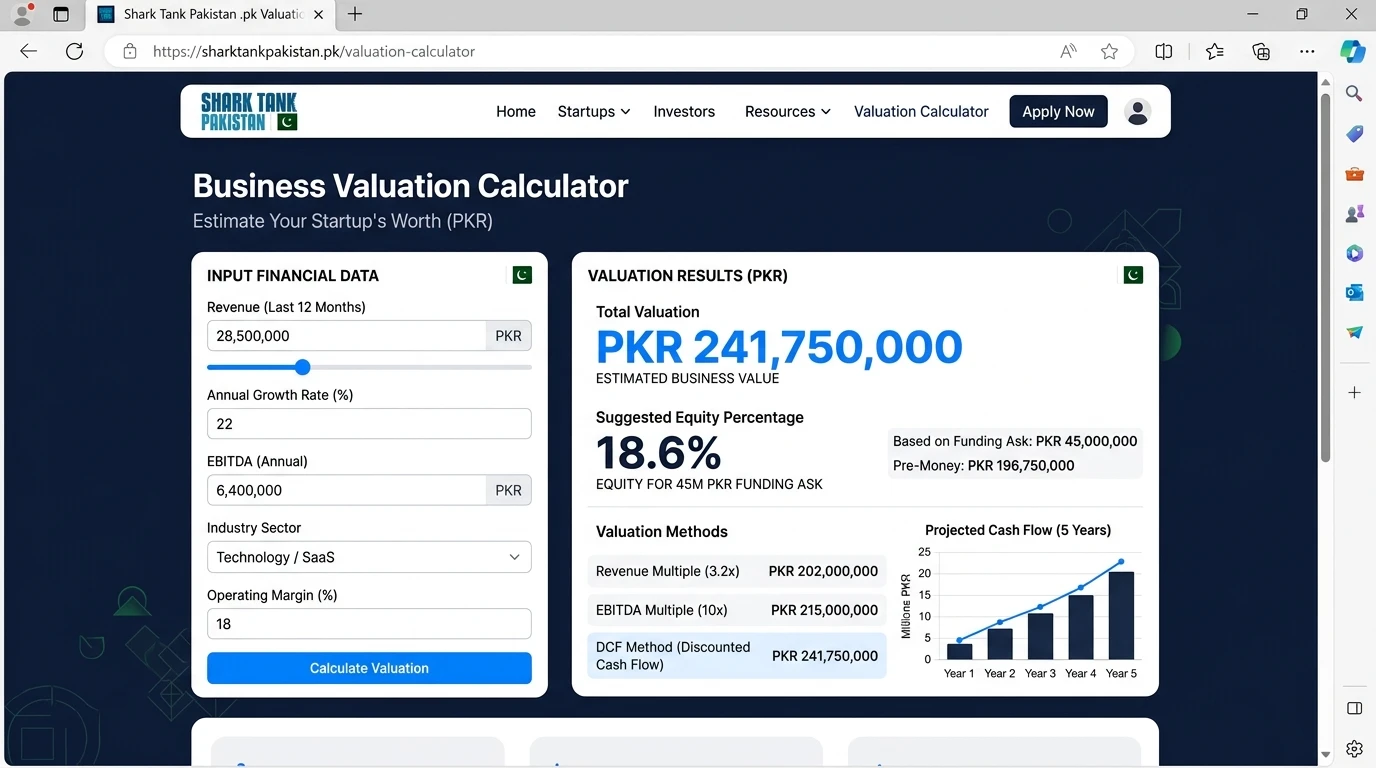
The SharkTankPakistan.pk Valuation Calculator is worth running before any pitch. It forces you to input real numbers and shows you what different methodologies produce — often revealing that your “gut” valuation is 3x what the revenue multiple method would suggest.
2. Due Diligence Rigour Has Increased Significantly
Off-camera due diligence is where several Season 1 deals reportedly ran into trouble. Sharks came back to the table after filming and discovered that the numbers presented didn’t fully match the books. Not always fraud — sometimes just founder optimism or poor accounting. Either way, it cost time and strained relationships.
Season 2 response: the Sharks are asking sharper, more specific questions on camera — before they make any commitment. Expect questions about bank statements, actual recurring revenue vs one-time revenue, pending liabilities, and legal registration status. Gone are the days when a polished pitch deck and a confident handshake could carry you through.
3. Social Impact and Scalability Are Now Weighted Differently
Season 1 saw a handful of pitches that were emotionally compelling — founders solving real social problems, businesses with genuine community value — but they lacked a clear scalability path. Some Sharks invested anyway. Others passed because they couldn’t see a return path.
The Season 2 shift is more nuanced: social impact still matters, particularly to certain Sharks who have stated public commitments to responsible investing. But the expectation now is that you demonstrate scalability alongside impact — not instead of it. “I’m helping farmers” is a powerful opening. “I’m helping farmers, and here’s how I reach 50,000 of them profitably within 24 months” is what gets a deal.

4. The Sharks Are More Willing to Walk Away — Faster
In Season 1, there was a clear generosity-of-spirit in the room. Sharks would probe, push back, counter-offer, and often find a creative middle ground. It made for great television. It also produced some deals that, in hindsight, didn’t have solid enough foundations.
Season 2 brings a sharper edge. Sharks who learned from Season 1 are more comfortable with an early “I’m out.” This isn’t coldness — it’s professional calibration. What it means for you as a founder is that you have a shorter window to establish credibility. The first two minutes of your pitch need to earn the next eight. If your opening is vague or your first numbers don’t land, you may not get the chance to course-correct.
5. Female Founders and Underrepresented Sectors Are Getting More Deliberate Attention
One of the public learnings from Season 1 was that the pitch pool skewed heavily toward certain types of businesses — tech-adjacent, urban, male-founded. The Season 2 production team and Shark panel have both signalled a deliberate effort to attract a wider variety of applicants, including female-founded startups, agri-tech, education, and healthcare businesses targeting underserved populations.
This is relevant for two reasons. First, if you’re building in one of these spaces, Season 2 may be unusually receptive to your pitch. Second, if you’re a traditional business — a manufacturer, a retailer, a services firm — know that you’ll need to work harder to show why your model is investable at the scale a Shark needs to justify writing a cheque.
Shark Tank Pakistan Season 1 vs Season 2: What Changed
| Dimension | Season 1 Approach | Season 2 Change |
|---|---|---|
| Valuation Scrutiny | Founders mostly stated their ask; Sharks negotiated from there | Methodology is challenged upfront — you must explain how you arrived at your number |
| Due Diligence | Largely post-deal; some discrepancies surfaced later | Harder questions asked on camera; cleaner books expected before pitching |
| Deal Speed | Longer deliberation; more creative counter-offers | Faster exits when a deal doesn’t make sense; more decisive Sharks |
| Sector Focus | Tech-heavy; urban-centric | Broader sector interest including agri-tech, health, education, female-founded businesses |
| Social Impact | Rewarded emotionally; not always tied to return path | Must demonstrate both impact and a scalable, profitable model |
| Founder Readiness Bar | Passion and concept could carry weak financials somewhat | Numbers fluency expected; inability to answer basic questions kills deals |
| Post-Deal Conversion | Variable; some deals fell through after filming | Greater emphasis on legality, company registration, clean financials before any deal closes |
What This Means for You — Based on Your Stage and Situation
If You’re Pre-Revenue and Thinking of Applying
Here’s the honest truth: Season 2 is harder to navigate as a pre-revenue founder, but it’s not impossible. The Sharks have always been willing to back vision — but they need to see something beyond an idea. That “something” could be a working prototype, strong early traction (even unpaid users), a proprietary process, or a demonstrably unfair competitive advantage in your space.
If you’re pre-revenue, your pitch needs to be relentlessly specific about what the investment will fund and what milestone it will unlock. “We need the money to build the product” is a weak ask. “We need PKR 50 lakh to complete the product, acquire our first 200 paying customers, and reach PKR 2 million monthly recurring revenue within nine months” is a pitch.
If You’re Generating Revenue But Struggling with Profitability
This is actually a strong position for Season 2 — if you can explain the path. Revenue-generating businesses that aren’t yet profitable are common in high-growth markets. What Sharks want to understand is your unit economics: what does it cost you to acquire a customer, and what does that customer generate over their lifetime with your business? If those two numbers suggest a profitable business at scale, you have a genuine conversation to be had.
The mistake founders in this position make is getting defensive about losses. Don’t hide the burn — explain it. “We’re currently burning PKR 8 lakh per month, primarily on customer acquisition. Our cost-per-acquisition has dropped 40% over the last quarter as our referral engine kicks in” is an answer that builds confidence, not concern.
If You’re a Profitable Business Seeking Growth Capital
You’re in the best position walking into Season 2 — and that’s also a risk, because profitable founders often underestimate how hard negotiation becomes when the Sharks know you don’t desperately need their money. Your challenge is to make the partnership compelling beyond the cheque. What does a Shark’s network, brand association, and experience bring that you genuinely can’t get elsewhere? Answer that authentically, and you’ll command better terms.
What the Sharks Got Wrong Too (And What They’re Fixing)
Accountability runs both ways. The Sharks made their own errors in Season 1, and understanding them is instructive.
Some deals were made on emotional pull rather than commercial logic — a founder’s story moved the room, terms were agreed, and the underlying business model was never fully interrogated. Others saw Sharks compete with each other for the best founder in the room, driving up valuations and giving away too much leverage. There were also cases where Sharks missed genuinely good deals because they applied Silicon Valley mental models to businesses that were fundamentally different — a family-run manufacturing business in Faisalabad doesn’t get valued the same way as a SaaS product with global ambitions.
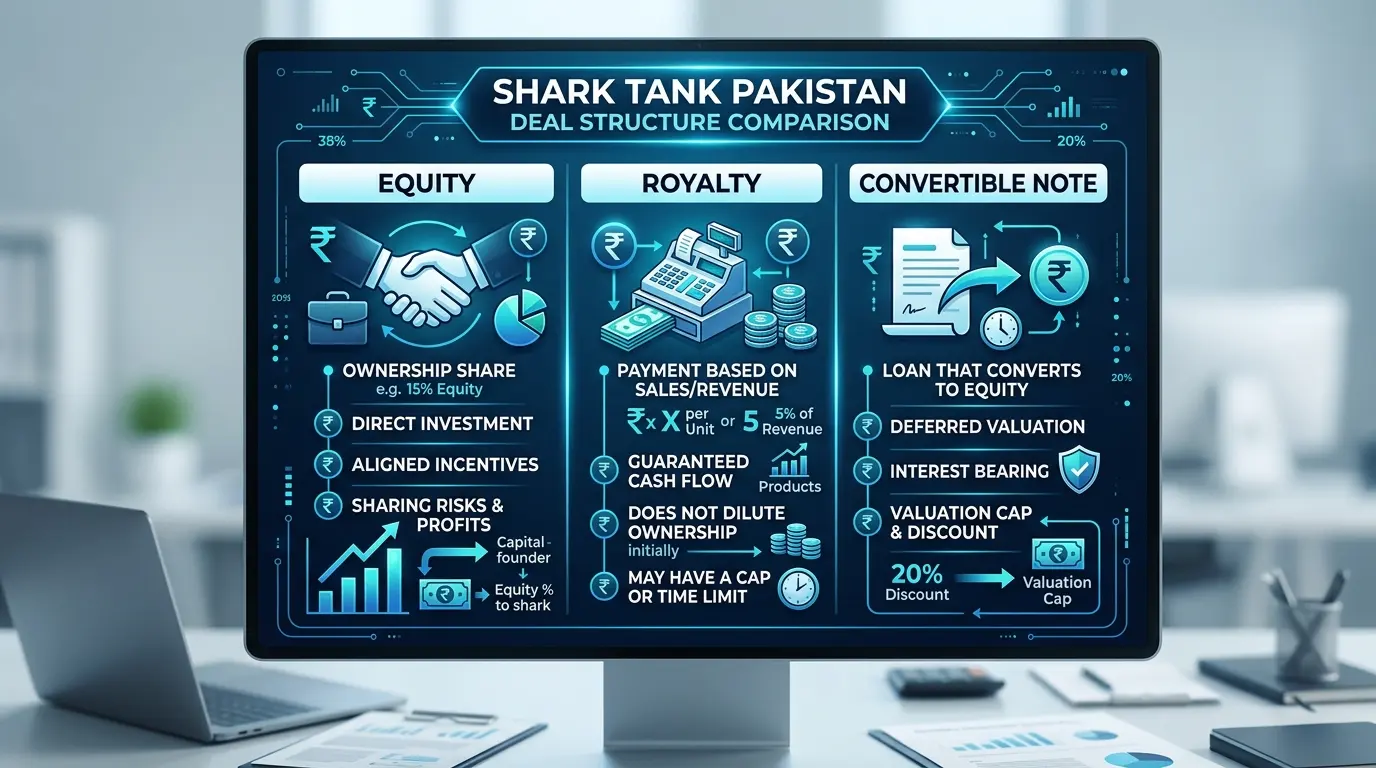
Season 2 corrections include better internal calibration among the Shark panel, more willingness to conduct rapid collaborative due diligence within the room, and a growing sophistication about which business models deserve which types of investment instruments. Expect to see more royalty deals, convertible notes, and milestone-based structures — not just straight equity for cash.
Globally, Shark Tank-style shows see a deal conversion rate (deals that actually close post-filming) of roughly 40–60%. In Pakistan’s context, where company registration, audited accounts, and formal legal structures are less common among early-stage founders, this rate was lower in Season 1. Season 2’s emphasis on business formalisation before pitching is a direct attempt to close that gap.
Common Mistakes Pakistani Founders Make — and What Season 2 Won’t Forgive
⚠️ Pitfalls That Kill Deals in Season 2
- Presenting projected revenue as current revenue. If you haven’t earned it yet, don’t present it as if you have. Sharks ask follow-up questions. The collapse of trust when this comes out is immediate.
- Confusing turnover with profit. “Our sales were PKR 3 crore last year” sounds impressive. “Our net profit was PKR 4 lakh” reframes the story entirely. Know both numbers and be ready to explain the gap.
- No registered legal entity. Several Season 1 deals struggled post-filming because the business wasn’t properly registered. A sole proprietorship is not the same as a Private Limited Company. Know your structure and have your paperwork in order.
- Ignoring co-founder conflict signals. When two co-founders give different answers to the same question, Sharks notice. Align on your story before you walk in — not just the numbers, but the roles, the vision, and the equity split.
- Asking for too little out of false modesty. Counterintuitively, some founders lowball their ask to seem “realistic.” This can signal a lack of ambition or a fundamental misunderstanding of growth capital. Ask for what you actually need to hit the next meaningful milestone.
- Over-rehearsing the pitch but under-preparing for Q&A. The pitch is five minutes. The Q&A might be twenty. That’s where deals are made and lost. Practise being challenged, not just presenting.
When to Ignore This Advice — Situations Where the Rules Shift
Most of the guidance above applies to a standard growth-stage pitch. But there are contexts where different logic applies:
If you’re a lifestyle business with no ambition to scale: Shark Tank — Season 1 or 2 — is probably not the right vehicle. The Sharks need a return on their investment, which means they need to see an exit path or meaningful dividend potential. A brilliant boutique business that makes PKR 40 lakh a year is not necessarily a bad business — it’s just not a venture-fundable one. Know the difference.
If your business is in a highly regulated sector: Healthcare, fintech, and education all carry regulatory complexity in Pakistan that can dramatically affect timelines and valuations. Season 2 Sharks are more alert to this — don’t gloss over it. Proactively addressing regulatory risk in your pitch is a sign of sophistication, not a red flag.
If you’re seeking a strategic partner rather than just capital: Be explicit about this. “I’m looking for an investor who can open doors in the Gulf market” is a legitimate ask that some Sharks can fulfil and others can’t. Knowing which Shark has the right network for your business can be the difference between a mediocre deal and a transformative one.
Put This Into Practice: How to Use SharkTankPakistan.pk Tools
Preparation for a Shark Tank Pakistan Season 2 pitch should involve more than rehearsing your story. Here’s a practical sequence:
- Run the Valuation Calculator. Input your last 12 months of revenue, your growth rate, and your industry. The calculator will show you what different valuation methodologies suggest — and the range gives you a defensible position in negotiations.
- Use the Equity Calculator. Once you have a valuation range, model out what different equity percentages actually mean in terms of founder dilution at different investment amounts. Many founders agree to equity splits without running the numbers and regret it later.
- Check your company registration status. Read the registration guide and confirm your legal structure is investor-ready. A sole proprietorship can pitch, but a Private Limited Company closes deals faster.
- Study the Season 1 pitches. The Season 1 best pitches breakdown on this site is one of the most useful preparation tools available — it shows you, in detail, what actually worked and why.
- Practise your Q&A, not just your pitch. The Sharks will challenge your assumptions. Record yourself being asked hard questions and watch it back. If you stumble, work on it.
Your business is ready. Your pitch might not be yet — find out now.
Try the Valuation Calculator →Frequently Asked Questions: Shark Tank Pakistan Season 2
What are the biggest Shark Tank Pakistan Season 2 changes compared to Season 1?
Season 2 brings stricter valuation scrutiny, stronger emphasis on auditable financials, a broader sector focus including agri-tech and female-founded businesses, and a panel more willing to decline deals quickly. Founders who come in without clear numbers or a legal business entity will find the room significantly less forgiving than Season 1.
Do I need a registered company to apply for Shark Tank Pakistan Season 2?
Technically, some sole proprietors have been accepted — but post-Season 1 experience strongly suggests that having a properly registered business (ideally a Private Limited Company under SECP) dramatically improves both your odds of getting a deal and of that deal actually closing after filming.
How much equity do the Sharks usually take on Shark Tank Pakistan?
Season 1 equity stakes typically ranged from 10% to 35%, with the average closer to 15–25% for most investment rounds. Season 2 is expected to see more structured deals — potentially including royalty arrangements or milestone-linked equity — rather than a simple flat-percentage exchange.
How should I calculate my valuation before pitching on Shark Tank Pakistan?
The most defensible methods are revenue multiples (typically 1x–5x annual revenue for early-stage Pakistani businesses, varying by sector) or EBITDA multiples for profitable businesses. Use the SharkTankPakistan.pk Valuation Calculator to model different scenarios before you commit to an ask.
What happens if a Shark makes me an offer on the show but it falls through later?
Deals made on Shark Tank Pakistan are verbal commitments subject to due diligence. If post-filming verification reveals discrepancies in the information you presented, the investor is not obligated to proceed. This is precisely why having clean, auditable financials and a registered legal entity matters — they remove the most common reasons deals collapse.
Can I apply to Shark Tank Pakistan Season 2 if my business is in a rural or agricultural sector?
Yes — and Season 2 specifically signals more openness to agri-tech, rural businesses, and non-urban startups. The key is demonstrating scale potential. A business that serves a small village is a charity model; a business that serves a replicable model across Punjab’s farming districts with a clear revenue mechanic is an investment opportunity.
How long does a Shark Tank Pakistan pitch take, and how much time will I actually have?
Pitches typically run 3–6 minutes, followed by 10–25 minutes of Q&A. The Q&A is where most deals are actually decided. Many founders over-prepare their opening pitch and under-prepare for the interrogation that follows. Budget at least 70% of your preparation time on handling tough questions, not delivering the pitch itself.
Is Shark Tank Pakistan investment money taxable in Pakistan?
Investment received as equity funding (in exchange for shares) is generally treated differently from income or loans under Pakistani tax law. However, tax implications depend on your business structure, the investment instrument used, and FBR filings. Consult a registered tax consultant or chartered accountant before finalising any deal structure.
🏁 Your Fast-Track Cheat Sheet: Top 3 Actions Before Season 2
- Know your valuation methodology, not just your number. Run the SharkTankPakistan.pk calculator, pick the method that makes sense for your stage and sector, and be ready to defend every assumption when a Shark pushes back. “We feel we’re worth X” is not a pitch — it’s a hope.
- Get your legal house in order before you apply. Register your company under SECP if you haven’t. Have at least 12 months of organised, clean financial records. Season 2 deals are more likely to close with founders who’ve done this groundwork than with those who haven’t.
- Prepare for the Q&A harder than you prepare for the pitch. Your five-minute opening matters — but the twenty minutes of Shark questions that follow are where you win or lose. Practise being challenged on your unit economics, your competitive advantage, your team, and your exit path. The founders who handle pressure well get deals. The ones who crack don’t.