
How to Register a Private Limited Company in Pakistan: The Complete SECP Online Guide (2026)
✅ Quick Answer: You can register a private limited company in Pakistan entirely online through the SECP eZfile portal. The process requires a digital signature (NCCPL or NIFT), name reservation, document submission, and fee payment — typically completed in 3 to 7 working days if all documents are in order. For Pakistani founders preparing for investor pitches or Shark Tank Pakistan applications, a private limited company is the gold-standard legal structure that investors and sharks expect.
If you’re building a startup in Pakistan — whether you’re dreaming of walking into the Shark Tank Pakistan tank, pitching to angel investors in Karachi, or launching a tech product from your Lahore co-working space — one thing will come up faster than you expect: you need a real company. Not a sole proprietorship. Not a vague “project.” A properly registered private limited company that signals you’re serious, protects your personal assets, and makes you eligible for funding.
The good news? The SECP (Securities and Exchange Commission of Pakistan) has digitized nearly the entire process. You can register a company in Pakistan SECP online without stepping into a government office — provided you know the sequence, the documents, and the common traps to avoid. This guide walks you through every step, with a focus on what matters for startup founders, not just compliance officers.
Why “Just Register a Company” Is the First Real Step for Pakistani Founders
I’ve spoken with dozens of early-stage Pakistani founders who think incorporation can wait. They want to build the product first, find customers first, maybe even pitch on Shark Tank Pakistan first. Here’s the reality: without a registered private limited company, you cannot open a business bank account in Pakistan, sign enforceable contracts, issue shares to investors, or receive institutional funding.
Shark Tank Pakistan judges — like their counterparts on Shark Tank US and Shark Tank India — invest by taking equity in a legal entity. They write cheques to companies, not individuals. If you pitch without a registered company, you’re asking sharks to invest in an idea floating in legal limbo. That’s not a conversation any serious investor wants to have. Registering your company through SECP is not a bureaucratic chore; it’s the infrastructure that makes your startup investable.
Beyond investor readiness, there’s a psychological shift. Filing those incorporation documents forces you to define your business’s authorized capital, decide on shareholders, and name directors. These aren’t just legal boxes — they’re the foundational governance decisions that shape how your company grows.
Step-by-Step: How to Register Company in Pakistan SECP (Online, 2026)
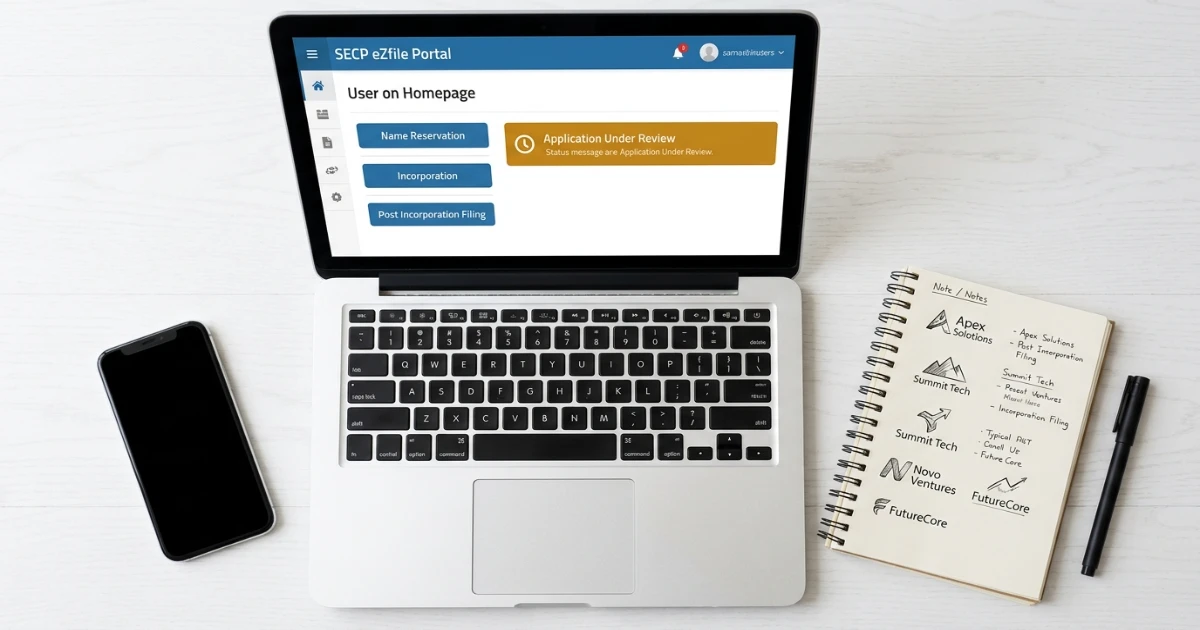
The SECP eZfile portal (ezfile.secp.gov.pk) is where the entire process lives. Below is the battle-tested sequence that works for private limited companies — the structure most relevant to startups, tech companies, and businesses that plan to raise external capital.
Step 1: Get Your Digital Signature First
Every document submitted to SECP requires a digital signature. You have two main options: NIFT e-Signature or NCCPL digital certificate. Most founders I’ve worked with prefer NIFT because the application process is slightly more streamlined. You’ll need your CNIC, a biometric verification visit, and a fee of approximately PKR 2,500–4,000 depending on validity period. This step takes 1–2 days if you’re prompt with the biometric appointment. Do this before anything else — without a digital signature, the SECP portal won’t let you proceed beyond the name reservation stage.
Step 2: Reserve Your Company Name
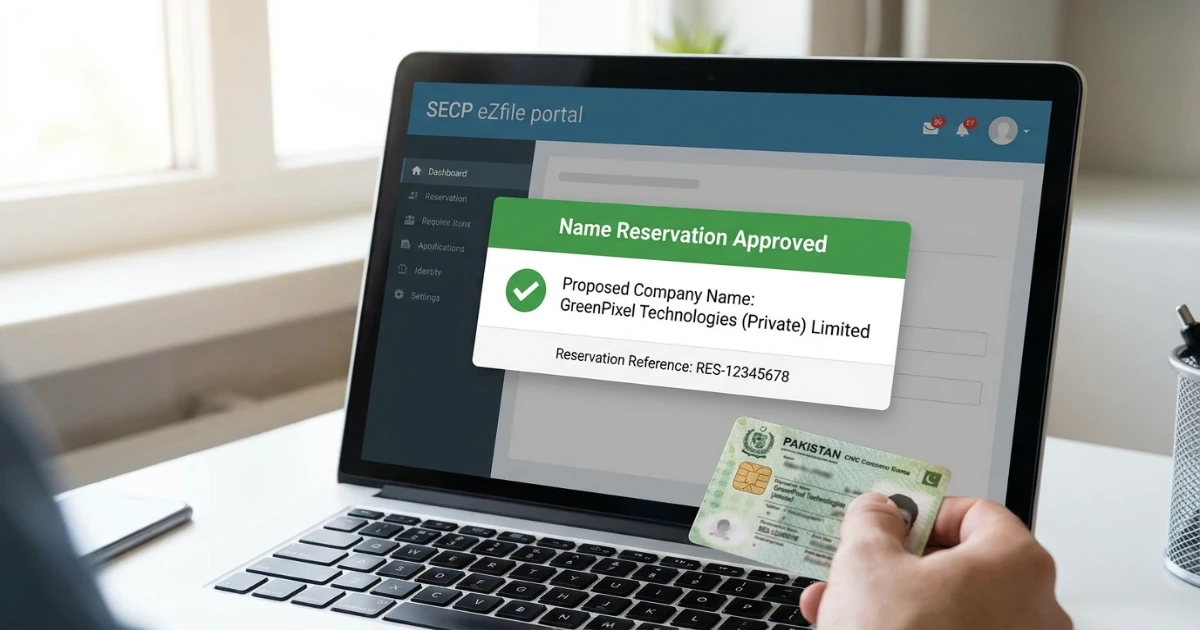
Log into eZfile, navigate to “Name Reservation,” and propose up to three names in order of preference. SECP’s system checks for conflicts with existing companies. The name must end with “(Private) Limited” — for example, “GreenPixel Technologies (Private) Limited.” Avoid generic terms, names of cities or provinces unless you have authorization, and anything that implies government affiliation. Pro tip: Check for matching domain names and social media handles before locking in your company name. You’ll thank yourself later.
Step 3: Prepare Your Incorporation Documents
With your name approved, gather these documents. Every Pakistani founder must submit:
- Form 1 (Declaration of Compliance): Signed by a company secretary or an authorized officer confirming all legal requirements are met.
- Form 21 (Notice of Situation of Registered Office): Your company’s physical address in Pakistan. A rental agreement or ownership document is required.
- Form 29 (Particulars of Directors and Officers): CNIC copies, residential addresses, and occupation details of all directors.
- Memorandum of Association (MoA): Defines your company’s name, registered office province, principal line of business, and authorized capital.
- Articles of Association (AoA): The internal rulebook for your company — voting rights, share transfer rules, board meeting procedures.
- Bank Certificate or Accountant’s Certificate: Evidence that the subscriber capital has been deposited or a professional certification from a practicing chartered accountant.
The MoA and AoA deserve careful attention. For startups planning to raise funding, your AoA should include provisions for issuing preference shares, drag-along rights, and board composition flexibility. Most founders use standard templates, but investors do notice when the Articles are thoughtfully drafted.
Step 4: Pay the Fees and Submit
SECP’s fee structure depends on your authorized capital. For most early-stage startups setting authorized capital between PKR 100,000 and PKR 1,000,000, the total filing fee (name reservation + incorporation + digital filing charges) typically runs between PKR 8,000 and PKR 15,000. Payment is made online through the eZfile portal via debit/credit card or online banking. Once submitted, your application enters the SECP examiner’s queue.
Step 5: Respond to Queries (If Any) and Receive Your Certificate
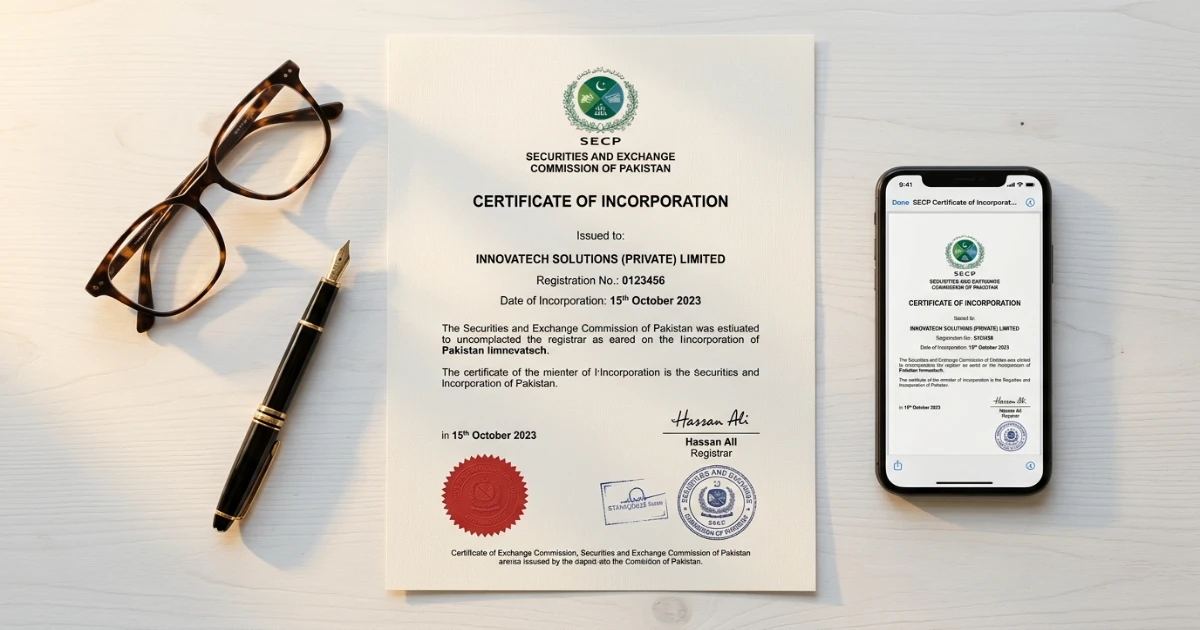
SECP examiners may raise queries — minor objections about document formatting, missing signatures, or unclear clauses in the MoA. Respond promptly through the portal. Once approved, you’ll receive your Certificate of Incorporation as a digitally signed PDF. This is your company’s birth certificate. Frame it, screenshot it, celebrate it — and then immediately move to the post-registration steps below because incorporation alone isn’t complete without tax registration.
Post-Registration: Tax, Bank Account, and Compliance Essentials
Incorporation with SECP is step one. Step two — often overlooked by first-time founders — is registering with the Federal Board of Revenue (FBR) for income tax, sales tax (if applicable), and obtaining your National Tax Number (NTN). Without NTN registration, you cannot open a corporate bank account, and without a corporate bank account, you cannot receive investor funds into the company’s name.
Here’s the post-incorporation checklist that moves you from “registered on paper” to “operational and fundable”:
- FBR NTN Registration: Apply through the FBR IRIS portal. Your SECP incorporation certificate is a required attachment. This typically takes 3–5 working days.
- Corporate Bank Account: Choose a bank that’s startup-friendly (several Pakistani banks now have dedicated SME and startup desks). You’ll need your incorporation certificate, NTN certificate, board resolution authorizing account opening, CNIC copies of directors, and proof of registered office.
- SECP Annual Filings: Every private limited company must file Form A (annual return) and Form 29 (changes in directors/officers, if any) each year. Late filing attracts penalties that compound.
- Auditor Appointment: Appoint a practicing chartered accountant as your company’s auditor within 90 days of incorporation.
Comparison: Private Limited Company vs Other Business Structures in Pakistan
Not every business needs a private limited company — but if your goal involves investors, scaling, or liability protection, the comparison settles quickly. Here’s how the main options stack up:
| Feature | Private Limited Company (SECP) | Single-Member Company | AOP / Partnership | Sole Proprietorship |
|---|---|---|---|---|
| Legal Entity Status | Separate legal entity | Separate legal entity | Not separate; partners personally liable | No separation from owner |
| Liability Protection | Limited to share capital | Limited to share capital | Unlimited personal liability | Unlimited personal liability |
| Investor Readiness | ✅ Ideal for equity investment | ✅ Convertible to private limited | ❌ Not suitable for equity deals | ❌ Cannot issue shares |
| Registration Complexity | Moderate (SECP eZfile) | Lower (fewer documents) | Low (registrar of firms) | None (only FBR registration) |
| Annual Compliance Cost | Moderate (audit + SECP filings) | Moderate | Low | Minimal |
| Shark Tank Pakistan Eligible? | ✅ Yes — preferred structure | ⚠️ Possible but less common | ❌ No | ❌ No |
For the overwhelming majority of startup founders I advise, a private limited company registered through SECP is the only structure that aligns with the goal of raising institutional capital. The compliance cost is real, but it’s the price of being taken seriously by investors, banks, and partners.
Situation-Based Guidance: How Your Registration Approach Should Shift
Your ideal incorporation strategy depends on where you are in the founder journey. Here’s how the advice changes:
If You’re Pre-Revenue with a Startup Idea
Keep authorized capital modest — PKR 500,000 to PKR 1,000,000 is sufficient. File simple MoA and AoA documents using standard templates. Your immediate priority after incorporation is getting your NTN, opening a bank account, and building a prototype or landing your first customer. Don’t over-engineer the corporate structure before you have a business. You can amend your MoA and increase authorized capital later when you’re closer to a funding round.
If You’re Generating Cash Flow and Preparing to Pitch
This is where the details matter. Before approaching Shark Tank Pakistan or any angel network, ensure your AoA includes provisions for issuing additional shares, creating different share classes, and allowing board observer rights for investors. Review your cap table with a corporate lawyer. If you have co-founders, all equity splits should be documented through proper share allotments — not informal WhatsApp agreements. Investors performing due diligence will request your SECP-issued Form 29 to verify the director and shareholder structure.
If You’re a Freelancer Scaling into an Agency
Many Pakistani freelancers earning significant foreign income operate as sole proprietors for years. When you cross roughly PKR 5–8 million in annual revenue or start hiring a team, incorporation becomes valuable for three reasons: limited liability protection, a corporate bank account that simplifies receiving international payments, and the ability to build a sellable asset rather than a personal brand. A single-member company registered through SECP might be a lighter first step before converting to a full private limited structure.
Common Pitfalls & When to Ignore Generic Registration Advice
Standard incorporation guides often miss the realities of operating in Pakistan. Here’s what actually trips up founders:
- Pitfall: Registering with unnecessarily high authorized capital. Every PKR 100,000 of authorized capital above certain thresholds increases your filing fees. For a pre-revenue startup, authorized capital of PKR 20,000,000 sounds impressive but means higher fees and zero practical benefit. Start small; increase later when you’re issuing shares to investors.
- Pitfall: Using your residential address as the registered office without landlord consent. SECP requires proof of address — a rental agreement or ownership document. If you’re in a rented apartment, your rental agreement likely prohibits commercial use. Either negotiate this with your landlord upfront or use a co-working space that offers registered office services (costs roughly PKR 2,000–5,000 per month).
- Pitfall: Ignoring the “principal line of business” clause in the MoA. This isn’t decorative. Your company can only legally undertake activities described in the MoA. If you register as “IT services” and later pivot to e-commerce, you’ll need to amend the MoA — a separate SECP filing. Draft the business objects clause broadly enough to accommodate reasonable pivots.
- Pitfall: Assigning all shares to a single person and calling it done. Even if you’re a solo founder today, consider allotting a small portion to a trusted family member or co-founder candidate. This makes future equity transactions cleaner and avoids the appearance of a “one-person show” when investors scrutinize your cap table.
How SharkTankPakistan.pk Resources Help You Beyond Registration
Registering your company is the foundation. What comes next — valuation, equity structuring, and pitch preparation — is where our calculators and guides earn their place in your founder toolkit. Once your SECP certificate is in hand:
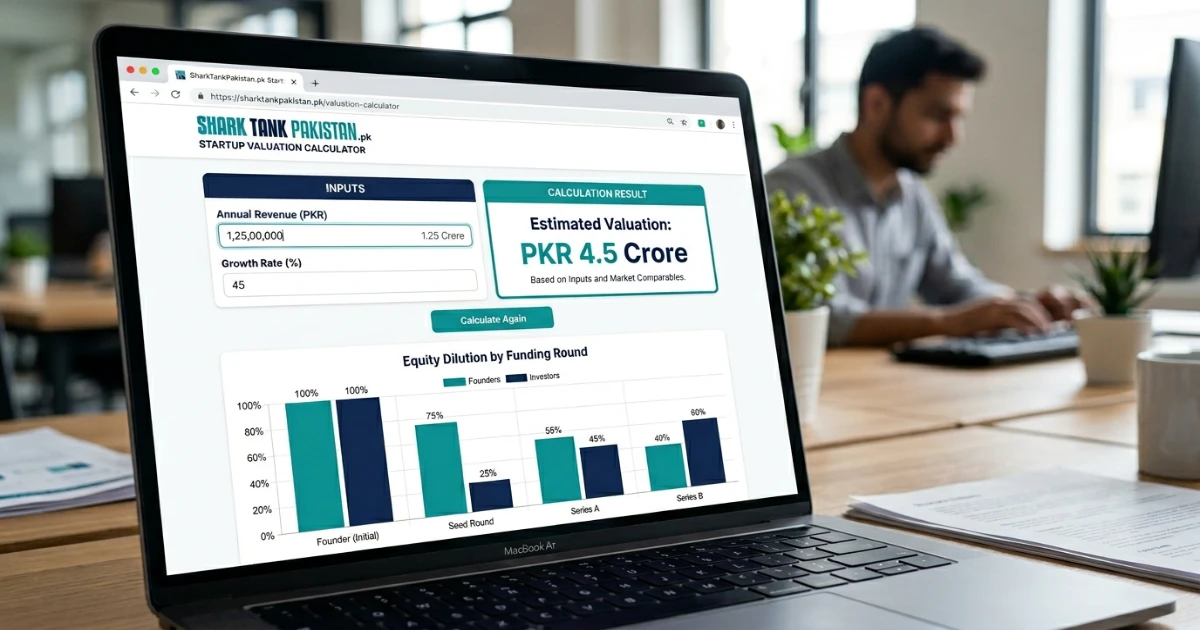
- Use the Startup Valuation Calculator to estimate what your newly registered company might be worth. Input your revenue, growth rate, and industry — the output gives you a realistic range to anchor your funding conversations.
- Model different deal structures with the Equity vs Loan Calculator. Once sharks start negotiating, you’ll know instantly whether offering 10% equity or proposing a convertible note makes more financial sense for your specific numbers.
- Review successful pitches in our Best Pitches from Shark Tank Pakistan Season 1 roundup to see how registered companies presented their financials, growth metrics, and valuation justifications.
Real-World Example: A Lahore-Based Startup’s Registration Journey
Consider a real scenario (name changed): a Lahore-based edtech founder — let’s call her Ayesha — spent six months building a learning app for matric students. She had 2,000 active users and was generating PKR 300,000 per month through subscriptions. A small angel investor expressed interest, but the first question was: “Is your company registered?”
Ayesha hadn’t incorporated. She completed the SECP registration process in five working days using this exact sequence: NIFT digital signature (2 days), name reservation (1 day), document preparation and submission (1 day), SECP approval (2 days with one minor query about her registered office address). Total cost: approximately PKR 18,000 including digital signature, filing fees, and a lawyer’s review of her AoA. The angel investment — PKR 8 million for 12% equity — closed three weeks later.
The key lesson isn’t that registration is fast. It’s that the investment conversation couldn’t have progressed at all without the incorporation certificate. The investor needed to see a legal entity, a bank account in the company’s name, and a clean cap table. Ayesha’s quick action turned a theoretical funding conversation into a signed term sheet.
FAQs: Register Company in Pakistan SECP
Can I register a company in Pakistan SECP entirely online without visiting any office?
Yes. The SECP eZfile portal handles the full process digitally — from name reservation to incorporation certificate issuance. The only physical step is biometric verification for your digital signature at a NIFT or NCCPL facility, which takes about 15 minutes. No SECP office visit is required.
How much does it cost to register a private limited company in Pakistan?
Total costs typically range from PKR 15,000 to PKR 30,000, including the digital signature (PKR 2,500–4,000), name reservation fee, incorporation filing fee (varies by authorized capital), and optional professional assistance for drafting MoA/AoA documents. For authorized capital under PKR 1,000,000, fees stay toward the lower end.
What is the minimum number of directors required for a private limited company in Pakistan?
A private limited company requires at least two directors under Pakistani law. At least one director must be a Pakistani resident. Directors can also be shareholders, and there’s no requirement for independent or non-executive directors at the registration stage.
Do I need a registered company to apply for Shark Tank Pakistan?
Yes. Shark Tank Pakistan requires contestants to have a registered business entity — typically a private limited company incorporated with SECP. The sharks invest by acquiring equity in a legal company, not by funding individuals. If you’re still in the planning phase, incorporate before submitting your application.
How long does SECP company registration take in Pakistan?
With complete and accurate documents, SECP typically processes incorporation applications within 3 to 7 working days. Name reservation takes 1 working day. The most common cause of delay is queries from SECP examiners about incomplete CNIC details, unclear registered office documentation, or signature mismatches.
Can a foreigner be a director or shareholder in a Pakistani private limited company?
Yes. Foreign nationals can serve as directors and shareholders of a Pakistani private limited company. They must provide passport copies and, if acting as directors, obtain a valid visa or work authorization. At least one director must be a Pakistani resident.
What is authorized capital, and how much should I set for my startup?
Authorized capital is the maximum amount of share capital your company is legally permitted to issue. For early-stage startups, PKR 500,000 to PKR 1,500,000 is a practical range. You can increase it later through an SECP filing when issuing shares to investors. Setting it too high unnecessarily increases initial filing fees.
Do I need a lawyer to register a company with SECP, or can I do it myself?
You can complete the SECP eZfile process yourself if you’re comfortable with legal forms and uploads. However, having a corporate lawyer or a professional incorporation service review your MoA and AoA — especially provisions related to share issuance, voting rights, and board composition — is strongly recommended if you plan to raise investor funding.
Your Fast-Track Cheat Sheet: Top 3 Actions to Take
1. Get your digital signature this week. Book the biometric appointment with NIFT or NCCPL now. Without it, nothing else moves. This is the single bottleneck that every founder faces at the start — clear it early. Cost: PKR 2,500–4,000. Time: 1–2 days.
2. File for name reservation and prepare your documents in parallel. While waiting for name approval (24 hours), gather CNIC copies, registered office proof, and draft your MoA/AoA. This concurrent approach cuts total registration time by 2–3 days. If you’re unsure about MoA clauses, invest PKR 5,000–10,000 in a one-hour review by a corporate lawyer.
3. Register with FBR and open a corporate bank account immediately after incorporation. The company exists on paper the moment SECP issues your certificate, but it’s not operational until it has an NTN and a bank account. This post-registration sequence is where momentum is often lost. Complete it within one week of incorporation.