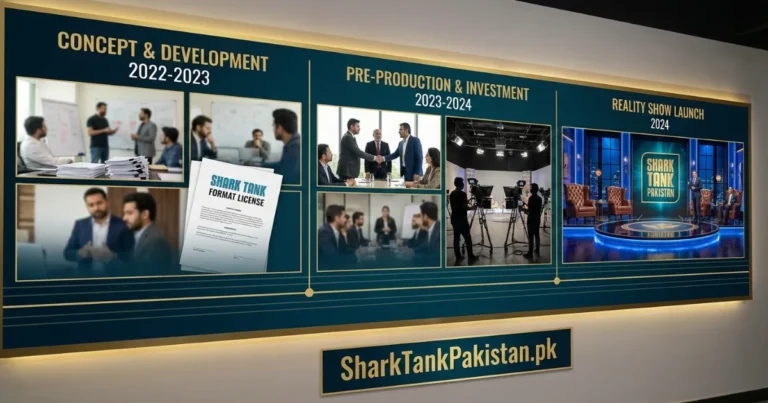
Shark Tank Pakistan Season 2 Audition Tips: 7 Proven Things to Do Before Applying
Quick Answer The single most important thing you must do before applying for Shark Tank Pakistan Season 2 is know your numbers cold — revenue, margins, customer acquisition cost, unit economics, and a defensible valuation — and be able to explain them in plain Urdu or English without a deck. Sharks invest in founders who understand their business at a granular level, not those who memorize a script.
If you’re reading this, you’re probably already imagining yourself standing in front of the Sharks, delivering the pitch that changes everything. That’s exactly the right energy.
But here’s what most Pakistani founders get wrong: they spend weeks perfecting their presentation slides and almost no time on the substance behind them. Season 1 of Shark Tank Pakistan proved one thing clearly — unprepared founders struggle fast when the questions move from story to numbers.
Season 2 preparation should be even sharper because awareness around the show has grown and investor expectations are likely to be higher. These Shark Tank Pakistan audition tips are built from Season 1 patterns, what worked, what failed, and the realities of running a business in Pakistan.
This guide isn’t a generic list of “be confident” and “dress well.” It’s a tactical, step-by-step breakdown of exactly what you must do before you hit submit on that application — and before you walk into the audition room.

Why Most Pakistani Applicants Crash Out Before the Real Pitch Even Begins
There’s a pattern that keeps repeating, and it’s heartbreaking to watch. A founder walks in with a genuinely interesting product — something that could actually sell in the Pakistani market — and within three minutes, the Sharks are exchanging glances. Not because the idea is bad. Because the founder can’t answer basic questions about their own business.
Shark Tank Pakistan is different from the US version in ways that matter deeply for your preparation. The Pakistani Sharks are operating in a high-inflation, currency-volatile economy.
They are thinking about import restrictions, informal documentation, SME cash flows, and whether a founder has the grit to survive sudden market or regulatory changes. Your Shark Tank Pakistan audition tips need to account for this context.
The Sharks are not just evaluating your business. They are evaluating whether you can navigate Pakistan’s business environment and still generate returns.
Season 1 taught us that the Sharks value operational transparency more than polished storytelling. They’d rather hear “we tried this, it failed, here’s what we learned” than a flawless narrative that collapses under questioning. Keep this in mind as you work through the seven steps below.
Shark Tank Pakistan Season 2 Audition Tips: 7 Steps Before Applying
1. Shark Tank Pakistan Season 2 Audition Tips Start With a One-Page Numbers Sheet
Forget the 20-slide deck for a moment. Take a single blank page and write down, from memory: your last 12 months of revenue (month by month), your gross margin percentage, your net profit or loss, your customer acquisition cost, your lifetime value per customer, your current burn rate, and your cash runway. If you can’t do this cold, you’re not ready.
Why this matters so much in the Pakistani context: many small businesses here operate on cash, with informal bookkeeping. The Sharks know this. They won’t penalize you for a lack of audited financials if you’re early-stage, but they will penalize you for not knowing your own numbers. When a founder hesitates on basic revenue, margin, or cost questions, the room usually loses confidence before the answer is complete.
Use the SharkTankPakistan.pk Valuation Calculator to pressure-test your numbers. Plug in different scenarios — what if your revenue grows 20%? What if it drops 15%? How does that change your valuation? Walk into the audition knowing your best case, base case, and worst case.
2. Nail Your Origin Story — Not Your Corporate Mission Statement
Every Shark Tank Pakistan audition has a moment where the founder is asked, essentially, “Why you? Why this business?” Most founders respond with something that sounds like it was written by a branding agency. Don’t do that. The Sharks want the real story — the personal, specific, sometimes messy reason you started this company.
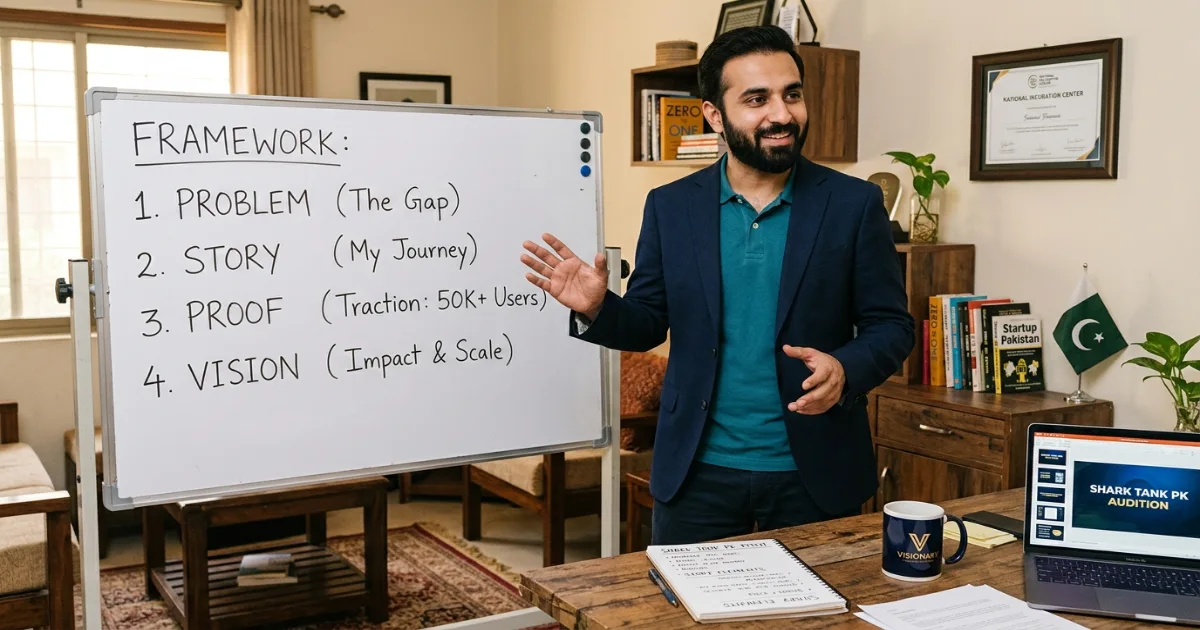
Here’s a framework that works: Problem → Personal Connection → Proof of Commitment → Vision. Start with the problem you saw in the Pakistani market. Make it tangible — “I watched my mother struggle to find quality halal-certified skincare that didn’t cost a fortune.” Then explain your personal connection to that problem. Then show proof that you didn’t just have an idea — you took action. Then, and only then, share your vision for where this goes.
Practice this story until it feels like a conversation, not a recitation. The audition producers are listening for authenticity. So are the Sharks.
3. Settle on a Valuation You Can Defend — Not a Number That Sounds Impressive
This is where more Pakistani applicants stumble than anywhere else. They walk in asking for Rs. 2 crore at a Rs. 20 crore valuation — for a business doing Rs. 80 lakh in annual revenue with thin margins. The math doesn’t work, and the Sharks will dismantle it in seconds.
A practical rule of thumb for Shark Tank Pakistan preparation is this: early-stage Pakistani startups should keep valuations tied closely to actual traction, assets, margins, and realistic growth potential. Growth-stage companies with proven traction can push higher, but you need the numbers to back it up. The Sharks are value-conscious — more so than their US counterparts — because the Pakistani market demands a margin of safety.
Your valuation needs to be tied to a method: revenue multiple (common for SaaS and recurring-revenue models), asset-based (for manufacturing or inventory-heavy businesses), or discounted cash flow (for predictable cash-generating businesses). If you can’t name which method you used and why, you’re not ready. Run your numbers through the SharkTankPakistan.pk Equity & Loan Calculator to see how different valuation asks translate into equity given — and what that means for your control of the company.
📊 Data Point: Season 1 Valuation Reality Check
Use Season 1 negotiations as a preparation benchmark, not as official closed-deal data. Many serious offers on shows like this tend to move into meaningful equity territory once risk, documentation, margins, and scalability are discussed. If you’re in a capital-intensive industry, be prepared to explain why your equity ask is fair — and what makes the upside worth the risk.
4. Anticipate the Brutal Questions — All of Them
Sharks are not your friends during the pitch. They’re potential investors performing due diligence in real time, on camera. Here are the questions that came up repeatedly in Season 1, and that you must have answers for:
- “What’s stopping a larger competitor from copying this tomorrow?” — Your answer must include a real moat: IP, exclusive supplier relationships, network effects, regulatory advantage, or speed of execution. Saying “we’ll work harder” is not a moat.
- “How much of your own money have you put in?” — If the answer is zero, be prepared for a tough conversation. Pakistani Sharks respect founders with skin in the game.
- “What’s your monthly household expense, and how are you covering it?” — This question reveals whether you’re financially stable enough to run a business without desperate decision-making.
- “Have you registered your company with SECP? Do you have an NTN? Are your tax filings current?” — Formalization matters. If you’re not registered, say so honestly and explain your plan.
- “What will you actually spend our money on — specifically?” — “Marketing” is not an answer. “Rs. 25 lakh on Instagram and influencer campaigns targeting women 25–40 in Karachi, Lahore, and Islamabad over six months, with an expected CAC of Rs. 800” — that’s an answer.
5. Record a Full-Length Practice Pitch on Video — Then Watch It Without Sound
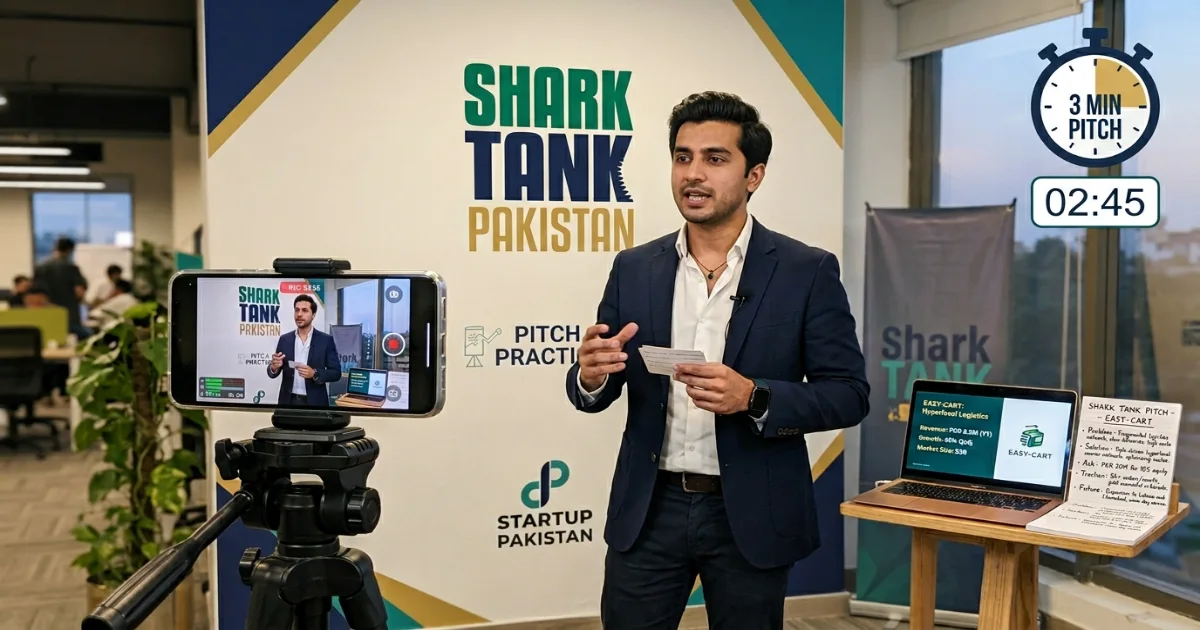
This tip separates serious applicants from the rest. Set up your phone and deliver your full pitch. Aim for 90 seconds to 3 minutes, which is the typical audition window.
Then do two reviews. First, watch it with sound and critique your content. Second — and this is the uncomfortable part — watch it on mute.
Study your body language, eye contact, hand movements, and posture. Are you swaying? Looking at the floor? Crossing your arms? The Sharks read body language instinctively, and producers also screen for camera presence.
Do this at least five times, with at least one recording in front of a friend or family member who will give you honest feedback. If you can’t deliver your pitch clearly in Urdu, English, or a natural mix of both without sounding rehearsed, keep practicing. The best pitches feel like a confident conversation, not a TED Talk.
6. Research Each Shark Like You’re Preparing for a Job Interview
The Sharks on Shark Tank Pakistan are not interchangeable. Each has specific industry expertise, investment patterns, pet peeves, and hot buttons. Season 2 may feature returning Sharks and possibly new ones — and you need to know who you’re pitching to.
If a Shark built their wealth in real estate, they’ll think in terms of asset value and cash flow. If another comes from tech, they’ll care about scalability and user metrics.
If one is known for consumer brands, expect questions about branding, retail margins, and distribution. Tailor parts of your pitch to the Sharks most likely to understand your sector — without alienating the others.
Never say, “I really want to work with you, Shark X” unless you can explain exactly why that specific Shark adds strategic value beyond their cheque.
Revisit the best Season 1 pitches on SharkTankPakistan.pk and study which Sharks engaged with which types of businesses. Look for patterns. That research is worth more than ten generic pitch coaching sessions.
7. Get Your Legal and Business Structure in Order — Before, Not After
You don’t need a perfectly structured private limited company with audited financials to apply. But you do need clarity on your current legal status and a credible plan for formalization. If you’re operating as a sole proprietorship with no SECP registration, be upfront about it and explain why — and when — you’ll register. The Sharks have seen enough Pakistani businesses to know that many start informally. What they won’t tolerate is vagueness or evasion.
At minimum, have these ready before you apply:
- Your CNIC and NTN (if available)
- Your business bank account details (or a clear reason why you don’t have one yet)
- Your SECP registration status and registration number (if applicable)
- Any trademark, patent, or intellectual property filings
- Your last filed tax return (personal or business)
- A cap table showing current ownership percentages, even if it’s just you at 100%
For detailed guidance, read our step-by-step application guide on SharkTankPakistan.pk, which covers the documentation requirements in depth.
Shark Tank Pakistan vs Shark Tank US: Key Audition Differences
| Dimension | Shark Tank Pakistan | Shark Tank US |
|---|---|---|
| Valuation expectations | More conservative; Sharks apply a higher risk discount due to economic volatility | Higher valuations accepted for early-stage companies with strong growth signals |
| Documentation scrutiny | High tolerance for informal structures, but deep probing on cash flows and undocumented revenue | Expects cleaner financials; informal accounting is rare and generally penalized |
| Language flexibility | Urdu, English, or natural code-switching all acceptable; authenticity matters more than polish | Mostly English presentation style; high polish expected |
| Sector focus | Strong interest in agritech, fintech, halal consumer goods, logistics, and edtech relevant to Pakistan | Broader range; deeper appetite for pure tech and DTC brands |
| Equity ask range (typical) | 5%–30%; Sharks often negotiate upward on equity for riskier deals | 5%–25%; more room for smaller equity asks if traction is strong |
💡 Insider Insight from Shark Tank Pakistan
One thing we observed consistently in Season 1: the Sharks invest in the founder first, the business second. When a founder demonstrated resilience — having bootstrapped through a crisis, pivoted after a failure, or built something from nothing in a small city — the Sharks leaned in. Pakistani investors place a premium on grit, coachability, and clear execution. If your story includes genuine adversity that you overcame, don’t hide it. It’s one of your strongest assets.
Situation-Based Adjustments: How Your Preparation Changes Based on Where You Stand
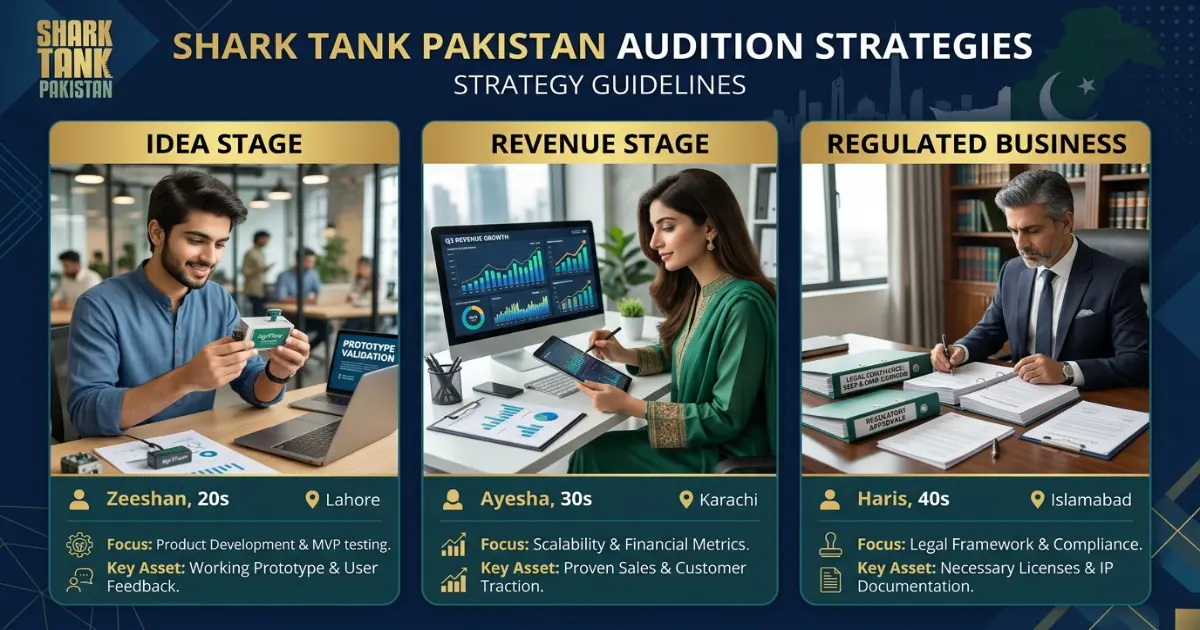
If You’re Pre-Revenue (Idea or Prototype Stage)
Your entire audition hinges on one thing: can you prove demand? Since you don’t have revenue data, you need compensating evidence.
Use letters of intent, pilot results, waitlist sign-ups, pre-orders, or survey data from your target market. Anything that shows real people want what you’re building will make your pitch stronger.
The Sharks will be skeptical of an idea-only pitch unless you have validated demand in Pakistan. Your valuation ask should be modest because you are selling potential, not performance.
If You’re Generating Consistent Revenue (Rs. 50 Lakh+ Annually)
Congratulations — you’re in the strongest position. But the scrutiny level rises accordingly. The Sharks will dig into your unit economics, retention, churn, and margins.
They’ll want to know why you need their money if you’re already profitable. A specific answer works best: “We’re profitable but capital-constrained for expansion into [specific market or channel].”
Your valuation can be more ambitious, but it must be anchored to real multiples from your sector.
If You’re a First-Time Founder vs. a Serial Entrepreneur
First-time founders should lean into coachability. The Sharks want to know you’ll take their advice, not just their money. Acknowledge what you don’t know and explain how a Shark’s operational expertise fills that gap.
Serial entrepreneurs should highlight their track record, even if previous ventures were not huge wins. “I learned X from my last business, and here’s how I’m applying that lesson” signals maturity.
Be careful: a serial entrepreneur who sounds uncoachable or dismissive can lose the room fast.
If You’re in a Regulated Industry (Fintech, Health, Education, Food)
You must demonstrate regulatory literacy. Know which licenses you need, which you have, and the timeline for getting the rest. The Pakistani regulatory landscape is complex — SECP, SBP, PTA, DRAP, provincial food authorities — and the Sharks need to know you’ve thought through compliance. If you’re navigating a grey area, be transparent about it and explain your risk mitigation strategy.
Common Pitfalls & When to Ignore Standard Audition Advice
Generic audition advice — “be confident,” “tell a story,” “know your audience” — is useful but incomplete. Here are the specific ways Pakistani founders misapply standard guidance, plus situations where the conventional wisdom might lead you astray.
Pitfall 1: Over-rehearsing to the point of rigidity. Yes, practice your pitch. But if you’ve memorized every word, you’ll crumble when a Shark interrupts you — and they will interrupt you. The goal is not to deliver a perfect monologue. It’s to navigate a conversation. Practice responding to interruptions. Have a friend throw unexpected questions at you mid-pitch.
Pitfall 2: Hiding weaknesses instead of addressing them head-on. If your business has an obvious vulnerability — a key supplier dependency, a regulatory risk, a concentrated customer base — don’t wait for the Sharks to find it. Acknowledge it early and explain your mitigation plan. This builds trust faster than any polished slide.
Pitfall 3: Asking for too little money. This sounds counterintuitive, but asking for an unrealistically small amount can backfire. It signals either that you haven’t thought through your capital needs or that you’re treating the show as a marketing stunt rather than a genuine fundraising exercise. Ask for what you actually need, with a clear, itemized use of funds.
When to ignore standard advice: Conventional audition wisdom says “always have a clear ask.” But if you’re open to a royalty deal, convertible note, or revenue-sharing arrangement instead of pure equity, say so.
Flexibility can be a strength, especially if the Sharks like your business but hesitate on your valuation. Similarly, standard advice says “never badmouth competitors” — and that’s mostly right.
But if a competitor has a well-known failure that your business specifically solves, naming it can sharpen your value proposition. Use judgment.
Real-World Example: What a Season 1 Applicant Got Right
Imagine two founders with the same product. One says, “We will scale production after investment.” The other says, “Right now we can produce 5,000 units a month. With investment, we have identified a co-packer that can take us to 25,000 units within 90 days, and here is the cost breakdown.” The second founder sounds investable because the scaling plan is specific, timed, and measurable.
That’s the standard. Specificity over generalities. Numbers over adjectives. Preparation over performance.
How to Use SharkTankPakistan.pk Tools for Your Audition Prep
We built the tools on this site specifically because we watched Pakistani founders struggle with the same gaps season after season. Here’s how to use them in your preparation:
Startup Valuation Calculator: Don’t just plug in one set of numbers. Run three scenarios — conservative, moderate, and optimistic — and understand what changes. Use the output to set a realistic ask and to prepare for the valuation conversation. The Sharks will respect that you’ve thought through multiple scenarios.
Equity & Loan Calculator: Model out what happens to your ownership at different equity percentages and investment amounts. Understand dilution. If a Shark offers a different structure — like convertible debt — you’ll be ready to evaluate it on the spot instead of freezing.
Application Guide: Read it twice. The first time for the big picture. The second time with a highlighter, noting every document, number, and detail you still need to prepare. Missing a single document can delay your application or get it rejected before anyone ever sees your pitch.

Frequently Asked Questions About Shark Tank Pakistan Auditions
Do I need a registered company to apply for Shark Tank Pakistan?
Not necessarily. You can apply as an individual founder or sole proprietor. However, you must be clear about your registration status and have a credible plan for formalization. SECP registration strengthens your application significantly, but the producers evaluate the business idea and the founder’s potential — not just the legal structure.
What is the minimum revenue required for Shark Tank Pakistan Season 2?
There is no official minimum revenue threshold. Season 1 featured businesses ranging from pre-revenue startups to established companies with multi-crore annual revenues. What matters more than the revenue number itself is whether you can demonstrate traction, demand, or a clear path to revenue — and whether your valuation aligns with your actual financial position.
How long is the actual audition pitch?
The initial audition pitch is typically 90 seconds to 3 minutes. You need to cover your business overview, the problem you’re solving, your traction, your ask, and why you’re the right founder — all within that window. If the producers are interested, they’ll ask follow-up questions and may invite you to a callback or the filmed pitch round.
Can I apply to Shark Tank Pakistan with just an idea and no product?
Yes, you can apply. But your chances of progressing are significantly lower unless you can demonstrate extraordinary domain expertise, a working prototype, validated market demand, or a unique insight that makes your idea defensible. Pure idea-stage applicants should bring compensating evidence — customer interviews, pilot data, letters of intent — to strengthen their case.
How much equity do the sharks usually take on Shark Tank Pakistan?
There is no single fixed equity range. On-screen negotiations often move higher or lower based on your valuation, investment amount, documentation quality, margins, perceived risk, and the specific Shark’s investment philosophy. Use Season 1 as a benchmark for negotiation style, not as guaranteed closed-deal data.
What documents do I need for the Shark Tank Pakistan application?
At minimum: your CNIC, a brief business summary, financial overview (even if informal), and details about your current business structure. Additional documents like SECP registration certificates, tax filings, bank statements, and intellectual property registrations strengthen your application. Refer to the full checklist in our application guide for a comprehensive list.
Is there an application fee for Shark Tank Pakistan?
The show has not required applicants to pay a third party for a guaranteed spot. Be wary of any person claiming they can secure selection in exchange for payment. Use only the application channel announced by the show’s producers or official social pages.
When is the deadline to apply for Shark Tank Pakistan Season 2?
Application windows and deadlines can change, so do not rely on screenshots or old social posts alone. Monitor the official Shark Tank Pakistan social media channels and check the current application link before preparing your submission. Once a window opens, apply early because shortlisting can move quickly.
⚡ Your Fast-Track Cheat Sheet: Top 3 Actions to Take Right Now
- Build your one-page numbers sheet today. This is one of the most important Shark Tank Pakistan audition tips because revenue, margins, CAC, LTV, burn rate, and runway must be clear from memory. If you can’t fill it out without looking at records, spend the next week getting intimate with your financials. This alone puts you ahead of 70% of applicants.
- Record and review three full practice pitches this week. Watch them with sound, then on mute. Fix the content gaps first, then the delivery. Do it again next week with a friend in the room throwing hard questions at you mid-pitch.
- Run your valuation through the SharkTankPakistan.pk calculator before you finalize your ask. Test conservative, moderate, and optimistic scenarios. Know which number you’ll lead with — and which number you’ll walk away at. Walking in without a walk-away number is walking in without a plan.