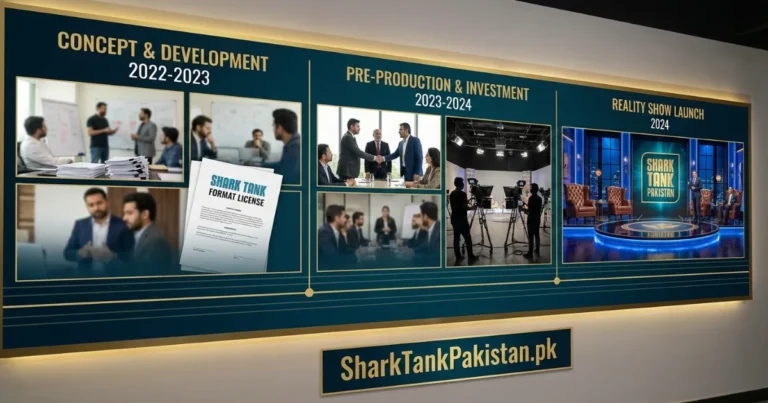
How to Answer “Tell Me About Your Business” in 60 Seconds: A Shark Tank-Ready Pitch Formula
⚡ The Short Answer: A winning tell me about your business pitch doesn’t describe what you do — it reveals why it matters. In 60 seconds, you must name the specific problem, show who has it, explain why your solution works, and prove with one number that it’s already gaining traction. If your answer sounds like a Wikipedia entry for your company, you’ve already lost the room.
You’re standing across from someone who could write you a cheque that changes everything. A shark, an angel investor, a potential partner at a networking iftar, or even a relative who finally asked what you’ve been “working on for so long.” They look you in the eye and say the four most deceptively simple words in entrepreneurship: “Tell me about your business.”
Most Pakistani founders respond with a rambling description of their product features, company history, and vague aspirations. They speak for three minutes. The listener’s eyes glaze over at 45 seconds. The opportunity evaporates. And the founder walks away thinking they just delivered a solid introduction — when in reality, they buried their best points under a mountain of context nobody asked for.
Here’s the uncomfortable truth: the tell me about your business pitch isn’t an invitation to explain everything. It’s a test. In 60 seconds or less, the other person decides whether to ask a follow-up question or change the subject. This is true on the Shark Tank Pakistan stage, in a formal investor meeting, and in a casual conversation at a Lahore coworking space. The rules don’t change. The time pressure just gets more brutal.
This article gives you a repeatable, testable, 60-second pitch framework — built specifically for Pakistani founders, calibrated for how Pakistani investors and sharks actually evaluate opportunities, and stripped of the fluffy advice that fills generic pitch guides. You’ll walk away with a script you can practice tonight and use tomorrow.

Why Most Pakistani Founders Get the “Tell Me About Your Business” Question Wrong
After watching dozens of pitches — on television, in live investor forums across Karachi, Lahore, and Islamabad, and in accelerator demo days — I can tell you that the failure pattern is remarkably consistent. It’s not that founders lack passion. They have too much of it, and it spills out in the wrong order.
The most common mistake is what I call the “origin story trap.” A founder gets asked about their business and immediately starts with: “Well, it all started in 2022 when I noticed that…” — and off they go on a two-minute journey through their personal discovery, their first prototype’s failure, and the friend who encouraged them to keep going. By the time they reach the actual business model, the listener has mentally checked out.
This happens partly because Pakistani education and corporate culture reward thoroughness over brevity. We’re taught to provide context, to be respectful of the listener’s time by giving “complete” answers. But in a pitch context, completeness is the enemy of clarity. The listener doesn’t need the full history. They need to know, right now: What problem exists? Who has it? What do you do about it? Is it working?
Another uniquely Pakistani dimension: many founders here pitch as if they’re trying to impress a government committee with the social impact of their work. They emphasize how many jobs they’ll create, how they’ll uplift underserved communities, how their mission aligns with national priorities. Those things matter — but not in the first 60 seconds. An investor, especially a shark, wants to know if this business can generate returns. Lead with impact, and you’ll sound like an NGO grant application. Lead with traction, and you’ll sound like an investment opportunity.
The Psychological Reality of a 60-Second Window
Research on investor decision-making — and the candid admissions of sharks themselves across Shark Tank franchises — reveals something stark: most investors form their initial “interested / not interested” judgment within the first 20–30 seconds of a pitch. The remaining time either confirms that judgment or, occasionally, reverses it if new information is compelling enough. This means your opening two sentences carry disproportionate weight. If you waste them on pleasantries or background, you’re fighting an uphill battle for the rest of the conversation.
💡 Insider Insight from Shark Tank Pakistan: On Shark Tank Pakistan, the sharks have collectively heard hundreds of pitches. They’ve developed what I call “pattern-matching exhaustion” — the moment they hear a pitch that sounds like every other pitch in a category, they stop actively listening and start waiting for the numbers. Your job in the first 15 seconds is to break the pattern. Say something specific, surprising, or quantifiable that resets their expectations. “We help students pass MDCAT” is pattern-matched and forgotten. “Our MDCAT prep app has a 92% pass rate — and 70% of our users are in cities without a single test-prep academy” forces a lean-in.

The 60-Second Pitch Formula: 5 Sentences That Actually Work
Strip away every piece of conventional pitch advice you’ve absorbed. No “elevator pitch” templates with fill-in-the-blank mad-lib structures. No “start with a question to hook the audience” gimmicks. What follows is a sentence-by-sentence framework that has been tested on real Pakistani investors, real pitches, and real feedback from sharks who’ve sat through countless presentations.
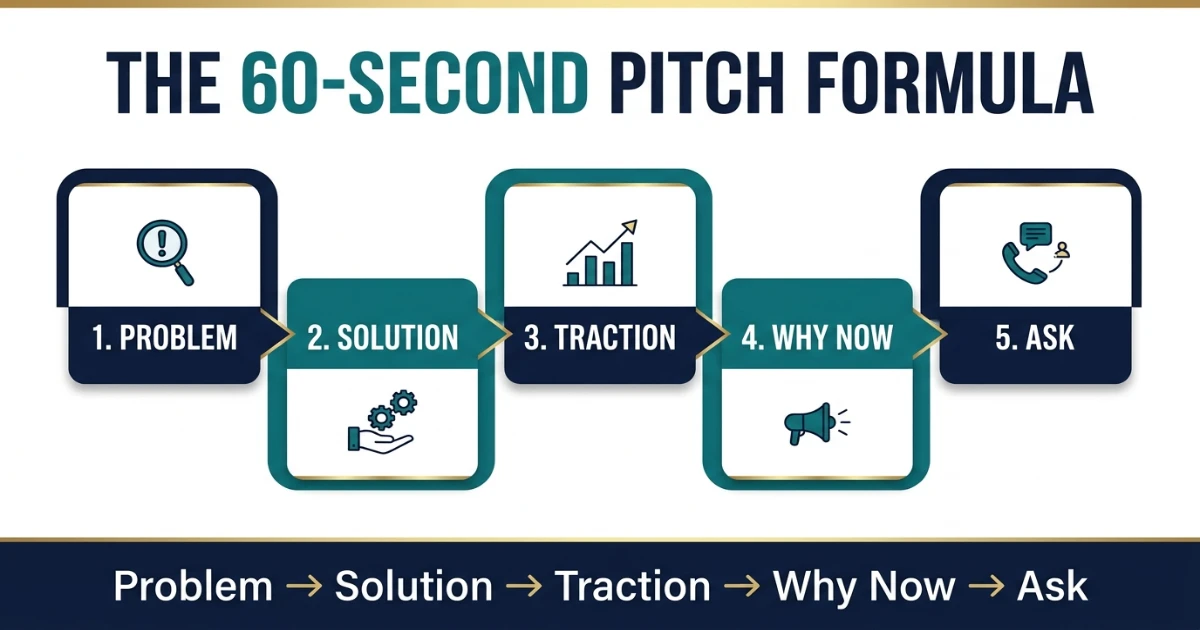
The entire tell me about your business pitch fits into five sentences. Each sentence has a specific job. None can be skipped. The order is non-negotiable — it follows the exact path an investor’s brain travels when deciding whether something is worth paying attention to.
Sentence 1: The Problem Sentence (12–15 seconds)
“Every year, [specific group of people in Pakistan] lose [specific quantified pain — money, time, opportunity] because [root cause].”
This sentence must name a real, painful, measurable problem. Not a vague “people struggle with education.” Try: “Every year, over 200,000 Pakistani students sit for the MDCAT — and nearly 60% fail, not because they aren’t capable, but because they have zero access to quality test prep outside of five major cities.” That lands. The listener now knows: who is affected, how many, what it costs them, and why it hasn’t been solved.
Sentence 2: The Solution Sentence (8–10 seconds)
“[Your company name] is a [category descriptor — app, platform, service] that [specific action that solves the problem] through [unique mechanism].”
No fluff. No “revolutionary” or “game-changing” adjectives. Just what it is and how it works. “ParhoSmart is a mobile learning app that delivers adaptive MDCAT prep in Urdu, optimized for low-bandwidth connections, through daily micro-quizzes and instant video explanations.”
Sentence 3: The Traction Sentence (10–12 seconds)
“Since [launch date], we’ve reached [number] users, [number] of whom are paying [price], with a monthly growth rate of [percentage].”
This is the sentence that separates serious founders from dreamers. You must have a number. If you’re pre-revenue, substitute an engagement metric: “Since our beta launch in January, we’ve onboarded 4,200 students, and our 30-day retention rate is 68% — we’re converting to paid next month at Rs 600/month.” Investors can work with projections if the engagement data is real. They cannot work with “we haven’t launched yet but people have told us it’s a great idea.”
Sentence 4: The Why-Now Sentence (8–10 seconds)
“The shift to [technology trend, policy change, market gap] means this problem is solvable now in a way it wasn’t two years ago.”
This addresses the unspoken investor question: “If this is such a good idea, why hasn’t someone already done it?” Reference the Pakistani context specifically — mobile data cost drops, JazzCash/Easypaisa penetration, HEC policy changes, smartphone adoption in tier-2 cities, the post-COVID normalization of online learning. Show that you’re riding a structural shift, not just hoping for luck.
Sentence 5: The Ask or The Hook (5–8 seconds)
“We’re here today because [specific reason — raising funds, seeking partnership, applying to the show] and I’d love to show you how we plan to reach 50,000 paying users by next year.”
End with clarity about what you want and an invitation to continue the conversation. On Shark Tank Pakistan, this transitions naturally into the sharks’ questioning. In a networking conversation, it opens the door for the other person to say, “Tell me more about the numbers,” or “How exactly does your tech work?” — which is exactly where you want them.
| Pitch Sentence | Core Job | Bad Example (Don’t Do This) | Good Example (Do This) |
|---|---|---|---|
| 1. Problem | Name a specific, quantified pain | “Education in Pakistan isn’t great.” | “Over 120,000 CSS aspirants spend Rs 80,000+ on academy fees — and 94% still fail the written exam on their first attempt.” |
| 2. Solution | Say what it is and how it works | “We have an innovative learning platform that uses AI.” | “CSSPrepHQ is a mobile-first platform that uses past-paper analytics to identify each student’s weakest subjects and drills them with adaptive practice.” |
| 3. Traction | Prove demand with a real number | “People are really excited about it.” | “We launched 5 months ago, have 2,800 registered users, 340 paying subscribers at Rs 1,200/month, and 11% month-on-month revenue growth.” |
| 4. Why Now | Show the window of opportunity | “Online learning is becoming popular everywhere.” | “Smartphone penetration in Pakistan’s tier-3 cities crossed 60% last year, and mobile data costs are now the lowest in the region — our target user just came online.” |
| 5. Ask/Hook | State what you want and invite follow-up | “So yeah, that’s what we do.” | “We’re raising Rs 2 crore to scale from 340 to 3,000 paying subscribers — and I’d like to walk you through the unit economics that make that possible.” |
Situation-Based Adjustments: How Your Pitch Changes Depending on Context
The five-sentence framework is your core script. But you must adapt it based on who you’re talking to and what stage your business is in. A rigid, one-size-fits-all pitch sounds robotic and fails to connect. Here’s how to adjust:
If You’re Pre-Revenue (No Paying Customers Yet)
Replace the traction sentence with a validation sentence. Instead of revenue, talk about engagement, waitlist size, pilot results, or letters of intent. “We haven’t launched paid subscriptions yet, but our beta has 1,800 active users with a 71% weekly retention rate, and 420 of them have joined our paid waitlist at the announced price point.” This reframes “no revenue” as “strong signal,” which is honest and compelling. Avoid the temptation to fabricate revenue projections — experienced investors can smell made-up numbers immediately. Lead with real engagement data instead.
If You’re Pitching on Shark Tank Pakistan vs. a Private Investor Meeting
On Shark Tank Pakistan, the pitch is performative as well as substantive. You need energy, presence, and a slightly tighter delivery — the cameras and the set create a natural adrenaline that you should channel, not suppress. In a private investor meeting, dial the energy down by 15%. Be conversational but still structured. The five-sentence order doesn’t change, but in a private meeting you can pause between sentences, read the room, and adjust your pacing based on body language. On TV, you deliver cleanly and let the sharks interrupt when they’re ready.
If You’re a Tech Startup vs. a Traditional Business
Tech startups should weight the Why-Now sentence more heavily — investors need to understand the technological or behavioral shift you’re riding. A traditional business (manufacturing, retail, food) should weight the Traction sentence more heavily. If you run a chai cafe chain with three profitable locations, lead harder with the numbers: “We’ve served 140,000 customers, our average outlet does Rs 18 lakh/month, and our unit economics are profitable from month four.” Traditional businesses win on proof, not on narrative about disruption. Own that.
If You’re Speaking to a Non-Investor (Potential Co-Founder, Customer, Journalist)
Adjust the final sentence. Instead of an investment ask, pivot to a relational or informational hook. “I’m looking for a technical co-founder who understands mobile infrastructure — if you know anyone, I’d love an introduction” or “We’re launching in Lahore next month, and I’d love for you to try the product and give me honest feedback.” The first four sentences remain the same; only the ask changes based on what you actually want from the conversation.
📊 Data Point: What Sharks Actually Remember
After analyzing post-pitch interviews and investor feedback across multiple Shark Tank franchises, a pattern emerges. Investors reliably remember three things from a pitch: the problem size (how many people are affected), one specific traction number (revenue, users, retention), and the founder’s personal connection to the problem. If you want to be memorable, make sure those three elements are delivered with absolute clarity. Everything else is supporting material that fades from memory within minutes.

Common Pitfalls & When to Ignore This Advice
Even with a solid framework, smart founders make predictable mistakes. Here are the most damaging ones I’ve observed in Pakistani pitch contexts — and the rare situations where you should consciously break the rules I’ve laid out above.
Pitfall 1: The “We’re the Uber of X” Framing. Pakistani investors have heard this so many times it triggers an automatic eye-roll. Unless you are genuinely operating a marketplace with network effects, do not compare yourself to a global tech giant. Describe your business in plain language. “We connect freelance graphic designers with SME clients in Pakistan” is better than “We’re the Fiverr of South Asia” — because the first sentence is true and the second is aspirational puffery.
Pitfall 2: Over-Explaining the Technology. Founders who are technically gifted often spend 40 of their 60 seconds describing how their algorithm works, what stack they built on, and why their tech architecture is superior. Investors care about technology only insofar as it creates a defensible advantage. If your tech is genuinely proprietary, say so in one sentence and move on. If it’s not, don’t dwell on it. The traction number matters more than the tech explanation.
Pitfall 3: The “Urdu-English Toggle” Trap. Many Pakistani founders unconsciously switch between Urdu and English mid-pitch, especially when they get nervous or passionate. A sentence that starts in English veers into Urdu for emphasis, then switches back. This isn’t inherently wrong — Pakistan is a bilingual business culture — but it can disrupt the rhythm of a tight 60-second delivery. Practice your pitch in whichever language you’re most comfortable with, and if you do mix, do it intentionally, not because you lost your train of thought. On Shark Tank Pakistan, a polished Urdu pitch with English business terms can be incredibly effective. A messy mix signals nervousness.
Pitfall 4: Not Having a Second Pitch Ready. If your 60-second pitch works, the listener will ask a follow-up question. Many founders spend all their preparation time on the opening and then improvise the rest. Have a 3-minute expanded version ready — one that goes deeper into the business model, competitive landscape, and financial projections. The 60-second version gets you the follow-up. The 3-minute version gets you the meeting. The 10-minute version gets you the term sheet.
When to Ignore This Five-Sentence Structure: If you have an extraordinarily compelling personal story that directly explains why you started this business — for example, you’re a cancer survivor building a health-tech platform, or you’re a former child labourer building an education NGO — lead with that story. Emotional resonance can override structural rules when it’s genuine, specific, and directly tied to the business. The same applies if you’re pitching in a competition format that explicitly asks for a different structure. But for 90% of pitch scenarios, the five-sentence framework holds.
How SharkTankPakistan.pk Tools Sharpen Your Pitch
A great tell me about your business pitch isn’t just about words — it’s backed by numbers that hold up under scrutiny. The calculators on SharkTankPakistan.pk exist to make sure your traction sentence and your ask are rooted in defensible math.
Before you pitch, open the Startup Valuation Calculator. Input your current revenue, growth rate, and the amount you’re seeking. The output tells you what percentage of your company you’re offering — and whether that percentage is reasonable for your stage. If you walk into a pitch asking for Rs 3 crore for 5% equity but the math says your pre-money valuation would need to be Rs 60 crore for that to make sense — and you have Rs 30 lakh in annual revenue — the sharks will dismantle your ask in seconds. The calculator lets you catch that mismatch before they do.
Similarly, the Equity vs Loan Calculator helps you decide what kind of ask makes sense for your business model. If you’re generating steady cash flow, a revenue-based financing ask might be smarter than dilution. If you’re pre-revenue but high-growth, equity is your path. Know which one you’re asking for and why — and be ready to explain it when a shark asks, “Why equity and not a loan?”
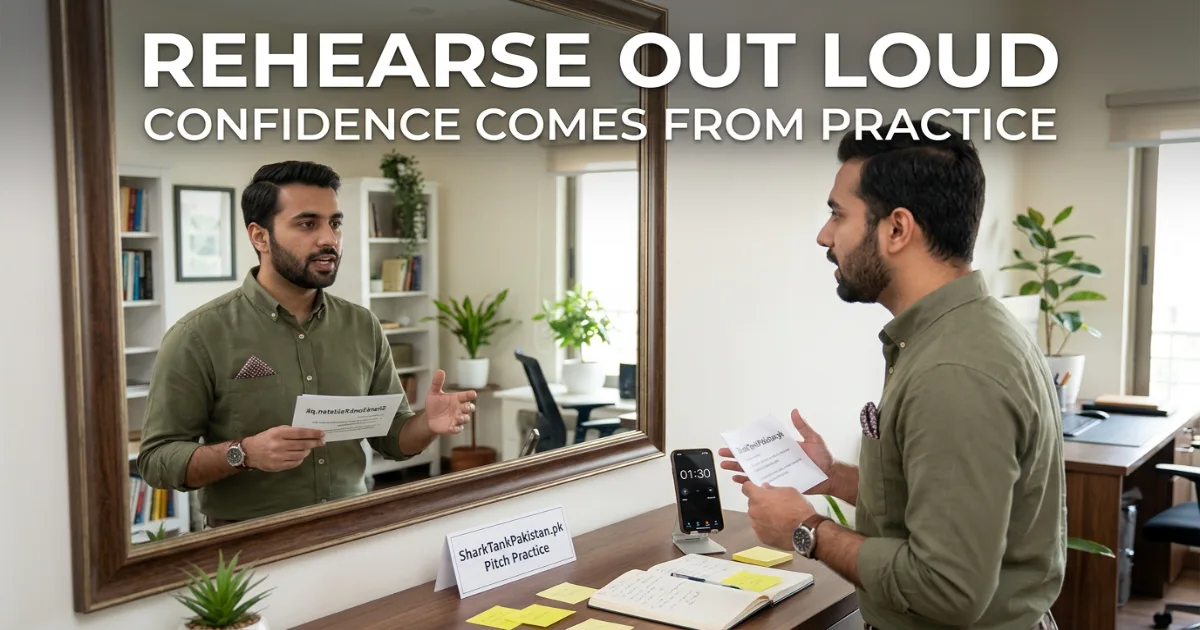
🧠 Put This into Practice: Write your five-sentence pitch right now. Time yourself. If it exceeds 65 seconds, cut words. If it’s under 45 seconds, you’re probably missing detail on traction or problem size. Then go to the SharkTankPakistan.pk Valuation Calculator and make sure the numbers in your traction sentence support the ask you’re planning to make. The pitch and the math must tell the same story.
❓ Frequently Asked Questions About the 60-Second Business Pitch
How long should my “tell me about your business” answer really be?
Aim for 55–65 seconds. Under 45 seconds feels rushed and incomplete. Over 75 seconds and you’ve lost attention. Practice with a timer until your delivery lands consistently in the 58–62 second range. The discipline of timing yourself reveals filler words and unnecessary context you didn’t realize you were including.
What if I don’t have any revenue or traction yet?
Lead with engagement metrics instead of revenue. Active users, retention rates, waitlist signups, pilot program results, letters of intent from potential customers — these are all valid traction signals for pre-revenue startups. Be honest about your stage. Investors respect transparency more than fabricated numbers, and a strong engagement story can still generate interest.
Should I pitch in English, Urdu, or a mix on Shark Tank Pakistan?
Shark Tank Pakistan pitches work in English, Urdu, or a natural bilingual blend. The key is intentionality — whichever language you choose, be consistent and comfortable. If you’re more expressive in Urdu, pitch primarily in Urdu and use English for business terms. If English is your professional comfort zone, stick to English. An authentic delivery in Urdu beats a stiff, memorized English pitch every time.
Do I need to memorize my pitch word-for-word?
No — and a perfectly memorized pitch often sounds robotic. Instead, memorize the five key points (Problem, Solution, Traction, Why Now, Ask) and the specific numbers for each. The exact wording can flex slightly. What must not change is the order and the data. You should be able to deliver your pitch naturally in multiple settings without sounding scripted.
How is the Shark Tank Pakistan “tell me about your business” different from a regular investor pitch?
The TV format adds performance pressure and a visual audience. On Shark Tank Pakistan, you’re pitching to the sharks, but also to cameras and eventual viewers. Energy and presence matter more. However, the content structure — problem, solution, traction, why now, ask — is identical to what works in any investor meeting. The packaging is slightly more polished for TV; the substance remains the same.
What’s the single biggest mistake in a “tell me about your business pitch” on Pakistani shows?
Starting with too much background and context instead of leading with the problem and traction. Sharks on Pakistani television, like their counterparts globally, make snap judgments. If your first 15 seconds are about how you founded the company, not about the customer pain you solve and the early proof you have, you’ve likely lost their full attention before you reach the interesting part.
Can the five-sentence framework work for a service business, not just a tech startup?
Absolutely. The framework is industry-agnostic. A catering business, a salon chain, a logistics company, a tutoring centre — all can use Problem, Solution, Traction, Why Now, and Ask. A catering pitch might say: “Corporate offices in Karachi spend 45 minutes daily deciding on lunch orders (Problem). We provide a curated, pre-scheduled corporate meal subscription (Solution). We serve 12 offices, generate Rs 9 lakh/month, with 92% client retention (Traction).” Same structure, different industry.
How do I handle follow-up questions after the 60-second pitch?
Prepare a 3-minute expanded version that covers business model, competitive landscape, unit economics, team background, and use of funds. The 60-second pitch earns you the right to the follow-up conversation. The 3-minute version answers the predictable next questions. If you don’t have the 3-minute version ready, you risk fumbling precisely when interest is highest.
🚀 Your Fast-Track Cheat Sheet: Top 3 Actions to Take
- Write and time your five-sentence pitch today. Use the Problem → Solution → Traction → Why Now → Ask structure. If it exceeds 65 seconds, edit ruthlessly. If you don’t have a traction number, find one — engagement, waitlist, pilot results, anything real. Practice standing up, out loud, until it flows naturally.
- Run your numbers through the SharkTankPakistan.pk Valuation Calculator. Make sure the ask you plan to make — whether on the show or in a private meeting — is mathematically defensible. A mismatched valuation and ask will undo even the most eloquent pitch within seconds of shark questioning.
- Record yourself on video delivering the pitch. Watch it back with the sound off first — what does your body language communicate? Then listen without watching — does your voice have energy and clarity? Most founders discover delivery issues they were completely unaware of. Fix them before you’re in front of someone who matters.