
Creating a Cash Flow Forecast with Our Free Tool
Getting your cash flow forecast Pakistan-ready isn’t just a spreadsheet exercise—it’s the single most honest conversation you’ll have with yourself before pitching to investors, applying to Shark Tank Pakistan, or simply trying to survive your first two years as a founder. The free tool on SharkTankPakistan.pk turns that conversation into something you can actually see, tweak, and trust.
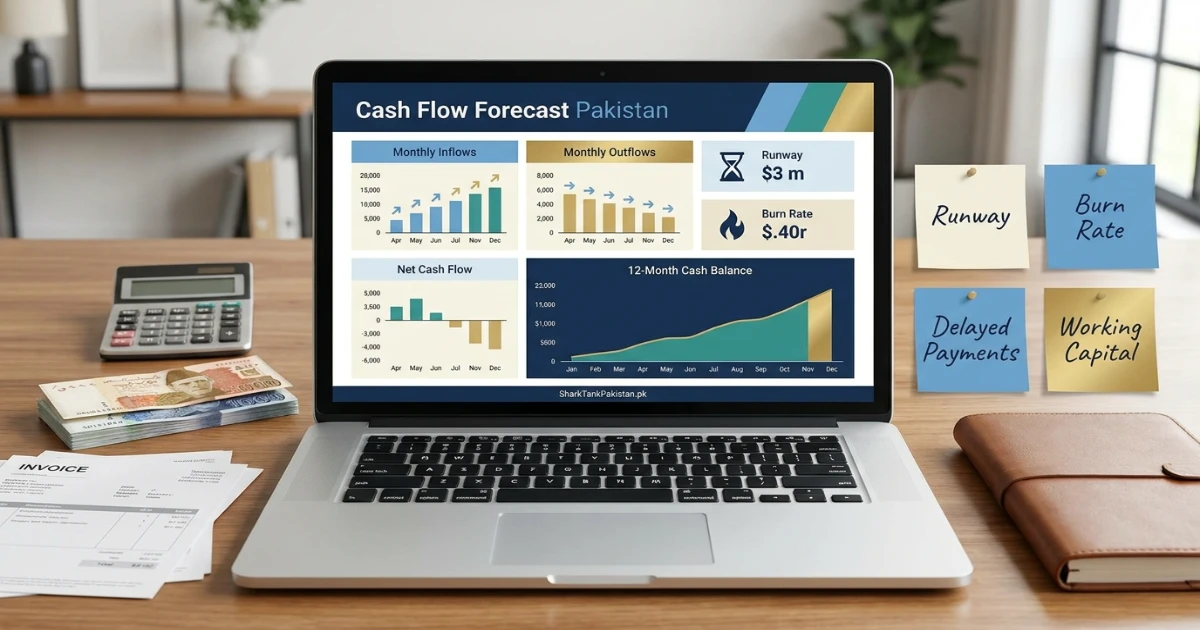
💡 The Short Answer: A cash flow forecast maps exactly when money will enter and leave your business each month. For Pakistani startups—where payment cycles can stretch 60 to 90 days and currency swings are real—this forecast is your early-warning system. Our free tool makes building one straightforward: enter your recurring inflows and outflows, adjust for local realities like delayed client payments or seasonal dips, and walk away with a 12-month projection you can actually defend in a pitch room.
Why Cash Flow Forecasting Hits Different in Pakistan
Let’s be blunt: most Pakistani small business owners and first-time founders learn about cash flow the hard way. They land a big order, celebrate the revenue on paper, and then freeze when salaries come due because the client’s cheque hasn’t cleared yet. That gap—between earning and collecting—is where businesses quietly suffocate.
In Pakistan, the problem has specific contours. Delayed payments from corporate clients and government departments are common. Import-dependent businesses face PKR-USD volatility that can turn a profitable month into a scramble. Seasonal demand shifts—Ramadan, Eid, wedding season, back-to-school—create feast-or-famine cycles that a generic template won’t capture. And if you’re preparing for Shark Tank Pakistan, the sharks will absolutely ask: “Walk us through your monthly cash flow. What happens if your biggest client pays 90 days late?”
A cash flow forecast tailored for Pakistani realities answers that question before it’s asked.
What a Cash Flow Forecast Actually Is (And What It Isn’t)
There’s a quiet confusion that trips up even experienced founders: they conflate a cash flow forecast with a profit and loss statement. They’re not the same thing, and treating them as interchangeable is dangerous.
A cash flow forecast tracks the actual movement of cash—when you receive money and when you pay it out. A P&L records revenue when it’s earned and expenses when they’re incurred, regardless of whether money has changed hands. You can be profitable on paper and still be unable to pay rent. That’s the gap a forecast closes.
| Dimension | Cash Flow Forecast | Profit & Loss Statement |
|---|---|---|
| Focus | Actual cash movement | Revenue and expenses on accrual basis |
| Timing | When money lands or leaves | When the transaction occurs |
| Best for | Short-term survival, liquidity planning | Tax filing, long-term profitability analysis |
| Pakistani nuance | Accounts for cheque clearing delays, advance supplier payments | Often used for FBR filings; doesn’t reflect cash reality |
| Shark Tank relevance | Shows whether you’ll survive the next 12 months | Shows whether the business model makes sense |
Why Most Pakistani Startups Get Cash Flow Wrong—And Pay for It Later
I’ve seen the same pattern across dozens of early-stage ventures in Lahore, Karachi, and Islamabad. Founders build beautiful revenue projections. They map out customer acquisition. They calculate unit economics down to the rupee. Then they go under—not because the idea was bad, but because they ran out of cash while waiting for receivables.
The root causes in Pakistan are predictable:
- Overly optimistic collection timelines. A client who says “30 days” in Karachi often means “we’ll process it in 30 and you’ll see the funds in 60.”
- Ignoring the advance-payment reality. In many Pakistani industries—textiles, manufacturing, retail supply—you pay suppliers upfront or with a 50% advance, even if your own customer pays you later.
- Currency exposure blindness. If your COGS involves imported raw materials or software subscriptions priced in USD, a 5% PKR depreciation can erase your margin in a week.
- Seasonal inventory traps. Stocking up for Eid or wedding season without a cash buffer often forces founders into expensive short-term borrowing.
The free tool on SharkTankPakistan.pk addresses these head-on by letting you set realistic collection lags, add advance-payment line items, and test different currency scenarios.
🔬 Insider Insight from Shark Tank Pakistan: In the US version, sharks regularly ask contestants: “What’s your burn rate? How many months of runway do you have?” Expect the same intensity from Pakistan’s sharks—but with an added layer: they’ll want to know how you handle local cash cycle friction. If you can show a forecast that accounts for delayed receivables and still demonstrates survivability, you separate yourself from 90% of pitchers instantly.
Step-by-Step: Building Your First Cash Flow Forecast with Our Free Tool
Here’s exactly how to use the SharkTankPakistan.pk Cash Flow Forecaster to build a projection you’ll actually use—not one that sits in a folder until a panic moment.
Step 1: Map Your Recurring Inflows
Start with what’s predictable. List every revenue stream that repeats monthly or quarterly: retainer clients, subscription revenue, recurring wholesale orders, marketplace payouts. For each, enter the realistic collection date—not the invoice date. If a client pays 45 days after invoicing on average, use 45 days. Optimism here is the enemy.
Step 2: List Every Outflow—Including the Invisible Ones
Rent, salaries, utility bills, and supplier payments are obvious. But also include: software subscriptions (many are USD-denominated), marketing ad spend, loan repayments, professional fees, advance tax payments, and—crucially—a buffer line for “miscellaneous/unplanned.” In Pakistan, that buffer line often saves you: regulatory fees, sudden fuel price hikes affecting logistics, or an unplanned equipment repair.
Step 3: Set Your Timing Realities
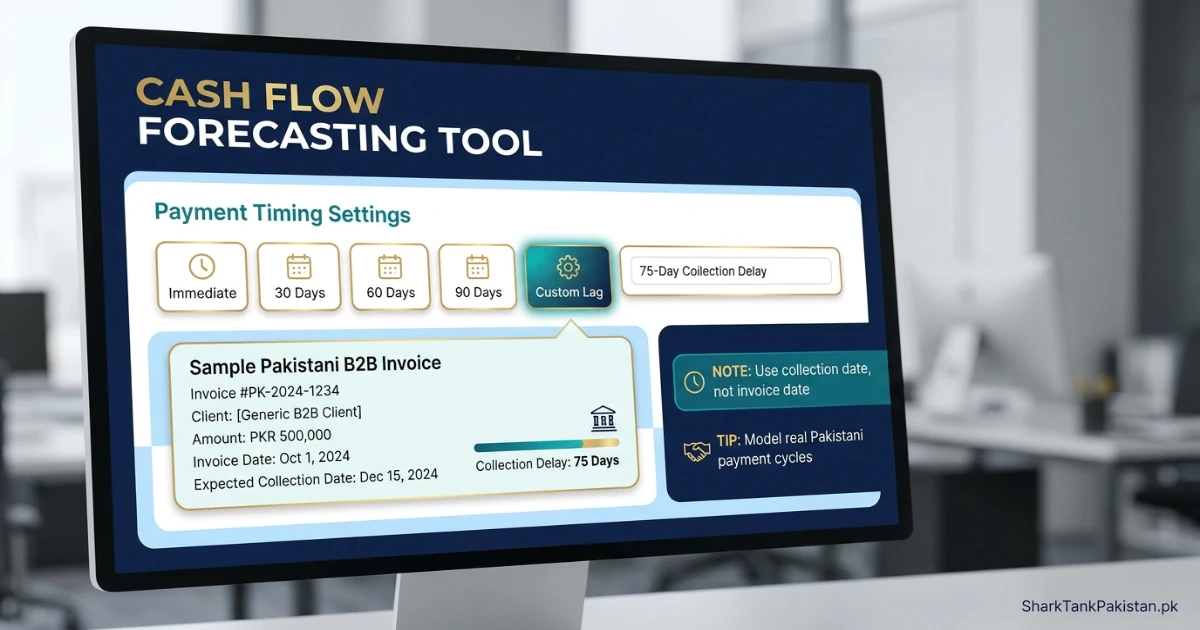
The tool lets you tag each line as “immediate,” “30-day,” “60-day,” or “custom.” Be honest. If your biggest wholesale buyer settles in 75 days, mark it as custom and set the lag. This is where the forecast stops being a theoretical exercise and becomes a mirror of your actual business.
Step 4: Add Seasonal Adjustments
If you’re in retail, your November and December (wedding season) might be 2x your normal month. If you’re in education or stationery, July-August spikes. Ramadan months often see a dip in B2B activity but a surge in food, gifting, and e-commerce. The tool includes a monthly multiplier so you can reflect these patterns without rebuilding the entire sheet.
Step 5: Stress-Test One Variable at a Time
What if your top client delays by 30 extra days? What if PKR slides 3% against the dollar? What if you lose one recurring revenue stream for two months? The forecaster lets you toggle these scenarios and instantly see which months turn red. That’s your risk map—and your pitch preparation gold.
Situation-Based Adjustments: Your Forecast Depends on Where You Stand
Not every founder should build the same type of forecast. Here’s how the approach shifts based on your stage and industry.
If You’re Pre-Revenue (Still Building the Product)
Your forecast is a burn-rate tracker first, a projection second. You’re not forecasting sales—you’re forecasting how long your current capital lasts. Focus intensely on outflow accuracy. List every monthly expense. Then calculate your runway: total cash divided by monthly net outflow. If the number is under 9 months, you need to either cut costs or raise funds soon. Sharks notice when founders don’t know this number cold.
If You’re Generating Consistent Revenue
Your forecast should now shift toward cash conversion cycle analysis. How many days between paying your supplier and collecting from your customer? If that gap is growing, you’re funding your own growth with working capital you may not have. Use the tool’s net cash flow month-over-month view to spot the trend before it becomes a crisis.
If You’re a Tech Startup vs. a Traditional Business
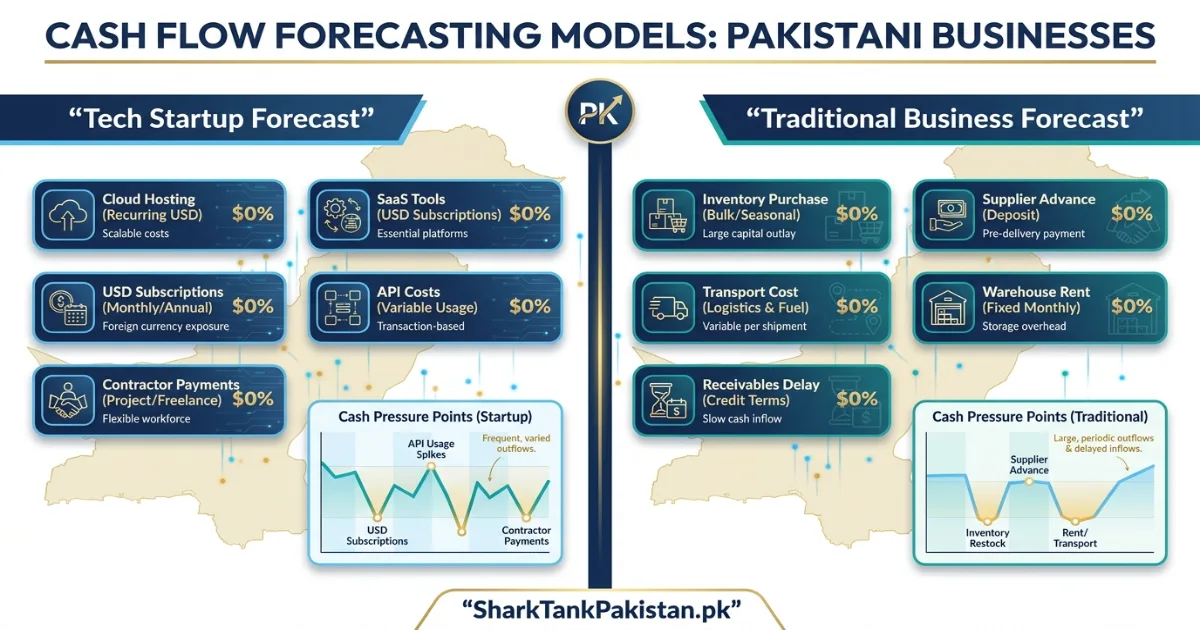
Tech startups often underestimate their USD-linked costs: cloud hosting, SaaS tools, API fees, international contractor payments. A traditional trading or manufacturing business, on the other hand, underestimates inventory carrying costs and advance supplier payments. The tool handles both, but what you emphasize in the forecast changes. For tech: flag every USD line item and build in a currency buffer. For traditional: model your inventory purchase cycle accurately—including the working capital gap between paying your supplier and selling the stock.
How a Solid Cash Flow Forecast Changes Your Shark Tank Pakistan Pitch
Let’s make this concrete. You walk into the tank. You’ve given your opening. A shark leans forward and asks: “What’s your monthly net cash position, and how long can you survive if revenue drops 30% for six months?”
If you’ve built your forecast properly using the tool, your answer isn’t a guess. You can say: “Our current monthly net cash outflow is PKR 850,000. At our current cash reserves of PKR 9.2 million, we have approximately 10.8 months of runway. Even with a 30% revenue dip, our adjusted burn extends that to roughly 8.5 months—enough to course-correct before needing additional capital.”
That level of clarity doesn’t just answer the question. It signals that you’re operationally disciplined. In a country where many founders pitch on passion alone, operational discipline is a differentiator.
💡 Why This Works (Shark Psychology): Sharks—whether in Pakistan, the US, or anywhere else—are pattern-matchers. They’ve seen hundreds of founders who can’t answer cash questions. When you can, you earn an unspoken credibility bump. It signals: “This person actually runs the business, not just the vision.”
Common Pitfalls & When to Ignore This Advice
No guide is complete without warning you about the ways a good tool gets misused. Here’s what trips people up and when you should deliberately deviate from standard forecasting advice.
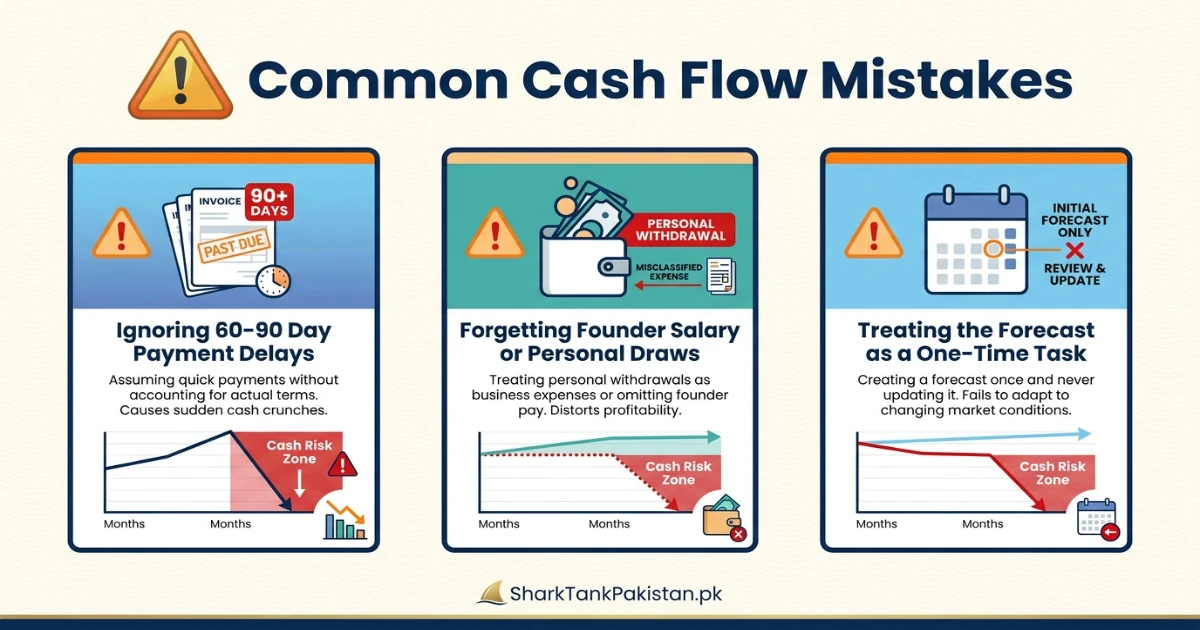
Pitfall 1: Forecasting Too Far Out with False Precision
A 12-month forecast is useful. A 36-month forecast for a 6-month-old startup is fiction dressed as strategy. Beyond 12 months, the variables in Pakistan—regulatory shifts, currency movement, political cycles—create too much noise. Keep your primary forecast at 12 months and revisit it monthly. If an investor asks for a 3-year projection, label it clearly as a “scenario model” not a “forecast.”
Pitfall 2: Treating the Forecast as Static
Your January forecast will be wrong by March. That’s not a failure—it’s the nature of business. The purpose of a forecast isn’t to predict the future perfectly. It’s to give you a framework for updating your assumptions as reality unfolds. Update it every month. Compare actuals to projections. That comparison is where the real learning lives.
When to Ignore Standard Forecasting Rules
If you’re in a hyper-growth phase and have just closed a funding round, your historical cash patterns are temporarily irrelevant—you’re operating in a new reality. In that case, build a forward-looking forecast based on your new run-rate, not your old one. Similarly, if you’re in an industry undergoing a sudden structural shift (think: regulatory crackdown on imports affecting your entire supply chain), toss the old assumptions and rebuild from scratch. The tool lets you clone and modify forecasts so you can keep a “baseline” and a “shock scenario” side by side.
Pitfall 3: Forgetting Personal Draws and Founder Salaries
In Pakistan, many founders blur personal and business finances in the early days. When building your forecast, include a realistic line for what you need to live on. If you’re withdrawing ad-hoc amounts from the business without tracking them, your cash flow forecast is missing a real outflow—and your net position will look healthier than it actually is.
Put This into Practice: Open the Tool Right Now
Head to the SharkTankPakistan.pk Cash Flow Forecaster and spend 20 minutes building your first draft. You don’t need perfect numbers. You need a starting point. Plug in what you know. Estimate what you don’t. Mark the uncertain lines clearly. The act of building it—of seeing your business reduced to inflows and outflows on a timeline—will surface questions you didn’t know you should be asking.
If you’re preparing a pitch for Shark Tank Pakistan, print the 12-month summary view and keep it in your pitch deck appendix. If a shark asks for it, you’ll be ready. If they don’t, you’ll still run a tighter business because of it.
A Real-World Glimpse: The E-Commerce Founder Who Almost Didn’t Make It
Consider a Karachi-based D2C skincare brand—call her Hira. She did PKR 4.2 million in sales during the wedding-season rush. On paper, she was profitable. But her raw-material supplier demanded 50% upfront, her packaging supplier required full advance payment, and her largest wholesale client paid on net-60 terms. By month three of her growth spurt, she was PKR 1.7 million short on working capital despite being “profitable.”
She used the SharkTankPakistan.pk Cash Flow Forecaster to model three scenarios: (1) business as usual with 60-day collections, (2) negotiating a 30-day collection timeline with her wholesaler, and (3) adding a small working-capital line of credit. Scenario 2 plus a modest credit line showed her surviving and scaling. Scenario 1 showed her running out of cash within five months. The forecast didn’t just diagnose the problem—it gave her a negotiation script for her wholesaler. She shortened terms to 35 days and avoided the crunch.
That’s the difference between a founder who thinks about cash flow and one who models it.

Frequently Asked Questions
Do I need a registered company in Pakistan to use the cash flow forecast tool?
No. The free tool on SharkTankPakistan.pk is available to anyone—whether you’re a registered private limited company, a sole proprietor, or still in the idea-validation stage. Cash flow discipline matters at every stage, not just after SECP registration.
How is a cash flow forecast different from a budget?
A budget sets spending targets and revenue goals. A cash flow forecast tracks the timing of actual cash movement. You can be under budget and still run out of cash if collections lag. They’re complementary tools, not substitutes.
What’s a healthy cash buffer for a Pakistani startup?
Aim for at least 3 to 6 months of operating expenses in readily accessible cash. In Pakistan, where unexpected delays—from client payments to regulatory hurdles—are common, the higher end of that range provides genuine peace of mind and negotiating power.
Can I use this forecast tool if my business has irregular, project-based income?
Absolutely. Instead of entering fixed monthly recurring amounts, use the custom-entry feature to add inflows and outflows as individual line items with specific expected dates. The tool accommodates lumpy, project-based revenue patterns common in consulting, construction, and creative agencies.
Will the sharks on Shark Tank Pakistan ask for my cash flow forecast?
Yes—directly or indirectly. Even if they don’t use the phrase “cash flow forecast,” they’ll ask about your runway, monthly burn, and how you’re managing working capital. Having the forecast ready—ideally printed or on a tablet—shows preparation that most contestants lack.
How often should I update my cash flow forecast?
Monthly, at minimum. Compare your actual bank movements against what you projected. The gap between projected and actual is where you’ll find the most valuable intelligence about your business. Quarterly updates are the bare minimum; weekly reviews are ideal during cash-tight periods.
Does the free tool account for Pakistani tax deductions and withholding tax?
The tool includes customizable outflow categories, so you can add line items for withholding tax deductions, advance income tax, sales tax payments, and any other FBR-related obligations. Accurate tax planning inside your forecast prevents nasty surprises at filing deadlines.
Is this tool suitable for a restaurant or retail business with daily cash sales?
Yes. For businesses with daily cash inflows, aggregate your daily sales into weekly or monthly totals and enter them as recurring inflows. The tool is flexible enough to handle both high-frequency cash businesses and invoice-based B2B models.
- Open the free tool and build a 12-month draft in one sitting. Use your best estimates. Don’t chase perfection—chase a baseline. You’ll refine it monthly, but you can’t refine what doesn’t exist.
- Flag your riskiest month. Look at the month with the lowest projected net cash position. That’s your danger zone. Build a contingency plan for it—whether it’s delaying a discretionary expense, securing a short-term credit line, or accelerating collections.
- If you’re pitching soon, print the 12-month summary. Tuck it into your pitch deck appendix. When a shark asks a cash-flow question—and one will—you’ll answer with data, not hesitation. That moment alone can shift the tone of the entire conversation.