Shark Tank Pakistan vs US: 10 Major Differences Every Founder Must Know
The Shark Tank Pakistan vs US comparison reveals two fundamentally different investment arenas. While both shows share the same format, Pakistan’s tank operates with smaller deal sizes, a stronger preference for royalty-based structures, deeper cultural sensitivities around pitching, and a unique market logic shaped by local consumer behaviour and regulatory frameworks. Winning in Pakistan is not about copying a US pitch — it’s about adapting your ask, your story, and your numbers to what Pakistani sharks actually value.
If you’ve watched even a handful of episodes from both shows, you’ll sense the gap. On Shark Tank US, a founder walks in, cracks a joke, asks for $500,000 at a $5 million valuation, and the sharks lean in. On Shark Tank Pakistan, the same approach might be met with a polite but firm “I’m out.” The difference isn’t just currency or camera angles — it runs deep in the expectations investors bring to the table, the business realities on the ground, and the unspoken cultural codes that colour every negotiation.
This guide breaks down the 10 most important differences between Shark Tank Pakistan vs US. Whether you’re a Pakistani founder preparing for the show, an investor curious about both ecosystems, or simply a fan trying to decode why some deals happen and others don’t, this is the comparison you’ve been searching for.
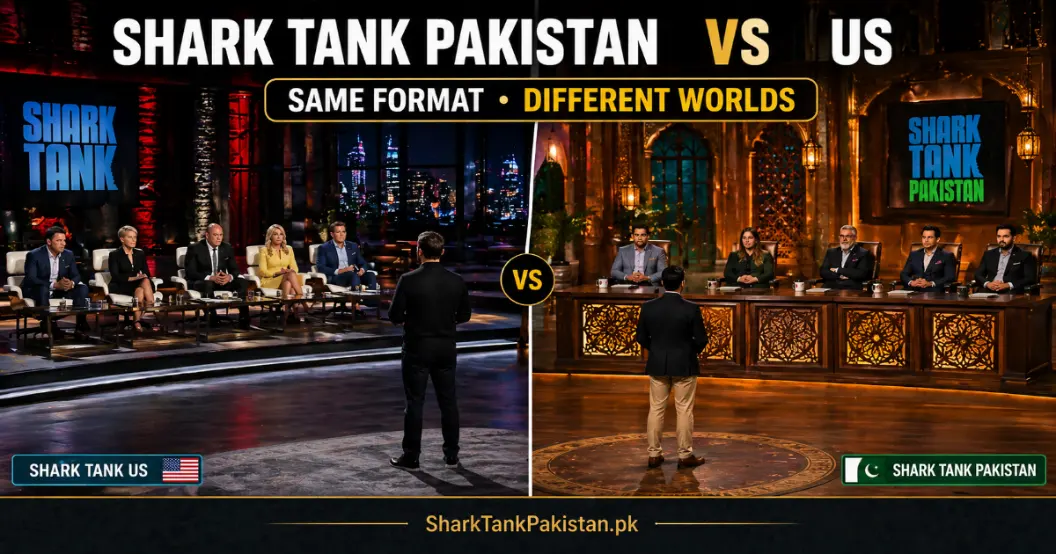
The 10 Major Differences Between Shark Tank Pakistan and Shark Tank US
1. Deal Size and Valuation Ranges
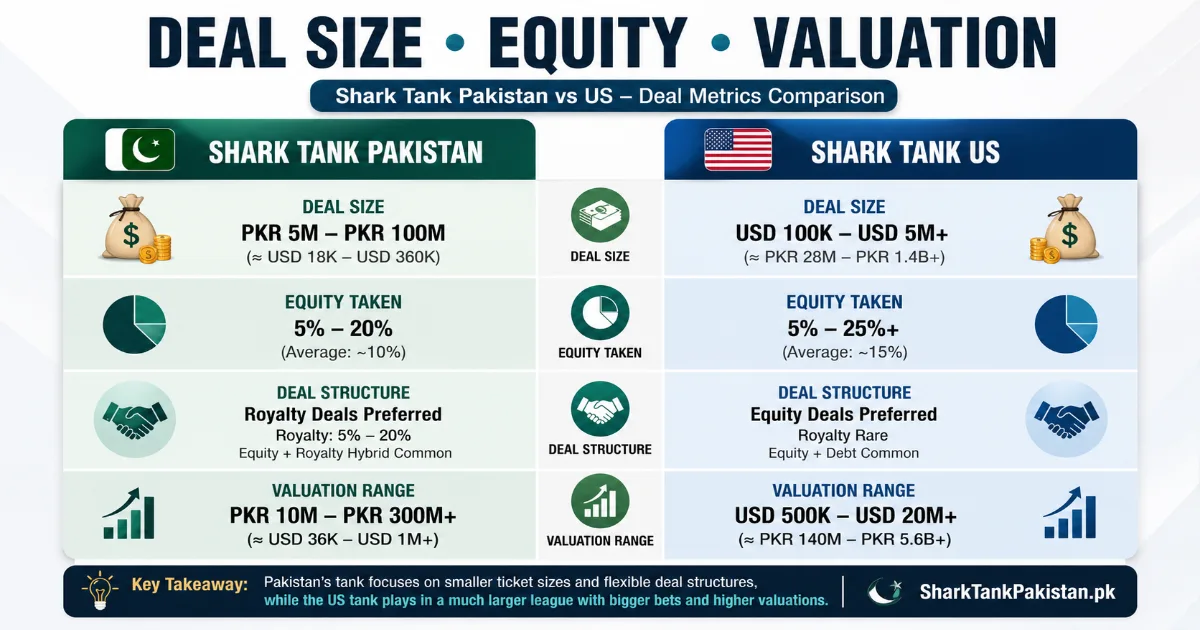
The most visible difference is the money on the table. On Shark Tank US, it’s common to see asks of $200,000 to $2 million, with valuations often crossing the $10 million mark for early-stage companies. In Pakistan, the typical ask ranges from PKR 30 lakh to PKR 3 crore (roughly $10,000 to $100,000), and pre-revenue startups rarely command valuations above PKR 5 crore. This isn’t just about currency conversion — it reflects the smaller capital pools, lower average ticket sizes in local venture capital, and a more conservative approach to risk.
2. Equity vs Royalty: The Deal Structure Divide
US sharks overwhelmingly prefer straight equity deals. Royalty arrangements exist but are the exception, usually reserved for cash-flow-positive businesses where the shark can recoup investment quickly. In Pakistan, the dynamic flips. Sharks frequently propose royalty-plus-equity structures or even pure royalty deals with a small equity kicker. Why? Because Pakistani investors often want to de-risk their capital through ongoing cash returns, especially in traditional businesses where exits (acquisitions, IPOs) are less frequent and less predictable than in Silicon Valley. For Pakistani founders, walking into the tank without a royalty scenario prepared is a strategic blind spot. Use the Equity-Loan Calculator to model how different royalty rates affect your long-term payout — it’s an exercise that can redefine your negotiation.
3. Cultural Pitching Style and Communication Norms
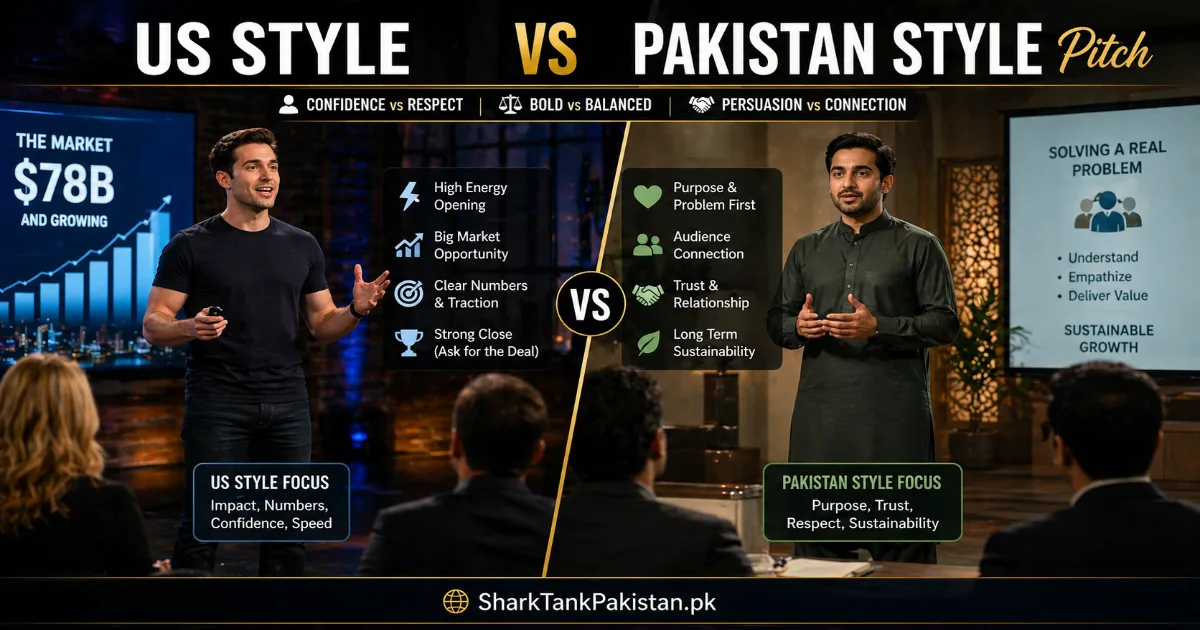
In the US, boldness is often rewarded. Founders are encouraged to state big visions, use powerful language, and even engage in light banter with sharks. In Pakistan, the line between confidence and arrogance is thinner and policed more strictly. A respectful tone, modest demeanour, and use of honorifics (sir, ma’am) are not optional — they’re expected. Sharks may warm to a founder who shows humility alongside ambition. Body language also shifts: sustained eye contact that reads as confident in the US can be interpreted as confrontational when directed at an older Pakistani shark. Navigating this nuance is so critical we’ve dedicated an entire guide to body language tips for Pakistani pitches.
4. Market Context and Addressable Opportunity
US sharks want to know if a business can scale nationally or globally. The total addressable market slide is pitched in billions. Pakistani sharks are equally interested in scale, but they view it through a different lens: deep penetration of a 240-million-person domestic market, often leveraging offline distribution networks, Kiryana retail, and word-of-mouth. A startup targeting 50,000 users in Karachi with a clear path to 500,000 across Punjab is more compelling than a vague “we’ll conquer Asia” claim. Local sharks appreciate granular, street-level market understanding over blue-sky projections.
5. Regulatory and Compliance Scrutiny
On Shark Tank US, basic legal incorporation (LLC, C-Corp) is expected, and few sharks drill into tax compliance history in the first minute. In Pakistan, the conversation shifts quickly: “Are you registered with SECP? Do you have an active NTN? Are your tax filings up to date?” The informal economy casts a long shadow, and sharks want assurance that the business is compliant and free of regulatory risk. A founder who hesitates on these questions loses credibility instantly. For a full walkthrough, see our guide to registering your startup in Pakistan.
6. Shark Profiles and Investment Philosophy
Shark Tank US features a mix of self-made billionaires (Mark Cuban), branding experts (Barbara Corcoran), and venture capitalists (Kevin O’Leary). Their investment philosophies are shaped by deep, liquid markets and a mature startup ecosystem. Pakistani sharks — many of whom are leading figures like Rabeel Warraich of Sarmayacar, Junaid Iqbal of Salt Ventures, or seasoned industrialists — bring a hybrid perspective. They understand both global venture metrics and the gritty realities of Pakistani supply chains, import duties, and cash-based consumer behaviour. They often invest not just capital but operating expertise and network access, and they expect founders to value that beyond the cheque.
Pakistani sharks have shown a distinct preference for businesses that demonstrate capital efficiency — turning PKR 10 lakh into PKR 50 lakh in revenue — over those that have simply raised and burned large amounts. This is a subtle but critical difference from the US tank, where high burn rates are sometimes tolerated or even expected in pursuit of hypergrowth. In Pakistan, frugality signals discipline, and discipline closes deals.
7. Audience Participation and Media Ecosystem
Shark Tank US is a multi-season juggernaut with massive social media follow-ups, product websites crashing from “Shark Tank effect” traffic, and a well-oiled PR machine. The Pakistani version is younger, but engagement is intense and deeply community-driven. A deal on Shark Tank Pakistan can generate not just sales, but significant brand legitimacy within the local market. The show’s audience trusts sharks’ judgment; a handshake can open doors to distributors, retailers, and even government support programmes. Founders need to be ready for the post-episode surge — both its opportunities and its operational stress.
8. Deal Follow-Through and Due Diligence
On both shows, the on-air handshake is just the beginning. Due diligence follows. In the US, the process is relatively standardised — legal teams, background checks, financial audits. In Pakistan, due diligence can be more relationship-heavy and may involve informal reference checks within industry circles. A shark’s word carries weight, but the final investment can still fall apart if the business’s documentation isn’t spotless or if the founder’s reputation doesn’t hold up in the close-knit Pakistani business community. Expect deeper personal vetting alongside the paperwork.
9. Types of Businesses That Get Funded
In the US, tech-enabled startups — apps, SaaS, direct-to-consumer brands — dominate the deal flow. Food and beverage, pet products, and novelty items also make strong appearances. In Pakistan, while tech startups are gaining ground, traditional businesses with proven revenue — food brands, textile innovations, agri-processing, small-scale manufacturing — receive serious attention. A pickle brand with PKR 3 crore in annual sales and 40% gross margins can outshine a pre-revenue AI startup. Sharks look for tangible proof, not just potential.
10. The Question Every Shark Asks (But in Pakistan, It Means Something Different)
On both tanks, sharks ask: “How will you use my money?” In the US, a broad answer like “marketing and team expansion” might fly if traction is strong. In Pakistan, sharks demand specificity: “What percentage goes to inventory? Which cities will you launch in? What’s the per-unit cost of your marketing campaign?” They want to see that you’ve thought through every rupee, because in a market where margins can be razor-thin, loose planning is a red flag. If you haven’t already modelled your use of funds on the SharkTankPakistan.pk Valuation Calculator, do it before you walk in — it will sharpen your ask beyond a single number.
Head-to-Head Comparison Table: Shark Tank Pakistan vs US
| Dimension | Shark Tank Pakistan | Shark Tank US |
|---|---|---|
| Average Deal Size | PKR 30 lakh – PKR 3 crore (~$10K–$100K) | $50K – $2 million |
| Common Equity Range | 10% – 35% (average 20–25%); pre-revenue higher | 5% – 30% (average 15–20%) |
| Deal Structures | Equity + royalty, convertible notes, or pure royalty common | Predominantly straight equity; royalties for cash-flowing biz |
| Valuation Approach | Conservative; 3–6x revenue for established; | Wide range; pre-revenue tech can hit $5M+ with strong IP | |
| Cultural Pitch Tone | Respectful, humble confidence; honorifics expected | Bold, direct, assertive; banter welcomed |
| Regulatory Emphasis | High; SECP, FBR, tax filings checked early | Moderate; assumed, but deeper due diligence later |
| Market Scaling Lens | Deep domestic penetration, offline retail integration | National/global scalability, e-commerce dominance |
| Shark Background | Mix of VCs, operators, industrialists; hands-on mentorship | Billionaires, branding gurus, VCs, liquidity-event veterans |
| Post-Deal Dynamic | Relationship-driven; informal reference checks; sharks open doors locally | Standardised due diligence; media exposure primary boost |
How to Adjust Your Pitch Based on Which Tank You’re Entering
If You’re Pitching on Shark Tank Pakistan After Studying US Episodes
Reset your ask. The numbers that impressed US sharks will feel inflated in Pakistan. Run your financials through local benchmarks. Replace global TAM slides with district-by-district expansion plans. Practice your pitch with a mentor who understands Pakistani investor psychology — not just the words, but the pauses, the eye contact, the salaam. And prepare for royalty questions. Even if you don’t offer it, sharks will ask.
If You’re a Pakistani Founder Pitching to US Shark Tank
You’ll need to translate your market size into terms US sharks grasp — they won’t intuitively understand the power of a Kiryana network. Use relatable comparisons. Your growth metrics need to show ambitious hockey sticks, not conservative curves. And your communication style can be more direct; don’t over-index on deference. A Pakistani founder who strikes the right balance between global ambition and authentic roots can be incredibly compelling.
If You’re an Investor or Fan Comparing Both Ecosystems
Recognise that Shark Tank Pakistan is not a scaled-down replica. It’s a distinct platform optimised for a market where relationships, cash efficiency, and offline distribution create different winners. The show’s real value isn’t just the money — it’s the mentorship and market access that sharks provide in a context where trusted networks still unlock more doors than a viral ad campaign.
Common Misconceptions About Shark Tank Pakistan vs US
Many Pakistani founders assume that because the set looks similar, the rules are the same. That assumption kills deals. Here are the most damaging myths:
- “A good US pitch deck will work in Pakistan.” No. Pakistani sharks prioritise unit economics and local traction differently. A deck built for US VCs may feel hollow without granular local data and regulatory nods.
- “Higher valuation always signals a stronger business.” In Pakistan, an unrealistically high valuation signals naivety. Sharks walk away from inflated numbers even if the business is solid. Arrive with a defensible valuation grounded in local comparables, not Silicon Valley dreams.
- “Royalties are a bad deal — I should only offer equity.” In the Pakistani ecosystem, a fair royalty can actually make your deal more attractive to sharks, especially if you’re early-stage. It aligns incentives and gives the shark a reason to actively support your cash flow.
- “If I don’t get a deal on the show, my business is doomed.” Many successful Pakistani companies pitched, got rejected, and still thrived. The exposure alone can be transformative. The tank is a platform, not a verdict.
When to Lean Into the US Approach (Even in Pakistan)
Despite the differences, there are times when a more US-style pitch tactic can work — if executed with nuance:
- Your product is a tech platform with clear global scalability. Pakistani sharks who are also VCs (like Rabeel Warraich) appreciate global-thinking founders. You can pitch a larger vision, but ground it with local proof points.
- You have an IP or patent that is defensible internationally. Bold, confident language about IP is not arrogance; it’s fact. Just ensure you can back it up.
- You’ve already secured traction outside Pakistan. If you’re exporting to the UAE, UK, or US, that’s a powerful signal. Present it with the same confidence a US founder would — sharks will validate it with the numbers.
How is Shark Tank Pakistan different from Shark Tank US?
Shark Tank Pakistan features smaller deal sizes (PKR 30 lakh–3 crore), frequent royalty-based structures, stronger cultural emphasis on respect and humility, and deeper scrutiny of local regulatory compliance. US sharks focus more on global scalability and equity-only deals with higher valuation tolerance. The Pakistani tank is built for a relationship-driven, capital-efficient market.
Do Pakistani sharks take less equity than US sharks?
Typically, no. Pakistani sharks often ask for slightly more equity on average (20–25%) compared to US sharks (15–20%), especially from early-stage or pre-revenue companies. This compensates for higher perceived risk in a less liquid exit environment. However, royalty components can offset the effective cost of capital for the founder.
Can I use the same pitch deck for both Shark Tank Pakistan and US?
Not effectively. A US pitch deck would need significant adaptation for Pakistan: lower valuation ask, detailed unit economics relevant to Pakistani costs and pricing, evidence of local market traction, regulatory compliance notes, and a communication tone that balances confidence with cultural respect. The numbers that impress US sharks often feel inflated to Pakistani investors.
Which sharks appear on Shark Tank Pakistan vs Shark Tank US?
Shark Tank US features well-known billionaires like Mark Cuban, Barbara Corcoran, Kevin O’Leary, Lori Greiner, and Daymond John. Shark Tank Pakistan includes leading Pakistani investors and entrepreneurs such as Rabeel Warraich (Sarmayacar), Junaid Iqbal (Salt Ventures), and other prominent figures from industry and venture capital. The Pakistani panel blends global VC experience with deep local market knowledge.
Are deals on Shark Tank Pakistan binding like they are in the US?
On both shows, the on-air handshake is a preliminary agreement subject to due diligence. In the US, that process is fairly standardised. In Pakistan, the due diligence phase can be more relationship-intensive, involving informal reference checks and deeper scrutiny of legal and tax documentation. Not all handshakes convert to final investments on either platform.
What types of businesses do best on Shark Tank Pakistan?
Businesses with proven revenue, strong unit economics, and clear local market fit perform best. This includes food and beverage brands, textile and fashion innovations, agri-tech, small-scale manufacturing, and consumer goods. Tech startups are gaining ground but face higher scrutiny if pre-revenue. Sharks value capital efficiency and tangible traction over speculative projections.
Is Shark Tank Pakistan worth applying to if I’m already profitable?
Yes. Profitable businesses with strong cash flow are highly attractive to Pakistani sharks, who may offer royalty-based structures that align with steady income. The show also provides unmatched brand visibility and credibility within the Pakistani market, which can open retail, distribution, and partnership doors far beyond the cash investment.
Your Fast‑Track Cheat Sheet: Top 3 Takeaways from Shark Tank Pakistan vs US
- Forget Silicon Valley numbers. Reset your valuation and ask to local benchmarks. Use the Valuation Calculator to ground yourself before you walk in.
- Embrace the royalty conversation. Don’t resist alternative deal structures — model them. Pakistani sharks often prefer a mix of equity and royalty, and a founder who can discuss it intelligently stands out.
- Adapt your story and your body language to the local code. Confidence plus respect, numbers plus narrative. Combine the best of both tanks, but never assume one formula fits the other.