How Much Loan Can Your Startup Afford? Use the Equity Loan Simulator
Quick Answer: An equity loan simulator Pakistan helps you determine exactly how much debt your startup can safely take on without suffocating its cash flow. You input your monthly revenue, expenses, and desired loan term, and it instantly shows you the maximum affordable loan amount — and what equity you might need to give up if you mix in investor capital.
Picture this: you’re standing in the Shark Tank Pakistan den, palms a little damp, and a Shark asks, “You want PKR 80 lakh. How exactly will you pay that back if sales dip 20%?” If your answer sounds like “well, we’ll manage,” the deal is as good as dead. That’s precisely why we built the equity loan simulator Pakistan — to turn guesswork into a numbered, defensible repayment plan that can hold up in the toughest room in Pakistani business.
Too many founders walk around with a loan number pulled from thin air. Maybe they heard a friend got 50 lakh, or they assume they need “one year’s expenses.” But a loan that’s too large can choke your startup with installment payments before you’ve even built a repeatable customer base. Too small, and you’ll limp along, unable to fund inventory, marketing, or essential hires. The simulator bridges that gap, giving you a figure rooted in your actual unit economics, not your hopes.
Why Pakistani Founders Need an Affordable Debt Reality Check
In Pakistan, the funding landscape is evolving but still thin. Formal venture capital exists, yet many founders bootstrap or rely on family loans, bank borrowing under the Kamyab Jawan program, or “friends and family” rounds. The common mistake? Treating all capital equally. Debt demands regular repayments regardless of sales. Equity demands a share of your business forever. A miscalibrated loan without a robust repayment stress test is a direct route to insolvency — I’ve seen three promising startups in Karachi and Lahore fold within 18 months because their monthly installments were 60% of their best‑month revenue.
On Shark Tank Pakistan, the Sharks don’t just evaluate your idea; they model your burn and debt servicing capacity out loud. When you use the equity loan simulator Pakistan, you’re essentially doing that Shark‑level math before you ever step onto the carpet. It forces you to answer: “What’s the absolute worst month, and can we still make the payment?” That answer changes everything.
Equity vs. Loan: The Real Cost No One Tells You
Before you touch the simulator, understand what you’re choosing between. While our primary tool helps you gauge affordable loan amounts, it also layers in an equity component to show what happens if you take a hybrid deal — which many Shark Tank Pakistan offers actually are. Here’s the breakdown in a way that applies specifically to the local scene:
| Factor | Pure Debt (Loan) | Pure Equity | Hybrid (Equity + Loan) |
|---|---|---|---|
| Ownership impact | Zero dilution — you keep 100% | You give away a % of the company forever | Some dilution + repayment obligation |
| Monthly cash drain | Fixed instalment (principal + interest) every month | No monthly payment; investor wants growth, not repayments | Smaller instalment + future dividend expectations |
| Risk if revenue drops | High — you still owe the bank/lender | Shared risk — investor bears losses too | Moderate; partly shared, partly fixed |
| Typical Pakistan rate | 15–22% KIBOR+; or 0% if family | 15–35% equity for early stage | 5–10% equity + reduced‑rate loan |
| Best for | Predictable cash flow, asset‑heavy, inventory‑based businesses | High‑growth, cash‑burning startups, pre‑revenue | Founders who want to limit dilution but still need cash |
In the Shark Tank Pakistan context, many deals are structured as convertible notes or simple loans with equity kickers — exactly the kind of instrument our equity loan simulator Pakistan can model when you toggle between scenarios.
How the Equity Loan Simulator Works (Step‑by‑Step)
The tool is built for non‑finance founders, but it’s rigorous. Here’s how you walk through it and interpret the output like an investor would.
Step 1: Gather Your Income and Expense Data
Bring a realistic view of your average monthly revenue, not just your peak month. If you’re pre‑revenue, use conservative projections and note that the simulator will highlight the risk. Also list all fixed monthly costs: rent, salaries, utilities, marketing subscriptions, supplier payments.
Step 2: Enter Your Debt Affordability Parameters
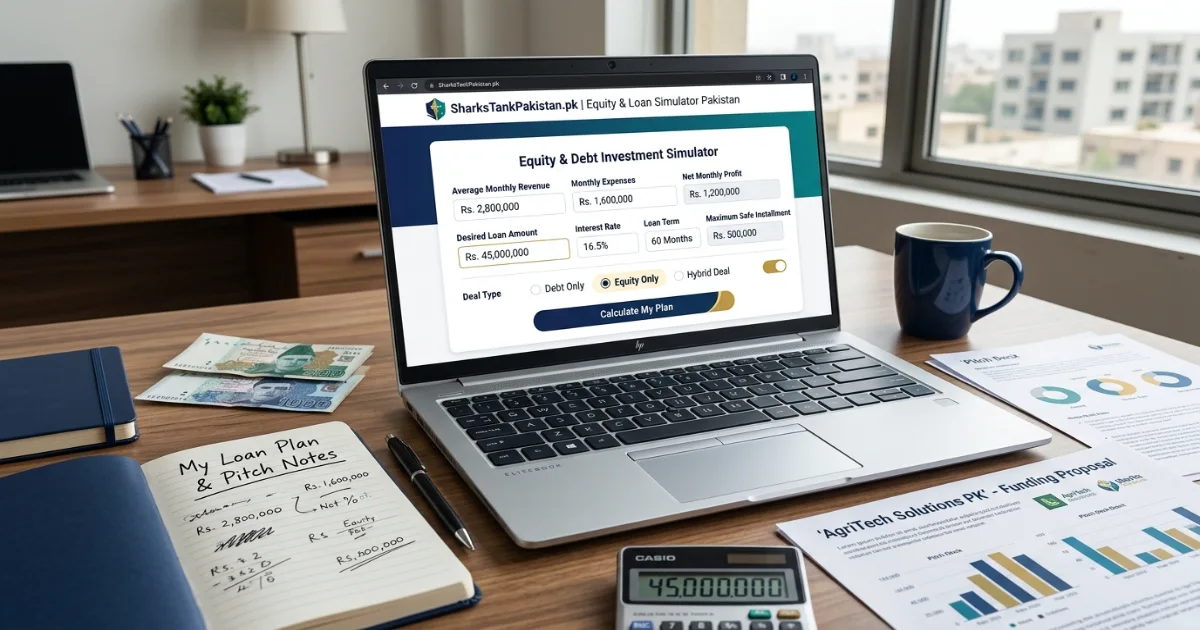
The simulator asks for your desired loan term (typically 12–36 months) and the maximum monthly instalment your startup can handle without sacrificing growth — often recommended at no more than 30–35% of your net monthly profit.
Step 3: Input the Equity Portion (If Any)
If you’re considering a Shark Tank Pakistan‑style hybrid, you can specify a percentage of equity you’re willing to part with and the corresponding reduction in loan amount. The simulator will instantly show what that does to your cash flow burden and your ownership stake over time.
Step 4: Simulate Downside Scenarios
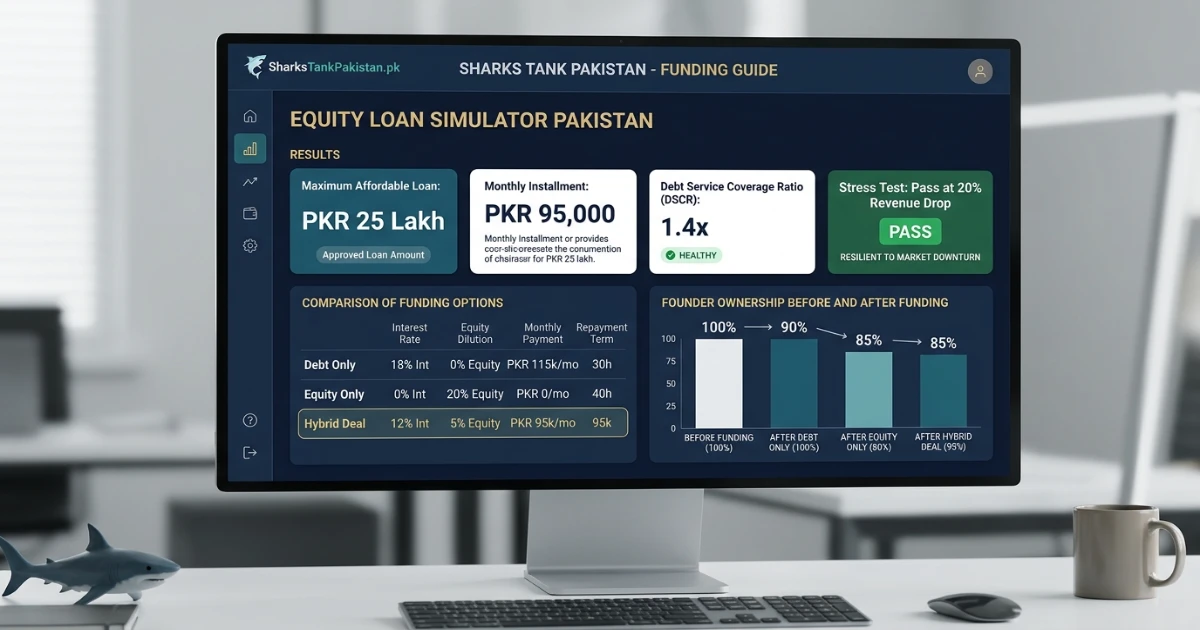
This is the part that impresses investors. The tool lets you stress‑test: what if sales drop 20%, 30%, or 50% for three months? It shows whether you’d still meet the instalment. You’ll see the “debt service coverage ratio” — a fancy term for “can you pay or not?” A ratio below 1.2 is a red flag; below 1.0 means you’re in trouble.
Step 5: Read Your Maximum Affordable Loan
The final output gives you an exact PKR figure — the maximum loan you can afford under normal and stressed conditions — and a recommended equity‑loan mix. It also estimates the total cost of borrowing after interest or profit.
Shark Tank Pakistan data point: In Season 1, roughly 60% of the deals involved some form of debt or convertible instrument. Founders who came in with a precise repayment capacity — not just “we’ll pay from future sales” — walked away with lower equity dilution because the Sharks trusted their numbers.
Situation‑Based Strategies: How Much Loan Makes Sense for You
If You’re Pre‑Revenue but Have a Prototype and Early Interest
Debt is dangerous here. Lenders don’t care about your prototype if there’s no income. The simulator would likely show a very low affordable amount. In this scenario, you’re better off using the calculator to understand what a small, equity‑only raise could look like, or waiting until you have at least a pilot customer. If you must borrow, keep it to a minimum — only what you need to reach a revenue‑generating milestone within six months.
If You’re Generating Consistent Monthly Cash Flow (E‑commerce, D2C, Food)
Now debt can be a smart accelerator. An e‑commerce startup doing PKR 15 lakh a month in revenue with 20% net margins (PKR 3 lakh) might afford a monthly instalment of PKR 90,000–1,00,000, allowing a loan of around PKR 25–30 lakh over three years. Run that through the equity loan simulator Pakistan and you’ll see precisely how much inventory that buys without drowning you.
If You’re a Tech Startup with SaaS or Recurring Revenue
Investors love predictable revenue. You can stretch affordability a bit because churn rates are lower. But the same principle applies: never let monthly debt service exceed 25–30% of recurring revenue. The simulator lets you input your MRR (monthly recurring revenue) and shows the comfortable debt ceiling — often higher than product businesses because of the stability, but still with a buffer.
If You’re Pitching on Shark Tank Pakistan vs. a Private Angel Investor
On the show, Sharks often propose a loan with a royalty or revenue share. The simulator can model that: a loan of PKR 50 lakh at 15% royalty until capital is recouped plus 5% equity. You’ll instantly see the true cost: if your revenue grows fast, the royalty cost might be much higher than simple interest. In private angel deals, you have more flexibility to negotiate pure equity or lower‑interest loans, but the simulator’s logic remains identical — just plug in the terms you’re discussing.
Common Pitfalls & When to Ignore the Simulator’s Recommendation
A tool is only as good as the assumptions you feed it. Pakistani founders often trip here.
- Overestimating revenue stability. Many startups project “hockey stick” growth. The simulator can’t protect you from unrealistic inputs. If you plug in a 40% month‑on‑month growth assumption, the output will show a huge affordable loan — but that’s a fantasy. Always use a flat or slightly declining revenue scenario for your base case.
- Forgetting taxes and one‑off costs. Your monthly net profit must account for tax provisions, equipment replacement, and seasonal dips. The simulator’s default expense fields might miss these if you only include direct costs.
- Ignoring the currency risk. If your revenue is in PKR but your loan is dollar‑linked (some startup loans), a rupee depreciation can make your instalment jump. The simulator can be adjusted by increasing the interest rate to simulate currency stress, but be aware it’s not a forex predictor.
- When the simulator says you can afford PKR 1 crore but your gut says no — listen to your gut. If a loan makes you lose sleep, it’s too big. The tool quantifies risk, but you must also consider psychological and relationship factors, especially if the loan involves family.
Even the best equity loan simulator Pakistan cannot predict the emotional cost of owing money. A PKR 20 lakh manageable loan that keeps you up at night might be worse than a PKR 5 lakh safe option. Use the simulator to find your technical limit, then dial it back by 20% for sanity.
Real‑World Example: The Smartphone Accessories Brand That Almost Sank
Zara, a Shark Tank Pakistan Season 1 applicant, imported mobile accessories. She projected PKR 12 lakh monthly revenue and borrowed PKR 35 lakh from a microfinance institution at 18% over 24 months — a monthly instalment of about PKR 1,75,000. But her actual revenue averaged PKR 9 lakh, and margins were thinner than expected. By month six, she was defaulting. After she re‑ran her numbers through the equity loan simulator Pakistan, it showed she should have borrowed no more than PKR 22 lakh. She restructured her loan, downsized inventory, and eventually stabilised. The simulator gave her the data to negotiate with her lender and avoid bankruptcy. Now she’s pitching again — with a number that actually works.

How to Use the SharkTankPakistan.pk Equity Loan Simulator Right Now
You don’t need to wait until you’re invited to the Den. The tool sits inside the “Calculators” section of the website, free and private. Here’s your quick‑start guide:
- Visit the equity loan simulator Pakistan page on SharkTankPakistan.pk.
- Select your startup stage (pre‑revenue, early revenue, steady revenue).
- Enter your average monthly revenue and total monthly costs.
- Slide the loan term and interest rate to match your lender’s offer (or use defaults).
- Optionally, input an equity percentage to see the hybrid mix.
- Hit “Run Simulation” and review the affordable loan amount, monthly breakdown, and stress test chart.
- Download the PDF report — it’s ready to email to co‑founders or even a Shark.
FAQs About Loan Affordability and Equity Loan Simulators
How much loan can my startup afford in Pakistan?
It depends on your net monthly profit and stability. A safe rule is your monthly instalment should not exceed 30–35% of your average net profit. Use the equity loan simulator Pakistan to run exact numbers with your own data.
What is an equity loan simulator?
It’s a financial tool that calculates the maximum loan amount your business can afford while also modeling the trade‑off with equity. It factors revenue, expenses, interest rate, loan term, and optional equity dilution to give a realistic borrowing limit.
Should startups in Pakistan take debt or equity?
If you have predictable cash flow and want to keep 100% ownership, debt can be a smart growth lever. If you’re pre‑revenue or need mentorship and network access, equity is often better despite dilution. Most Shark Tank deals are hybrids.
How do I calculate loan affordability for my small business?
First, determine your average monthly free cash flow (profit after all costs). Then divide by the monthly instalment factor for your intended loan. The equity loan simulator does this instantly and includes stress scenarios.
What interest rate should I use for a Pakistani startup loan?
For formal bank loans, use KIBOR + 2–5%, typically around 17–22%. For family or angel loans, 0–8%. Microfinance rates hover near 20–25%. Adjust the slider in the simulator to match your reality.
Can I use the equity loan simulator for Shark Tank Pakistan pitches?
Absolutely. It’s designed to mirror the kind of debt‑repayment logic that Sharks use. Many applicants have used it to set a realistic ask and to negotiate terms confidently on air.
Does the simulator consider seasonal businesses?
Yes, you can input variable monthly revenue manually or use the built‑in adjustment slider to simulate a 30% dip in off‑season months and see the impact on loan affordability.
Your Fast‑Track Cheat Sheet: 3 Moves to Make Today
- Gather your real numbers. Open your last six months of books; if you don’t have books, reconstruct them now. You can’t simulate what you don’t measure.
- Run the worst‑case scenario first. In the equity loan simulator Pakistan, drop your revenue by 25% and see if you can still service the loan. That’s the figure a Shark will care about.
- Set your debt ceiling 20% below the simulator’s “affordable” result. Then work to negotiate a loan that’s at or under that ceiling. You’ll have breathing room — and confidence.