Import Duty Calculator Pakistan: Your E‑commerce Startup’s Complete Customs Cost Playbook
Fast Answer: An import duty calculator Pakistan helps you instantly estimate total customs charges — customs duty, additional customs duty, sales tax, and income tax — on goods you import into Pakistan. Use it with the correct HS code and CIF value, and you’ll know your final landed cost before placing an order, avoiding nasty surprises that can kill your e-commerce margins.
You’ve found a brilliant product at a brilliant price. Maybe it’s custom-printed tote bags from China or handcrafted leather wallets from Turkey. The math in your spreadsheet says you’ll net 40% margins selling on Instagram and Daraz. Then the shipment arrives. The customs bill is nearly double what you guessed. Suddenly your profit evaporates. If that sounds familiar — or terrifying — you’re exactly who this guide is for.
On Shark Tank Pakistan, one thing separates confident, deal‑ready founders from the ones who get roasted: rigorous unit economics. When a Shark asks “What’s your landed cost?” you can’t mumble. You need an exact breakdown, taxes included. Our import duty calculator Pakistan (available right here on SharkTankPakistan.pk) turns that complexity into a clear number. This article walks you through everything behind that calculator — the tariffs, the taxes, the tricks, and the real‑world rules of importing for e‑commerce in Pakistan.
Understanding Import Duty in Pakistan: It’s Never Just One Tax
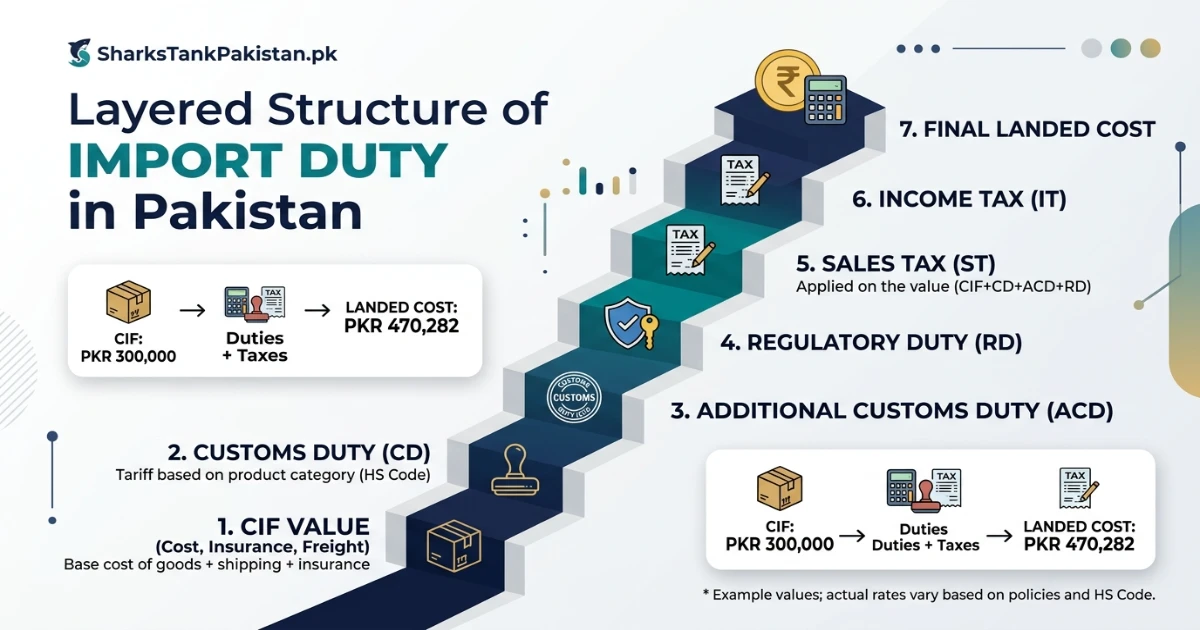
Most first‑time importers assume “duty” means a single customs percentage. In Pakistan, the final customs bill is a layered stack. When you use an import duty calculator Pakistan, it combines these components automatically, but you still need to understand them. Here’s what hits your wallet:
- Customs Duty (CD): The basic tariff based on the HS code. Varies wildly — 3% on some raw materials, 20‑30% on electronics, over 50% on luxury items.
- Additional Customs Duty (ACD): An extra percentage often applied on top of CD.
- Regulatory Duty (RD): Applied on specific goods (e.g., certain garments) to protect local industry. Not always present.
- Sales Tax (GST): Usually 17% in Pakistan, calculated on the sum of assessable value + CD + ACD + RD. This is often the silent budget killer.
- Income Tax (Withholding): Collected at import stage, typically 5.5% for commercial importers (2% for manufacturers). Can be adjusted later, but it impacts cash flow now.
So a SIM‑free mobile phone accessory with a CIF value of PKR 50,000 could attract roughly PKR 10,000 customs duty (20%), then 17% sales tax on the new total, pushing the all‑in cost up by 40‑50%. This is why generic “20% duty” assumptions are dangerous.
Why E‑commerce Startups Can’t Afford to Guess Import Costs
In the Den, the Sharks drill down on margin sustainability. If a founder says “Our product sells for 3,000 rupees and costs 1,200 rupees to import,” they’re about to get questioned on whether that 1,200 includes customs, freight, clearing, and warehousing. I’ve seen pitches where the numbers fall apart the moment an investor asks “and what’s your actual landed cost?”
For e‑commerce, the stakes are even higher because you’re competing on price with hundreds of other sellers. If you underestimate duties by 15%, you’re either losing money on every order or you’ve priced yourself out of the market. An import duty calculator Pakistan gives you certainty — and that certainty makes you investable.
From the Den: Shark Rabeel Warraich once stopped a pitch mid‑sentence and said, “You’re telling me your cost is PKR 800? I know what customs charges on that category. It’s at least PKR 1,050. Update your numbers and come back.” Precision matters.
How to Calculate Import Duty for Your Products (Step by Step)
Here’s the exact workflow our import duty calculator Pakistan follows. Work through this once manually, then let the tool do the heavy lifting forever.
Step 1: Pin Down the HS Code
Every product has a Harmonized System code. For a cotton t‑shirt it might be 6109.10.00; for a Bluetooth earphone, 8518.30.20. The HS code determines your customs duty rate. You can search the Pakistan Customs Tariff on the FBR website or use a third‑party lookup. Get it wrong, and your duty estimate will be wrong — and customs may even seize your goods.
Step 2: Calculate the Assessable Value (CIF)
CIF stands for Cost, Insurance, and Freight. This is the value customs uses. If you paid $1,000 for the goods, $150 for freight, and $20 insurance, your CIF is $1,170. Convert to PKR at the customs exchange rate. Never use the product cost alone.
Step 3: Find the Customs Duty Percentage
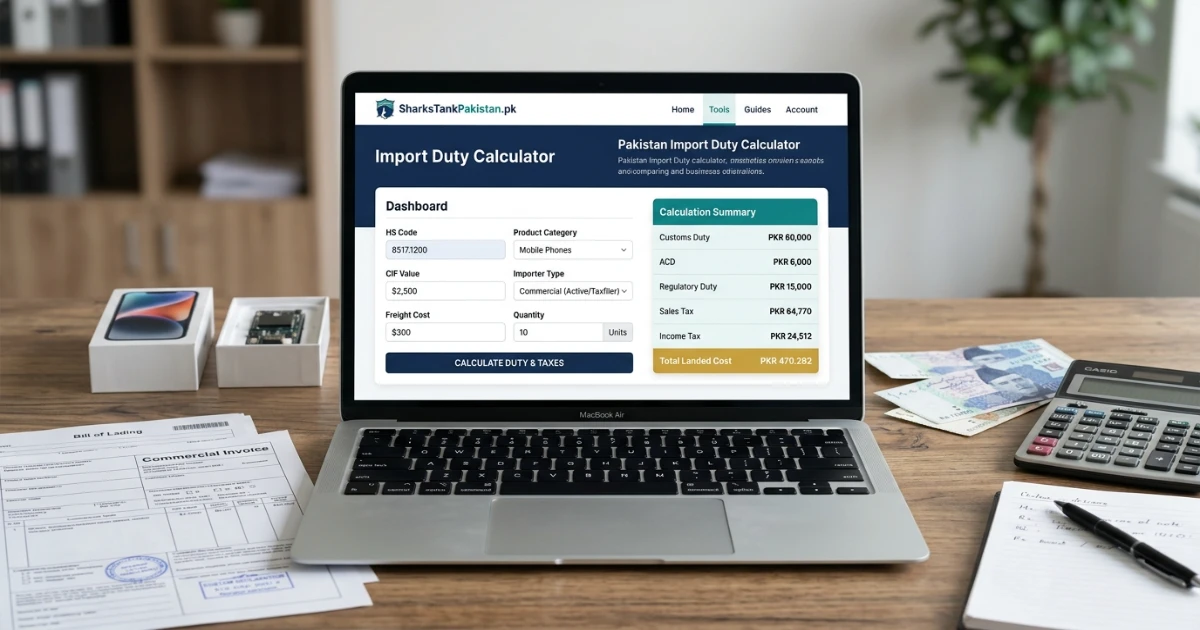
Check the tariff for your HS code. Suppose the CD rate is 20%. On a CIF of PKR 300,000, that’s PKR 60,000.
Step 4: Add Additional Customs Duty and Regulatory Duty
If ACD is 2% and RD is 5% (for a specific category), apply them on the CIF. Now your base duty becomes PKR 60,000 (CD) + PKR 6,000 (ACD) + PKR 15,000 (RD) = PKR 81,000.
Step 5: Apply Sales Tax
Sales tax (GST) is 17% of (CIF + total duties). Here CIF PKR 300,000 + duties PKR 81,000 = PKR 381,000. 17% of that is PKR 64,770.
Step 6: Add Income Tax on Imports
If you’re a commercial importer, income tax is 5.5% of the CIF + duties + sales tax? No, income tax is applied on the total value inclusive of all duties and taxes except income tax itself. Typically it’s on (CIF + CD + ACD + RD + GST) = PKR 445,770 × 5.5% = PKR 24,512.
Step 7: Total Landed Customs Cost
Sum: PKR 81,000 duties + PKR 64,770 sales tax + PKR 24,512 income tax = PKR 170,282. Add to the original CIF, and your landed cost is PKR 470,282 before clearing charges and inland transport. That’s a 57% markup on CIF — quite a jump from “20% duty.”
Comparison: Duty Rates for Popular E‑commerce Product Categories
Not all products are taxed equally. Here’s a realistic snapshot. Always verify with the latest FBR tariff, but this table shows why an import duty calculator Pakistan must be product‑aware.
| Category | Example HS Code | Customs Duty | Typical Additional Duty | Estimated Total Tax Burden* |
|---|---|---|---|---|
| Mobile phone accessories (cases, chargers) | 8504.40.90 | 20% | 2% ACD | ~44‑47% of CIF |
| Cotton apparel (T‑shirts) | 6109.10.00 | 11‑20% | 2% + possible RD | ~32‑45% |
| Leather handbags | 4202.21.00 | 20% | 2% ACD | ~44% |
| Cosmetics (makeup, skincare) | 3304.99.10 | 20‑25% | 2% ACD, plus RD possible | ~48‑52% |
| Home decor (candles, ceramics) | 6911.10.00 | 10‑16% | 2% | ~30‑38% |
| Electronics (Bluetooth speakers) | 8518.22.00 | 20% | 2% | ~44% |
Situation‑Based Adjustments: Your Import Duty Strategy Changes Based on Your E‑commerce Model
One‑size advice fails because the import rules bend depending on how you bring goods in.
If You’re a Small‑Scale Reseller Importing via Courier (DHL, FedEx, UPS)
Personal shipments or low‑value consignments under $100 CIF used to enjoy de minimis benefits, but Pakistan has tightened regulations. Even parcels valued at PKR 5,000 can attract duties now. Always assume duties apply. However, courier clearance often includes simplified declaration with slightly lower processing fees. Use the calculator but set “commercial” if you’re an active seller.
If You’re a Registered Company Importing Commercial Quantities
You’ll most likely be classified as a commercial importer. This means the full 5.5% income tax rate and potential for 6% additional sales tax (if not registered for sales tax). The good news: you can claim input tax adjustments if you’re GST registered. Your calculator must differentiate between filer and non‑filer status — ours does.
If You Dropship (Supplier Ships Directly to Customer in Pakistan)
Then the customer becomes the importer of record. Duties and taxes are collected from the buyer on delivery. This can cause major cart abandonment if surprise charges appear. Be transparent about “customs handling fees may apply” and use a calculator to estimate what your customers might face.
If You Import Inventory for a Private Label Brand and Sell on Daraz
You’re a commercial importer. Plus, Daraz Fulfilment requires exact stock cost data. A miscalculated landed cost means you set the wrong selling price across hundreds of orders. The import duty calculator Pakistan becomes your daily tool for forecasting margin per SKU.
Don’t forget: currency fluctuations matter massively. The CIF in rupees changes between the day you order and the day the goods arrive. Build a 3‑5% buffer into your costing. Shark Tank Pakistan’s investors will spot a rigid pricing plan that doesn’t account for rupee depreciation.
Expert Insight: What the Sharks Would Drill Into About Import Costs
I’ve watched enough pitches to know this pattern: an e‑commerce founder quotes a “per unit cost” that magically leaves out two or three tax lines. When a Shark presses, the founder stumbles, then admits they “used a friend’s customs agent number.” That’s the moment trust evaporates.
Shark Fahd Bangash, a seasoned investor in consumer brands, has said in several episodes (paraphrased): “You don’t need to be a customs expert, but you must know your landed cost to the last rupee. If you don’t, you’re not serious.” The import duty calculator is not a replacement for an expert — but it makes you sound like one in the Den.

Common Pitfalls & When NOT to Follow Generic Import Duty Advice
Even a good calculator can’t fix human error. Here’s where Pakistani e‑commerce founders get tripped up — and when to ignore cookie‑cutter suggestions.
- Misclassification of HS code. “Bags” covers everything from plastic shopping bags (duty 16%) to leather handbags (20%+). If you guess, you risk underpaying and facing penalties. Don’t rely on a competitor’s code. Use the official tariff or a customs consultant.
- Valuation undervaluation. Some traders try to declare a lower CIF to save tax. Customs has valuation databases. If your declared value looks too low, they’ll reassess and impose fines. This is not a sustainable strategy for a startup seeking investment.
- Treating all imports equally. The calculator’s output changes drastically between “commercial importer” and “manufacturer” profiles. If you’re a small‑scale reseller but you tick the manufacturer box in the tool to get a lower income‑tax rate, you’re relying on false assumptions. Use the right status.
- Ignoring freight forwarder and clearance fees. A calculator gives you government duties and taxes. It doesn’t include customs agent fees, warehousing, demurrage, or delivery from port to your warehouse. Those add another 3‑8%.
- When to ignore the calculator’s output: If the product is subject to anti‑dumping duties, temporary surcharges, or specific SRO exemptions that the tool hasn’t been updated for. Always cross‑check with a licensed customs broker for your first complex shipment.
How to Use the SharkTankPakistan.pk Import Duty Calculator
This isn’t a generic tariff lookup. It’s built for the way Pakistani e‑commerce founders think. You’ll find it inside our Tools section.
Step 1: Go to the import duty calculator Pakistan on the site. Step 2: Enter your HS code (or search by product description). Step 3: Input the CIF value in PKR or USD, and select your importer type (commercial, manufacturer, individual). Step 4: The calculator instantly shows customs duty, ACD, regulatory duty, sales tax, income tax, and a total landed duty estimate. Step 5: Download the breakdown as a reference for your business plan or pitch deck.

Real‑World Example: How a Daraz Seller Scaled by Mastering Import Costs
Aamna, running a skincare brand from Lahore, sourced serums from South Korea. Her initial cost estimate used a flat 20% duty guess. After two shipments, actual customs ate 48% of CIF, leaving her cash‑strapped. She switched to our import duty calculator Pakistan, re‑entered correct HS codes, and realized her true landed cost. She then renegotiated her factory price, adjusted her retail pricing, and built a buffer for currency fluctuations. Within six months, her margins stabilized above 35%, and she attracted interest from an angel investor who loved her “tight numbers.”
Her story isn’t unusual. The difference between a struggling e‑commerce startup and a fundable one often comes down to a single spreadsheet cell: landed cost.
FAQs About Import Duty Calculation in Pakistan
How do I calculate import duty in Pakistan?
Find the correct HS code for your product, determine CIF value, check customs duty rate from the FBR tariff, add applicable additional and regulatory duties, then apply 17% sales tax on the total, and finally add income tax (typically 5.5% for commercial importers). Our import duty calculator automates these steps.
What is the duty rate for importing mobile phone accessories from China?
Most mobile accessories carry a 20% customs duty, a 2% additional customs duty, plus 17% sales tax and income tax. Total landed cost markup is typically 44‑47% over CIF. Always verify the latest HS code because some chargers may have different classification.
Do I pay import duty on items bought online for personal use?
Yes, unless the shipment qualifies for a de minimis exemption (very low value, inconsistently applied). In practice, even small parcels via courier attract duties and taxes. Customs assesses duty based on declared value or assessed value if the declaration seems low.
What is the minimum value for duty‑free import in Pakistan?
There is no universal duty‑free minimum in Pakistan for commercial shipments. Small gift parcels under $100 used to face lighter scrutiny, but enforcement has become stricter. For e‑commerce, assume every consignment is dutiable.
How can an e‑commerce startup reduce import duties legally?
Look into temporary import schemes like DTRE if you re‑export, or check if your raw material qualifies for reduced tariffs under a Free Trade Agreement. For finished goods, proper HS classification and accurate valuation are the only safe ways — incorrect coding just delays the cost.
Does Shark Tank Pakistan have episodes about import‑heavy e‑commerce?
Yes, several pitches have involved import‑reliant products — from cosmetics to gadgets. The Sharks consistently ask for landed cost breakdowns. Watching these pitches shows how critical import duty knowledge is to securing investment.
Is there a free import duty calculator for small businesses?
Absolutely. SharkTankPakistan.pk offers a free import duty calculator Pakistan that estimates customs duty, sales tax, and income tax based on your HS code and CIF. It’s designed for e‑commerce startups and is regularly updated with current rates.
Your Fast‑Track Cheat Sheet: 3 Actions to Take Right Now
- Grab the exact HS code for each product you intend to import. Bookmark the FBR tariff page or use a reliable lookup. A wrong code distorts every estimate downstream.
- Run your numbers through the SharkTankPakistan.pk import duty calculator. Don’t settle for a ballpark. See the real total customs hit, then adjust your pricing or sourcing accordingly.
- Build a landed‑cost buffer of at least 5%. Include rupee depreciation, incidental clearance fees, and minor category‑rate changes. When you walk into the Den (or an investor meeting), that buffer shows forward‑thinking discipline.