
How to Invest in Pakistani Startups from Abroad: A Complete Guide for Expats
⚡ The Short Answer: You can absolutely invest in Pakistani startups from abroad — the legal framework exists, the ecosystem is hungry for smart capital, and your diaspora perspective is uniquely valuable. The key is navigating the Roshan Digital Account, structuring your investment correctly through SECP-compliant agreements, and partnering with local networks that help you trust but verify from a distance.
Every month, the Pakistani diaspora sends over $2.5 billion back home in remittances. Most of it goes to families, real estate, or savings accounts. A tiny fraction — barely a trickle — finds its way into the startups that are quietly reshaping the country’s economic future. If you’re a Pakistani expat reading this, you’ve probably thought: “I want to invest back home, but I don’t know how to start, and I’m worried about losing money in a system I’m not physically present in.”
That’s exactly the gap this guide closes. The startup ecosystem you see on Shark Tank Pakistan — the ambitious founders, the sharks fighting over deals, the valuations that sometimes make you raise an eyebrow — is open to you. Not as a spectator, but as an investor. Whether you have $5,000 or $500,000 to deploy, the mechanisms exist. You just need to know which doors to open, in what order, and with what precautions.
We’ll walk through the legal routes, the cultural nuances you’ll navigate from thousands of miles away, the vehicles that protect your capital, and the tools on SharksTankPakistan.pk that help you size up any deal. By the end, you’ll have a clear, actionable roadmap to invest in Pakistani startups from abroad — not as a charity case, but as a serious, return-generating part of your portfolio.

Why Now Is the Moment for Diaspora Startup Investment
The Pakistani startup ecosystem has matured dramatically in the last three years. Annual startup funding crossed $350 million in 2023–24, local venture capital firms are proliferating, and regulatory reforms — like the SECP’s Startup Portal and relaxed foreign investment rules — have made it easier for overseas Pakistanis to invest in Pakistani startups from abroad. Meanwhile, the rupee’s depreciation means your dollars or pounds now stretch significantly further, giving you more equity for less capital.
But beyond the economics, there’s a deeper pull. Many expats carry a sense of wanting to contribute to Pakistan’s development while also building wealth. Startup investing lets you do both. You’re not just wiring money; you’re backing the next generation of Pakistani problem-solvers — the same kind of entrepreneurs you watch pitch on Shark Tank Pakistan, tackling everything from agri-tech in Punjab to fintech in Karachi.
The Trust Bridge: Why Startups Want Diaspora Investors
Founders in Pakistan don’t just want your money; they want your network, your exposure to global markets, and your understanding of customer behaviour in developed economies. A Pakistani expat investor who spent years in Silicon Valley or London’s financial district brings mentoring value that a purely local investor often cannot. This gives you negotiation power — not to exploit, but to structure deals where your contribution beyond capital is recognized and rewarded.
When you invest in Pakistani startups from abroad, you’re not a silent cheque-writer; you’re a strategic bridge, and that role commands respect and, often, favourable terms.
💡 Insider Insight from Shark Tank Pakistan: Several sharks on the panel are themselves expats or have deep overseas experience. They’ve publicly stated that they back founders who understand both local realities and global ambition. When a diaspora investor comes on board, that international validation signal alone can attract further funding. As an expat, your involvement can be the catalyst that de-risks a startup for others.
The Legal Roadmap: Exactly How to Invest in Pakistani Startups from Abroad
This is where most expats freeze. They assume the legal hurdles are insurmountable. They are not. Here’s the step-by-step path, simplified without being simplistic.
Step 1: Open a Roshan Digital Account (RDA)
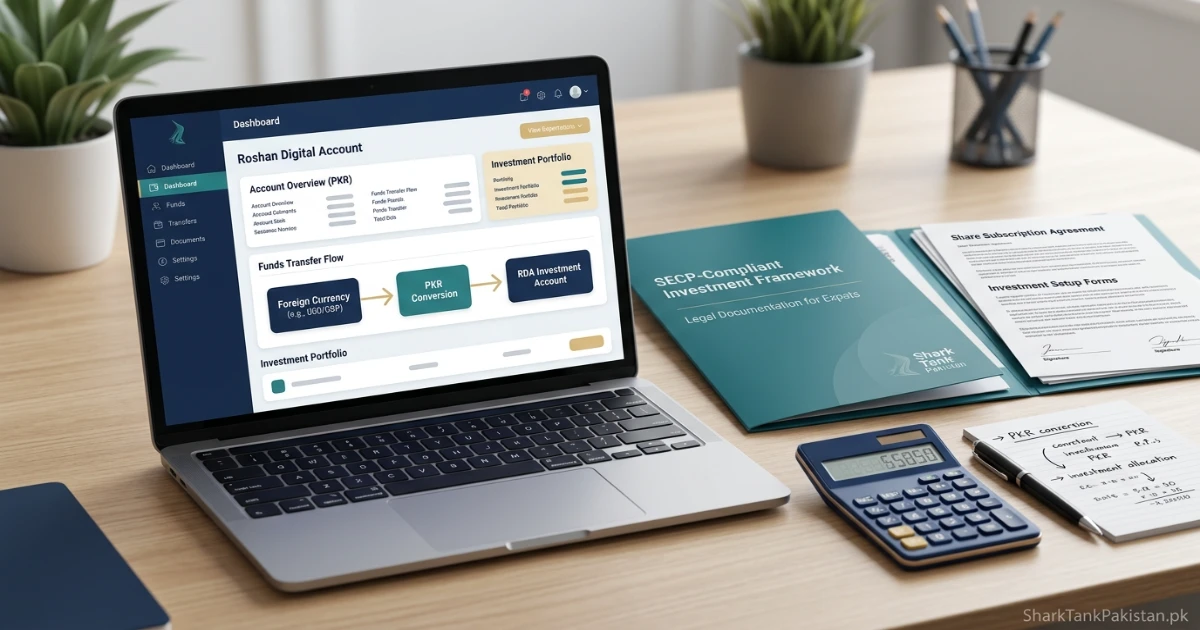
The RDA, launched by the State Bank of Pakistan, allows non-resident Pakistanis to open a bank account entirely online, using their foreign passport and NICOP. You can fund it in USD, GBP, EUR, or other major currencies, and then convert to PKR for domestic investments. Crucially, the RDA can be used to invest in the Pakistani stock market, government bonds, and — through specific provisions — in private companies, including startups, provided the transactions are structured correctly.
Check with your chosen bank about their RDA investment capabilities; HBL, UBL, and Standard Chartered offer the most comprehensive startup-friendly options. This is your primary on-ramp to invest in Pakistani startups from abroad legally and transparently.
Step 2: Choose Your Investment Vehicle
You don’t need to set up a complex offshore entity on day one. Most early-stage investments can be made directly as an individual through a simple Share Subscription Agreement registered with SECP. However, if you’re deploying significant capital (over $100,000) or plan to make multiple investments, consider setting up a single-member private limited company in Pakistan that acts as your holding vehicle. This provides liability protection and simplifies tax filing under Pakistani law.
Consult a local corporate lawyer — ideally one familiar with diaspora investors — before signing anything. The legal fees are modest (typically Rs 50,000–150,000) compared to the protection they offer.
Step 3: Conduct Due Diligence from a Distance
You can’t walk into the startup’s office in Gulberg or Nazimabad to look them in the eye. So you build a trusted local layer: a chartered accountant who can verify financials, a lawyer who checks the cap table and IP assignments, and — ideally — a local angel investor or mentor who can provide an on-the-ground reference. The Pakistani startup community is relatively tight-knit. Founders’ reputations precede them. Asking in local WhatsApp groups, LinkedIn communities, or through platforms like PakLaunch and Invest2Innovate can surface information you’d never get from a pitch deck.
This is where your cultural intuition as an overseas Pakistani becomes a superpower: you know when someone is being genuine versus when they’re giving you the “diaspora treatment” — all charm and no substance.
Step 4: Structure Your Terms Using SharkTankPakistan.pk Calculators
Before you negotiate valuation, open the Startup Valuation Calculator. Plug in the startup’s revenue, growth rate, and comparable multiples. This gives you a data-driven baseline. Then use the Equity vs Loan Calculator to decide whether you want equity, a convertible note, or a SAFE-like instrument. Many diaspora investors prefer convertible notes: they delay valuation, provide downside protection, and convert at a discount when the startup raises its next round. Whatever you choose, ensure your terms are documented in an SECP-compliant agreement. A handshake won’t hold up in a Pakistani court if things go wrong.
| Investment Route | Best For | Complexity | Key Requirement |
|---|---|---|---|
| Direct Equity via RDA | $5k–$100k, one-off investments | Low-Medium | Roshan Digital Account, NICOP, Share Subscription Agreement |
| Convertible Note / SAFE | $15k–$250k, early-stage with high growth uncertainty | Medium | Legal counsel experienced in international convertible instruments |
| Pakistani Holding Company | $100k+, portfolio approach | Medium-High | Local company registration, tax filing, nominee director |
| Local Angel Syndicate | $1k–$50k, passive, diversified | Low | Membership in a syndicate platform like PakLaunch or an informal group |
| Venture Capital Fund | $50k+, institutional-quality deals | Low | Accreditation proof, lock-up period acceptance |
Situation-Based Adjustments: Tailoring Your Approach
If You Have a Small Amount to Invest ($2,000–$10,000)
Don’t try to lead a round. Instead, join a local angel syndicate or invest alongside an experienced local lead. This way, you benefit from their due diligence, and your capital is pooled for meaningful impact. Your value add here is often not the money itself but the global perspective you offer the startup. Negotiate for advisory shares or a small equity stake in exchange for mentorship and international introductions. Many early-stage startups in Pakistan value this far more than a slightly larger cheque from a silent source.
If You Have Significant Capital ($100,000+)
You can lead rounds and negotiate board observer or director seats. Use your status as an expat investor to request transparent, structured reporting — monthly financials, OKR tracking, and quarterly video calls. This protects you from the “out of sight, out of mind” risk. Also, consider earmarking part of your investment for legal and accounting support for the startup itself — a grant-like component that ensures they build clean financial foundations. This aligns incentives and protects your capital.
If You Want a Mostly Passive Role
Consider investing in a local venture capital fund that focuses on Pakistan. Funds like Indus Valley Capital, Sarmayacar, or Zayn Capital accept diaspora LPs. You’ll receive regular reports, and the fund manager handles all due diligence and monitoring. This is the lowest-hassle route, though you sacrifice the direct connection and potential for outsized returns through personal involvement.
Common Pitfalls & When to Ignore This Advice
Pitfall 1: Expecting Western-Level Corporate Governance Immediately. Many Pakistani startups are run by brilliant, passionate founders who have never maintained formal board minutes or audited financials. If you invest, you may need to fund the transition to professional governance rather than demanding it as a condition. Be patient but firm. Set a timeline — within six months, we’ll have quarterly board meetings — and tie a portion of your investment to achieving those milestones.
Pitfall 2: Ignoring Family Dynamics. A startup that appears to be a tech company might actually be an extension of a family business with unspoken obligations and complex ownership structures. Ask directly about family involvement. If the founder’s cousin is the unregistered CTO and the father holds the office lease, untangling those knots later can become a nightmare. Your cultural understanding as a Pakistani helps you ask these questions respectfully but thoroughly.
Pitfall 3: Over-Relying on One Relationship. Because you’re abroad, you might anchor on the first local contact who offers to “handle everything.” Verify everything independently. Use multiple references. The Pakistani business culture is relationship-based, which can be a strength, but it also means a single broken relationship can isolate you from information. Build a network of at least three local contacts — a lawyer, an accountant, and a fellow investor — who don’t all know each other.
When to Ignore This Entire Framework: If you already have a co-founder or partner living in Pakistan who is operationally involved, many of the distance-related safeguards can be relaxed. You might invest through a joint holding structure or even a simple partnership, leaning on their local presence for verification. Similarly, if the startup is run by a trusted family member, formal legal structures can be streamlined — though never entirely skipped. Also, if you’re investing only a small, disposable amount as a gesture of support, the formal vehicles may be overkill; a clear, simple agreement may suffice. Use judgment.

How SharkTankPakistan.pk Tools Help You Invest Smarter
The calculators on this site exist precisely because valuation is where most cross-border deals break down. A founder may quote a valuation based on what they saw on Shark Tank Pakistan, while you may be anchored to tech multiples in your country of residence. The Startup Valuation Calculator bridges that gap. It uses revenue multiples common in Pakistani startup sectors — edtech, fintech, logistics, health — and spits out a range that reflects local reality, not Silicon Valley fantasy.
Similarly, the Equity vs Loan Calculator lets you model what your return looks like under different structures. Should you take equity directly, or offer a convertible note with a 20% discount? The calculator shows you the dilution impact and payoff scenarios. For expats, this is invaluable because your tax situation may make one structure significantly more advantageous than another — and the calculator lets you run those numbers before you pay a lawyer to draft documents.
🧠 Try It Yourself: Identify a startup you’re considering. Run its projected numbers through the Valuation Calculator. Does the ask match the output? If not, you have the basis for a respectful, data-backed renegotiation — and you’ll sound like someone who knows what they’re doing, not someone guessing from abroad.

A Real-World Example: From Dubai to DHA
Consider “Tariq,” a Pakistani IT professional in Dubai. He had saved $40,000 and wanted to invest it in a Pakistani agri-tech startup he’d seen pitch on Shark Tank Pakistan. The startup — a cold-chain logistics platform for mango exports — was raising a seed round. Tariq opened a Roshan Digital Account with HBL, transferred $10,000 as his initial commitment, and used a Karachi-based lawyer to structure a convertible note with a 22% discount.
He also joined the startup’s advisory board, offering his UAE logistics connections. Within 18 months, the startup raised a Series A at a $4 million valuation, and Tariq’s note converted at a significant discount, giving him equity worth roughly 2.3x his original investment — and a front-row seat to a business that was transforming the mango export supply chain. His story is not unusual; it’s replicable, and it’s the template this guide is built on.
❓ Frequently Asked Questions About Investing in Pakistani Startups from Abroad
Can I really invest in Pakistani startups from abroad using a Roshan Digital Account?
Yes, provided the startup is registered with SECP and the transaction is structured as an equity investment or a formal loan. You’ll need a Share Subscription Agreement or convertible note documentation. Consult your RDA bank about their specific process for routing funds to a private company.
What’s the minimum amount I need to invest in a Pakistani startup?
There’s no legal minimum, but practically, startups looking for angel investment typically accept cheques starting from $2,000–$5,000. For smaller amounts, joining a syndicate is more efficient. Always ensure the legal costs of documentation don’t consume a large percentage of your investment.
Are there tax benefits for diaspora investors in Pakistan?
Yes. Pakistan has double taxation agreements with many countries, including the UK, Canada, and UAE, meaning you can claim foreign tax credits. Additionally, startup investments held for more than two years may qualify for reduced capital gains tax rates under current SECP regulations. Consult a cross-border tax specialist.
How do I find trustworthy startups to invest in from overseas?
Start with platforms like Invest2Innovate, PakLaunch, and local angel networks. Attend Pakistani startup demo days virtually. Also, follow Shark Tank Pakistan pitches and reach out to sharks’ portfolio companies — they often welcome diaspora investors who add strategic value.
Do I need to visit Pakistan to close an investment deal?
No. Most legal documents can be signed digitally and notarized remotely. However, building genuine trust with the founder is much easier with at least one in-person meeting. If you can visit once, do it. If not, invest in longer, more frequent video calls to establish rapport.
What currency risks should I consider when investing in Pakistani startups?
Your investment will likely be in PKR, and your returns, if any, will be in PKR. If the rupee depreciates significantly against your home currency, your returns could be eroded. Some sophisticated deals include currency adjustment clauses, but most early-stage investments do not. Factor this into your expected return calculations.
How does the SECP regulate foreign individual investors in startups?
SECP treats foreign individual investors — including non-resident Pakistanis — similarly to domestic individuals for most equity investments, provided the investment is made through proper banking channels and documented correctly. There’s no general restriction on foreign ownership of Pakistani private companies, but certain sectors (defence, broadcasting) require additional approvals. Always check sector-specific rules.
Can I invest in a startup that appeared on Shark Tank Pakistan but didn’t get a deal?
Absolutely. Many startups that appear on the show leave without a deal but still have strong potential. The show gives them visibility, and they often become more open to smaller, diaspora-led investments afterward. Reach out via their official contact channels — they’re usually eager to talk.
🚀 Your Fast-Track Cheat Sheet: Top 3 Actions to Take
- Open a Roshan Digital Account this week. Even if you don’t invest immediately, having the account ready removes the biggest logistical hurdle. Choose a bank with strong investment services and a dedicated diaspora support team.
- Join two or three Pakistani startup networks from abroad. Start with online groups like Pakistan Startup Network on LinkedIn, subscribe to newsletters from Invest2Innovate and PakLaunch, and set Google Alerts for “Pakistani startup raises seed” to spot opportunities early.
- Use the SharkTankPakistan.pk Valuation Calculator before every discussion. When a founder quotes a valuation, run it through the tool. This single habit will prevent you from overpaying and give you the confidence to negotiate from a position of local-market knowledge.