
The Psychology of Persuasion in a Pakistani Business Context
⚡ The Short Answer: Persuasion in business Pakistan is built on trust-before-transaction logic. While Western frameworks like Cialdini’s principles still apply, they work only when layered with collectivist relationship norms, respect for hierarchy, and indirect communication patterns that honour ‘izzat’ (honour) and interpersonal harmony. The most persuasive Pakistani founders don’t just present data — they make investors feel like partners in a shared journey.
Walk into a pitch meeting in Karachi with a perfect 20-slide deck, precise financial projections, and a Harvard-honed delivery, and you might still walk out empty-handed. The missing ingredient? You probably forgot to have chai first, ask about the investor’s family, and let the relationship breathe before the ask. That’s not inefficiency — it’s the operating system of persuasion in business Pakistan, and getting it wrong costs founders deals, partnerships, and influence every single week.
On Shark Tank Pakistan, you’ll see this dynamic play out in real time. Some pitchers step into the tank and immediately connect — the sharks lean forward, the conversation softens, and suddenly a “no” becomes a “tell me more.” Others rattle off impressive numbers but never generate heat. The difference isn’t always about the business. It’s often about how well the founder understands the psychological levers that actually move people in a Pakistani cultural setting.
This guide unpacks exactly that — the persuasion principles that work on the ground, how to adapt them for different audiences (sharks, angel investors, corporate buyers, even your own team), and the mistakes that even experienced entrepreneurs keep making. If you’re preparing a pitch, negotiating a funding round, or simply trying to become more influential in Pakistan’s business ecosystem, this is the deep-dive you need.
Why Persuasion Works Differently in Pakistan (And Why Most Imported Advice Fails)
Before we dissect techniques, we have to answer the uncomfortable question: why do the persuasion playbooks that work so cleanly in Silicon Valley or London stumble so often in Lahore, Islamabad, or Faisalabad?
The short answer is that Pakistan is a high-context, collectivist business culture where the relationship is the message. In low-context cultures (US, Germany, Scandinavia), persuasion is largely informational — get the facts right, structure your argument logically, and a rational actor will say yes. In Pakistan, the same facts can be received completely differently depending on who delivers them, how long you’ve known each other, whether the approach respects the invisible status hierarchies in the room, and whether you’ve invested in the right “third-party references” (a cousin of a friend, a mutual contact’s endorsement) that signal you belong.
This isn’t a flaw. It’s a system that evolved to manage risk in an environment where formal legal contracts are often slower and less trusted than personal guarantees. When a shark on Shark Tank Pakistan says, “I like you, but I don’t like your valuation,” they’re not joking — the “I like you” part is often 60% of the persuasion battle already won.

Moreover, the concept of ‘izzat’ — honour, reputation, face — runs through every business conversation. A persuasion attempt that publicly challenges someone’s expertise, dismisses their concerns bluntly, or ignores the contributions of senior figures in the room may win the logical argument but lose the relationship permanently. Skilled Pakistani business persuaders know how to disagree without humiliating, and how to frame an ask so that saying “yes” enhances the other person’s standing, not diminishes it.
The Core Persuasion Frameworks — Reframed for Pakistani Business Realities
Robert Cialdini’s six principles of influence — reciprocity, commitment and consistency, social proof, authority, liking, and scarcity — remain some of the most researched tools in persuasion psychology. But applying them in Pakistan requires translation, not transplantation. Here’s how each principle shifts:
1. Reciprocity: Give Before You Ask, But Give Relationally
In Western contexts, reciprocity often shows up as free samples, complimentary reports, or a helpful favour. In Pakistan, the most powerful reciprocity is relational: making an introduction to someone valuable in your network, showing genuine care for the investor’s family or personal interests, offering a market insight that helps them even outside this deal. When a founder sends a shark a relevant industry article with a note saying, “Thought this might interest you given your textile portfolio,” weeks before the pitch, that deposit earns attention later.
2. Social Proof: Leverage Community, Not Just Celebrities
Showing that “5000 customers love our product” is standard social proof. But in Pakistan, the proof that moves the needle is often narrower and deeper: “Three uncles from the Lahore Chamber already backed us,” or “Such-and-such well-known business family introduced us to you.” The social proof that matters is community-based, reference-heavy, and signals that you’re already vetted by people the decision-maker respects.
3. Authority: Credentials Plus Character
Degrees and certifications count, but they’re not enough. Authority in Pakistan blends formal expertise with perceived character — age, family background, piety, humility. A young founder who speaks respectfully about their mentors and shows they’ve “done their time” in the industry earns authority faster than one who just flashes a foreign MBA. The smartest founders narrate their expertise through stories of struggle and perseverance, which resonates deeply.
4. Consistency: Align with Values, Not Just Numbers
Getting someone to commit to small “yeses” builds momentum. But in Pakistan, those small commitments are often value-based: “As you care about creating jobs for youth, here’s how our platform will employ 200 university graduates in the first year.” Tie your ask to something the investor already believes about themselves, and consistency pressures them to act in line with that identity.
5. Liking: Similarity and Familiarity Trump Everything
We say yes to people we like. And in Pakistan, liking is accelerated by perceived similarity — same city, same alma mater, same business community, same cricket team, even similar family structures. Savvy founders subtly uncover these commonalities before the big meeting. They don’t fake it; they genuinely seek genuine overlaps. And they never underestimate the power of “light conversation” that reveals shared ground.
6. Scarcity: Use Genuine Opportunity Scarcity, Not Fake Deadlines
“This offer expires Friday” works poorly in a market where everyone has seen that trick. But genuine scarcity — “We’re closing a round with another investor next week, and we’d prefer you to be part of it, but the seat is limited” — works when the founder can back it up with quiet confidence, not desperation. The key is to make the scarcity about the unique fit, not just a countdown clock.
💡 Insider Insight from Shark Tank Pakistan: Several sharks have privately noted that the pitches that win them over aren’t always the highest-revenue businesses — they’re the ones where the founder made them feel like they were being invited into a trusted inner circle. That sense of “we’re going to build this together, and I specifically want your wisdom, not just your cheque” activates a blend of liking, reciprocity, and consistency that pure financial projections never touch.

Western vs. Pakistani Persuasion: A Comparison Table
| Persuasion Dimension | Western Norm | Pakistani Adaptation |
|---|---|---|
| Opening Approach | State the purpose immediately; “let’s get down to business” | Warm greeting, inquire about well-being, family, shared connections; business introduced gradually |
| Use of Data | Data leads the argument; logic-first | Data supports the argument after trust is established; relationship-first, then numbers |
| Handling Disagreement | Direct contradiction is acceptable if fact-based | Disagreement is softened (“With respect, there’s another perspective…”) to preserve ‘izzat’ and harmony |
| Decision-Making Style | Individual, often rapid | Often consultative; the visible decision-maker may need to confer with family elders or partners off-stage |
| Scarcity Tactics | Time-bound offers, limited stock | Relationship-bound exclusivity (“We’re only taking one strategic partner, and we want it to be you”) |
| Follow-Up | Email, formal updates | WhatsApp voice notes, informal check-ins, remembering personal milestones (Eid, weddings) |
Persuasion Inside the Shark Tank Pakistan Tank: What the Cameras Don’t Always Show
When you watch Shark Tank Pakistan, you’re seeing an edited version of a pitch that originally ran 45–60 minutes. What gets cut? Often, it’s the 10 minutes of rapport-building, the shark who asks about the founder’s background, the moments where persuasion psychology is doing its heaviest lifting.
From multiple post-pitch interviews and observations, several patterns emerge about what works in the tank:
- Founders who acknowledge a shark’s expertise before countering an objection get further. “Sir, you’ve built one of the largest retail chains in Pakistan, so I completely understand why you see the distribution challenge. Here’s how we solved it differently…” This combination of authority-flattery and confident redirection lands better than defensive rebuttals.
- Storytelling about the problem, not just the product, creates emotional investment. When a founder talks about watching their mother struggle with X, or growing up in a small town where Y was missing, the sharks’ persuasion resistance drops because the ask becomes personal, not commercial.
- Physical presence and non-verbal cues matter enormously. Maintaining eye contact without aggression, open palm gestures that signal honesty, and a calm voice even under pressure all trigger deep-seated trust responses that Pakistani business people, including the sharks, are culturally attuned to read.
🧠 Why This Works: Pakistani culture places a high premium on adab (respectful conduct) and tarbiyat (upbringing). A founder whose non-verbals signal “I respect your position and I’m not here to challenge your dignity” activates the persuasion principle of liking at a visceral level. It’s not about being submissive; it’s about being situationally intelligent. The sharks have publicly acknowledged that they sometimes invest in a founder they like even when the business is raw, because the person is persuadable and coachable — which is itself a persuasion win.
Situation-Based Adjustments: How Your Persuasion Approach Must Change
The persuasion style that works on a Shark Tank Pakistan set won’t work in a formal corporate boardroom, and the style that wins over a Karachi angel investor might fall flat with a Peshawar-based family business patriarch. Here’s how to calibrate:
If you’re pitching to sharks or national-level investors…
These individuals see hundreds of pitches. They’ve developed immunity to standard persuasion tricks. What still works: vulnerability combined with quiet competence. Admit what you don’t know, but demonstrate mastery of what you do. Show that you’ve deeply prepared, then use the Startup Valuation Calculator to ground your ask in numbers that don’t feel plucked from the air. The shark’s trust increases when the valuation feels defensible, not aspirational.
If you’re persuading a private angel investor in your network…
This person already knows you or knows someone who knows you. The persuasion task is about deepening, not creating, trust. Don’t oversell — it will feel transactional. Instead, position the investment as a partnership where they bring more than money (connections, wisdom, market access). The reciprocity principle here is: “I value what only you can offer.” Mention that their name on your cap table will attract other investors — that’s a social proof gift you’re giving them.
If you’re persuading corporate clients or B2B buyers…
Corporate Pakistan, especially in traditional sectors (textiles, manufacturing, commodities), still runs on long-standing relationships and third-party endorsements. A cold approach using a sleek sales deck rarely works. Instead, get a mutual contact to make the introduction, reference shared business values (“Like your company, we believe in long-term supplier relationships”), and prove your reliability with small, low-risk engagements before asking for large commitments. This is consistency and trust-building in slow motion, but it’s the only tempo that works here.
If you’re persuading your own team or co-founders…
Persuasion with people who share your daily reality requires a different toolkit. Pakistani employees and partners respond strongly to dignity and inclusion. Frame decisions as collective wins, use “we” more than “I”, and when you need to push for something difficult, anchor it in a shared mission that goes beyond profit — building something for Pakistan, creating opportunities, making a name that families can be proud of. This taps into the deep collectivist motivation that salary alone can’t unlock.
Common Pitfalls & When to Deliberately Ignore “Best Practices”
Even the most sophisticated entrepreneurs stumble on predictable persuasion landmines in Pakistan. Here are the big ones — and the specific situations where the standard advice should be thrown out entirely.
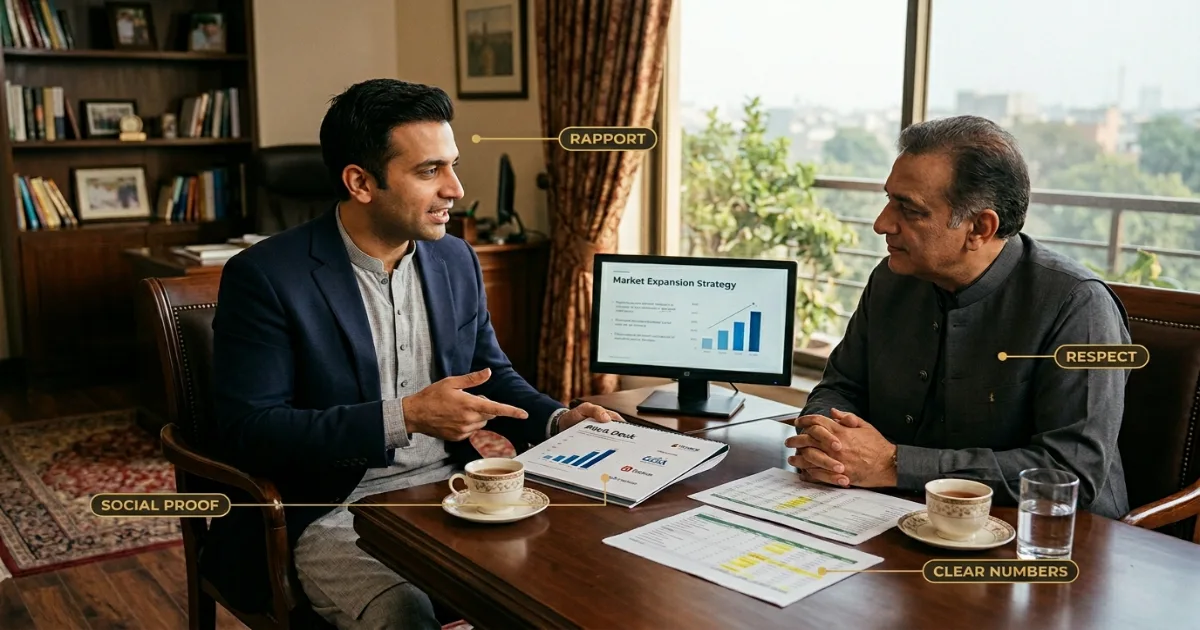
Pitfall 1: Leading with data before building rapport. Nothing kills persuasion faster in Pakistan than diving into charts and graphs before the other person feels seen as a human being. The fix is simple: invest the first 5–10 minutes in genuine human connection. If you’re in a hurry, you’re in the wrong meeting.
Pitfall 2: Overpromising to create excitement. In a culture where a person’s word is their bond, overselling and underdelivering damages your reputation in ways that take years to repair. Persuasion through authenticity — including soberly admitting risks — often builds more trust than relentless positivity. The sharks on Shark Tank Pakistan repeatedly say they respect founders who are realistic about their challenges.
Pitfall 3: Neglecting the ‘reference chain’. A pitch from a stranger is a cold call. A pitch from a stranger who was introduced by someone the investor trusts is a warm opportunity. In Pakistan, the reference chain is a fundamental persuasion infrastructure. Founders who ignore it and go direct often face an invisible wall.
Pitfall 4: Using scarcity without proof. If you hint that other investors are circling but can’t name them or the investor senses bluff, your credibility tanks. Scarcity must be real, subtle, and conveyed almost reluctantly. “I don’t want to pressure you, but I owe the other group an answer by Tuesday” works; “this deal is going fast” doesn’t.
📊 Data Point: In a small survey of Pakistani angel investors, 78% said the single biggest persuasion failure in pitches was “the founder talked too much about the business and too little about why they were the right person to run it.” The person, not the product, is often the deal-maker or deal-breaker. Your character is your main persuasion asset.
When to ignore “always be closing” advice: The pressure to close quickly, common in Western sales training, can backfire spectacularly in Pakistan. If you’re dealing with a family-run conglomerate or an investor whose decision process involves elders, pushing for a fast yes is seen as disrespectful. In those situations, the most persuasive move is to make it easy for them to take their time — “I know you need to discuss this with your family; I’m happy to wait” — which paradoxically accelerates a positive decision because it communicates respect for their world.
When to be direct despite cultural norms: There are moments — especially with sharks who have explicitly asked for clarity or when negotiating critical deal terms — where indirectness can hurt you. If a shark says, “Tell me honestly, can you scale this without me?” and you give a roundabout answer, you lose respect. In that specific high-stakes setting, calibrated directness signals confidence. The art is knowing when the relationship is solid enough to bear a direct message.
How to Use SharkTankPakistan.pk Tools to Strengthen Your Persuasion
Persuasion isn’t just about words — it’s about the credibility that comes from preparation. When a founder on Shark Tank Pakistan can say, “I used the SharksTankPakistan.pk Valuation Calculator to arrive at this number,” or “According to the Equity-Loan Calculator, this structure gives you a 20% IRR,” something shifts in the room. The ask stops being opinion and starts being analysis.
Here’s how to integrate the site’s tools into your persuasion playbook:
- Valuation Calculator: Before any investor conversation, run your numbers. Come with a valuation you can explain and defend, not a number you “feel” is right. Investors respect founders who respect their own numbers enough to stress-test them. Try the Startup Valuation Calculator.
- Equity-Loan Calculator: When proposing a blended deal structure (equity plus a convertible note, for instance), show the investor the impact on their returns using clear visual outputs. This isn’t just math — it’s persuasive because it removes ambiguity and fear, two deal-killers.
- Pitch Preparation Resources: The site’s guides on how to apply to Shark Tank Pakistan and what makes a great pitch give you a structural backbone that frees you to focus on the human connection during the actual conversation.
The calculators and frameworks aren’t just homework. They’re persuasion tools — they signal that you’re systematic, serious, and respectful of the investor’s need to see a logical basis for the ask. In a culture where the relationship opens the door but the details close the deal, that matters.
A Composite Real-World Example: How a Lahore-Based Founder Persuaded a Shark
Consider a composite example drawn from multiple real pitches and post-show analyses. A Lahore-based founder — let’s call him Ali — entered the tank with a modest edtech startup. His revenue was only PKR 1.2 crore annually, and his ask was PKR 5 crore for 10% equity. On paper, the numbers were borderline. But Ali walked out with a deal, and here’s why.
First, he didn’t start with the numbers. He told a 90-second story about a student in a rural Punjab village who used his app to pass exams her parents thought she’d fail. The sharks leaned in. Then, when he introduced his revenue slide, he said, “I know this number isn’t huge yet, but let me walk you through our retention data and what happens when we put PKR 1 into marketing.” He handed the sharks a printed sheet — not just slides — with unit economics they could hold and scrutinize. That tangible gesture signalled transparency.
When one shark challenged his valuation, Ali didn’t argue. He said, “I understand why it feels high. I ran the same calculation on the SharksTankPakistan.pk Valuation Calculator using three different methods, and this is the middle estimate. If you see a gap, I’m open to hearing which method you’d weight differently.” The shark’s posture shifted from critic to collaborator. They negotiated, and a deal closed at PKR 3.5 crore for 12% — a structure that Ali had already modelled and knew he could accept.
Persuasion won because Ali prepared the numbers deeply, but more importantly, he respected the sharks’ intelligence, triggered emotional connection first, and made the negotiation feel like joint problem-solving. That’s the playbook.

Frequently Asked Questions About Persuasion in Business Pakistan
- What is the biggest persuasion mistake Pakistani founders make when pitching?
- Starting with numbers before building any personal connection. In Pakistan’s business culture, a pitch that skips warm rapport feels transactional and cold. Spend even five minutes on genuine human connection — it changes how the entire data presentation lands afterward.
- How do you persuade someone who has more power or status than you in Pakistan?
- Respect their status openly. Acknowledge their experience before offering a different viewpoint. Use phrases like “With your experience, you’ve probably seen this, but our data suggests…” This preserves their izzat while introducing your perspective. Never challenge seniority directly — reframe as collaborative insight.
- Are Western persuasion books like Cialdini’s ‘Influence’ useful in Pakistan?
- Yes, but only when culturally translated. The principles hold — reciprocity, social proof, scarcity — but the expression must be adapted. Reciprocity might mean making a personal introduction instead of giving a free trial; social proof relies on community references, not anonymous reviews. Read the principles, then run them through a local lens.
- How important is storytelling compared to data in Pakistani business persuasion?
- Critically important. A story that illustrates the problem emotionally will almost always make the data feel more meaningful when it arrives. On Shark Tank Pakistan, the most successful pitches almost always include a personal narrative that humanizes the founder before the financials appear. Data alone rarely seals a deal.
- What role does family reputation play in persuasion?
- Substantial. In many Pakistani business circles, your family name or your association with known business families acts as an instant credential. If you lack that, build credibility through other trusted community references or by demonstrating exceptional character over time. Reputation isn’t everything, but it’s an immediate trust shortcut.
- How do you handle a ‘no’ gracefully in Pakistan while keeping the door open?
- Thank the person sincerely for their time and insight. Don’t show frustration. Later, send a thoughtful follow-up (a relevant article, a festival greeting) that maintains warmth without immediately re-pitching. In many cases, a respectful exit today becomes a warmer reception six months later.
- Does using Urdu or English matter in a persuasive business pitch?
- Code-switching between Urdu and English, when done naturally, can increase persuasion. Urdu often conveys warmth, emotion, and cultural authenticity, while English can add precision and global competence. The most effective persuaders blend both based on the audience and the moment — never forcing either.
- How can the SharksTankPakistan.pk Valuation Calculator help with persuasion?
- It moves your ask from “I think I’m worth this” to “Here’s the objective methodology that produced this number.” In a persuasion context, that shift reduces the investor’s perceived risk and makes negotiation feel like a shared analysis rather than a contest of wills. Run your numbers through the calculator before any funding conversation.
📋 Your Fast-Track Cheat Sheet: Top 3 Persuasion Actions to Take
- Map the relationship before you map the deal. Identify who the decision-maker trusts, what shared connections exist, and what matters to them personally. In Pakistan’s business environment, persuasion is relational infrastructure first, content second. Never walk into a high-stakes meeting without this map.
- Lead with story, support with data, close with collaboration. Open emotionally, present your evidence once rapport is established, and frame the ask as an invitation to build something together. This sequence works because it aligns with the cultural script of trust before transaction.
- Use the calculators and tools on this site to turn your persuasion from art into evidence. When you can back your valuation with a methodology the investor can inspect, you’re no longer selling — you’re problem-solving together. That subtle shift is often the difference between a polite ‘no’ and a signed deal.