Venture Capital in Pakistan 2026: Which VCs Are Actively Funding?
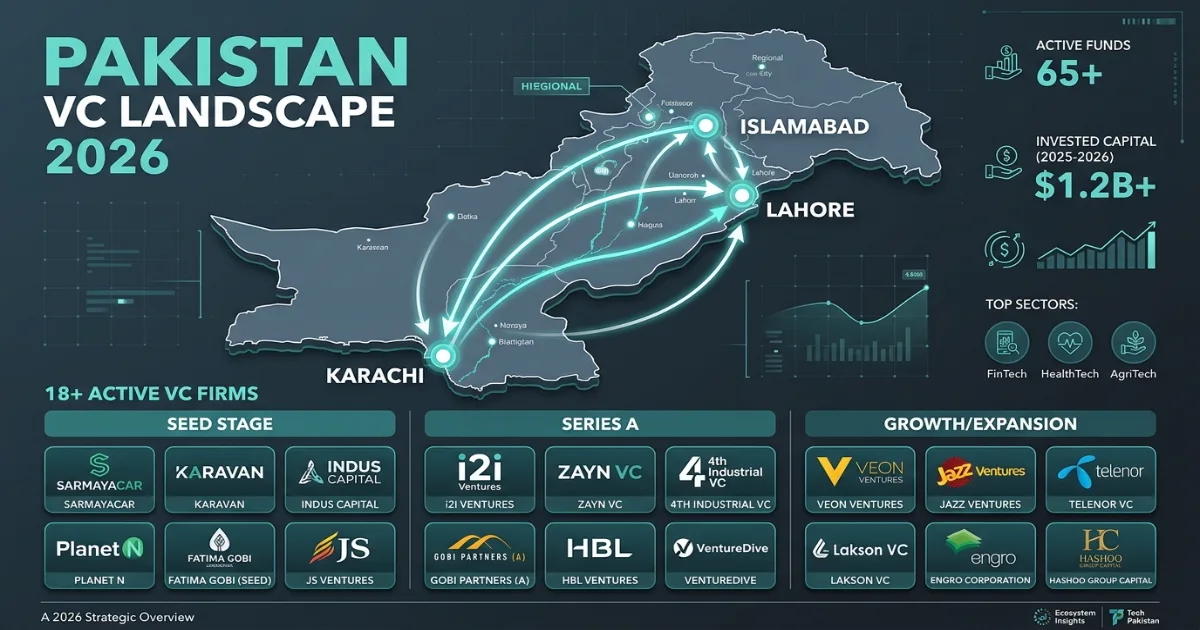
The Short Answer: As of 2026, roughly 18–22 venture capital firms are actively deploying capital in Pakistan, with Sarmayacar, Zayn Capital, i2i Ventures, Indus Valley Capital, and Lakson Investments Venture Capital leading the charge. Most activity concentrates on fintech, agritech, climate-tech, logistics, and B2B SaaS. If you’re a Pakistani founder seeking institutional funding right now, the window is open — but VCs have grown far more selective since the 2021–22 peak. They want traction, not just narrative.
Three years ago, Pakistani startups were breaking funding records every quarter. Then came the global reset. Valuations corrected. A wave of early-stage companies folded. The tourists left. What remains in 2026 is a smaller, sharper, and — arguably — healthier venture capital ecosystem. If you’re searching for venture capital firms Pakistan that are genuinely writing cheques today (not just updating their LinkedIn banners), this guide is for you.
I’ve spent the last five years tracking funding rounds, talking to founders post-pitch, and watching how Shark Tank Pakistan has reshaped the early-stage funding conversation in this country. The VC landscape in Pakistan has matured considerably. The cheque sizes are different now. The diligence is tougher. And the firms that survived the correction have real conviction — which is exactly what serious founders should want.
Why the VC Question Matters More Than Ever for Pakistani Founders
Let’s rewind briefly. Between 2019 and 2022, Pakistan saw a surge of international interest. SoftBank Vision Fund scouts were visiting Karachi. Global accelerators were parachuting in. Local funds multiplied. Then interest rates climbed, LPs pulled back, and the global venture market contracted. By mid-2023, many funds that had announced Pakistan-focused allocations quietly paused deployment.
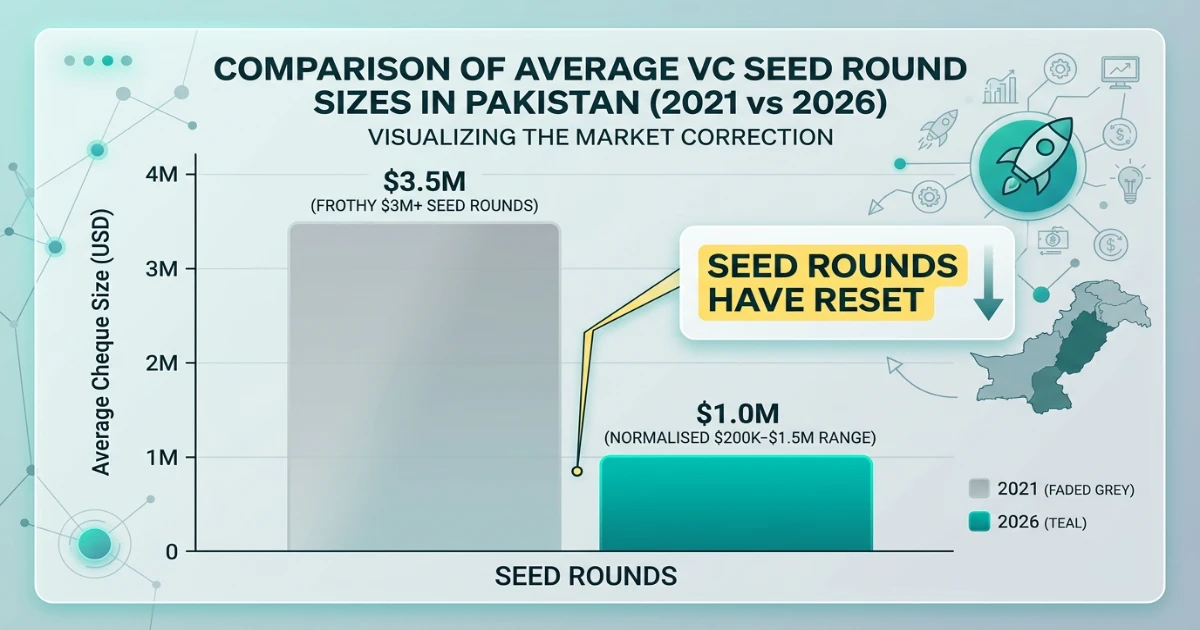
Fast-forward to 2026. The picture is different. The funds still active today are the ones that actually understand Pakistan — its regulatory quirks, its infrastructure gaps, its demographic tailwinds, and its genuinely resilient entrepreneurs. These VCs aren’t chasing hype cycles. They’re writing smaller initial cheques (typically $250K–$1.5M for seed rounds), demanding clearer paths to unit economics, and staying closer to their portfolio companies.
For a founder, this is good news. You’re no longer competing against 15 overfunded clones of the same idea. If you have a real business — not just a deck — you can get a meeting. But you need to know which door to knock on.
The Active Venture Capital Firms in Pakistan (2026 Edition)
Below is a curated — not exhaustive — list of venture capital firms Pakistan founders should have on their radar. I’ve excluded funds that have gone dormant and focused on those with demonstrable deal activity in the last 18 months.
| VC Firm | Typical Stage | Cheque Size (USD) | Notable Sectors | HQ / Focus |
|---|---|---|---|---|
| Sarmayacar | Seed – Series A | $500K – $3M | Fintech, B2B SaaS, Climate | Karachi / Pakistan-first |
| Zayn Capital | Pre-Seed – Seed | $200K – $1.2M | Fintech, Logistics, Healthtech | Dubai + Karachi |
| i2i Ventures | Pre-Seed – Seed | $150K – $800K | Consumer Tech, Agritech, SaaS | Karachi / Female co-founded |
| Indus Valley Capital | Seed – Series A | $500K – $4M | Edtech, B2B SaaS, Fintech | Karachi / Pakistan-only |
| Lakson Investments VC | Seed – Growth | $300K – $5M | Agritech, Health, Consumer | Karachi / Corporate-backed |
| Fatima Ventures | Seed – Series A | $400K – $2.5M | Agritech, Energy, Deep Tech | Lahore / Industrial group |
| 47 Ventures | Pre-Seed – Seed | $100K – $600K | B2B SaaS, Logistics, AI | Islamabad + Karachi |
| Karavan | Pre-Seed | $50K – $250K | Very early, sector-agnostic | Lahore / Operator-led |
A few others worth tracking: Sadaqat Ventures (sector-agnostic, family-office style), BitRate (crypto-adjacent, selective), and Accelerate Prosperity (quasi-VC with a development mandate in northern Pakistan). The common thread? All of them want to see revenue — or at minimum, a deeply engaged user base with a clear monetisation path.
What Pakistani VCs Actually Want in 2026 (It’s Not the Same as 2021)
If you last fundraised in 2021, everything you knew is outdated. Here’s what diligence looks like now:
- Unit economics over TAM slides. Every partner I’ve spoken with in 2025–26 says the same thing: “Show me contribution margin per transaction. Then we’ll talk about the addressable market.”
- Founder-market fit scrutiny. Why you? What edge do you have that a well-funded competitor can’t replicate in six months? Pakistani VCs have been burned by imported-founders-without-local-context, and they’re now biased toward operators who’ve lived the problem.
- Capital efficiency. A startup that burned $2M to reach $20K MRR is not getting a term sheet. One that reached $25K MRR on $300K raised? That founder will have competing offers.
- Regulatory awareness. With SECP tightening digital lending rules and the SBP increasingly watchful of fintech, VCs want founders who understand compliance — not founders who treat it as an afterthought.
In Season 1 of Shark Tank Pakistan, multiple sharks pressed founders on unit-level profitability — not just gross revenue. That’s not TV drama. That’s exactly what Pakistani VCs now ask in every first meeting. If you can’t answer “What’s your gross margin per order after delivery and payment gateway fees?” you’re not ready to fundraise. The sharks reflect the same scrutiny institutional VCs apply.
How Your Funding Strategy Changes Based on Where You Are
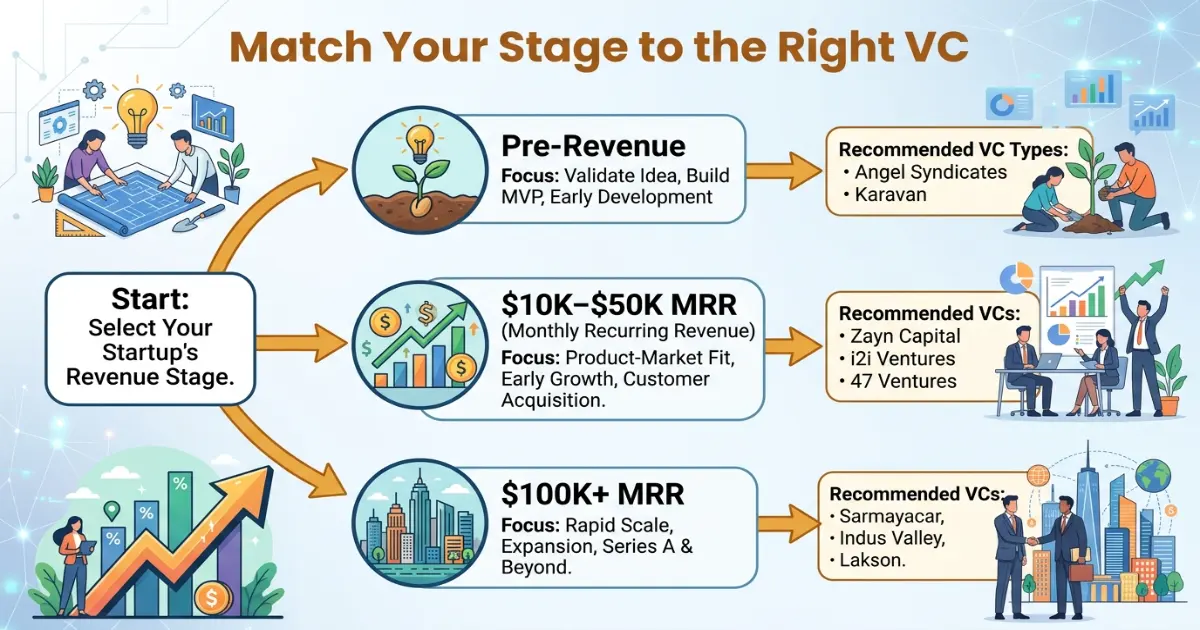
If You’re Pre-Revenue (Idea Stage or MVP Only)
Honest truth: most of the VCs listed above will not fund you. The exceptions are Karavan (very early, operator-led) and certain angel syndicates operating alongside i2i Ventures. Your best path is likely an angel round of $30K–$100K, potentially supplemented by a grant from Ignite or a local incubator like NIC Karachi or Plan9. Build until you have some traction metric — even 500 active users with retention data — before approaching institutional VCs.
If You’re Generating $10K–$50K Monthly Revenue
This is the sweet spot for Pakistani seed-stage VCs in 2026. You’re derisked enough to get a meeting, but you still have to show growth trajectory. At this stage, Zayn Capital, i2i Ventures, and 47 Ventures are your most realistic targets. Prepare a tight data room: cohort retention charts, contribution margins, CAC by channel, and a realistic 18-month plan.
If You’re Scaling ($100K+ MRR, Category Leader)
Sarmayacar, Indus Valley Capital, and Lakson Investments VC can write larger cheques. At this level, they’ll also help with follow-on introductions to MENA-based Series A funds. The conversation shifts from “Will this work?” to “How defensible is the moat?” — so bring defensibility data: switching costs, network effects, regulatory barriers, exclusive partnerships.
Common Pitfalls & When to Ignore This Advice
Every year, I see Pakistani founders make the same avoidable mistakes when engaging venture capital firms Pakistan. Here are the big ones:
- Spray-and-pray outreach. Mass-emailing 30 VCs with the same generic deck is a fast track to the trash folder. Pakistani VCs talk to each other. If three partners see the same impersonal email within a week, your credibility evaporates.
- Inflated “projected” revenue hockey sticks. VCs in this market have now seen enough actual outcomes to calibrate their scepticism. A projection showing 20x growth in 18 months without a credible channel strategy gets you marked as naive.
- Ignoring the family office / HNI route. Not every business needs institutional VC. Many profitable Pakistani SMEs would be better served by a strategic high-net-worth individual who brings distribution connections alongside capital. If your business model isn’t venture-scale (i.e., it can’t realistically 30x in 5–7 years), VC is the wrong instrument.
- Fundraising too early. The single costliest mistake. Giving away 20%+ equity at a $300K valuation to fund product development leaves you with a messy cap table and demotivated founders by the time you hit Series A.
How to Use SharkTankPakistan.pk Tools to Strengthen Your VC Pitch
Before you walk into any VC meeting, you need to know your numbers cold. The valuation calculator on this site isn’t a toy — it’s built on the same methodologies Pakistani VCs and angel investors use to triangulate fair valuations. Here’s a practical pre-meeting workflow:
- Run your numbers through the Valuation Calculator. Use your actual trailing twelve-month revenue and growth rate. The output gives you a defensible range — not a fantasy number.
- Use the Equity-Loan Calculator to model scenarios. What does a $400K raise at 18% equity look like versus $250K at 12%? Which leaves you with enough founder ownership to stay motivated through the next round?
- Study the pitch structure used on Shark Tank Pakistan. The show’s format — problem, solution, traction, ask — mirrors exactly what VCs want in the first 3 minutes of a meeting. Watch the best pitches on the site and reverse-engineer them.
Open the SharkTankPakistan.pk Valuation Calculator and plug in your own numbers. You’ll see instantly how a realistic ask can make or break your pitch.
A Real-World Example from the Ecosystem
Take the case of a Lahore-based B2B agritech startup — let’s call them “CropConnect” — that raised a $700K seed round in late 2025 from a syndicate led by Fatima Ventures with participation from i2i Ventures. What got them the term sheet wasn’t their deck. It was three things: (1) they had $18K MRR from 40+ paying farmers and aggregators, (2) their founder had spent five years in the fertiliser distribution business before starting up, and (3) they walked into the meeting with a clear answer to “What’s your cost to serve each additional farmer?” — it was falling, not rising. That last data point alone separated them from six other agritech pitches the VCs saw that quarter.
The lesson: VCs in Pakistan are pattern-matching for operational muscle, not just storytelling. The firms listed above have seen too many beautiful decks attached to businesses that couldn’t execute. Show them you can.

When NOT to Chase Venture Capital — and What to Do Instead
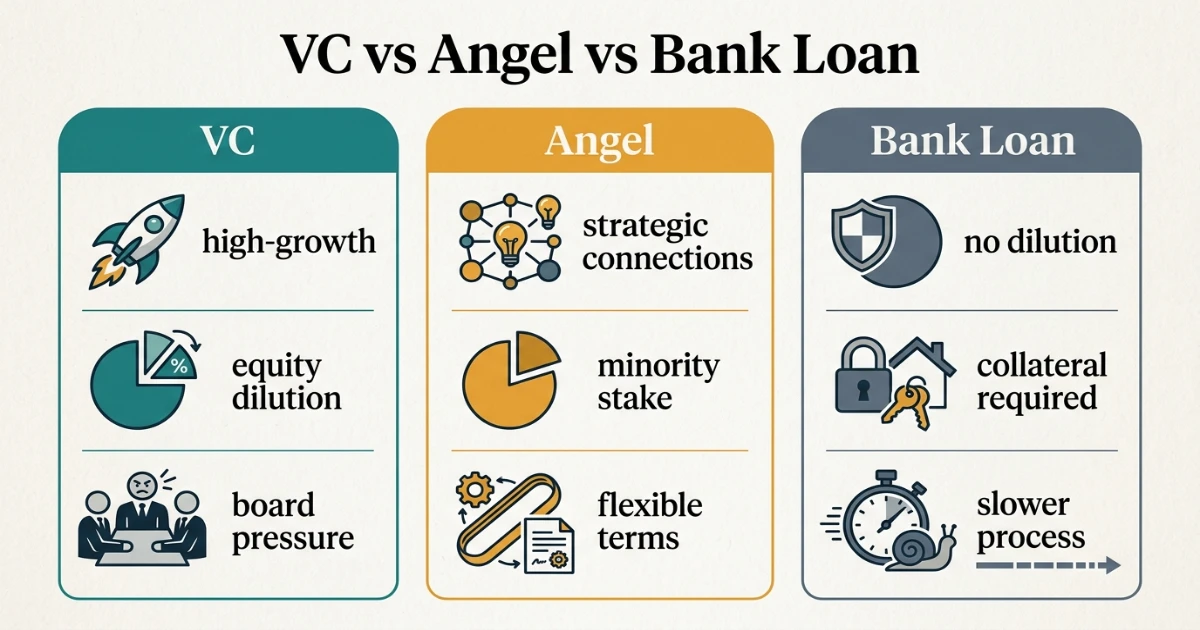
This might be the most important section in this article. Venture capital is a specific instrument designed for a specific type of company: high-growth, high-risk, scalable with low marginal cost, and aiming for an exit (acquisition or IPO) within 5–10 years. Many profitable businesses in Pakistan do not fit that profile — and that’s perfectly fine.
If your business is a steady-state services company, a single-location retail operation, or a lifestyle business that reliably generates PKR 3–8 million per month for its owners, VC is likely the wrong path. You’d be taking on pressure to grow at unnatural rates, potentially compromising profitability, and diluting ownership — all for capital you may not actually need. In these cases, explore revenue-based financing, bank loans (yes, Pakistani banks are slowly improving their SME lending), or strategic angel investors who take a minority stake and don’t demand board seats.
The smartest founders I know in Pakistan spent real time asking: “Is this a venture-scale business?” before they ever reached out to a VC. Be that founder.
How to Approach a Pakistani VC Firm — The 2026 Playbook
Cold emails still work in this market, but only if they’re hyper-specific. Here’s a framework that consistently gets responses from the firms listed above:
- Warm intro where possible. Check your LinkedIn mutual connections. A 30-second intro from a founder the VC already backed is worth 100 cold emails.
- Subject line with a specific metric. Not “Exciting opportunity in fintech.” Try: “B2B fintech — $22K MRR, 40% gross margin, 8% weekly growth.”
- Body: Problem, your unique insight, traction, ask. Four short paragraphs. No attachments in the first email — include a link to a Notion data room or a 6-slide teaser deck.
- Follow up once. After 7–10 days. If no response, move on. Pakistani VCs are inundated; a non-reply isn’t personal.
FAQs: Venture Capital in Pakistan
Which venture capital firms in Pakistan are most active in 2026?
Sarmayacar, Zayn Capital, i2i Ventures, Indus Valley Capital, and Lakson Investments Venture Capital are the most consistently active. Several others, including Fatima Ventures and 47 Ventures, have closed multiple deals in the past 18 months.
What is the minimum revenue Pakistani VCs expect before investing?
For seed-stage firms, $10K–$20K monthly recurring revenue is the typical threshold. Pre-revenue startups are rarely funded by institutional VCs unless the founding team has an exceptional track record or the technology is deeply proprietary.
Do Pakistani VCs invest in non-tech businesses?
Rarely. Most VC firms in Pakistan focus on tech-enabled or tech-first businesses. Traditional manufacturing, retail, or services businesses are better suited for bank loans, HNIs, or family offices.
How long does it take to close a VC round in Pakistan?
From first meeting to funds in the bank, expect 8–16 weeks. Due diligence, term sheet negotiation, and legal documentation each take time. Rushed processes almost always signal red flags.
Can a Shark Tank Pakistan appearance help me get VC funding?
Yes, but indirectly. Several Season 1 contestants received inbound VC interest after their episodes aired — even those who didn’t close a deal on the show. The exposure acts as social proof, but VCs will still run their own diligence.
What equity percentage do Pakistani VCs typically take at seed stage?
Most seed-stage deals in Pakistan land between 12% and 22% equity, depending on cheque size, traction, and competitive dynamics. Avoid giving more than 25% in a single round to preserve founder economics for future raises.
Are there any Pakistan-focused VC funds based outside the country?
Yes. Several MENA-headquartered funds actively invest in Pakistan, including Zayn Capital (Dubai) and select syndicates from Saudi Arabia. Some Singapore-based family offices also participate in Pakistani seed rounds.
⚡ Your Fast-Track Cheat Sheet: Top 3 Actions to Take
- Benchmark your readiness honestly. If you’re below $10K MRR, focus on traction — not fundraising. Use the SharkTankPakistan.pk Valuation Calculator to understand where you stand before approaching any VC.
- Target the right firms for your stage. Pre-seed? Karavan or angel syndicates. Seed with revenue? Zayn Capital, i2i Ventures, 47 Ventures. Scaling fast? Sarmayacar, Indus Valley Capital, Lakson. Mismatched outreach wastes everyone’s time and damages your reputation.
- Lead with unit economics, not projections. The Pakistani VC market in 2026 rewards operators who understand their numbers at a granular level. Know your contribution margin per transaction, your CAC by channel, and your cohort retention — and make those the centrepiece of every conversation.