
5 Mistakes Pakistani Entrepreneurs Make When Pitching to Investors
⚡ The Short Answer: Most Pakistani founders sabotage their own pitches before the first slide loads. The five recurring pitching mistakes Pakistan investors see constantly are: inflating valuations without a single data point to back them up, pitching a family-run shop as if it’s the next unicorn, showing up with messy or missing financials, asking for equity percentages plucked from thin air, and treating the investor meeting like a one-time transaction instead of the start of a long-term relationship. Fix these five, and you’re already ahead of 80% of the pitches investors sit through in this market.
Walk into any investor gathering in Karachi, Lahore, or Islamabad and you’ll hear the same lament whispered between chai refills: “Great product. Terrible pitch.” Pakistan’s startup ecosystem is buzzing right now — fintech rounds are closing, Shark Tank Pakistan has put founder stories into living rooms across the country, and for the first time in a generation, young entrepreneurs actually believe they can build something big without leaving home. But belief without preparation is just hope. And hope, as any shark will tell you, doesn’t get you a cheque.
What follows is not generic advice scraped from a Silicon Valley blog and clumsily repackaged with a Lahore filter. This is grounded in how Pakistani investors actually think, what they scrutinize, and the specific pitching mistakes Pakistan founders keep making — episode after episode, meeting after meeting. If you’re preparing a pitch deck, applying to Shark Tank Pakistan, or sitting across from an angel investor next week, consider this your pre-flight checklist.

Why Pakistani Pitches Fail Differently
Before dissecting the five mistakes, let’s address something rarely said aloud: Pakistani entrepreneurs are not making the same pitching errors as their counterparts in Austin or Berlin. The fundamentals of a bad pitch are universal — poor preparation, weak storytelling, unrealistic asks — but the flavour is distinct. Pakistan’s business culture is shaped by decades of family-run enterprises, an economy where documentation lags behind ambition, and an investor class that, until recently, had more experience with real estate and textiles than with SaaS metrics.
What this means in practice: a Pakistani founder might walk into a pitch meeting having run a profitable business for three years but never produced a formal balance sheet. Or they might ask for Rs. 2 crore in exchange for 5% equity because their cousin’s friend got a similar deal “somewhere in Dubai.” The numbers are made up, the logic is emotional, and the investor — who genuinely wants to say yes — ends up saying no because the risk feels unquantifiable.
Understanding this cultural and structural backdrop is essential. The five pitching mistakes Pakistan investors encounter most frequently are not sins of incompetence. They’re sins of context — habits picked up from an informal business environment that don’t translate to the structured world of equity investment. Let’s fix them one by one.
Mistake #1: The “Fictional Valuation” — Pulling Numbers Out of Thin Air
This is the granddaddy of all pitching mistakes Pakistan founders make. An entrepreneur walks in, slides to the “Ask” page, and calmly states their company is worth Rs. 15 crore. When the investor asks “Based on what?” — the room goes quiet. The answer, when it eventually stumbles out, is some version of “Based on our future potential.”
Investors in Pakistan have grown allergic to this. Not because they don’t believe in potential — they’re in the business of potential — but because a valuation without methodology signals that the founder hasn’t done the work. It says: I want your money, but I haven’t thought seriously about what a fair exchange looks like.
What Pakistani Investors Actually Want to See
Valuation in Pakistan’s early-stage ecosystem typically relies on a few accepted frameworks: revenue multiples (for businesses with consistent cash flow), discounted cash flow projections (for asset-heavy or predictable models), or comparable transaction analysis (what similar startups in the region have recently raised at). A pre-revenue tech startup will often use the Berkus Method or a risk-adjusted scorecard approach — but the key is showing your work.
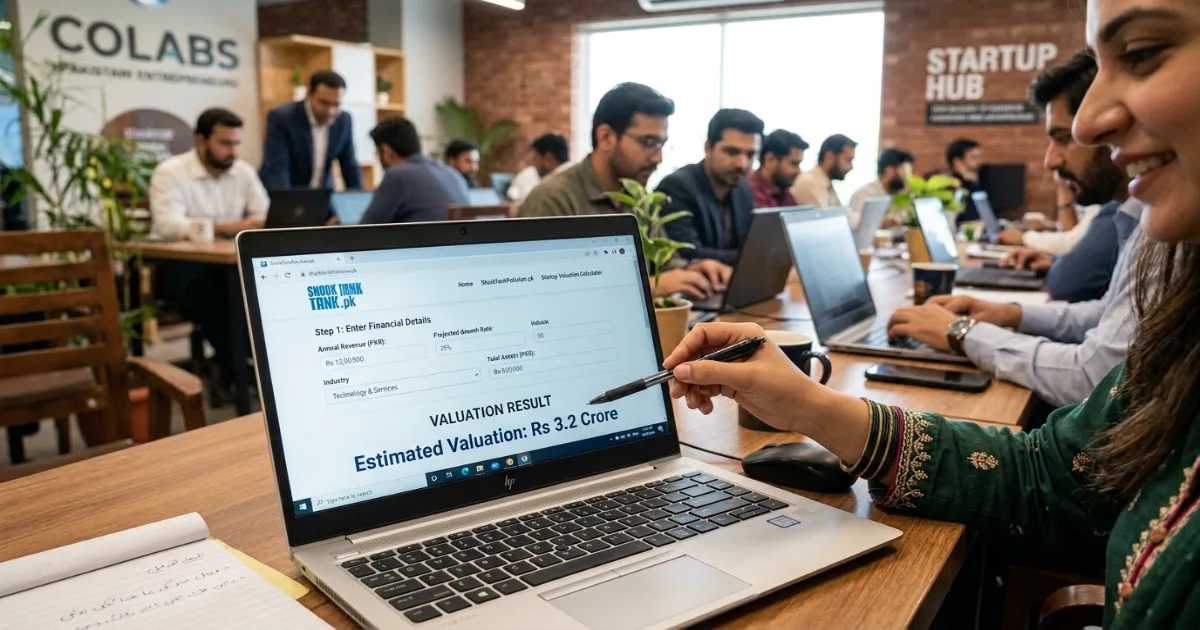
If you’re unsure where to start, open the SharkTankPakistan.pk Valuation Calculator. Plug in your actual revenue, growth rate, and asset base. Even if the output isn’t the final number you pitch, the exercise forces you to confront the gap between what you feel your business is worth and what the numbers can justify. That gap is where investor trust gets built or broken.
Mistake #2: Pitching a Small Business as Though It’s a Scalable Startup
There’s nothing wrong with running a profitable small business. Pakistan’s economy is built on them — the kiryana store that turned into a wholesale operation, the boutique tailoring unit that now serves three cities, the catering service that dominates wedding season. These are dignified, cash-generating enterprises. But they are not necessarily investable in the venture capital sense.
The second of the big pitching mistakes Pakistan investors flag is the category confusion: founders who pitch a lifestyle or linear-growth business using startup language — “scalable,” “disruptive,” “asset-light platform” — when the underlying model requires proportional increases in headcount, inventory, or physical space to grow.
The Scalability Litmus Test
Ask yourself honestly: if your revenue doubled tomorrow, would your costs also roughly double? If the answer is yes, you’re running a high-margin small business — which is fantastic, but it’s not what equity investors are typically looking for. Equity investors need to see a path to exponential returns, because their model depends on a few big winners offsetting many losses.
This doesn’t mean you shouldn’t seek funding. It means you should seek the right kind of funding — perhaps debt financing, revenue-based financing, or a strategic partnership — and pitch accordingly. Walking into a venture pitch with a business that can’t scale beyond the founder’s personal bandwidth is a fast track to a polite no.
Mistake #3: The “Napkin Financials” Problem
Pakistan’s informal economy is massive — estimates suggest it accounts for 30–40% of GDP. Many successful entrepreneurs have built thriving businesses while operating largely outside formal accounting systems. They know their numbers in their head: monthly sales, approximate margins, rough expenses. The problem? Investors don’t write cheques based on what’s in your head.
This is the third pitching mistakes Pakistan founders rarely see coming because, in their day-to-day operations, “knowing the numbers” has always been enough. But an investor needs unit economics: customer acquisition cost, lifetime value, gross margin per unit, churn rate, runway projections. If you can’t produce these, the investor assumes one of two things — either the business isn’t as healthy as you claim, or you’re not serious enough to have done the homework. Neither inspires confidence.
A Quick Financial Readiness Checklist
Before any pitch meeting, have these within arm’s reach:
- Last 12 months’ P&L — even if unaudited, even if on a spreadsheet
- Unit economics on a single slide — revenue per unit/customer, direct cost per unit, contribution margin
- Cash flow statement — when money comes in, when it goes out, and how much runway you have
- Cap table — who owns what, including any informal investors or family shareholders
- Use-of-funds breakdown — exactly where the investment will go, with percentages

Mistake #4: The Equity Ask That Makes No Mathematical Sense
Founders routinely walk into pitches and say, “We’re raising Rs. 3 crore for 10% equity.” When asked how they arrived at 10%, the reasoning collapses into one of two buckets: “It feels fair” or “We don’t want to give away too much.” Both answers miss the point entirely.
Your equity ask is not about what feels fair — it’s a mathematical output of your valuation and your funding requirement. If your business is worth Rs. 10 crore and you need Rs. 2 crore, you’re offering roughly 16.7% equity (allowing for some dilution nuance). If you’re pre-revenue and asking for Rs. 5 crore at a Rs. 50 crore valuation, you’d better have staggering traction or proprietary IP to justify it.
Among the most damaging pitching mistakes Pakistan investors report is the mismatch between the ask and the stage. Early-stage Pakistani startups frequently anchor to valuations they’ve seen on Shark Tank US, not realizing those deals involve revenue-generating companies with years of traction in massive markets. Your Rs. 30 lakh annual profit boutique brand is not worth Rs. 8 crore just because a comparable American company raised at a similar multiple. Market size, growth rate, and exit potential all compress multiples in Pakistan.
Mistake #5: Treating the Investor Relationship Like a One-Time Transaction
Pakistan is a relationship-driven economy. Deals get done over dinner, partnerships are forged across years, and trust accrues slowly. Yet many founders — especially younger ones shaped by the transactional speed of digital culture — treat an investor pitch like a marketplace checkout: present product, name price, swipe card, done.
This is arguably the most culturally misaligned of all pitching mistakes Pakistan entrepreneurs make. Investors here — whether angels, VCs, or sharks on the show — are buying into a multi-year relationship. They want to know you’re coachable, that you’ll pick up the phone when things get hard, that you won’t vanish the moment the money hits your account. If your pitch radiates “just give me the capital and leave me alone,” you’ll get exactly that — left alone, without the capital.
Building Relationship Signals Into Your Pitch
Small shifts make a massive difference. Reference previous investor conversations and what you learned from them. Acknowledge the gaps in your plan and invite input. Ask the investor about their expertise and how it might complement your weaknesses. These signals communicate that you’re looking for a partner, not just a paycheque. In Pakistan’s tight-knit investment circles — where reputation travels faster than term sheets — this matters enormously.

Comparison Table: What Founders Pitch vs. What Investors Actually Evaluate
| What Founders Focus On | What Investors Actually Care About | The Fix |
|---|---|---|
| The “big idea” and vision | Execution capability and traction so far | Lead with what you’ve done, not what you will do |
| A high valuation as a status symbol | A valuation grounded in methodology and comparables | Use the Valuation Calculator; be ready to defend every assumption |
| Market size of the global opportunity | Addressable market in Pakistan and realistic capture rate | Show SAM and SOM, not just TAM; ground it in local data |
| How much money they want | Exactly where every rupee will go and what milestones it buys | Present a 12–18 month use-of-funds roadmap tied to specific KPIs |
| Their passion and hustle story | Unit economics, margins, and path to profitability | Put the financials slide before the story slide if needed |
| That they’re “open to negotiation” | A well-reasoned starting point that shows preparation | Anchor with logic, not with a random high number |
Situation-Based Adjustments: How the Advice Changes for Different Founders
If You’re Pre-Revenue (No Sales Yet)
Your pitch cannot lean on financials you don’t have, so you must compensate with exceptional clarity on the problem, a prototype or MVP that demonstrates commitment beyond talk, and a go-to-market plan that shows you understand distribution in Pakistan — which channels, what cost, what timeline. Your valuation will almost certainly be lower than you want, and that’s okay. Raising too much at too high a valuation at this stage creates a down-round risk that can kill your company later. Focus on raising enough to hit a clear, demonstrable milestone that unlocks the next round.
If You’re Generating Consistent Revenue
You have the opposite problem: you’ve got numbers, but you might be underselling the scalability story. Investors will scrutinize whether your growth is replicable or dependent on your personal network. Frame your traction as evidence of product-market fit, not as a victory lap. And please — have clean financials. A revenue-generating business with messy books looks worse than a pre-revenue startup with immaculate projections.
If You’re a Tech Startup
Pakistani tech founders tend to over-index on product features and under-index on distribution economics. Your pitch needs a clear answer to: “How will you acquire customers in Pakistan’s mobile-first but trust-sensitive market?” Also, be prepared for questions about team — investors know that tech talent retention in Pakistan is fiercely competitive.
If You’re Running a Traditional Business Seeking Growth Capital
Don’t try to sound like a tech startup if you’re not one. Instead, emphasize asset efficiency, cash flow stability, and expansion pathways (new cities, new product lines, franchise model). Explore whether debt or revenue-based financing might actually serve you better than equity — and come to the pitch knowing the trade-offs.
Common Pitfalls & When to Ignore This Advice
Every rule has its exceptions. Here’s where the standard pitching playbook might not apply to you — and when following it blindly could backfire.
If you have a genuinely hot deal with multiple term sheets: You have leverage. A high valuation might be defensible if demand is real and competing offers exist. But don’t fabricate scarcity — the Pakistani investor community is small, and they talk.
If you’re pitching a family-office investor rather than a VC: Relationship and trust often outweigh valuation precision. Family offices in Pakistan — including several of the sharks — frequently invest based on founder quality and sector conviction rather than spreadsheet-perfect models. The financials still need to exist, but the pitch can lean more heavily on vision and partnership.
If your business is a social enterprise or impact-first model: Traditional VC valuation frameworks may not apply neatly. Be upfront about your blended return expectations and seek investors whose mandate aligns with your mission. Pakistan has a growing impact investment scene — don’t waste time pitching pure financial return investors if that’s not your game.
If you’re still at the idea stage with nothing built: Frankly, you probably shouldn’t be pitching equity investors yet. Build something first — even a small pilot, even a waitlist of 200 people. The advice in this article presumes you have something to show. Without it, no amount of pitch polish will help.
Real-World Example: A Pitch That Got It Right
Consider a Karachi-based D2C skincare brand that appeared on Shark Tank Pakistan. The founder walked in with a clear ask: Rs. 1.5 crore for 12% equity. The valuation — roughly Rs. 12.5 crore — raised eyebrows until she displayed 18 months of consistent revenue growth, a 62% gross margin, and a customer repeat rate that outpaced every competitor in the category. When pushed on distribution, she had detailed unit economics for Instagram ads versus pharmacy shelf placement. When asked about her team, she openly admitted gaps and explained exactly which roles the investment would fund.
She got a deal — not because her product was the most innovative (it was solid but not revolutionary), but because her pitch answered every unspoken question before it was asked. The sharks spent zero energy trying to extract basic information and all their energy negotiating terms. That’s the goal.
Put This Into Practice Right Now
Reading about pitching mistakes Pakistan investors see is useful. Applying the fixes is what changes outcomes. Here are three immediate actions you can take — today — without spending a rupee:
- Run your numbers through the SharkTankPakistan.pk Valuation Calculator. Use your actual revenue or your most honest projections. Note where the output diverges from the number you had in your head. That gap is your preparation priority.
- Do the “scalability test” on your own business. If revenue doubled, would costs double too? If yes, reconsider whether equity investment is the right path — or whether you need to redesign part of your model before pitching.
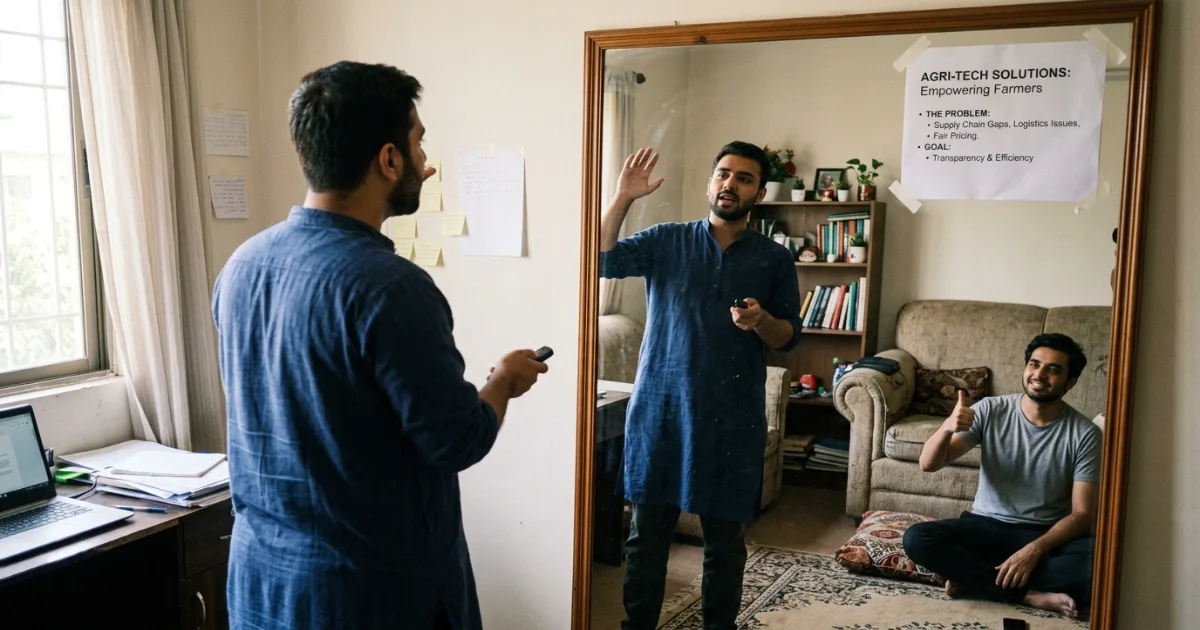
- Practice your equity-ask defence out loud. If you can’t explain your valuation and equity percentage in two clear sentences without saying “um,” “future potential,” or “I feel,” you’re not ready. Record yourself. Listen back. Refine.
✅ Your Fast-Track Cheat Sheet: Top 3 Actions
- Ground your valuation in methodology, not emotion. Use actual data, a recognized framework, and the calculators available on SharksTankPakistan.pk. If you can’t defend the number in two sentences, it’s not ready.
- Know whether you’re pitching a scalable venture or a great small business. Both deserve funding — but not necessarily the same type. Match your ask to your model, and don’t pretend to be something you’re not.
- Treat the pitch as the start of a relationship, not a transaction. Signal coachability, preparation, and long-term thinking. In Pakistan’s investor ecosystem, who you are matters almost as much as what you’re building.
Frequently Asked Questions
What is the most common pitching mistake Pakistani founders make?
Overvaluing the business without data to support the number. Investors consistently report that unrealistic, emotionally driven valuations are the single biggest reason promising Pakistani pitches fall apart in the first few minutes.
How much equity do sharks usually take on Shark Tank Pakistan?
It varies widely, but deals typically range from 10% to 35% equity depending on the stage, valuation, and negotiation. Early-stage, pre-revenue companies generally give up more equity than those with established revenue and traction.
Do I need a registered company to pitch to investors in Pakistan?
Technically, you can pitch with just an idea, but serious investors almost always require at least a registered sole proprietorship or private limited company before funds are transferred. SECP registration adds credibility and legal clarity to any deal.
What financial documents must I have ready before pitching?
At minimum: a profit and loss statement for the last 12 months (if operational), a clear unit economics breakdown, a cash flow projection, a capitalization table, and a detailed use-of-funds plan showing where the investment will be allocated.
Can I pitch to Shark Tank Pakistan if my business is not yet profitable?
Yes. Many contestants on the show were pre-profit or even pre-revenue. The key is demonstrating a clear path to profitability, strong unit economics, and a compelling growth strategy — not just a big idea with no execution plan.
How is pitching in Pakistan different from pitching in the US or Dubai?
Pakistani investors tend to place higher emphasis on personal trust, coachability, and relationship longevity. They also scrutinize documentation more rigorously because many businesses operate partly in the informal economy. Valuation multiples are typically more conservative than in the US.
What if my family owns part of the business — do I need to disclose that?
Absolutely. Undisclosed family shareholding on a cap table is a major red flag. Transparency about all ownership — including informal arrangements — is non-negotiable. Hidden stakeholders can derail deals during due diligence.