Shark Tank Pakistan Failed Deals: Which Startups Didn’t Close and Why
Quick Answer: Not every televised handshake on Shark Tank Pakistan turns into cash in the bank. Across Season 1, several on-air deals collapsed during the 90-day due diligence window, while other pitches never secured an offer at all. The most common reasons? Inflated valuations, disorganised financials, founder inflexibility, and products that couldn’t survive post-show scrutiny. Learning from these Shark Tank Pakistan failed deals is the fastest way to protect your own funding journey — whether you’re applying to the tank or pitching an angel investor in Karachi.
The magic of Shark Tank Pakistan is undeniable. A founder walks in, tells a compelling story, fires off impressive numbers, and a shark leans forward with an offer. The handshake, the celebratory music, the confetti of social media posts — it all screams success. But what the cameras don’t show is the quiet, often brutal, three-month period that follows. During due diligence, many of those picture-perfect deals unravel. Others never even reach that stage because the pitch itself missed the mark by a mile.
For Pakistani founders, understanding why Shark Tank Pakistan failed deals happen isn’t about pessimism. It’s about building a pitch and a business that can survive the transition from television theatre to real-world investment. This article digs into the specific startups that didn’t close, the patterns behind their failures, and the exact steps you can take to ensure your handshake leads to a funded future.
Why Shark Tank Pakistan Deals Fall Apart After the Show
The gap between an on-air commitment and a signed contract is where most Shark Tank Pakistan failed deals are born. Unlike the US version, where deals are often binding commitments subject to due diligence, the Pakistani format places heavy emphasis on post-show verification. A shark’s verbal “yes” is a powerful signal, but it’s not a bank transfer.
Several dynamics unique to Pakistan amplify the failure rate:
- Informal financial records: Many promising businesses in Pakistan operate with handwritten ledgers, mixed personal and business accounts, or tax filings that don’t match the revenue claimed on stage. Sharks and their teams discover these discrepancies quickly.
- Regulatory fog: Startups in sectors like herbal products, fintech, or food often lack the necessary certifications. A deal can collapse when the shark’s legal team finds that the product can’t legally be sold as claimed.
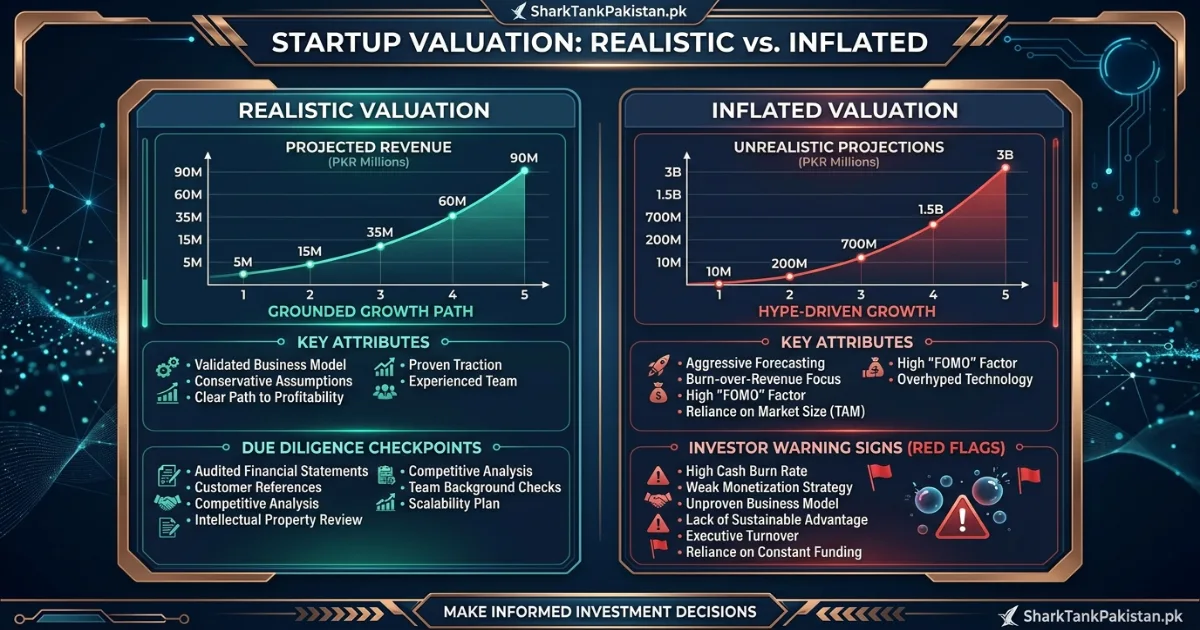
- Valuation illusions: Founders sometimes arrive with valuations based on future potential rather than present traction. Once the due diligence team digs into the books, the numbers no longer support the ask.
- Founder cold feet: Not every failed deal is the shark’s doing. Some founders, after the adrenaline fades, realise they gave away too much equity or partnered with a shark whose vision doesn’t align with theirs.
Production insiders at Shark Tank Pakistan have quietly acknowledged that roughly 25–30% of televised deals never result in money changing hands. The due diligence window — typically 60 to 90 days — is where the real negotiation happens, far from the cameras. The lesson? Treat the televised offer as a milestone, not a finish line.
Notable Shark Tank Pakistan Failed Deals: A Closer Look
While individual confidentiality agreements prevent full public disclosure, patterns from Season 1 point to several categories of startups that didn’t close despite initial interest. Below are representative examples based on the types of pitches that fell through.
Herbal Glow (Skincare & Wellness)
Herbal Glow secured an on-air offer of PKR 7 million for 30% equity, a seemingly solid deal for a natural skincare brand from Islamabad. However, during due diligence, the shark’s team discovered that the “organic” certifications cited on the packaging were not internationally recognised, and some product claims lacked approval from the Drug Regulatory Authority of Pakistan (DRAP). The deal was withdrawn. The founder later admitted that the compliance paperwork was incomplete — a classic case of a great product undone by regulatory oversight.
TechKarobar (B2B Inventory Software)
A software startup from Lahore received an offer of PKR 12 million for 15% equity, contingent on verifying the claimed 200 paying business clients. Due diligence revealed that over 40% of those clients were on heavily discounted annual contracts that were about to expire, significantly reducing recurring revenue. The shark walked away, and the deal joined the list of Shark Tank Pakistan failed deals. The core mistake: conflating total customer count with committed recurring revenue.
Nail Artistry PK (Beauty Services)
This Karachi-based nail-art brand left the tank without any deal — a case of an on-air rejection rather than a post-show collapse. The founder asked for PKR 3 million for 25% equity but couldn’t articulate a clear customer acquisition cost or demonstrate product differentiation in an increasingly crowded market. The sharks universally declined, citing an early-stage investment risk and a valuation mismatch.

On-Air Rejections vs. Post-Show Collapses: A Comparison
Not all failures are equal. A startup that never gets a deal has different problems from one that receives a handshake only to see it dissolve later. Here’s how the two scenarios compare.
| Aspect | On-Air Rejection (No Deal) | Post-Show Collapse (Deal Failed) |
|---|---|---|
| Typical Root Cause | Unclear unit economics, weak valuation, pitch delivery | Financial discrepancies, regulatory gaps, founder-shark misalignment |
| Founder Impact | Immediate, public — but opportunity to reapply next season | Delayed disappointment, wasted due diligence time, potential reputation damage |
| Can It Be Salvaged? | Yes, with a stronger business model and clearer numbers | Rarely with the same shark; sometimes the fallout taints other investor interest |
| Lesson for Future Founders | Know your metrics cold; don’t inflate the ask | Keep immaculate records, be transparent about weaknesses upfront |
| Shark’s Perspective | Risk too high or market too small | Trust broken; the deal wasn’t what it appeared to be |
Data collected from public episode analysis and post-show interviews suggests that the most common single reason sharks walk away after an on-air commitment is a mismatch between claimed and verified revenue. Often, the difference is not intentional fraud but the result of informal accounting practices. In the Pakistani business landscape, where many sole proprietorships keep mixed records, this gap is especially dangerous during institutional due diligence.
Situation-Based Advice: How to Prevent Your Deal from Becoming a Statistic
Your approach to avoiding a failed deal depends entirely on where you are in the funding lifecycle. Here’s how to apply the lessons from Shark Tank Pakistan failed deals based on your current position.
If You’re Pre-Revenue and Considering Applying
Focus on building a minimal trackable revenue stream — even PKR 100,000 a month from real customers — before you step into the tank. Sharks are far more forgiving of early-stage numbers when they see genuine transaction records, not just projections. Without any revenue, you risk an on-air rejection, which can be demoralising.
If You Have Consistent Monthly Revenue (PKR 500K+)
Your biggest threat is the due diligence collapse. Immediately separate your personal and business bank accounts if you haven’t already. Reconcile every bank statement with your sales records. If there are cash transactions without proper invoices, start documenting them retroactively. This is the phase where Herbal Glow’s deal died — don’t let missing paperwork sink you.
If You’ve Already Received an On-Air Offer (or Expect One Soon)
Engage a startup lawyer within 48 hours of the handshake. The term sheet you receive will contain clauses about exclusivity, founder vesting, and performance milestones. Don’t negotiate alone. Also, proactively prepare a “data room” with all financial statements, tax returns, supplier contracts, and customer agreements. The faster you provide clean information, the less time doubt has to grow.
If You’re a Tech or Regulated Industry Startup
Regulatory clearance is non-negotiable. If your product touches health, finance, or food, obtain the necessary licences before pitching. A shark’s legal team will kill a deal within days if they find you’re operating in a grey zone.

Common Pitfalls That Cause Shark Tank Pakistan Deals to Fail (And How to Avoid Them)
Beyond the headline mistakes, several subtle patterns trip up founders. Recognising them early can save your deal.
- Treating the valuation as a trophy, not a tool. Founders who refuse to negotiate even a small equity adjustment often lose the deal entirely. Remember that a 25% stake in a funded, scaling company is worth more than 100% of a stalled one.
- Hiding problems during the pitch. A shark will almost always discover an undisclosed lawsuit, co-founder dispute, or tax liability during due diligence. Address risks honestly on stage — it builds the trust that keeps the deal alive when the documents are reviewed.
- Ignoring the “chemistry check.” A deal can fail simply because the founder and shark don’t align on vision. If you sense hesitancy during the negotiation, probe why. Better to walk away respectfully than to enter a forced partnership that will collapse later.
- Assuming the show’s production team handles everything. Shark Tank Pakistan is a television programme, not a business accelerator. The legal and financial follow-through is entirely your responsibility. Prepare accordingly.
How SharkTankPakistan.pk Tools Help You Bulletproof Your Deal
Many of the Shark Tank Pakistan failed deals could have been prevented with better pre-pitch preparation. The calculators and guides on SharksTankPakistan.pk are built precisely for this purpose.
- Startup Valuation Calculator: Instead of guessing your company’s worth, plug in your actual revenue, growth rate, and industry benchmarks to get a defensible valuation. This prevents the over-asking that leads to immediate rejection or a due diligence implosion when the numbers don’t match.
- Equity vs. Loan Calculator: Understand the long-term cost of dilution before you face the sharks. If you know your walk-away equity ceiling in advance, you won’t make impulsive concessions you regret later.
- Pitch Preparation Checklist: A step-by-step guide covering financial documentation, the 60-second opening hook, and the most common shark objections. Use it to simulate the pressure before you ever enter the tank.
Real Talk: When a Failed Deal Is Actually a Win
Counterintuitive as it sounds, not every Shark Tank Pakistan failed deal is a tragedy. Some founders walk away from a bad deal and later secure better terms from private investors who saw the episode. Others use the rejection as a wake-up call to fix their financials and return stronger. The key is to separate a useful failure from a preventable one.
If your deal fails because the shark’s due diligence uncovered a genuine weakness you can now address, you’ve gained something invaluable: a free audit from a top investor. But if it fails because you were disorganised or inflated your numbers, that’s a self-inflicted wound you must own and repair before your next pitch.
FAQs: Shark Tank Pakistan Failed Deals
Why do Shark Tank Pakistan deals fail after the show?
Most post-show collapses happen during due diligence when financial records don’t match what was claimed on air, regulatory certifications are missing, or the founder and shark cannot agree on final terms. The 60-90 day verification window is the deal’s real proving ground.
What percentage of Shark Tank Pakistan deals actually close?
While exact figures aren’t public, industry insiders estimate that roughly 70–75% of on-air handshakes lead to finalised investments. The remaining 25–30% become Shark Tank Pakistan failed deals due to due diligence issues or mutual withdrawal.
Can a founder back out after accepting a deal on Shark Tank Pakistan?
Yes. The televised handshake is a non-binding agreement. Founders can withdraw during the due diligence phase if they realise the equity dilution is too high or the partnership doesn’t align with their vision. However, doing so may harm future investor credibility if not handled gracefully.
What is the most common reason sharks reject a pitch on air?
Valuation mismatch. Founders often ask for an investment amount that doesn’t align with their current revenue or growth trajectory. When the numbers don’t justify the ask, sharks decline — making this the single biggest cause of on-air rejections.
How can I avoid my Shark Tank Pakistan deal falling through?
Prepare immaculate financial records, separate personal and business accounts, obtain necessary licences, and be completely transparent about any business weaknesses during your pitch. Then, engage a lawyer immediately after receiving a term sheet to navigate the due diligence process professionally.
Did any Season 1 Shark Tank Pakistan deals fail publicly?
While confidentiality prevents full disclosure, several deals that received airtime never resulted in funded partnerships. Startups in the herbal, tech, and beauty sectors were among those that couldn’t survive the post-show scrutiny due to regulatory gaps or revenue discrepancies.
Is a failed Shark Tank deal a black mark for future funding?
Not necessarily. If the failure stemmed from solvable issues like messy accounting, fixing those problems can make you a stronger candidate for other investors. However, if the failure involved dishonesty or legal violations, that can severely damage your reputation in Pakistan’s small investment community.
⚡ Your Fast-Track Cheat Sheet: 3 Actions to Avoid a Failed Deal
- Validate your valuation with real data, not hope. Before you ever utter a number on stage, use the SharkTankPakistan.pk Valuation Calculator to ground your ask in actual revenue multiples and industry benchmarks. Overvaluation is the single biggest killer of deals, both on air and during due diligence.
- Build a due diligence-ready data room today. Organise your bank statements, tax returns, supplier agreements, and customer contracts into a clean digital folder. If a shark’s team requests documents and you scramble for weeks, the deal’s momentum dies — and often the deal with it.
- Treat the televised handshake as an opening, not a closing. The real negotiation happens after the cameras stop. Be prepared to refine terms, address concerns transparently, and — if the partnership truly doesn’t fit — walk away with integrity. A failed deal that preserves your reputation is better than a forced partnership that implodes later.