How to Start a Clothing Brand in Pakistan from Scratch
⚡ Quick Answer: To start a clothing brand Pakistan entrepreneurs need to follow a clear sequence: define a specific niche, create a business plan, register the legal entity, source fabric and stitching from Pakistan’s robust textile hubs, build a minimum viable collection, set up sales channels (online and offline), and market aggressively on Instagram and TikTok. The real differentiator is not just design—it’s mastering unit economics and branding in a market where unstitched fabric and fast fashion dominate.
Pakistan is the world’s eighth-largest textile exporter. Cotton flows from the fields of Punjab to the looms of Faisalabad and the finishing units of Karachi. Yet, for decades, the domestic clothing market remained split between tailor-made shalwar kameez and a handful of legacy retail brands. That is changing—fast. A new wave of homegrown clothing brands is emerging, built by founders who understand Instagram aesthetics, direct-to-consumer economics, and the power of storytelling. If you have ever wanted to start a clothing brand Pakistan has never been a more fertile ground for it, provided you approach it as a real business and not just a creative outlet.
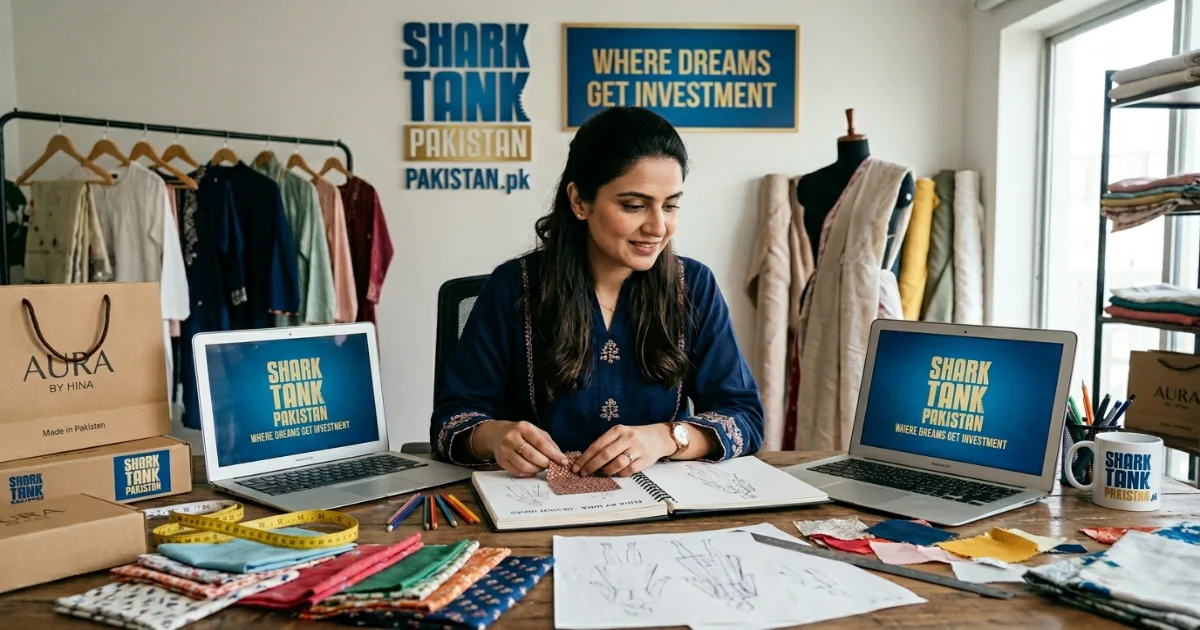
Whether you dream of launching a modest-wear label, a streetwear line inspired by truck art, or a sustainable kids’ clothing brand, this guide walks you through every step—from legal registration to your first 100 orders. And if you are building something scalable, who knows? We might see you pitching on Shark Tank Pakistan one day.
Why Pakistan’s Clothing Market Is Primed for New Brands
Three structural shifts are creating opportunity. First, internet penetration and smartphone adoption mean a Karachi-based brand can sell to customers in Sialkot, Quetta, and even the Pakistani diaspora in the UK without ever opening a physical store. Second, the rise of digital payment gateways and cash-on-delivery logistics networks has lowered the barrier to e-commerce. Third, a growing middle class is seeking clothing that reflects personal identity—modest fashion, fusion wear, minimalist basics—and legacy brands are often too slow to serve these niches.
But opportunity is not the same as ease. Pakistan’s clothing industry is brutally competitive at the low end and capital-intensive at the high end. The sweet spot for a new brand is a distinct, well-defined customer segment with a product that is difficult to find in local markets or on Daraz. Generic kurtis with a logo slapped on will not work. Thoughtful design, consistent quality, and a brand story will.
Step-by-Step: From Idea to First Sale
Step 1: Pick Your Niche and Validate It
The biggest mistake first-time founders make is trying to launch a brand for “everyone.” You cannot. Start with a sharp niche. Examples from Pakistan’s current market: hand-embroidered organic cotton kids’ clothes, contemporary modest-wear with pockets (yes, pockets sell), or unisex block-printed co-ord sets. Once you have an idea, validate it before investing heavily. Show sketches or samples to 20 people who match your target customer profile. Run a simple Instagram poll.
Check if similar products on Daraz have consistent positive reviews and sales velocity. If you can sell 30–50 units through pre-orders to friends and family without a full collection, you have early proof of demand.
Step 2: Write a Lean Business Plan
This does not need to be a 40-page document. A lean plan covering these five questions is enough: (1) Who exactly is your customer? (2) What specific problem does your clothing solve or what desire does it fulfill? (3) How will you manufacture and deliver the product? (4) What is your selling price, cost price, and gross margin per unit? (5) How will customers discover you? The financial piece is critical. In Pakistan, a healthy clothing brand should target at least a 50-60% gross margin to cover marketing and operating expenses.
If your kurti costs PKR 1,200 to produce, you need to retail it at PKR 2,800–3,200 minimum. Use the SharkTankPakistan.pk Equity Loan Calculator to model how much capital you will need and what funding structure makes sense if you seek investors later.
Step 3: Register Your Business Legally
You can start informally as a sole proprietor, but if you plan to scale, raise funding, or pitch on Shark Tank Pakistan, you need a registered entity. For most clothing brands, a private limited company with SECP is the right structure. It protects personal assets, allows you to issue shares to investors, and builds credibility with suppliers. The process involves name reservation, filing incorporation documents, and obtaining a National Tax Number. As a clothing brand, you will also need a sales tax registration if your turnover exceeds the threshold (currently PKR 10 million for manufacturing).
Do not skip this step—unregistered businesses cannot claim input tax on fabric purchases, and that eats directly into margins. For a full walkthrough, see our guide on registering a private limited company in Pakistan linked in the resources below.
Step 4: Source Fabric, Trims, and Manufacturing
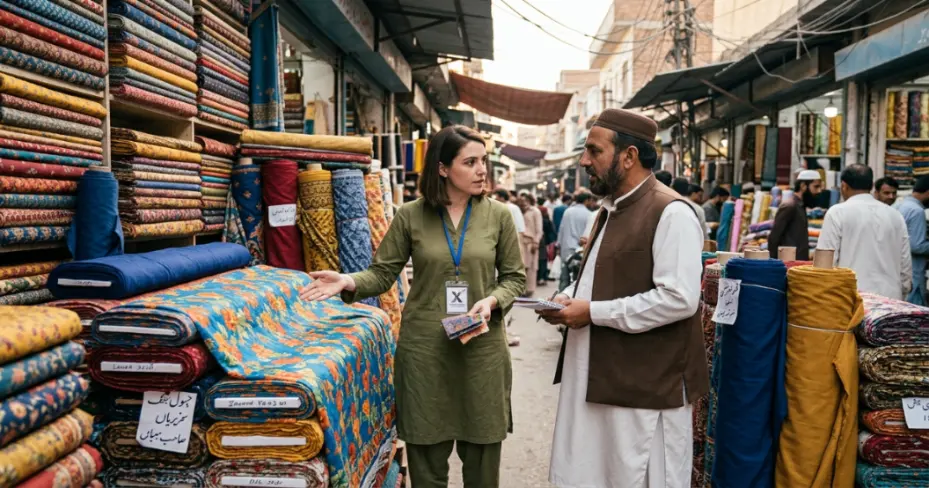
Pakistan’s textile ecosystem is your biggest advantage. For fabric, go to Faisalabad (for cotton, lawn, and blends) or Karachi’s Boultan Market and Jodia Bazaar (for a wider variety including silks and synthetics). For stitching, you have three main options: hire an in-house tailoring team (higher fixed cost), contract with a small stitching unit (flexible but requires quality control), or work with a larger manufacturer (minimum order quantities apply, usually 100+ pieces per design). Many successful small brands start by partnering with a trusted master tailor and a few assistants, then scale to a factory as volumes grow.
Always pay for a sample before committing to bulk production. The sample is your quality benchmark—if the production run does not match it, reject the lot. This is non-negotiable.
Step 5: Design Your Launch Collection (Start Small)
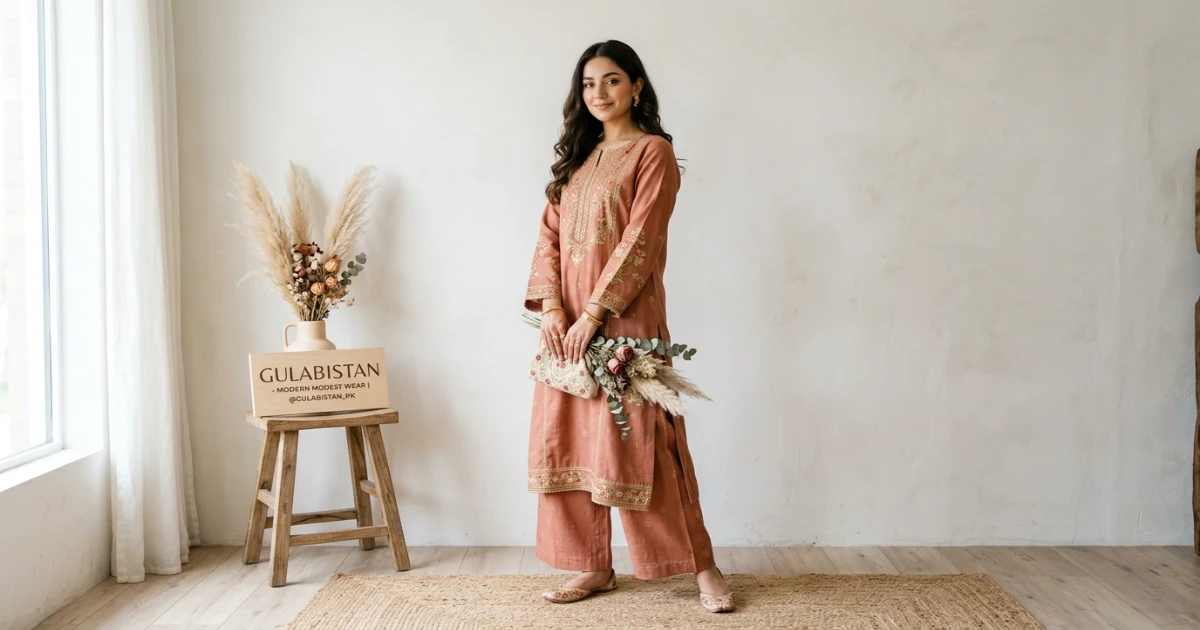
Do not launch with 50 designs. A tight 8–12 piece collection is far smarter. It reduces inventory risk, simplifies production, and allows you to test which styles resonate. Each piece should have clear product photography—this is where many Pakistani brands underinvest. You cannot sell clothing with poorly lit phone photos. Hire a professional photographer or a skilled freelancer; even a half-day shoot with good natural light and a clean backdrop can produce the 15–20 high-quality images you need. Show the garment on a model and include close-ups of fabric texture, stitching, and fit. If you are selling on Instagram (which you absolutely should), invest in short video reels showing the clothing in motion.
Step 6: Set Up Sales Channels
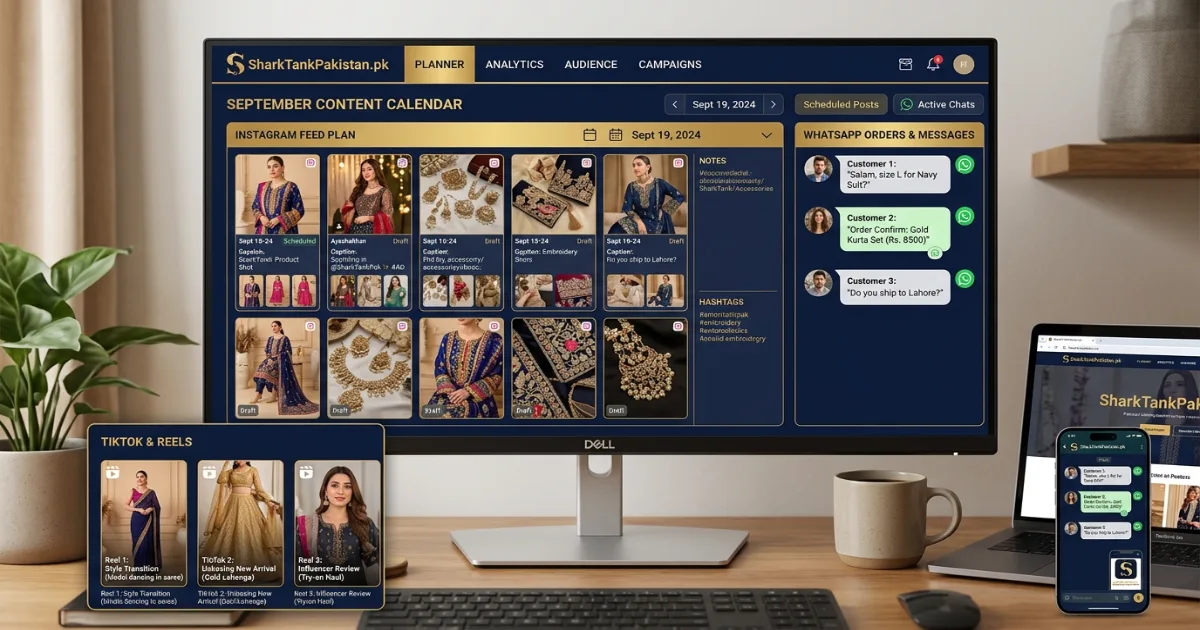
The modern Pakistani clothing brand sells across three channels: an Instagram storefront (with orders via WhatsApp DM or link-in-bio), a dedicated website (Shopify or WooCommerce are the easiest), and optionally a marketplace like Daraz for discoverability. Cash on delivery remains dominant—about 80% of e-commerce transactions in Pakistan—but you must manage COD risk. Partial prepayment (e.g., PKR 300–500 advance via Easypaisa or bank transfer) can reduce returns. Once you scale, integrate a payment gateway like JazzCash, EasyPaisa, or a bank’s online payment system to capture card and mobile wallet payments. Each channel requires different margins and effort; start with Instagram + a simple website and add marketplaces later.
Step 7: Market Like a Brand, Not a Shop
Here is where storytelling separates a brand from a commodity seller. Your marketing should answer: why does this brand exist? What values does it stand for? Is it about Pakistani craftsmanship, sustainable production, or bold self-expression? Use Instagram Reels, TikTok, and influencer collaborations to build awareness. Micro-influencers (5,000–30,000 followers) with high engagement in your niche often deliver better return on investment than celebrity endorsements. Run targeted ads to custom audiences of Pakistani fashion enthusiasts. Collect customer phone numbers and build a WhatsApp broadcast list for new collection launches. The brands that win are those that make customers feel like they are joining something, not just buying a shirt.
🧠 Shark Tank Pakistan Insight: The Sharks consistently ask clothing brand founders about their repeat purchase rate and customer acquisition cost. If you can prove that customers come back and that you can acquire them profitably, you dramatically increase your funding chances. Start tracking these metrics from day one—even if your “system” is a simple Google Sheet.
Comparison: Selling Models for Your Clothing Brand
The business model you choose shapes your pricing, inventory risk, and brand positioning. Here is how the three main models compare for a Pakistani clothing startup.
| Model | How It Works | Capital Needed | Margin Potential | Risk Level |
|---|---|---|---|---|
| Made-to-Order (Pre-Order) | Take orders first, then manufacture. No inventory holding. | Low (PKR 100,000 – 300,000) | 45–55% | Low inventory risk; higher delivery time risk |
| Ready-to-Ship Inventory | Produce stock in advance, ship immediately after order. | Medium (PKR 400,000 – 1,200,000) | 50–65% | Moderate; unsold stock risk |
| Wholesale/Third-Party Retail | Sell batches to boutiques or multi-brand stores. | High (PKR 800,000+) | 35–45% (lower per unit but volume potential) | Lower per-unit risk but requires scale |
| Hybrid (Online D2C + Limited Wholesale) | Mainly sell direct via website/Insta, plus selective boutique partnerships. | Medium-High | 50–60% blended | Balanced; requires strong brand identity |
Situation-Based Advice: How Your Approach Should Shift
If You Are Bootstrapping with Under PKR 500,000
Adopt the made-to-order model. Focus on one product category—perhaps unstitched two-piece suits or printed cotton shirts—and market entirely through Instagram organic content and WhatsApp groups. Do not rent a studio or hire a full-time team. Use a shared stitching unit and handle packaging yourself. Your goal is to reach 50–60 orders per month and generate consistent cash flow before scaling.
If You Have Access to PKR 1.5–3 Million in Capital
You can afford a small ready-to-ship inventory. Launch a dedicated Shopify store, invest in professional product photography, and run targeted Facebook and Instagram ads. Hire one dedicated pattern master and a small quality-control person. Your priority is to prove product-market fit with return customer data. At this stage, track unit economics obsessively—if your gross margin drops below 50%, you will struggle to cover marketing and overhead.
If You Are Building with a Co-Founder Who Handles Operations
Clothing brands live and die on execution, not just design. A co-founder who manages sourcing, production timelines, and logistics lets the creative founder focus on design and marketing. If you are a solo founder, be prepared to spend 60% of your time on operations, not sketching. Many Shark Tank Pakistan investors specifically ask about the team composition for this reason.
If You Eventually Want to Pitch on Shark Tank Pakistan
Start positioning your brand as an investment-ready business now. That means: registered company, clean financial records, documented unit economics, a clear brand identity, and ideally 12+ months of sales data showing growth. Use the Startup Valuation Calculator on SharkTankPakistan.pk to estimate your company’s worth before you walk into the Tank. Know your numbers cold—how much capital you are raising, what equity you are offering, and exactly how you will spend the investment to scale production or enter new markets.
Common Pitfalls When You Start a Clothing Brand in Pakistan
Too many aspiring founders repeat the same mistakes. Learn from them instead of making them.
- Designing for Yourself Instead of a Customer: Your personal taste is not a market. Validate designs with real potential buyers before production. A kurti you love but no one buys is dead stock.
- Underpricing: The fear that “Pakistani customers won’t pay high prices” leads to razor-thin margins. There is a growing segment willing to pay for quality and design. Price for profit, not just to compete with bazaar stalls.
- Ignoring Quality Control: One batch of uneven stitching or color bleeding can destroy your brand’s reputation. Check every piece before it ships. No exceptions.
- Spending Heavily on a Physical Store Too Early: Rent in a good commercial area can swallow your working capital. Build the online brand first. Open a physical outlet only when the data shows concentrated demand in one city.
- Copying a Trend Without a Unique Angle: If everyone is doing lawn, your lawn needs a differentiator—maybe digital prints by Pakistani artists, or a sustainable organic cotton line. Pure copycat brands have no defensibility.
A Real-World Example: The Instagram-First Pakistani Brand
Consider the trajectory of a hypothetical Lahore-based brand we will call “Mitti.” The founder started with PKR 300,000 in personal savings. She designed 10 block-printed cotton co-ord sets, sourced fabric from Anarkali markets, had them stitched by a local tailor she paid per piece. She photographed the outfits on a friend in front of a white wall with natural light. She launched an Instagram page and spent PKR 20,000 on ads targeting women aged 22–35 interested in “sustainable fashion Pakistan.” In the first month, she took 40 orders via WhatsApp DM, with a 50% advance payment. Her average order value was PKR 3,500, cost per unit was PKR 1,400, giving her a 60% gross margin.
By month six, she had reinvested profits into a small website, a proper photoshoot, and a dedicated stitching unit with two tailors. She is now considering raising outside capital to expand into international shipping to the Pakistani diaspora in the Middle East and UK. When she walks into a Shark Tank Pakistan pitch, she will have real numbers, not just enthusiasm.
Tools on SharkTankPakistan.pk That Can Help You
While building a clothing brand is hands-on, financial clarity is what separates hobbyists from serious founders. Use these free tools to keep your business on track:
- Startup Valuation Calculator: Estimate the pre-money valuation of your clothing brand based on revenue, growth rate, and industry multiples. Essential before you pitch any investor or even a bank.
- Equity vs Loan Calculator: Model how taking a loan versus giving up equity impacts your long-term ownership. Many clothing brands fund initial inventory through personal loans; this tool shows the true cost.
- Salary and Cost Calculator: Project your operational expenses—tailor salaries, rent, marketing—so you know exactly how many units you must sell to break even each month.
Open the calculators now and plug in your projected numbers. Seeing the math in black and white often changes the business decisions you make.
FAQs: Starting a Clothing Brand in Pakistan
How much money do I need to start a clothing brand in Pakistan?
You can launch a lean made-to-order brand with as little as PKR 150,000–300,000. For a small ready-to-ship inventory, budget PKR 500,000–1.2 million. The exact figure depends on your product type, marketing plan, and whether you rent a workspace. Start small and reinvest profits rather than overcapitalizing early.
Do I need a registered company to sell clothing online in Pakistan?
Not immediately. You can operate as a sole proprietor with a bank account and a tax filing. But if you plan to scale, raise funding, or claim input tax credit on fabric purchases, registering a private limited company with SECP and obtaining NTN and sales tax registration is strongly recommended.
Which is better: selling on Instagram or having my own website?
Do both. Instagram is where Pakistani consumers discover fashion brands. Use it for marketing, storytelling, and order-taking via DM. A dedicated website (Shopify or WooCommerce) builds credibility, captures email addresses, and allows you to integrate payment gateways for a smoother customer experience. Start with Instagram, add a website within 3–4 months.
Where can I find reliable fabric suppliers and manufacturers in Pakistan?
Faisalabad is the hub for cotton, lawn, and blended fabrics. Karachi’s Jodia Bazaar and Boultan Market offer a vast range including silks and synthetics. For stitching, small units operate in all major cities—ask for referrals in Facebook groups like “Women Entrepreneurs Pakistan” or visit textile clusters. Always get a sample before bulk production.
What are the biggest challenges of running a clothing brand in Pakistan?
Consistent quality control across batches, managing cash flow when dealing with cash-on-delivery returns, and building a distinct brand identity in a crowded market. Additionally, unreliable power supply can delay production, so have backup plans. Successful brands tackle these by obsessing over operations, not just design.
Can a clothing brand get investment on Shark Tank Pakistan?
Absolutely. Clothing and fashion brands have secured deals on Shark Tank globally and in Pakistan. Investors look for differentiated brand identity, healthy unit economics, repeat customer rates, and a clear plan for scaling—often through e-commerce, export markets, or category expansion. A strong pitch with real numbers can win a deal.
How do I price my clothing to be competitive yet profitable?
Calculate total landed cost per unit (fabric, stitching, trims, packaging, delivery). Multiply by 2.5 to 3.5 to get a retail price that covers marketing and overhead while yielding profit. Do not price based on what local shops charge; price based on your brand’s perceived value. A unique design justifies a premium.
Is it possible to export a Pakistani clothing brand internationally?
Yes, and many small brands are doing it via direct shipping to diaspora customers. Focus on lightweight, high-value items (lawn suits, embroidered pieces, statement co-ords). You can use Pakistan Post’s export services or private couriers. Ensure your product tags meet destination country requirements for fiber content and care labels.
⚡ Your Fast-Track Cheat Sheet: Top 3 Actions to Take
- Niche down ruthlessly and validate with pre-orders before bulk production. Do not try to please everyone. A specific customer with a specific need is your beachhead. Sell 30 pieces to that audience before you invest in inventory.
- Register your legal entity and set up a financial tracking system from day one. Even if you start as a sole proprietor, keep separate bank accounts and record every expense. Clean books are the first thing an investor—or Shark—will ask to see.
- Build your brand on Instagram and treat content as seriously as your stitching. Consistent, high-quality visual storytelling converts followers into paying customers. Invest in good photography and reels. Your marketing is not a side task; it is the engine of your business.