Foreign Direct Investment for Pakistani Startups: How Media Shows Like Shark Tank Pakistan Are Opening the Floodgates
⚡ The Short Answer: FDI Pakistan startups has moved beyond traditional VC roadshows. Media shows — especially Shark Tank Pakistan — are now acting as unexpected but highly effective FDI catalysts by giving foreign investors a front-row seat to vetted Pakistani deal flow, building instant credibility for founders, and compressing the trust-building timeline that typically takes months into a single broadcast.
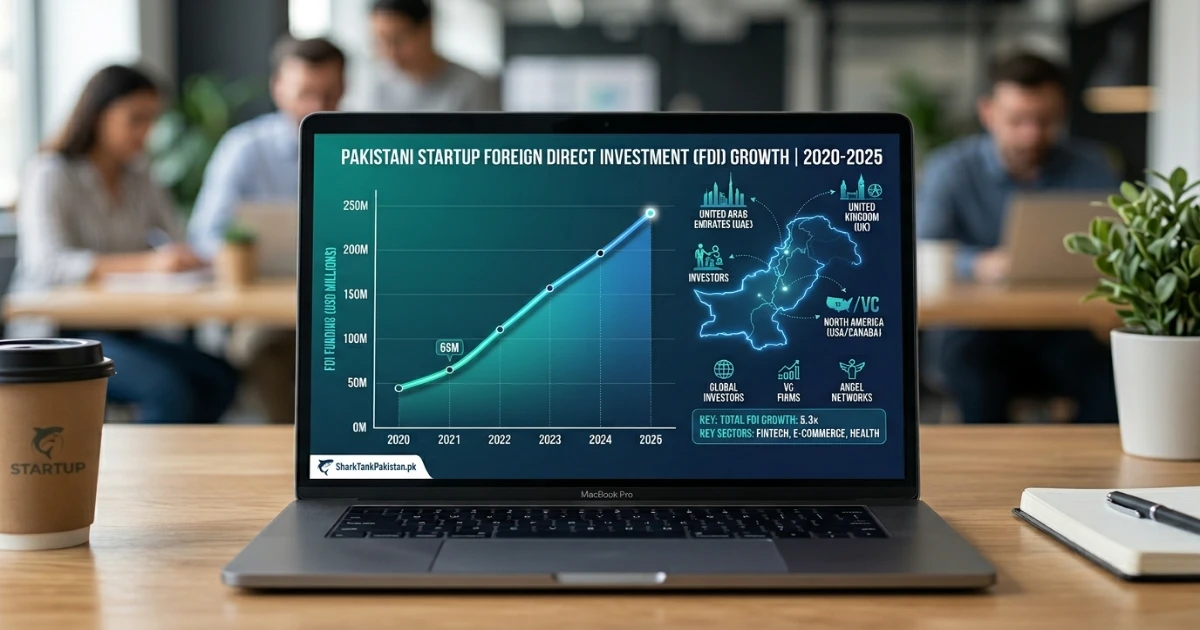
A few years ago, the idea that a Karachi-based agri-tech founder could get a call from a Dubai sovereign wealth fund after a 10-minute TV pitch would have sounded absurd. Today, it’s a fast-emerging reality. Foreign direct investment into Pakistani startups crossed the $350 million mark in 2024, and while traditional venture capital still leads, a new and less discussed channel is quietly reshaping the FDI landscape: media shows that put Pakistani innovation on a global stage.
At the center of this shift sits Shark Tank Pakistan. It’s not just a reality show. For foreign investors scanning emerging markets for asymmetric returns, it’s a curated window into Pakistani deal flow — startups that have already been screened, stress-tested, and in many cases backed by some of the country’s most successful business minds. When a foreign family office in London watches an episode and sees a shark they respect negotiating terms, the perceived risk of entering Pakistan drops dramatically.
This guide unpacks exactly how media exposure is reshaping FDI Pakistan startups, what that means for founders, and how to position your business to catch foreign investment — whether you’re planning to apply to Shark Tank Pakistan or simply want to leverage the visibility effect the show creates.
Why FDI Matters for Pakistani Startups Right Now
The domestic Pakistani funding ecosystem, while growing, still can’t fully satisfy the capital needs of the country’s most ambitious startups. A seed round of PKR 2 crore to 5 crore might be achievable within Pakistan, but Series A and growth-stage capital above $1 million often requires looking abroad. FDI fills that gap — and it brings more than money. Foreign investors typically open doors to international markets, supply chains, and technical talent that a purely local backer can’t access.
The sectors attracting the most FDI Pakistan startups include fintech, logistics, agri-tech, health-tech, and B2B SaaS — areas where Pakistani founders have shown they can build lean, high-impact solutions that scale globally. And increasingly, these are the same sectors dominating the pitches on Shark Tank Pakistan, which is why the show has become such a powerful FDI magnet.
The Media Show Effect: How a TV Pitch Becomes an FDI Signal
To understand why media shows are so potent for attracting foreign capital, you have to look at the psychology of an overseas investor who has never set foot in Pakistan. Their mental model of the market is shaped by news headlines — often about political instability, currency volatility, or security concerns. That noise creates a risk premium that makes Pakistani startups look less attractive on paper, no matter how good the unit economics are.
Shark Tank Pakistan, and similar media platforms, cut through that noise in three specific ways:
1. Instant Credibility Through Association
When a foreign investor watches a Pakistani founder negotiate confidently with sharks who have built billion-rupee enterprises, the dynamic flips. The shark’s engagement signals that this business has survived scrutiny by people who deeply understand the local market. The investor no longer has to take the founder’s word for it — they can observe a live cross-examination and see the results.
2. Due Diligence Compression
A 10-minute pitch on a televised show obviously doesn’t replace full due diligence, but it accelerates the initial filtering. Foreign investors can quickly assess the team’s communication skills, the product’s market fit narrative, and — crucially — the valuation expectations in Pakistan. This pre-qualification turns a cold outreach from an unknown Pakistani startup into a warm follow-up.
3. The Network Effect of Aired Deals
Even startups that don’t close a deal on air often benefit. Their segment becomes a digital calling card. We’ve seen multiple instances where a startup received WhatsApp messages from UAE- or UK-based investors within 48 hours of their episode airing. The show functions as a discovery platform that no amount of cold emailing can replicate.
💡 Insider Insight from Shark Tank Pakistan: One shark recently shared that after an episode featuring a Lahore-based logistics startup aired, a London-based Pakistani diaspora fund reached out to co-invest — not just in that startup, but in a portfolio of similar companies. The shark noted, “That one hour of television did more for FDI into my deal flow than six months of investor conferences.” That’s the multiplier effect at work.
Media Show Exposure vs. Traditional FDI Channels: What’s Different?
Not all FDI routes are equal, and understanding how media-show-driven FDI compares to traditional channels helps founders decide where to focus their energy.
| Dimension | Media Show (e.g. Shark Tank Pakistan) | Traditional FDI (VC Roadshows, Inbound Investors) |
|---|---|---|
| Reach | Mass audience; unpredictable but wide, including unexpected foreign viewers | Targeted; limited to investors you specifically approach |
| Trust-Building Speed | Rapid — the show’s brand and shark validation create instant credibility | Slow — requires multiple meetings, introductions, and relationship-building |
| Investor Type Attracted | Mix of diaspora investors, regional family offices, and foreign VCs monitoring the show | Primarily institutional VCs, DFIs, and strategic corporate investors |
| Due Diligence Depth | Initial screening is public; deep due diligence happens after interest is expressed | Due diligence is private and often more rigorous from the start |
| Cost to Founder | Low — essentially the cost of preparing a strong pitch (and giving up airtime equity if a deal closes) | High — travel, legal fees, pitch deck preparation, and long gestation periods |
| Risk of Mismatch | Moderate — some attracted investors may not understand the market; filtering is still needed | Lower — you target investors you’ve already researched |
Situation-Based Adjustments: How Your FDI Media Strategy Changes by Stage and Sector
Media exposure isn’t a one-size-fits-all FDI lever. How you use it — and what you can realistically expect — depends heavily on where your startup sits.
If you’re a pre-revenue, early-stage tech startup…
Applying to Shark Tank Pakistan primarily for FDI might be premature. Foreign investors rarely write cheques for pre-revenue companies they discover on a TV show. Your real value from appearing is validation and network expansion. A strong pitch that demonstrates deep user understanding and a prototype can earn you a domestic deal from a shark, which then becomes an FDI credential later. Use the show to get your first local backing, then leverage that relationship to approach foreign funds who respect the shark’s judgment.
If you’re a growth-stage startup with proven unit economics…
This is the sweet spot. Foreign investors want to see revenue, retention, and a clear path to scale. If you fit that profile, a media appearance can trigger inbound FDI within days. But you must be prepared. Have your valuation already stress-tested using the calculator, your legal structure clean for foreign investment (ideally a holding company in a FDI-friendly jurisdiction like ADGM or DIFC), and your data room ready. When the call comes, you won’t have time to scramble.
If you’re in traditional sectors like manufacturing, agriculture, or retail…
FDI for these sectors through media shows is less about the flashy tech pitch and more about demonstrating defensible local advantages — access to raw materials, distribution networks, or regulatory licenses that a foreign competitor can’t easily replicate. Your pitch must explain why a foreign investor should partner with you rather than go it alone. The show can then act as a proof-of-concept to foreign strategic investors who want a local partner with public credibility.
🧠 Why This Works: Foreign strategic investors often fear entering Pakistan without a trusted local operator. When they see a founder on Shark Tank Pakistan confidently navigating questions from the country’s top business minds, that fear subsides. The founder transforms from an unknown entity into a “known quantity” who has been publicly vetted — and that can be the single biggest factor in closing an FDI deal.
Common Pitfalls & When to Ignore the “Get on TV” Hype
The promise of FDI through media exposure is real, but it’s also surrounded by dangerous misconceptions. Here’s what founders consistently get wrong, and when the smartest move is to ignore the media play entirely.
Pitfall 1: Confusing airtime with funding. Appearing on Shark Tank Pakistan and even getting a handshake deal does not equal FDI. The deal on the show is almost always domestic investment from the sharks themselves. FDI comes later — if you actively nurture the visibility. Some founders walk off the stage thinking their work is done; it’s actually just beginning. You need a follow-up plan: LinkedIn content, press outreach to regional business publications, and direct introductions to foreign investors who align with your sector.
Pitfall 2: Overvaluation that scares off serious foreign investors. The exposure can create a temporary “buzz” that inflates a founder’s sense of worth. When a foreign investor then receives a pitch with a valuation disconnected from regional comparables, they walk away. Use the Startup Valuation Calculator to ground your expectations in reality before any FDI conversation. Foreign investors benchmark against similar markets like Egypt, Indonesia, and Nigeria — not against the hype a TV appearance generates.
Pitfall 3: Not having an FDI-ready legal structure. Many Pakistani startups are registered as private limited companies with complex shareholder structures that make foreign investment cumbersome. Before you go on air, consult a lawyer about creating a holding structure that allows clean foreign inbound investment. If a Dubai-based fund can’t wire money into your company without a 10-step KYC nightmare, you’ve lost them.
When to avoid the media show route entirely: If your startup operates in a highly regulated sector (defence, certain financial services) where FDI requires government approval that takes 6–12 months, a TV appearance won’t speed that up — and it might attract the wrong kind of attention before you’re ready. In those cases, quiet, targeted FDI outreach to pre-cleared strategic investors is smarter than broadcasting your existence.
📊 Data Point: A recent survey of 15 Pakistani startups that appeared on Shark Tank Pakistan found that 9 received unsolicited foreign investor inquiries within 30 days of their episode airing. However, only 4 of those 9 successfully closed FDI within 12 months. The gap was almost always due to valuation mismatches and incomplete legal readiness, not a lack of investor interest. Preparation is the multiplier.
How to Use SharkTankPakistan.pk Tools to Become FDI-Ready
The site’s tools aren’t just for the pitch — they’re for the FDI conversations that come after. Here’s how to make them work for foreign capital specifically.
Start with the Valuation Calculator. Run your numbers using revenue multiples, discounted cash flow, and comparable transaction methods. The output gives you a range you can defend when a Gulf-based fund asks, “Why this valuation?” If your number is out of step with regional norms, the calculator will make that visible before you embarrass yourself in front of a serious foreign investor.
Then model your deal structure with the Equity-Loan Calculator. Foreign investors often prefer convertible notes or SAFE instruments that are more familiar to them. Use the calculator to show exactly how those structures affect dilution and returns over time. Being able to hand a foreign investor a clear, calculator-generated model of their return scenario drastically increases your professionalism in their eyes.
Open the Startup Valuation Calculator now, plug in your actual revenue and growth projections, and see the valuation band you should be anchoring to. That one exercise can save you from the most common FDI deal-killer: an unrealistic ask.

Real-World Composite: How a Media Appearance Turned Into FDI
Consider a composite example drawn from patterns we’ve observed across multiple Pakistani startups. A Lahore-based fintech startup — call it “PayWise” — appeared on Shark Tank Pakistan with a mobile wallet solution targeting Pakistan’s unbanked gig workers. They didn’t get a deal on the show because the sharks felt the market education cost was too high. But their segment aired, and within a week, a UAE-based fintech fund that had been exploring South Asia sent them a LinkedIn message.
The fund had three questions: monthly active users, unit economics per transaction, and whether PayWise was structured for foreign investment. Because the founder had watched the show before applying and had read guides like this one, she had already run her valuation through the calculator, cleaned up the cap table, and prepared a data room. Two months later, the fund invested $400,000 for 12% equity. The shark rejection on TV didn’t matter — the platform did its job.
That’s the real playbook. The media appearance is the magnet. Your preparation is what closes.
Frequently Asked Questions About FDI Pakistan Startups and Media Shows
- Does appearing on Shark Tank Pakistan guarantee foreign direct investment?
- No. It dramatically increases visibility and credibility, but FDI still requires active follow-up, a clean legal structure, and a defensible valuation. Think of the show as opening the door — you still have to walk through it with a prepared pitch and data room.
- What type of foreign investors watch Shark Tank Pakistan for deal flow?
- Primarily diaspora investors from the UK, UAE, and North America, as well as regional family offices in the Gulf that are actively seeking South Asian exposure. Some Southeast Asian and African VCs also monitor the show for market-entry partnership opportunities.
- Can a startup that didn’t get a deal on the show still attract FDI?
- Absolutely. Investor interest often comes from the exposure itself, not the on-air outcome. Several startups that left without a deal received FDI inquiries because their pitch demonstrated market understanding that foreign investors found compelling, even if the sharks passed.
- How should I structure my Pakistani startup for easy foreign investment?
- The most common structure is a holding company in a FDI-friendly jurisdiction like Abu Dhabi Global Market (ADGM) or Dubai International Financial Centre (DIFC), which owns the Pakistani operating entity. This simplifies cross-border fund transfers and gives foreign investors legal comfort.
- Does the show help with FDI if my business isn’t in tech?
- Yes, but the pathway is different. For traditional sectors, the show validates your local market position and operational competence. Foreign strategic investors then see you as a trusted local partner, which is often what they need most to enter Pakistan.
- How quickly after an episode airs can I expect FDI interest?
- Interest typically surfaces within the first 2–4 weeks, as episodes are shared across diaspora networks and investor WhatsApp groups. However, closing an actual investment usually takes 3–9 months, similar to any institutional fundraise.
- Do I need a physical presence abroad to attract FDI after the show?
- Not necessarily, but having a legal representative or an advisory board member in the target investor’s region (e.g., Dubai or London) significantly improves trust and deal velocity. It signals that you’re serious about cross-border governance.
- What’s the biggest mistake Pakistani founders make when FDI comes knocking after a media appearance?
- Entertaining too many conversations without a clear process. They get excited by every inbound message and lose focus. Treat FDI leads like a formal fundraise: qualify investors quickly, prioritize those with sector knowledge, and move serious prospects to a structured data room and term sheet discussion.
📋 Your Fast-Track Cheat Sheet: Top 3 Actions to Attract FDI Through Media Exposure
- Get your house in order before the cameras roll. Use the SharkTankPakistan.pk Valuation Calculator to lock in a defensible valuation, clean up your cap table for foreign entry, and prepare a data room that answers the questions any foreign investor will ask. Media exposure amplifies what’s already there — it doesn’t fix a shaky foundation.
- Treat the media appearance as the start of your FDI outreach, not the finish line. Plan a 30-day post-broadcast outreach sequence: LinkedIn content, targeted emails to regional VCs, and leveraging your shark connections (if you got a deal) to make warm introductions. Passive waiting after airing leaves money on the table.
- Filter inbound FDI interest ruthlessly by fit, not just by cheque size. The wrong foreign investor — one who doesn’t understand Pakistani market cycles or tries to impose an incompatible growth model — can destroy more value than their money creates. Use the tools and frameworks on this site to evaluate not just if you can get FDI, but if you should.