Islamabad/Rawalpindi: The New Startup Hubs in 2026?
💡 The Short Answer: Yes, Islamabad startups are rapidly reshaping Pakistan’s entrepreneurial map — with a unique blend of government support, top-tier talent, and lower operating costs. While Karachi still leads in volume and Lahore in creative energy, the twin cities are quietly becoming the smartest launchpad for capital-efficient, tech-forward ventures that could one day dominate a Shark Tank Pakistan pitch.
~12 minutes
Founders evaluating where to base a startup, Shark Tank Pakistan applicants from the north
SaaS, EdTech, HealthTech, AgriTech, GovTech
Rapidly maturing — last 3 years have seen a 2x increase in funded startups
For years, the Pakistani startup conversation orbited around Karachi’s sprawling commercial energy and Lahore’s creative buzz. Islamabad, with its wide boulevards and quieter pace, seemed like a city for government officers and diplomats — not entrepreneurs. That perception is now dangerously outdated. A wave of Islamabad startups is proving that the capital region, including its twin city Rawalpindi, might just be the most pragmatic place to build a venture in Pakistan right now. If you’re planning to apply to Shark Tank Pakistan, or simply want to raise your first round in a location that rewards thoughtfulness over hype, it’s time to look north.
The Twin Cities Advantage: Why Islamabad and Rawalpindi Are Gaining Ground
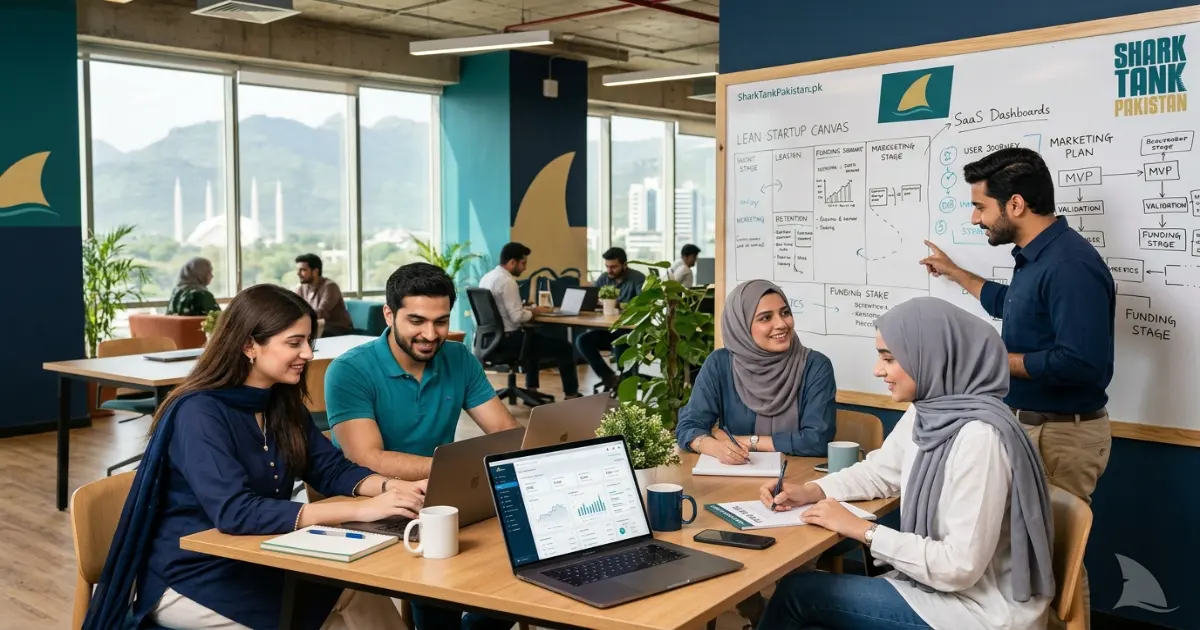
Islamabad and Rawalpindi together offer a startup environment that is distinct from the country’s two traditional powerhouses. The advantages are structural, not accidental. First, proximity to federal government ministries means that policy-driven startups — think GovTech, health-tech, or agri-tech — can build relationships and pilot projects faster. Second, the cost of living and commercial rent in Islamabad is still significantly lower than in Karachi’s Defence or Lahore’s Gulberg, allowing founders to extend their runway by 20–30%. Third, the human capital pipeline is exceptional: NUST, FAST, Air University, and Comsats are churning out engineers, designers, and business graduates who often prefer to stay local rather than relocate.
Rawalpindi adds another layer. It offers even lower real estate costs, a dense consumer market, and a gritty, hustle-oriented culture that balances Islamabad’s sometimes overly deliberate pace. Together, the twin cities create a dual-speed ecosystem where you can plan in Islamabad’s calm and test in Rawalpindi’s chaos.
How Islamabad Startups Compare to Karachi and Lahore
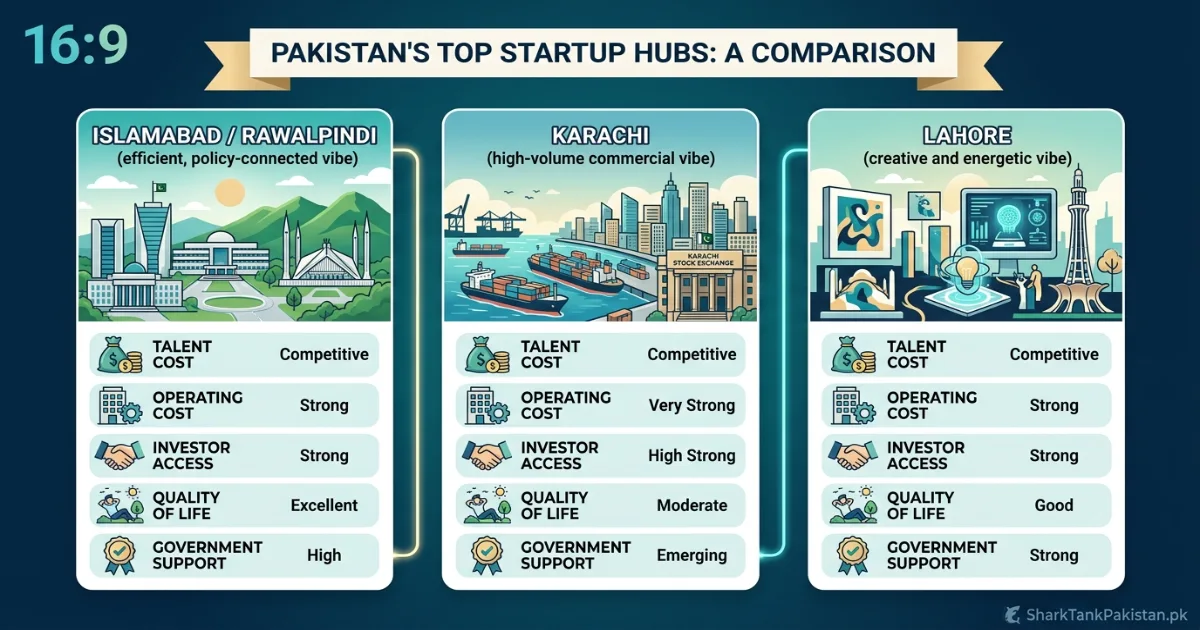
To make an informed decision about where to base your startup, you need to see the trade-offs clearly. The table below stacks Islamabad/Rawalpindi against the two more established hubs.
| Factor | Islamabad / Rawalpindi | Karachi | Lahore |
|---|---|---|---|
| Talent Quality & Cost | Strong tech talent from top universities; salaries 15–25% lower than Karachi | Deepest and most diverse talent pool, but highest salary expectations | Excellent creative and tech talent; mid-range costs |
| Operating Costs | Lowest among major cities; coworking desks from PKR 8,000/month | Highest; prime office space is expensive | Moderate, rising quickly in Gulberg/DHA |
| Access to VC / Angel Funding | Growing; local angels plus a few VCs opening offices; still behind Karachi | Largest concentration of institutional investors and angel networks | Strong investor presence, especially for consumer tech |
| Quality of Life | Clean, green, minimal traffic; easier to retain talent | High energy but chaotic infrastructure; longer commutes | Lively cultural scene but increasing congestion |
| Government Connections | Unmatched access to federal ministries and regulators | Provincial government access; more bureaucratic layers | Provincial access; strong Punjab IT Board support |
| Shark Tank Pakistan Footprint | Increasing number of contestants; auditions held regularly | Historically most contestants; still the biggest pool | Strong representation; many food and apparel brands |
💡 Insider Insight from Shark Tank Pakistan Scouts: Audition teams have noted that Islamabad-based founders tend to arrive with more polished financials and clearer regulatory compliance — likely because they’re closer to SECP and tax authorities. However, they sometimes undersell their storytelling compared to Karachi and Lahore founders. The lesson: use Islamabad’s precision as your foundation, but don’t forget to bring the emotional fire that Sharks look for.
The Sectors Thriving in Islamabad’s Startup Ecosystem
Not every business is suited for the twin cities. But in a few sectors, Islamabad startups are genuinely leading the pack.
SaaS and B2B Tech
Islamabad’s calm environment is ideal for building complex software products. Companies like AlmaBetter and EduFi are writing code that serves both local and international clients. The lower burn rate means SaaS startups can survive longer on smaller seed rounds while they find product-market fit.
EdTech and HealthTech
Proximity to the Higher Education Commission and health regulatory bodies gives EdTech and HealthTech ventures a head start. Piloting a new learning platform in Islamabad’s schools or a telemedicine solution with Polyclinic is logistically simpler than navigating three layers of bureaucracy in Karachi.
AgriTech and GovTech
This is where Islamabad’s location becomes a moat. Startups working on farm-to-fork supply chains or digital government services can literally walk into ministry offices for feedback and partnership. No other city offers this level of policy-level access.
Government Support and Policy Tailwinds
Islamabad’s startup rise isn’t just organic; it’s being engineered. The Special Technology Zones Authority (STZA) offers a 10-year tax holiday on income, customs duty exemptions on equipment, and other incentives for tech companies that set up in designated zones. Ignite National Technology Fund runs multiple grant programs, and the National Incubation Center (NIC) in Islamabad has graduated over 200 startups. These are tangible tailwinds that directly reduce the cost and risk of launching a venture.
For a Shark Tank Pakistan contestant, mentioning that your startup is STZA-registered or an NIC graduate adds instant credibility — it signals to investors that your business has already cleared a vetting process. It’s a quiet edge that many Karachi-based founders lack.
📊 Data Point: According to a 2025 report by Invest2Innovate, Islamabad-based startups raised over $35 million in disclosed funding in the last two years — nearly triple the figure from the previous biennium. While still trailing Karachi’s $120 million, the growth rate is the steepest in the country.
The Reality Check: Challenges Nobody Talks About
I wouldn’t be a useful mentor if I only painted a rosy picture. Islamabad’s startup ecosystem is real, but it has sharp edges.
- Smaller local market for consumer goods. If your product relies on massive B2C volume, Islamabad’s population is a fraction of Karachi’s. You’ll need to expand south quickly — and that means bridging a cultural and logistical gap.
- Shallow investor networks. While angels exist, the density of active, risk-hungry investors is lower. Many founders still travel to Karachi for serious fundraising rounds. The Sharks on Shark Tank Pakistan are based across cities, but the post-deal mentorship often flows through Karachi’s networks.
- A conservative business culture. Islamabad can feel risk-averse compared to Lahore’s hustle. “Beta, get a government job” is still a common refrain. Breaking out of that mindset requires deliberate effort to surround yourself with other founders.
- Infrastructure gaps in Rawalpindi. While Rawalpindi offers cost advantages, power outages and internet stability in some areas lag behind Islamabad proper. If your startup is fully remote-dependent, choose your specific neighborhood carefully.
Situation-Based Advice: Should YOU Build Your Startup in Islamabad?
The answer depends heavily on what kind of founder you are and what you’re building.
If You’re a First-Time Tech Founder
Islamabad might be your safest bet. Lower costs give you a longer runway to make mistakes. The close-knit community means you can find mentorship easily — NIC and local meetups are less crowded with posers than in Karachi. You can afford a small office in Blue Area or I-8 without sacrificing half your seed round.
If You’re Building a Consumer Brand (Food, Fashion, Retail)
Be cautious. Islamabad’s consumer base is affluent but small. You’ll need a clear plan to penetrate Lahore and Karachi’s far larger markets. Rawalpindi, however, can serve as a valuable testing ground — its diverse demographic mimics the broader Pakistani middle class more closely than Islamabad’s elite sectors.
If You’re Pre-Revenue and Bootstrapping
The twin cities are a blessing. Rent a desk at a coworking space for a few thousand rupees, hire part-time talent from local universities, and apply to Ignite grants. You can stretch PKR 20 lakh for 12–15 months, compared to 8–10 months in Karachi. That extra time often makes the difference between a pivot and a shutdown.
If You’re Preparing for Shark Tank Pakistan
Being from Islamabad is neither a plus nor a minus — it’s a story angle. Use it to your advantage. Frame your startup as one that’s built in the country’s policy nerve center, with unique insights into regulation and national-scale opportunities. Then, use the Startup Valuation Calculator to prove that your lean cost structure leads to higher margins than comparable Karachi-based businesses. Numbers win arguments, and Islamabad’s cost advantage translates directly into numbers.

Common Pitfalls & When to Ignore the “Islamabad Hype”
The narrative that “Islamabad is the next Silicon Valley of Pakistan” can lead to complacency. Here’s where founders get it wrong — and when it’s smart to ignore standard advice.
- Pitfall: Assuming low costs mean easy success. Lower burn doesn’t excuse weak unit economics. You still need to build something people will pay for. Don’t confuse a long runway with a viable business.
- Pitfall: Staying insular. Islamabad’s ecosystem can feel like a bubble. If you never travel to Karachi or Lahore for investor meetings and industry events, you’ll miss crucial connections. The Sharks on Shark Tank Pakistan expect you to understand the whole country, not just F-6.
- When to ignore the advice “always raise in Karachi”: If you’ve built a GovTech startup with actual ministry contracts, raising in Islamabad from angels who understand the procurement cycle may be smarter than chasing Karachi VCs who won’t appreciate the asset. Context trumps dogma.
- Pitfall: Underestimating talent retention. Yes, you can hire cheaper, but top developers will still leave for remote international jobs if you don’t offer equity and a compelling mission. The Islamabad talent pool is deep but not infinite; treat your team like a competitive advantage.
How SharkTankPakistan.pk Tools Help Islamabad Founders Raise Smarter
One advantage of Islamabad’s understated style is that founders are often more meticulous. Channel that into our calculators. Use the Equity vs Loan Calculator to model different funding scenarios against your lower fixed costs. You might discover you need less capital than a Karachi competitor, which translates into less dilution — a huge win when you negotiate equity with investors. The Valuation Calculator can help you anchor your ask with data that reflects your efficiency. When you finally stand before the Sharks, you won’t just tell them you’re from Islamabad; you’ll show them why that means their investment will stretch further and deliver higher returns.
Real-World Spark: The Agritech Startup That Quietly Scaled from Islamabad
Take the case of a bootstrapped agritech platform that began in a tiny office in I-9. The founders leveraged connections with the Ministry of National Food Security to pilot their digital marketplace for small farmers in Potohar. With a modest PKR 8 million grant from Ignite and an additional PKR 2 crore from a local angel network, they avoided costly Karachi rent and built a lean team from NUST graduates. Their valuation, when they finally pitched to institutional investors, was supported by real government contracts and a 40% month-over-month growth in farmer onboarding — not just hype.
The company hasn’t yet appeared on Shark Tank Pakistan, but its trajectory mirrors what the smartest Islamabad startups are achieving: quiet growth that becomes impossible to ignore.
FAQs: Islamabad and Rawalpindi Startup Questions Answered
Are Islamabad startups really getting funded?
Yes, and the pace is accelerating. In 2024 alone, Islamabad-based startups raised over $20 million across seed and pre-seed rounds. While Karachi still dominates total volume, Islamabad’s deal count is growing faster year-on-year, especially in B2B and deep tech.
Is Rawalpindi cheaper than Islamabad for a startup office?
Yes, commercial rents in Rawalpindi can be 30-50% lower than in Islamabad’s Blue Area or F-sectors. However, check internet reliability and power backup; some older commercial areas need infrastructure upgrades. Saddar and Bahria Town offer good balances.
Which universities produce the best startup talent in the twin cities?
NUST and FAST are the top feeders, especially for engineering and computer science. COMSATS and Air University also contribute strong talent. Many founders actively recruit final-year students through internship-to-hire pipelines.
Does the government really help startups in Islamabad?
Yes, through STZA tax incentives, Ignite grants, and NIC incubation. The key is navigating the paperwork — which is easier when you’re physically present in Islamabad to attend meetings and build relationships with program officers.
Can I appear on Shark Tank Pakistan if my startup is based in Islamabad?
Absolutely. Shark Tank Pakistan holds open auditions in Islamabad, and several contestants from the twin cities have already secured deals. The show’s production actively scouts for diversity of location, so being from the north can work to your advantage.
What type of startup is most likely to succeed in Islamabad?
B2B SaaS, GovTech, AgriTech, and EdTech have the highest success rates because they align with Islamabad’s strengths: policy access, talent density, and lower costs. Pure consumer brands need a clear plan to scale beyond the city’s limited population.
Is it better to start my business in Karachi or Islamabad?
It depends entirely on your industry and personal network. If you need massive consumer volume or dense investor networks, Karachi still wins. If you’re building a capital-efficient tech product and value a quieter, policy-adjacent environment, Islamabad is the smarter choice.
How do I find a co-founder or technical partner in Islamabad?
Attend events at NIC Islamabad, join the “Islamabad Startups” Facebook group, and hang out at coworking spaces like Daftarkhwan or The Hive. The community is smaller and more welcoming than in Karachi, making it easier to build genuine connections.
✅ Your Fast-Track Cheat Sheet: Top 3 Actions to Take
1. Visit NIC Islamabad and STZA in person. Spend a day understanding the incentives, grants, and mentorship available. Many founders leave money on the table simply because they never walked through the door.
2. Model your costs with Islamabad-specific inputs. Use the SharkTankPakistan.pk Equity and Valuation calculators, but plug in the lower rent, salary, and operational costs typical of the twin cities. See how much extra runway that buys you — and let that shape your funding ask.
3. Build a bridge to Karachi and Lahore early. Don’t become an Islamabad-only founder. Attend at least one major startup event in Karachi before you fundraise, and build relationships with at least three investors from outside the twin cities. The Sharks will respect a founder who truly understands Pakistan, not just one city.