
Reduce Bounce Rate Pakistan: Convert Casual Visitors Into Paying Customers
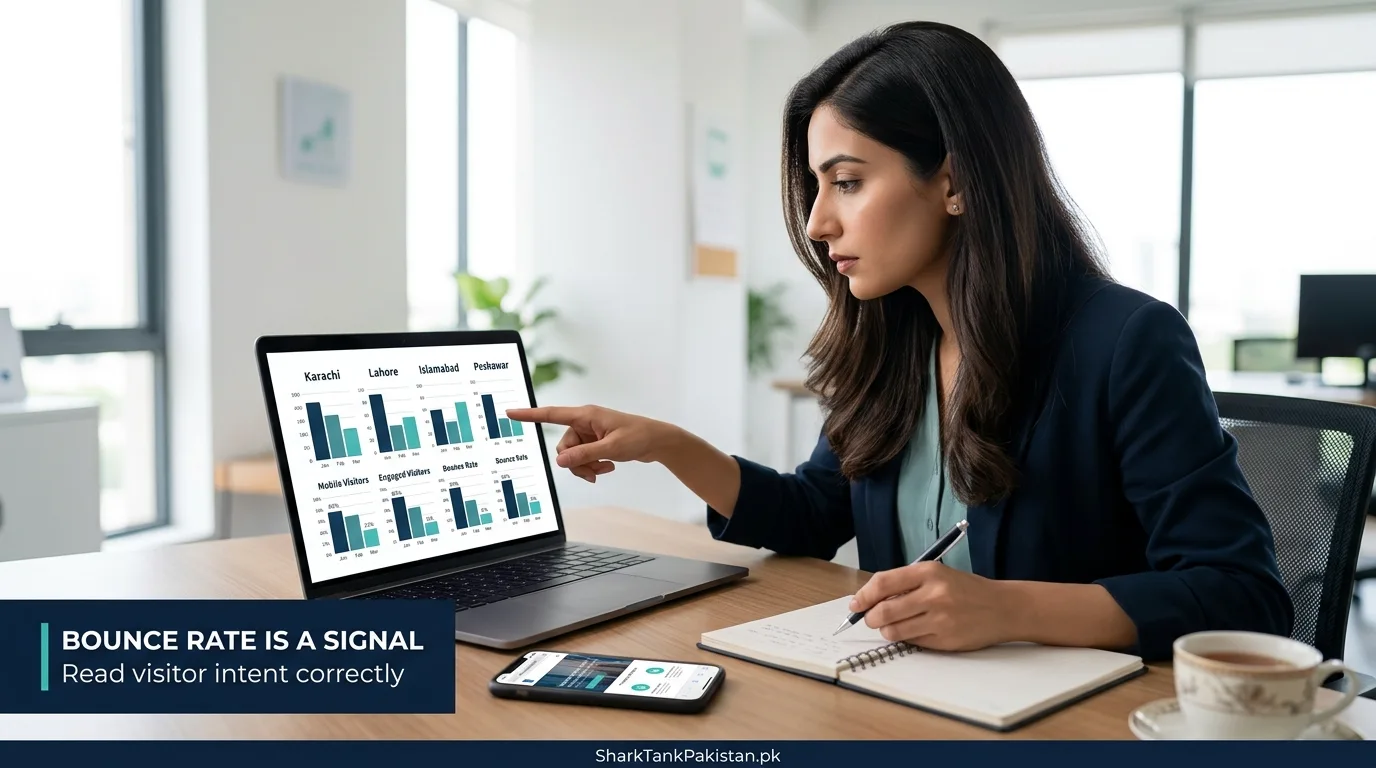
⚡ The Short Answer: Reduce bounce rate Pakistan by matching visitor expectations within three seconds of landing: use clear above-the-fold messaging, fast mobile pages, and one obvious next action. For Pakistani businesses, these practical fixes help turn paid and organic visitors into enquiries, orders and repeat customers.
If you are building a business in Pakistan, a reduce bounce rate Pakistan strategy can protect revenue before you spend more money on traffic. Whether you are a Shark Tank Pakistan contestant, a Shopify founder in Gulberg, or a services startup in Islamabad, your website is constantly deciding whether visitors stay or leave.
A high bounce rate can waste ad spend, reduce enquiries and weaken your conversion story. Visitors decide quickly, so clarity, speed and a useful next step matter from the first screen.
Reducing bounce rate is not about gimmicks. Aggressive pop-ups, countdown timers and heavy animations can make the experience worse, especially on mobile connections.
This reduce bounce rate Pakistan guide focuses on practical improvements: page-speed fixes, clearer landing-page messaging, trustworthy calls to action and better content paths for e-commerce, SaaS and service businesses.
Reduce Bounce Rate Pakistan: What the Metric Actually Means
Let’s clear up the biggest misconception first. Bounce rate is the percentage of visitors who land on a single page of your site and leave without triggering a second pageview or a meaningful interaction event. A “bounce” is not automatically bad. Someone might land on your contact page, find your phone number, call you, and never click another page. That’s a bounce — and a successful conversion at the same time. The metric is useful only when you understand the intent behind the visit.
For Pakistani businesses, context matters enormously. A visitor from a Facebook ad on a slow 3G connection in Peshawar who abandons your product page after eight seconds of loading is a very different story from someone on fiber broadband in Karachi who reads your entire blog post, books a consultation, and leaves satisfied. Google Analytics 4 has thankfully moved toward engagement rate as a smarter metric, but bounce rate remains a critical diagnostic signal — especially when segmented by traffic source, device type, and geography.
Why Reduce Bounce Rate Pakistan Efforts Protect Startup Revenue
Let’s put numbers to the problem. Suppose your online store selling Pakistani artisanal goods gets 10,000 monthly visitors from organic search and paid ads, with an average order value of PKR 4,500. If your bounce rate sits at 72% — not uncommon for under-optimized Pakistani e-commerce sites — only 2,800 visitors even stick around to browse. If a modest optimization effort drops your bounce rate to 58%, you now have 4,200 engaged visitors. That’s 1,400 more potential buyers per month. Even at a conservative 2% conversion rate, that’s 28 additional orders — roughly PKR 126,000 in new monthly revenue — from the same traffic you were already paying for.
For startups pitching on Shark Tank Pakistan, these numbers carry extra weight. Investors — whether Sharks or angels in the room — increasingly ask to see digital traction metrics. A high bounce rate on your flagship site raises immediate questions about product-market fit, user experience competency, and whether you truly understand your customer. You don’t want to be fumbling for explanations when Rabeel Waraich or Junaid Iqbal asks about your online conversion funnel.
Reduce Bounce Rate Pakistan: Diagnose Why Visitors Leave
Before changing a single pixel, you need to know why people are leaving. A reliable reduce bounce rate Pakistan audit starts with evidence from traffic sources, mobile performance and session behaviour rather than blind redesigns.
1. Segment Your Bounce Rate by Traffic Source
Open GA4 and compare bounce rates across organic search, paid social, direct traffic, and referral. Often, paid social — especially from TikTok and Facebook ads popular in Pakistan — drives the highest bounce rates because ad creative sets expectations that the landing page doesn’t match. If your Facebook ad promises “Premium Leather Jackets Starting at PKR 3,999” and the landing page shows a full catalog with prices starting at PKR 7,500, visitors will bounce instantly. That’s not a design problem. That’s a promise-delivery gap.
2. Check Mobile Performance on Local Networks
Over 80% of Pakistani web traffic comes from mobile devices, and connection speeds vary dramatically by region and carrier. Use PageSpeed Insights and test with throttled connections mimicking 3G and 4G conditions. A page that loads in 1.8 seconds on your office fiber connection might take 9 seconds on a Jazz or Zong 4G connection in a congested area. Those extra seconds are bounce-rate killers.
3. Watch Session Recordings
Tools like Hotjar or Microsoft Clarity (free) let you watch anonymized recordings of real visitors. You’ll spot exactly where they hesitate, where they scroll, and where they abandon the page. For one Lahore-based fashion brand, session recordings revealed that visitors were repeatedly clicking on product images expecting zoom functionality — and bouncing when nothing happened. A simple image zoom plugin reduced their product page bounce rate by 19% in three weeks.
Step-by-Step: Reduce Bounce Rate Pakistan and Improve Sales
Now put your reduce bounce rate Pakistan plan into action. Start with the fixes that remove the biggest friction for Pakistani visitors: clear promises, faster mobile pages, simpler calls to action and landing pages that match the original click.
Step 1: Fix Your Above-the-Fold Messaging (The 3-Second Rule)
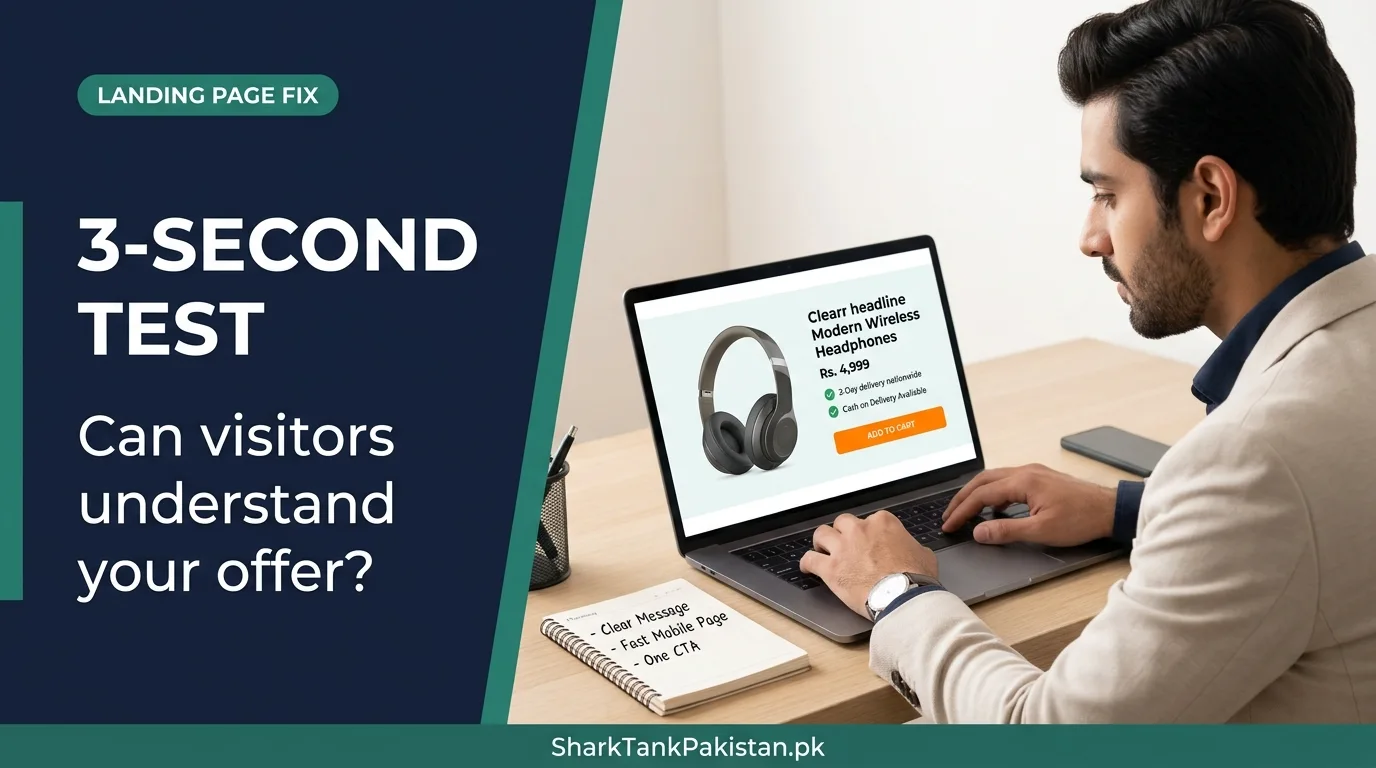
A visitor should understand three things within three seconds of landing: what you offer, who it’s for, and what they should do next. That’s it. No vague taglines like “Quality You Deserve.” No auto-playing videos that delay the message. Look at your homepage and product landing pages right now. If you have to scroll or squint to understand what the business does, you’re leaking visitors by the thousands.
Action: Write a one-line value proposition that a tired, distracted person on a noisy Lahore bus can understand instantly. Example: “Hand-stitched leather bags, delivered across Pakistan in 4 days — free returns.” Place it prominently. Test variations. The best-performing Pakistani e-commerce sites use Urdu-mixed English headlines for warmth and relatability — don’t be afraid to sound local.
Step 2: Crush Your Page Load Time on Mobile
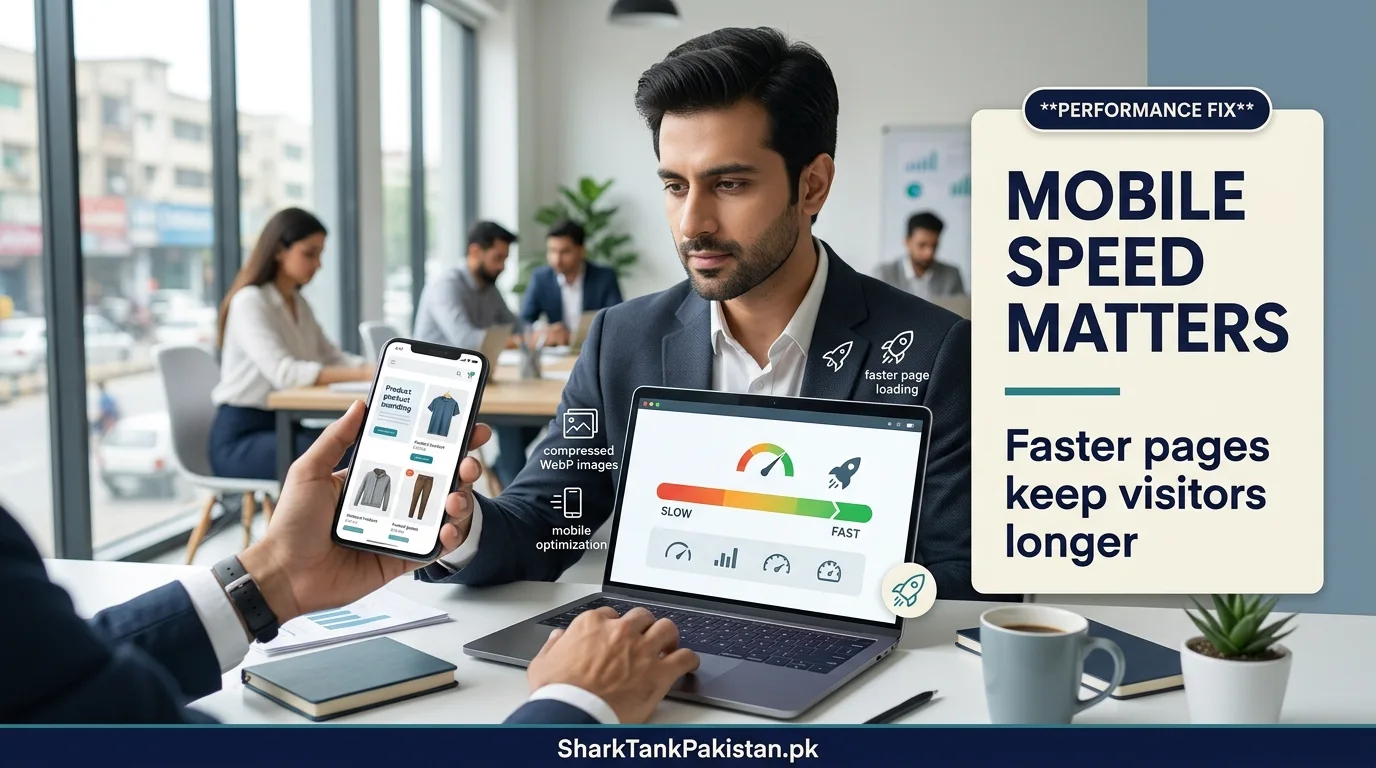
This is non-negotiable. If your page takes more than 3 seconds to become visually complete on a mid-range smartphone using mobile data, your bounce rate will climb sharply. Common culprits: unoptimized product images (2MB+ PNGs are everywhere on Pakistani sites), bloated Shopify apps, cheap shared hosting, and unminified CSS/JS. Use WebP format for images. Enable lazy loading. Consider a CDN with nodes close to Pakistan. If you’re on WordPress, use a lightweight theme and minimal plugins.
Step 3: Make Your Call-to-Action Obvious and Singular
Every landing page should have one primary action. Not five. If you sell products, the primary action is “Add to Cart” or “Buy Now.” If you’re a service business, it’s “Book a Free Consultation” or “WhatsApp Us.” Pakistani visitors often prefer WhatsApp as a first point of contact — having a visible, one-tap WhatsApp button can significantly reduce bounce rates for service and consultation businesses. The key is clarity: one action, clearly signposted, no competing demands.
Step 4: Match Your Landing Page to Your Traffic Source
If someone clicks a Google ad for “affordable running shoes Pakistan,” don’t send them to your homepage. Send them to a dedicated landing page showing affordable running shoes, with prices in PKR, available sizes, and delivery estimates. This alignment — called message match — is one of the most underrated bounce rate reducers. Every percentage point of mismatch between ad promise and landing page reality inflates your bounce rate and wastes your ad budget.
Step 5: Improve Internal Linking and Content Flow
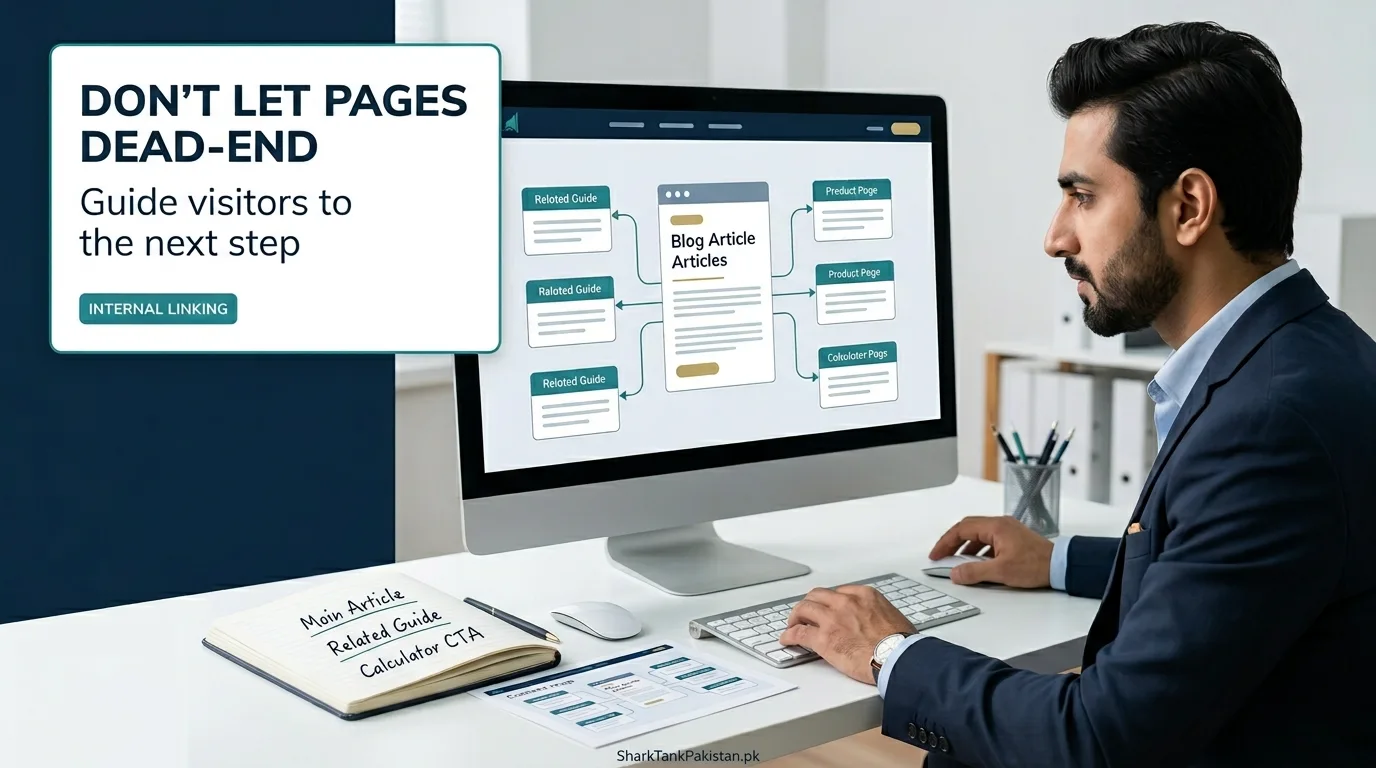
Pages that dead-end — blog posts with no related reading, product pages with no “you might also like” section, service pages with no case studies or next steps — trap visitors and force them to either hit the back button or close the tab. Strategic internal links give visitors a natural path deeper into your site. For content-heavy sites, this is the single highest-ROI tactic for reducing bounce rate without changing your traffic sources.
Comparison Table: Bounce Rate Fixes vs. Actual Impact
| Fix | Effort Level | Typical Bounce Rate Reduction | Best For |
|---|---|---|---|
| Improve page load speed (under 3s) | Medium | 8–15% | All Pakistani sites, especially mobile-heavy |
| Clarify above-the-fold value proposition | Low | 10–20% | Startups, service businesses, SaaS |
| Message match (ad → landing page) | Low–Medium | 15–25% | Paid traffic campaigns |
| Add WhatsApp/contact CTA | Low | 5–12% | Service businesses, consultancies |
| Improve internal linking | Low | 8–18% | Content sites, blogs, resource hubs |
| Mobile UX redesign | High | 12–20% | E-commerce, high-volume landing pages |
| Add trust signals (reviews, badges) | Low | 5–10% | New or lesser-known brands |
Situation-Based Adjustments: How Your Approach Changes
If You’re Running an E-Commerce Store
Your bounce rate battle is fought on product pages and category pages. Focus obsessively on: image quality and zoom, clear pricing in PKR, visible delivery timelines, trust badges (Cash on Delivery remains king in Pakistan — make sure visitors see it immediately), and a friction-free checkout. Remove forced account creation before purchase. Every extra step between “I want this” and “I bought this” inflates bounce rate and cart abandonment together.
If You’re a Service Business or Consultancy
Your visitors need reassurance before they commit. High bounce rates on service pages often signal a trust gap. Add: client logos (even if they’re Pakistani SMEs — familiarity builds trust), a clear “How We Work” section with timelines, transparent pricing ranges, and a low-commitment first step like a free 15-minute call or WhatsApp consultation. Pakistani B2B buyers often research extensively before reaching out — give them enough substance to stay and explore.
If You’re Pre-Revenue (Pre-Launch or Early-Stage)
If you don’t have sales yet, your website’s job is to collect emails, build a waitlist, or generate early interest. A high bounce rate here suggests your value proposition isn’t landing. Simplify your page to: a clear problem statement, your solution in one sentence, a social proof snippet (even “Trusted by 200+ early subscribers”), and an email signup form. Remove everything else. Pre-revenue pages should be laser-focused — every extra section dilutes the primary action.
If You’re a Shark Tank Pakistan Contestant Preparing Your Digital Presence
Your website will be scrutinized by producers, Sharks, and viewers within hours of your episode airing. Before you pitch, audit your site: check mobile speed, ensure your About page tells a compelling story, verify all product links work, and make sure your press kit or media page is easily findable. A spike in traffic after your episode is guaranteed — a high bounce rate during that spike wastes the single biggest marketing moment your brand will ever get.
Common Mistakes That Actually Increase Bounce Rate
It is easy to make things worse while trying to make them better. A reduce bounce rate Pakistan plan should remove friction, not add distracting pop-ups, slow media or confusing design choices.
Mistake 1: Auto-playing videos with sound. On mobile connections, auto-play videos slow page rendering and consume data — two things that infuriate Pakistani visitors who may be on limited data plans. If you must use video, keep it silent, user-initiated, and lightweight.
Mistake 2: Aggressive pop-ups within seconds of arrival. Nothing says “I don’t respect your time” like a full-screen email capture pop-up before the visitor has read a single word. If you use pop-ups, trigger them on exit intent or after at least 30 seconds of engagement, not immediately.
Mistake 3: Ignoring Urdu and regional language accessibility. A significant portion of Pakistani consumers prefer browsing in Urdu or Roman Urdu. If your entire site is in formal English and your target audience spans beyond DHA and Gulberg, you’re creating an unnecessary bounce-rate penalty. Consider bilingual key messaging — even just Urdu headlines on English pages — to widen your retention net.
Mistake 4: Over-optimizing for desktop when 80%+ traffic is mobile. This is still shockingly common. If you’re designing on a 27-inch monitor and testing on your office WiFi, you’re seeing a completely different website from what your actual customers experience on a 6.1-inch screen over mobile data. Design mobile-first, test on real devices, and use throttled connections.
Tools to Support Your Reduce Bounce Rate Pakistan Plan
While our core calculators — like the Startup Valuation Calculator and Equity vs Loan Calculator — are built for funding decisions, they connect directly to the bounce rate conversation. Here’s how: a realistic valuation gives you confidence in your numbers, which sharpens your pitch, which improves your website’s messaging clarity. When your value proposition is backed by solid financial reasoning, your landing pages naturally become more convincing, and visitors stick around longer.
Try this exercise: Open the SharkTankPakistan.pk Valuation Calculator. Plug in your revenue, growth rate, and industry. The output helps you articulate your business’s worth — which you can then translate directly into homepage copy that resonates with both customers and potential investors. Clear, confident numbers reduce uncertainty. Reduced uncertainty reduces bounce rate. It’s a virtuous cycle.
Real-World Snapshot: A Pakistani E-Commerce Brand That Cut Bounce Rate by 26%
A Karachi-based organic skincare brand — selling through Shopify and running Meta ads across Pakistan — was struggling with a 74% bounce rate on their best-selling product page. The page had beautiful photography but slow load times (7.2 seconds on mobile), no visible delivery information above the fold, and a cluttered layout with competing CTAs. Here’s what they changed over six weeks:
- Compressed all product images to WebP format and implemented lazy loading — load time dropped to 2.9 seconds.
- Added a sticky “Add to Cart” button and moved delivery estimates (3–5 days, free over PKR 2,000) to the top of the page.
- Removed the newsletter pop-up that fired on page load and replaced it with a subtle inline signup below the product description.
- Added three customer review snippets with photos directly below the product title.
Result: Bounce rate fell from 74% to 48%. Conversion rate improved from 1.1% to 2.4%. Monthly revenue from that single product page increased by approximately PKR 340,000 — all without increasing ad spend. The lesson is clear: bounce rate optimization is not a vanity metric exercise. It’s a direct revenue lever.
FAQs: Reduce Bounce Rate Pakistan for Business Websites
What is a good bounce rate for a Pakistani e-commerce website?
A healthy bounce rate for Pakistani e-commerce typically falls between 40% and 55%. Anything above 65% warrants investigation, especially on product pages. Context matters — blog content naturally has higher bounce rates, while well-optimized landing pages should trend lower.
Does a high bounce rate hurt my Google rankings in Pakistan?
Not directly — Google has stated bounce rate is not a ranking factor. However, a high bounce rate often correlates with poor user experience signals (low dwell time, low engagement), which can indirectly affect rankings, especially for competitive search terms in Pakistani markets.
How quickly can I reduce bounce rate after making changes?
Meaningful improvements typically show in analytics within 2–4 weeks of implementing changes, assuming consistent traffic volumes. Speed-related fixes can show impact faster — sometimes within days — because they immediately improve the experience for every visitor.
Should I worry about bounce rate on blog posts and informational pages?
Less than you think. Blog visitors often arrive, read the article they searched for, get their answer, and leave satisfied. That’s a successful visit, not a failure. Focus bounce rate optimization on pages designed to drive conversions — product pages, landing pages, and service inquiry pages.
Can WhatsApp integration really reduce bounce rate for Pakistani sites?
Yes, significantly for service businesses and consultancies. Pakistani consumers are accustomed to WhatsApp as a primary business communication channel. A visible, one-tap WhatsApp button gives visitors an immediate, low-commitment way to engage — often preventing a bounce entirely.
What’s the single fastest way to reduce bounce rate on a tight budget?
Improve your above-the-fold messaging clarity. It costs nothing but time and thought. Rewrite your headline to state exactly what you do and who it helps. Remove vague language. Test with real visitors. This alone can reduce bounce rate by 10–20% without touching a line of code.
Does using Urdu or Roman Urdu on my website help reduce bounce rate?
For businesses targeting mass-market Pakistani audiences, yes. Bilingual messaging — especially Urdu headlines or key value propositions in Roman Urdu — can make visitors feel more at home and understood, improving both time on page and trust. Test it on your highest-traffic pages first.
How does Shark Tank Pakistan exposure affect website bounce rate?
After a Shark Tank Pakistan episode airs, contestant websites often see massive traffic spikes — but also elevated bounce rates, because many visitors are curious browsers, not ready buyers. Optimizing your site before airing (clear story, fast load, easy navigation) helps convert that spike into lasting customers.
🚀 Reduce Bounce Rate Pakistan: Your Top 3 Actions Starting Today
1. Audit your mobile load speed immediately. Run PageSpeed Insights on your top 5 landing pages using a throttled mobile connection. If any page exceeds 4 seconds to become interactive, compress images, enable caching, and consider a CDN. This is the single highest-ROI technical fix for Pakistani audiences.
2. Rewrite your above-the-fold headline on every major landing page. Make sure a first-time visitor understands what you offer within three seconds. Use plain language. Test variations. If you’re unsure, ask five people outside your industry to look at your homepage for five seconds and tell you what the business does.
3. Align every paid ad with a dedicated, matching landing page. Stop sending ad traffic to your homepage. For each active ad campaign, create or designate a landing page that precisely matches the ad’s promise. Message match is the fastest behavioral fix for ad-driven bounce rate — and it improves Quality Scores and lowers cost-per-click as a bonus.