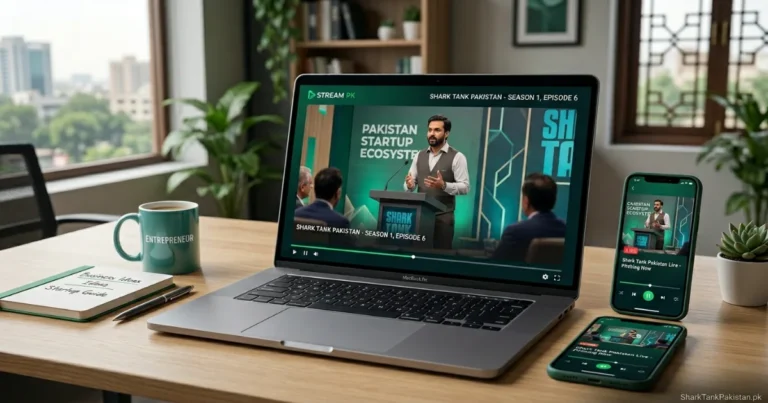
Shark Tank Pakistan Deal Changes: 7 Reasons Final Terms Differ from the Pitch
⚡ The Short Answer: Shark Tank Pakistan deal changes happen because a handshake on camera is not a binding contract. The televised offer is a conditional agreement that undergoes rigorous due diligence, legal structuring, and often renegotiation once the sharks examine financials, cap tables, and market realities. In Pakistan, additional factors like informal debt, undocumented family ownership, and currency volatility often reshape the final terms — sometimes for the better, sometimes to the deal’s breaking point.
You watch a Pakistani founder walk into the tank, nerves on full display. Ten minutes later a shark extends a hand, and the deal seems sealed. Viewers celebrate. But those who follow the startup world know that what happens next can alter everything. Equity percentages shift. Royalty clauses appear. Sometimes the entire deal evaporates. If you’ve ever asked why the final agreement often looks nothing like the televised moment, you’re asking one of the most important questions for any founder considering Shark Tank Pakistan deal changes as a real path to funding.
This isn’t a flaw in the show. It’s the reality of serious investing compressed into a television format. And for Pakistani entrepreneurs — who often operate with less formalized financials, complex family business structures, and a more volatile economic backdrop — the gap between the pitch-room promise and the due-diligence reality can be wider than in other Shark Tank editions. Understanding that gap isn’t just curiosity. It’s survival training.
Let’s pull back the curtain on why deals change, when you should accept the revisions, and when you might be better off walking away.

Why Shark Tank Pakistan Deal Changes Begin After the Televised Offer
This is the most misunderstood part of the Shark Tank Pakistan experience. When a shark says “I’ll give you PKR 2 crore for 20% equity,” that’s a non-binding letter of intent — expressed verbally, under bright lights, with significant time pressure. There’s no signed term sheet on the carpet. The production team captures a moment of mutual interest. The real work starts afterward.
In practice, both parties enter a post-production phase that typically lasts four to eight weeks. The shark’s team conducts due diligence. The founder’s claims about revenue, margins, customer concentration, and intellectual property get verified. Simultaneously, lawyers draft the actual shareholder agreement, and that’s where the fine print begins to diverge from the televised headline.
For Pakistani founders, this phase often uncovers issues that were never discussed on air: unregistered partnership agreements, tax filing inconsistencies, supplier advances treated as informal debt, or family members holding unspoken equity stakes. None of this makes a founder dishonest. It makes their business a typical Pakistani enterprise — one that was never structured for institutional investment. But it does invite renegotiation.
🧠 Why This Works (Production Logic)
Reality check: Both the founder and the shark benefit from a clean on-air narrative. The founder wants to signal traction to the world. The shark wants to appear decisive and construct a portfolio story. Neither party is incentivized to air the messy details on camera. But those messy details are exactly what the due diligence process is designed to expose — and they’re the primary engine of Shark Tank Pakistan deal changes.
How Due Diligence Triggers Shark Tank Pakistan Deal Changes
Once the cameras stop, the shark’s team typically requests a data room with at least these documents:
- Audited (or accountant-prepared) financial statements for the last two to three years
- Bank statements that reconcile with revenue claims
- Tax returns and SECP filings
- Cap table with proof of ownership
- Copies of key contracts: supplier agreements, distribution deals, IP registrations
- Details of any outstanding loans, personal guarantees, or pending litigation
What happens next in Pakistan often surprises founders who believed their on-air narrative was fully accurate.
Revenue Discrepancies Are the Biggest Deal-Killer
A founder might state “we did PKR 3 crore in revenue last year” on television, and genuinely believe it. But the shark’s accountant might discover that PKR 80 lakh of that was advance bookings for services not yet delivered, or that PKR 30 lakh came from a one-off asset sale rather than recurring operations. Suddenly the run-rate revenue is PKR 1.9 crore, not 3 crore. The valuation multiple collapses. The deal needs to be restructured — or it’s dead.
Undocumented Debt and Personal Guarantees
Pakistani small businesses frequently rely on informal lending: loans from relatives, overdrafts personally guaranteed by the founder, or supplier credit extended on verbal trust. These obligations don’t appear on a balance sheet but they absolutely affect cash flow and risk. When a shark’s team finds a PKR 50 lakh personal loan the founder didn’t disclose (often because they didn’t consider it “business debt”), it changes the risk profile. The shark may demand more equity, add a royalty component, or require the founder to clear that debt before the deal closes.
Family Ownership That Wasn’t Disclosed
A founder may pitch as the sole owner, only for due diligence to reveal that 40% of the company is held by a father who funded the initial capital — without any formal documentation. In Pakistan’s family-business culture, this is extremely common. But for an institutional investor, it creates a legal nightmare. The deal suddenly needs to accommodate a third party who may not be aligned with the growth strategy. This almost always leads to renegotiation.

7 Common Shark Tank Pakistan Deal Changes Founders Should Understand
Not all alterations are red flags. Some are natural refinements. Others should give a founder serious pause. Here’s how to categorize what you might face.
| Type of Change | How It Happens | Founder’s Risk Level |
|---|---|---|
| Equity increase | Shark demands 25% instead of the on-air 20% after finding weaker-than-claimed financials | Medium — dilutes you more but may still be worth the strategic value |
| Valuation reduction | Agreed PKR 5 crore valuation drops to PKR 3.2 crore post-DD | High — signals major credibility gap; can be legitimate if numbers were overstated |
| Addition of royalty | Shark adds a 3% revenue royalty until their investment is recouped, plus equity | Medium — common in Pakistan to de-risk; model the cash impact first |
| Tranched investment | Instead of a lump sum, money is released upon hitting milestones | Low if milestones are realistic; high if they’re aspirational and you’ll starve before reaching them |
| Founder salary cap or clawback | Shark inserts a clause limiting founder salary or requiring repayment if targets missed | Variable — protects discipline but can create personal financial stress |
| Board control or veto rights | Shark gains disproportionate voting power despite minority equity | High — can make you a spectator in your own company |
| Employment condition | Shark requires the founder to stay full-time for a minimum period, with vesting | Low to moderate — standard, but consider your personal life plans |
The table above isn’t exhaustive, but it covers the most frequent Shark Tank Pakistan deal changes reported by founders who navigated the post-show phase. The key takeaway: the on-air terms are a rough sketch. The final terms are the sculpture — and the sculptor has full access to your business’s naked numbers.
Local Market Realities That Reshape Deals
Why do these changes happen more dramatically on Shark Tank Pakistan than in some other editions? Pakistan’s economic environment injects unique variables into every deal conversation.
Currency Volatility
A shark might offer PKR 1.5 crore on air, but if the PKR depreciates by 12% between the handshake and the final agreement, the investment’s real value drops. Some sharks respond by demanding a higher equity stake to compensate, especially if the business’s revenue is PKR-denominated while its input costs are dollar-linked. Founders who don’t anticipate this conversation get blindsided.
Informal Business Practices
As mentioned, many Pakistani businesses run on trust-based, undocumented arrangements. The shark’s legal team, often accustomed to internationally compliant structures, will flag these as material risks. The founder then faces a painful choice: formalize everything (which may alienate long-standing partners) or accept revised terms that reflect the elevated risk.
Regulatory and Tax Uncertainty
Shifts in import duties, sales tax rates, or sector-specific regulations can alter a business’s profitability forecast between the pitch and the deal closing. Sharks, particularly those with manufacturing or import-heavy portfolios, are sensitive to this and may build protective clauses into the agreement that weren’t mentioned on air.
When Should You Accept a Deal Change — and When Should You Walk?
The answer depends less on the change itself and more on your alternatives, your stage, and your long-term goals.
If You’re Pre-Revenue or Burning Cash
A deal change that increases equity from 15% to 22% might sting, but if the shark brings distribution channels, regulatory connections, and operational mentorship, it could be the difference between survival and shutting down. In Pakistan, where venture capital is scarce, a strategic shark is often worth more than the equity you’re giving up. Run the numbers using our Equity & Loan Calculator to see your dilution scenario over two funding rounds — you may find the difference between 15% and 22% matters less than you think if the shark’s involvement doubles your growth rate.
If You’re Profitable with Multiple Investor Options
Here, you have leverage. If due diligence reveals nothing materially wrong and the shark is pushing for concessions simply because they can, you’re in a position to push back — or walk. A profitable Pakistani business with strong unit economics doesn’t need to accept predatory terms. In fact, walking away can sometimes bring the shark back to the original terms.
If the Change Involves Personal Liability
Be extremely cautious about deal clauses that require personal guarantees, put your family assets at risk, or tie you to the business for a decade with no exit. Pakistani founders, especially those from middle-class backgrounds, often underestimate what these clauses mean in practice. Talk to a lawyer before signing. This isn’t the place to save on legal fees.
If the Shark’s Involvement Changes Post-Deal
An on-air commitment to “mentor you personally every month” may, in the final contract, become a vague advisory role with no enforceable obligation. If the mentorship was a major reason you accepted a lower valuation, and that commitment evaporates in the fine print, you’re giving away equity for nothing. Renegotiate or walk.
💡 Insider Insight from Shark Tank Pakistan
Season 1 participants have noted that some sharks, after the initial legal draft is shared, are willing to adjust terms if the founder presents a clear, data-backed counterproposal. The lesson: don’t treat the first draft as final. Treat it as the opening of a negotiation, and come armed with your own numbers.

Common Pitfalls That Turn Deal Changes into Deal Disasters
Founders often walk into post-show negotiations with the wrong mindset. Here’s what to avoid.
Pitfall 1: Assuming the On-Air Terms Are Morally Binding
Viewers may feel a shark “broke their promise,” but legally, no promise was made. The on-air interaction is a mutual expression of interest. Expecting it to be honored without adjustment ignores how professional investing works. Go in with emotional detachment.
Pitfall 2: Hiding Issues to Keep the Deal Alive
If due diligence will expose a problem eventually, disclose it proactively. Sharks respect transparency. Discovering that you tried to conceal a family loan or an unresolved legal dispute will destroy trust and almost certainly kill the deal — or result in far worse terms than honesty would have produced.
Pitfall 3: Letting the Shark’s Public Profile Intimidate You
Just because someone is a respected business figure doesn’t mean every term they propose is fair. Read every clause. Ask questions. Hire independent legal counsel. A shark who respects you will respect your due diligence on them, too.
Pitfall 4: Ignoring the “No-Deal” Option
Sometimes the best outcome is walking away with your national TV exposure and a clearer understanding of your business’s gaps. Several Pakistani entrepreneurs leveraged their appearance — even without a closed deal — to attract other investors, secure retail partnerships, or land media coverage they never could have bought. A bad deal is worse than no deal.
When to Ignore This Entire Conversation
If you’re applying to Shark Tank Pakistan purely for marketing exposure and have no intention of actually closing a deal under any altered terms, this discussion matters less. But know that even if you plan to walk, the on-air scrutiny will sharpen your business story in ways that pay off for years.
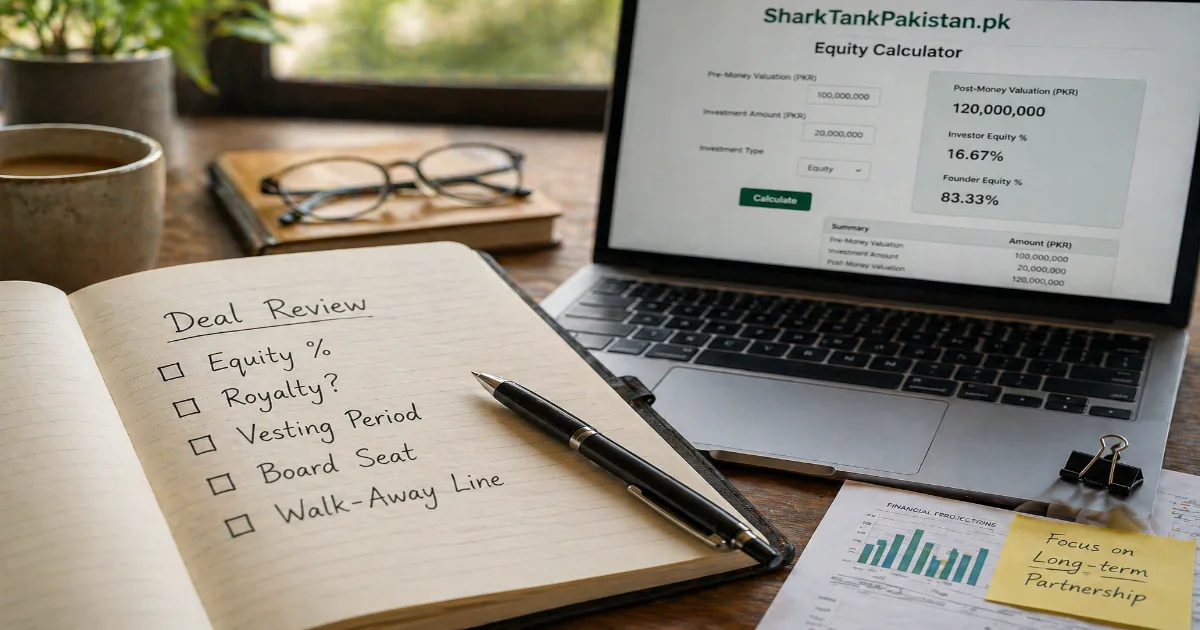
Put This Into Practice: Model Your Deal Scenarios
Don’t wait for a shark to tell you your numbers don’t work. Use the tools on SharkTankPakistan.pk to pressure-test your business before you ever set foot in the tank — or before you respond to a post-show renegotiation.
- Valuation Reality Check: Open our Startup Valuation Calculator and input your clean, verified numbers — not the optimistic ones you’d pitch on TV. The output will show you what a reasonable investor would actually pay. If your on-air ask was far higher, a valuation reduction post-DD is predictable, not punitive.
- Equity Dilution Modeling: Use the Equity & Loan Calculator to simulate different equity stakes with and without royalty components. See what a 3% revenue royalty does to your free cash flow over three years. If you can’t make the math work in the calculator, you can’t make it work in real life.
- Scenario Stress-Testing: Adjust for a 10% currency depreciation, a 5% input cost increase, and a one-quarter revenue dip — all simultaneously. If your business survives that scenario, you’ve got a defensible position when a shark pushes for harsher terms based on macroeconomic risk.
What a Successful Post-Show Renegotiation Looks Like
Consider a hypothetical but realistic Pakistani scenario: A food-tech founder secures an on-air offer of PKR 3 crore for 18% equity. During due diligence, the shark’s team finds that 30% of the claimed revenue came from a corporate catering contract that isn’t renewed for next year. The run-rate revenue is lower. The shark proposes revised terms: PKR 2.5 crore for 22% equity, with a 2% royalty until the investment is recouped.
A panicked founder might reject this outright. A smart founder runs the numbers. They realize that accepting the new terms still gives them enough capital to expand into two new cities, and the royalty disappears once the shark is made whole — which the revised cash flow projections show could happen in 18 months. They counter with a request for milestone-based equity buyback options. The shark agrees. The deal closes. The founder now has capital, a strategic partner, and a structure that rewards performance.
The difference between a deal-kill and a deal-win was the founder’s ability to model the change, negotiate calmly, and recognize that not all Shark Tank Pakistan deal changes are hostile. Many are simply the market doing its job.
Frequently Asked Questions
Why do some Shark Tank Pakistan deals fail after the show?
Most failures occur during due diligence. Discrepancies between the on-air financial claims and verified documents, undisclosed debt or family ownership, and unrealistic valuation expectations are the top reasons. Sometimes the founder or shark simply loses interest once the pressure of the TV moment fades.
Can a shark legally change the terms after a handshake on Shark Tank Pakistan?
Yes. The televised handshake is not a binding contract. It’s a preliminary agreement subject to due diligence, legal documentation, and often board approval. Until a signed shareholder agreement is executed, terms can be renegotiated — or the deal abandoned.
What percentage of Shark Tank Pakistan on-air deals actually close?
Globally, an estimated 25–35% of on-air deals never close. In Pakistan’s less-formalized ecosystem, the figure is likely closer to 35–40%, though precise data isn’t publicly available. The best protection is honest, verified numbers from day one.
How can I protect myself from unfair deal changes?
Be truthful in your pitch. Have your financials audited or professionally reviewed beforehand. Disclose potential issues proactively. Hire independent legal counsel to review all documents. And never be afraid to walk away if the revised terms don’t serve your business’s long-term health.
Do the sharks on Shark Tank Pakistan add royalty clauses often?
Yes, royalty clauses are a common tool on the show, especially when the shark perceives higher risk or wants to accelerate their return. They’re more frequent in asset-light or early-stage businesses where traditional equity alone doesn’t provide enough downside protection.
What should I do if due diligence reveals a problem I didn’t know about?
Disclose it immediately to the shark’s team with a clear explanation and a proposed mitigation plan. Trying to hide it will destroy trust. If the problem is manageable, the deal can often be restructured. If it’s fundamental, accept that the deal may not survive — and that’s better than a future legal dispute.
Is a lower valuation always a bad outcome?
Not necessarily. A lower valuation with a well-connected strategic shark can produce a higher long-term return than a higher valuation with a passive investor. Focus on the total value the partnership brings, not just the headline number.
📋 Your Fast-Track Cheat Sheet: Top 3 Actions to Take
- Pressure-test your own numbers before you pitch. Use the SharkTankPakistan.pk valuation and equity calculators with conservative assumptions. If the numbers hold up, you’ll walk into due diligence with far less fear of unfavorable changes — and a much stronger negotiating position.
- Build a due diligence pack now, not later. Gather audited financials, bank statements, tax receipts, cap table documentation, and key contracts. If a shark asks for them after the show, having them ready signals professionalism and shortens the negotiation window, reducing the time for new complexities to arise.
- Decide your walk-away lines in advance. Before you ever accept a televised handshake, know your minimum acceptable terms: equity ceiling, valuation floor, personal liability boundaries. When the revised contract arrives, measure it against those pre-set lines — not against the adrenaline of the moment.