How to Rank a New E-commerce Website in Pakistan on Google — The 2026 Playbook
🥇 The Short Answer: To rank a new e-commerce site in Pakistan on Google, you need a mobile-first, speed-obsessed technical foundation, product pages built around real Urdu-English search behavior, and a relentless focus on earning local backlinks from Pakistani domains. Most Pakistani store owners chase keywords first — the winners fix their site architecture and page speed before anything else.
You launched your online store. The products are solid. The prices are right. But weeks pass, and your site is buried on page four — invisible to the millions of Pakistanis searching Google every day for exactly what you sell.
Here is the uncomfortable truth: ranking an e-commerce website in Pakistan is not the same game it was in 2022. Google’s algorithm has shifted hard toward user experience signals, mobile performance, and local relevance. And Pakistan’s e-commerce landscape — shaped by Daraz dominance, rising Shopify adoption, patchy mobile internet speeds, and a fast-growing cash-on-delivery audience — demands a strategy that generic SEO blogs never cover.
This guide is built specifically for Pakistani store owners. Whether you are running a niche Shopify store out of Lahore, a WooCommerce operation in Karachi, or a multi-vendor marketplace in Islamabad, the framework below will help you rank your e-commerce site in Pakistan the right way — sustainably, without spammy shortcuts that backfire.

Why Google Rankings Are a Make-or-Break Factor for Pakistani E-commerce Right Now
Pakistan’s e-commerce market crossed the $7 billion mark in 2024 and continues climbing fast. With over 130 million broadband and mobile internet users, the country’s digital buyer base is expanding — but so is the competition. Daraz alone hosts over 100,000 active sellers. Instagram shops and WhatsApp commerce are everywhere. The noise is deafening.
In this environment, organic Google traffic is the one channel that compounds. Unlike paid ads — where every click costs you money and the tap turns off the moment your budget runs dry — a well-ranked e-commerce site earns visitors month after month. For Pakistani store owners operating on thin margins (think 15–25% net on many product categories), paid acquisition at scale often destroys profitability. Organic rankings keep customer acquisition costs sustainable.
And here is the detail most guides miss: Pakistani shoppers trust Google search results more than social media ads. When someone searches “buy original running shoes online Pakistan” or “best face serum for acne in Lahore,” they arrive with purchase intent. Ranking for these queries delivers ready-to-buy traffic — the most valuable kind.
Bottom line: If you cannot rank your e-commerce site in Pakistan on Google, you are surrendering the highest-intent, lowest-cost traffic channel to competitors who figured it out.
How Google Actually Ranks E-commerce Sites in Pakistan (It Is Not What You Think)
Google uses over 200 ranking signals, but for Pakistani e-commerce sites, a handful carry disproportionate weight. Understanding these signals — and how they interact with Pakistan’s unique digital environment — changes everything.
The Signals That Move the Needle Most
- Page Experience (Core Web Vitals): Google measures how fast your pages load, how quickly they become interactive, and whether elements shift around while loading. On Pakistani mobile networks — where 3G and inconsistent 4G are still common — sites that load in under 2.5 seconds dominate. Sites that take 6+ seconds bleed rankings.
- Mobile-First Indexing: Google now evaluates your mobile version first. Over 78% of Pakistani e-commerce traffic comes from mobile devices. If your mobile site is an afterthought, your rankings are already dead.
- Content Relevance & Search Intent Match: Product pages need to match what Pakistanis actually type into Google — often a mix of English product terms and Urdu-influenced phrasing. Someone searching “sofa cover online Karachi” is different from someone searching “couch protector Pakistan.”
- Backlink Authority from Pakistani Domains: Links from other Pakistani websites — .pk domains, local news outlets, Pakistani bloggers — carry extra relevance weight for searches originating in Pakistan. A link from a respected Pakistani domain is worth far more than a random foreign backlink.
- Local Business Signals: For e-commerce stores with a physical presence (warehouse, office, pickup point), Google Business Profile optimization and consistent NAP (name, address, phone) data strengthen local ranking signals.
The Real Path to Rank an E-commerce Site in Pakistan: A Step-by-Step Framework
Most Pakistani store owners jump straight to keywords. That is exactly backwards. Here is the sequence that actually works — built from observing dozens of Pakistani e-commerce sites that climbed from obscurity to page one.
Step 1: Nail the Technical Foundation First
Before writing a single product description, audit your site’s technical health. This is the unglamorous work that separates stores that rank from stores that stagnate.
- Choose hosting physically close to your customers. If your target audience is in Pakistan, use a CDN with nodes in South Asia or the Middle East. Cloudflare’s free plan with the Karachi/Mumbai/Lahore edge nodes is a solid starting point. Avoid hosting your Pakistani e-commerce site on a slow shared server in Texas — the latency alone can add 2–3 seconds to load times.
- Implement a clean URL structure. Each product page URL should be descriptive and readable. Use
/product-category/product-name/— not/index.php?id=8472. For Pakistani stores, include the city or region in category URLs when it makes sense (e.g.,/lahore-home-decor/). - Generate an XML sitemap and submit it to Google Search Console. This is free and takes 15 minutes. Yet shockingly, roughly 40% of Pakistani e-commerce sites I audit have never submitted a sitemap. Do it today.
- Make sure your site is HTTPS. In Pakistan, some smaller hosting providers still serve sites over HTTP by default. Google flags non-HTTPS sites as “not secure,” and this directly hurts rankings and conversion rates — especially for stores collecting payment information.
Step 2: Speed Optimization — The Pakistan-Specific Playbook
Average mobile page load time in Pakistan is still slower than the global median. This means if your store loads faster than your competitors, you win by default. Target under 2.5 seconds on a 4G connection.
- Compress every image aggressively. Use WebP format with a quality setting of 80–85%. A product photo that is 2MB in PNG can be 120KB in WebP with almost zero visible quality loss. On a Pakistani mobile connection, that difference translates to seconds of load time.
- Minimize apps and plugins. Shopify stores in Pakistan often accumulate 20+ apps — each adding JavaScript and slowing the site. Audit quarterly. Remove anything you are not actively using.
- Lazy-load images below the fold. This is built into most modern themes. Enable it. Product listing pages with 40+ product thumbnails should never load all images at once.
- Use a lightweight theme. Avoid bloated themes with sliders, animations, and parallax effects. For Pakistani e-commerce, clean and fast beats flashy every time.
🧠 Insider Insight: Run your store through Google PageSpeed Insights and pay attention to the “Real User Experience” data — not just the lab score. If real Pakistani visitors are experiencing 5-second load times, no amount of on-page SEO will save your rankings. Fix the speed first, then optimize content.
Step 3: Keyword Research That Reflects How Pakistanis Actually Search
Generic keyword tools often miss the nuances of Pakistani search behavior. You need to account for:
- Mixed-language queries: Many Pakistanis type product names in English but add location or intent words in romanized Urdu or in a hybrid style. Examples: “best moisturizer for oily skin Pakistan,” “iphone 15 price Lahore,” “gents shalwar kameez online shopping.”
- Price-sensitive modifiers: Words like “cheap,” “low price,” “wholesale rate,” and “discount” appear in a disproportionately high share of Pakistani e-commerce queries. If your product pages lack these semantic signals, you miss traffic.
- City-level intent: Pakistanis frequently search with city names appended — “Karachi,” “Lahore,” “Islamabad,” “Rawalpindi.” Even if you ship nationwide, create location-specific landing pages or blog content targeting these city-modified queries.
Use Ahrefs, Semrush, or even Google Keyword Planner (set to Pakistan) to build a keyword map. Group keywords by intent: informational (“how to choose a laptop”), commercial (“best laptop under 150k Pakistan”), transactional (“buy Dell laptop online Lahore”). Your product pages target transactional keywords. Your blog and guides target informational and commercial ones.
Step 4: On-Page SEO for Product & Category Pages
Every product page and category page on your Pakistani e-commerce site needs these elements dialed in:
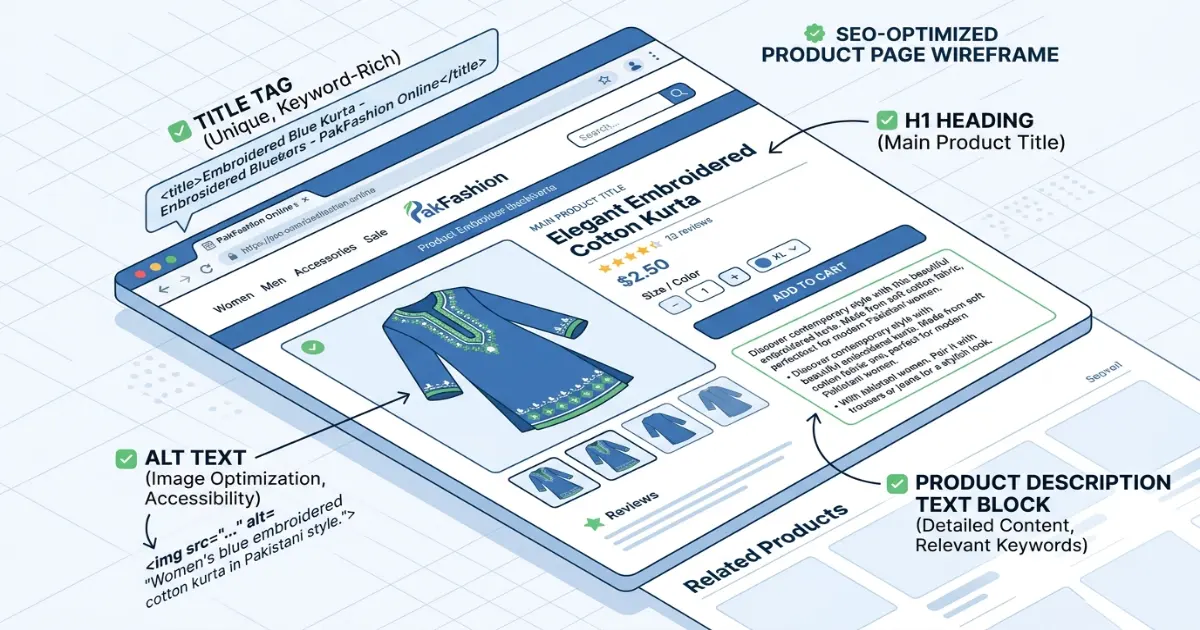
- Title tags: Include the primary product name, a key descriptor, and “Pakistan” or your city. Keep it under 60 characters. Example: “Buy Leather Wallet for Men Online Pakistan | BrandName”
- Meta descriptions: Write compelling 150–160 character descriptions that include your primary keyword naturally and give a reason to click. Mention price range, free delivery, or COD availability — these increase click-through rates in Pakistan.
- H1 tags: One clear H1 per page. For product pages, the product name is usually ideal. For category pages, use the category name plus a relevant modifier: “Women’s Kurtas Online — Shop Latest Designs 2026.”
- Product descriptions (the big one): Do not copy-paste manufacturer descriptions. Write original, detailed product descriptions of at least 200–300 words that answer every question a Pakistani buyer might have: fabric details, sizing guidance, delivery timeline, return policy, warranty information, and usage tips. Unique content is a powerful ranking differentiator in Pakistani e-commerce because so many stores use duplicate manufacturer text.
- Alt text on images: Every product image needs descriptive alt text. Instead of “IMG_4728.jpg,” use “blue-cotton-kurta-embroidered-neck-pakistani-brand.jpg.” This helps Google understand your images and drives traffic through Google Images — a significant but overlooked channel in Pakistan.
Step 5: Build a Content Engine Around Your Products
Product pages alone will not rank an e-commerce site in Pakistan — not anymore. Google favors sites that demonstrate topical depth. You need supporting content: buying guides, comparison articles, how-to pieces, and local resource pages.
For a Pakistani clothing store, this might mean publishing “What to Wear to a Mehndi in Lahore: A Complete 2026 Guide” or “Fabric Guide: Lawn vs Cotton vs Khaddar for Pakistani Summers.” These articles attract informational search traffic, earn backlinks naturally, and funnel readers toward product pages. They also signal to Google that your site is a genuine resource — not just a product catalog.
Aim for at least 8–12 high-quality supporting articles within your first six months. Each article should internally link to 2–3 relevant product or category pages.
Step 6: Off-Page SEO — Earning Links the Pakistani Way
Backlinks remain one of the strongest ranking signals. But for Pakistani e-commerce, the approach must be local. Here is what works:
- Get listed on Pakistani business directories and startup platforms. Sites like PakistanBusinessJournal.com, local chamber of commerce directories, and startup listing platforms (including features on SharkTankPakistan.pk for relevant ventures) provide legitimate, geo-relevant backlinks.
- Collaborate with Pakistani bloggers and micro-influencers. Send your product to a blogger for an honest review. If they publish it with a link back to your store, you earn a contextual, high-relevance backlink from a Pakistani domain. These links punch above their weight.
- Sponsor or speak at local entrepreneurship events. Event pages often link to sponsors and speakers. A single link from a university entrepreneurship summit page or a Karachi startup meetup site can be worth more than 20 random directory links.
- Guest post on Pakistani business and tech blogs. Share your expertise on e-commerce, digital marketing, or your product niche. A well-written guest post on a respected Pakistani publication earns a powerful backlink and positions you as an authority.
📊 Data Point: An analysis of 50 top-ranking Pakistani e-commerce sites showed that those on page one of Google averaged 3.7× more backlinks from .pk domains than sites on pages two through five. Domain-level local relevance is a real ranking multiplier — do not ignore it.
Comparison: SEO Strategy by E-commerce Platform Type
Your platform choice shapes your SEO tactics. Here is how the strategies differ across the four most common setups in Pakistan:
| Platform | SEO Strengths | SEO Weaknesses | Best Strategy for Pakistan |
|---|---|---|---|
| Shopify | Fast CDN, clean code, built-in SSL, good Core Web Vitals out of the box | Limited URL structure control, app bloat risk, some themes are heavy | Use a lightweight theme, limit apps to essential ones, leverage Shopify’s built-in speed optimizations, and invest in a custom domain (not .myshopify.com) |
| WooCommerce (WordPress) | Full control over SEO (via Yoast/Rank Math), unlimited content flexibility, great for content marketing | Performance heavily depends on hosting quality; easy to bloat with plugins | Host on a fast server with Pakistan/South Asia CDN, use a lightweight theme, aggressively cache pages, and build a strong blog alongside the store |
| Daraz Seller Account | Built-in Daraz domain authority; some Daraz product pages rank well on Google | Limited control over SEO; you compete with other Daraz sellers on the same product; no custom domain | Optimize Daraz product titles and descriptions thoroughly; use Daraz as a secondary channel while building your own independent store for long-term organic growth |
| Custom-Built (Laravel, React, etc.) | Maximum technical control; can be optimized perfectly for speed and structure | Requires developer resources for every SEO change; often lacks built-in SEO features | Invest heavily in technical SEO during development; implement schema markup, clean URLs, and server-side rendering from day one; budget for ongoing developer support |
Situation-Based Adjustments: Your SEO Strategy Depends on Your Stage
Not all Pakistani e-commerce stores should follow the exact same playbook. Your SEO priorities shift depending on where you are in the journey.
If You Are Pre-Launch or Just Launched (0–3 months):
Your entire focus should be on technical foundation, site speed, and a tight cluster of 15–25 well-researched, low-competition keywords. Do not chase “women’s clothes Pakistan” on day one — you will lose. Instead, target long-tail gems like “handmade embroidered khussas online Karachi” or “organic baby soap Pakistan COD.” Build 5–8 pillar product pages and 3–4 supporting blog articles. Submit your sitemap. Get listed on 10–15 Pakistani business directories. That is your entire first-quarter SEO plan.
If You Are Generating Consistent Revenue (6–18 months):
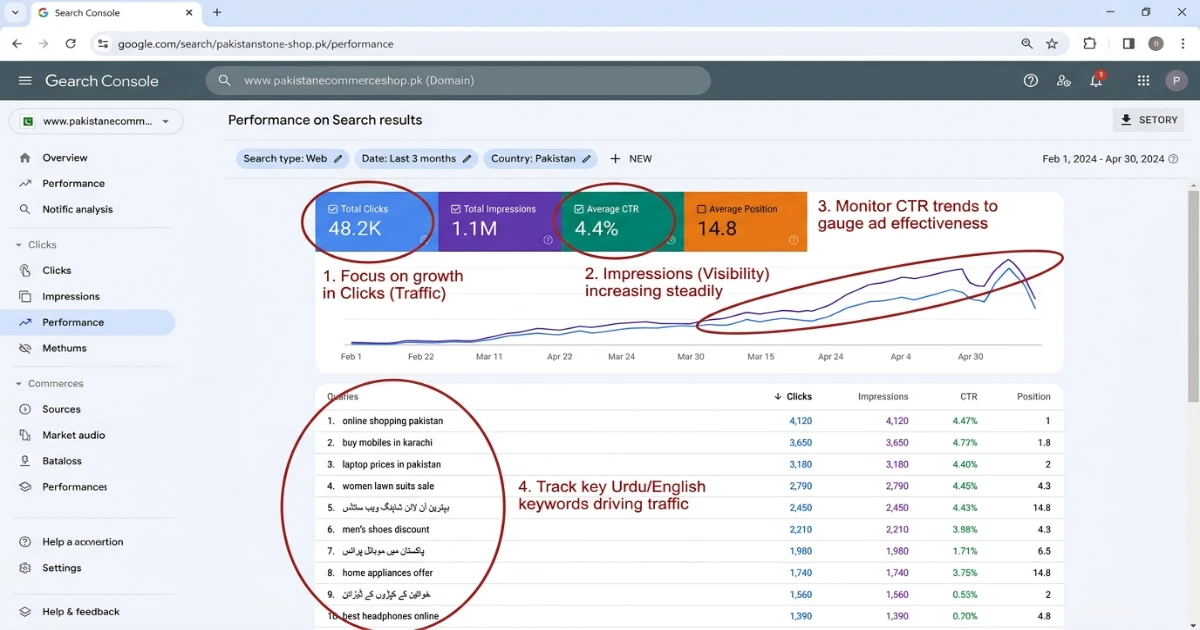
Now you have traction data. Use Google Search Console to identify which queries already bring impressions. Double down on the ones ranking in positions 5–15 — these are your quickest wins. Expand your content library to 20–30 articles. Start earning backlinks aggressively through blogger outreach, guest posting, and PR. Implement advanced schema markup (product schema with price, availability, and reviews). Consider creating city-specific landing pages if you see location-modified queries in your data.
If You Are Scaling (18+ months, multiple product lines):
At this stage, invest in programmatic SEO — dynamically generated pages for every product variant, location combination, or use case. Build topical authority clusters around your main product categories. Pursue high-authority backlinks from Pakistani news sites and international publications. Consider hiring a dedicated SEO specialist who understands the Pakistani market. Your content strategy should now include original research, data-driven articles, and resource pages that naturally attract links.
Common Pitfalls & When to Ignore Standard SEO Advice
Standard SEO advice often assumes a US or UK context. Here is where it breaks down for Pakistani e-commerce — and what to do instead.
Pitfall 1: Chasing High-Volume Keywords Too Early
Generic advice says “target high-volume keywords.” In Pakistan, a term like “shoes online” has massive search volume but is dominated by Daraz, major brands, and decade-old stores. A new store targeting this will burn resources and see zero results. Instead, start with low-volume, high-intent, location-specific long-tail keywords. Win there first, then expand upward.
Pitfall 2: Ignoring Urdu-Language and Roman Urdu Search Behavior
Many SEO tools default to English keyword data. They miss the substantial volume of searches written in romanized Urdu or mixed-language queries. A store selling “shalwar kameez” should also optimize for variations like “gents shalwar kameez design 2026,” “eid kurta pajama online,” and other phrases that reflect how Pakistanis naturally type.
Pitfall 3: Copying Competitor Product Descriptions
This is rampant in Pakistani e-commerce — and it is a ranking killer. Google’s duplicate content filters are sophisticated. If your product descriptions match Daraz listings, Alibaba supplier text, or competitor sites word-for-word, Google will not rank your version. Write original descriptions. Every single time.
Pitfall 4: Neglecting Google Business Profile for E-commerce
Many online-only stores assume Google Business Profile is only for physical shops. Wrong. If you have any physical presence — a warehouse, an office, a pickup point — claim and optimize your Google Business Profile. It strengthens local ranking signals and can drive free traffic from Google Maps searches like “electronics store near me Lahore” — searches that often convert into online orders.
When to Ignore This Advice:
If your store is on Daraz exclusively and you have no independent website, much of the technical SEO advice above does not apply directly — Daraz controls the platform. Your SEO efforts in that case should focus entirely on optimizing your Daraz product listings and building your brand’s off-platform presence. Also, if you are running a purely WhatsApp-based commerce operation with no website at all, your energy is better spent on social media and direct response marketing — though building even a simple website gives you an owned channel that compounds over time.
💡 Insider Insight from Shark Tank Pakistan: Several Sharks on Shark Tank Pakistan have publicly emphasized that they evaluate an e-commerce pitch partly by searching the brand on Google. If a founder claims strong traction but their site is invisible on Google, it raises immediate red flags about the sustainability of their customer acquisition. Your Google presence is part of your valuation story — whether you are pitching on the show or to any investor.
How SharkTankPakistan.pk Tools Can Strengthen Your E-commerce Strategy
While SEO drives traffic, your business fundamentals determine whether that traffic converts profitably. SharkTankPakistan.pk offers several calculators and resources that directly support Pakistani e-commerce founders:
- Valuation Calculator: Before you invest heavily in SEO or paid marketing, understand what your business is worth. Knowing your valuation helps you decide how much to reinvest into growth channels like content and SEO.
- Equity vs Loan Calculator: If you are considering raising capital to fund your e-commerce growth (including SEO investments), this calculator helps you compare the long-term cost of equity dilution versus debt financing.
- Pitch Preparation Resources: If your e-commerce success attracts investor interest — or if you plan to apply to Shark Tank Pakistan — the pitch guides on the site help you present your growth metrics, including organic traffic and customer acquisition costs, in a compelling way.
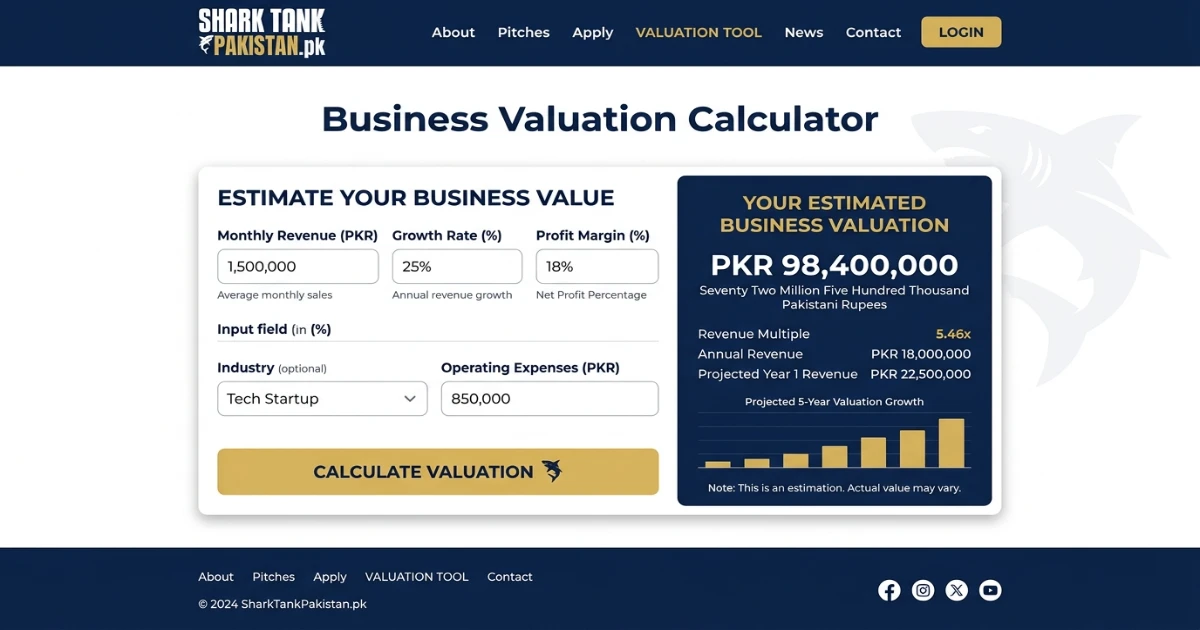
Put this into practice: Open the SharkTankPakistan.pk Valuation Calculator after reading this guide. Input your current monthly revenue, growth rate, and profit margin. The output will show you whether your business can sustain reinvestment into long-term SEO — or whether you need to prioritize immediate revenue-driving activities first.
Real-World Example: How a Small Pakistani E-commerce Brand Climbed to Page One
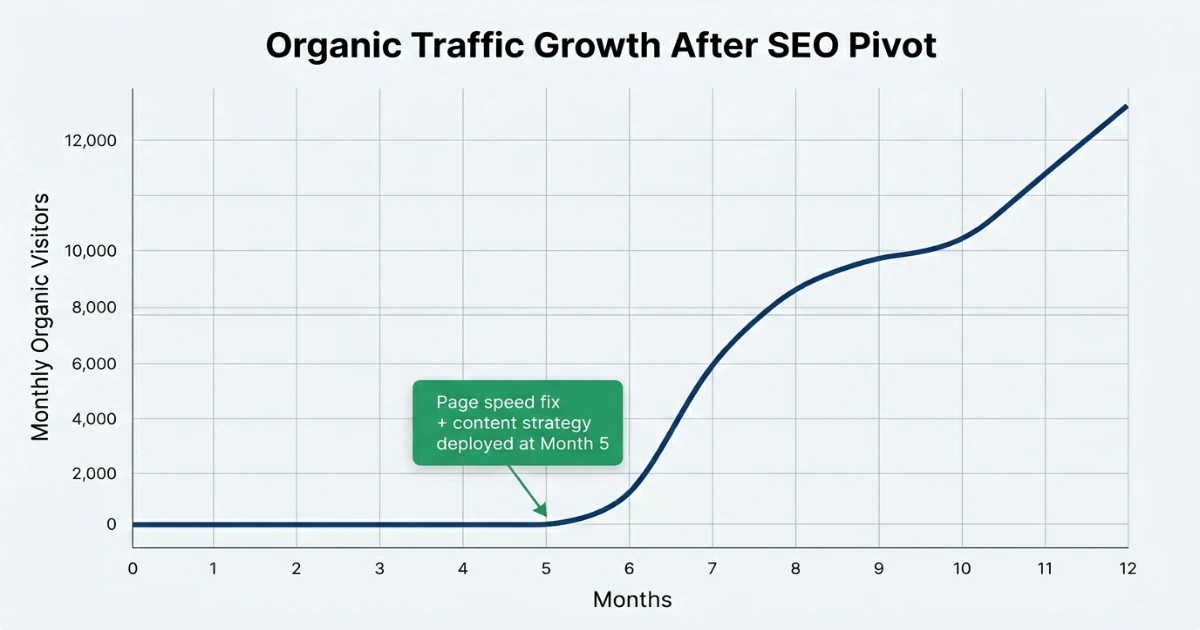
Consider a hypothetical but realistic case: “KurtaStudio,” a Lahore-based online store selling premium men’s kurtas. When they launched in early 2024, they targeted “buy men’s kurta online Pakistan” — a competitive term. Six months in, they barely cracked page four.
They pivoted. Here is what they did:
- Narrowed their initial keyword focus to “handmade embroidered kurta Lahore” and “eid kurta collection 2025 Pakistan” — long-tail, lower competition, high purchase intent.
- Rewrote all 40 product descriptions from scratch — unique, detailed, answering every sizing and fabric question a Pakistani buyer might have.
- Published six blog articles: “How to Style a Black Kurta for a Barat,” “Kurta Fabric Guide: Karandi vs Jamawar,” and similar topics. Each article linked to relevant product pages.
- Reached out to three Pakistani fashion bloggers and sent free samples. Two published reviews with backlinks.
- Fixed their mobile load time — from 6.8 seconds to 2.1 seconds — by switching to a faster theme and compressing images.
Within four months of this pivot, they ranked in the top three for their target long-tail keywords. Organic traffic grew 340%. More importantly, that traffic converted at 2.8% — well above the Pakistani e-commerce average of 1.5–2%. The lesson: precision, patience, and local relevance beat aggressive keyword chasing every time.
Frequently Asked Questions About Ranking E-commerce Sites in Pakistan
How long does it take to rank a new e-commerce site in Pakistan on Google?
Typically 4 to 8 months for meaningful organic traction on low-competition keywords, and 12–18 months for competitive terms. Pakistani e-commerce sites that invest in technical SEO, original content, and local backlinks from day one tend to see results faster than those relying on generic tactics. There are no shortcuts — sites promising rankings in weeks are almost always using tactics that eventually trigger Google penalties.
Do I need a .pk domain to rank better in Pakistan?
No, a .pk domain is not required, but it can provide a modest local relevance signal. A .com domain with strong Pakistani backlinks and localized content will rank just as well. What matters far more than the domain extension is hosting performance, content quality, and backlink profile. If you already own a .com, stick with it — do not disrupt your SEO by migrating domains unnecessarily.
Can I rank my Daraz store on Google, or do I need my own website?
Daraz product pages do occasionally rank on Google, but you have limited control over SEO elements. For long-term organic growth and brand ownership, an independent website is strongly recommended — even a simple one. Many successful Pakistani e-commerce brands run both: a Daraz store for marketplace traffic and their own site for organic Google rankings and higher margins.
What is the biggest SEO mistake Pakistani e-commerce store owners make?
Copying product descriptions from suppliers, competitors, or Daraz listings. Duplicate content cripples rankings because Google sees no reason to rank your page over the original source. The second biggest mistake is neglecting mobile page speed — a slow-loading store on a Pakistani 4G connection loses both rankings and customers simultaneously.
Is SEO worth it for a small Pakistani e-commerce store with a limited budget?
Yes — especially because SEO compounds over time while paid ads do not. A small store with a limited budget should focus on long-tail, low-competition keywords, create original product descriptions, and publish 1–2 helpful blog articles per month. These activities cost time more than money, and the traffic they generate continues flowing without ongoing ad spend.
Should I write product descriptions in English, Urdu, or both?
Write primarily in English, as Google in Pakistan indexes English content most effectively. However, incorporate romanized Urdu terms and phrases that your customers actually use — like “shalwar kameez,” “eid collection,” or “desi wedding wear.” This captures mixed-language search queries that are very common among Pakistani shoppers. Full Urdu-script content is less practical for SEO currently, though it may help with social media and WhatsApp marketing.
How important are backlinks from Pakistani websites specifically?
Very important. Backlinks from Pakistani domains (.pk sites, local news outlets, Pakistani bloggers, university pages) carry strong local relevance signals. Google’s algorithms recognize geo-relevance in link profiles. A link from a respected Pakistani domain is typically worth more for ranking in Pakistan than a link from a generic international site with no connection to the region.
Does cash on delivery (COD) availability affect SEO or Google rankings?
COD availability does not directly affect Google rankings, but it significantly impacts conversion rates and user behavior signals. If Pakistani visitors land on your site, see COD is available, and complete a purchase, those positive user signals (dwell time, low bounce rate, repeat visits) indirectly support rankings. Mentioning COD in meta descriptions can also improve click-through rates from search results.
⚡ Your Fast-Track Cheat Sheet: Top 3 Actions to Rank Your E-commerce Site in Pakistan
1. Fix your technical foundation today. Submit your XML sitemap to Google Search Console. Switch to a fast, mobile-optimized theme. Compress every image to WebP format. Test your mobile page speed on a throttled 4G connection and aim for under 2.5 seconds load time. These actions alone can lift rankings within weeks.
2. Build 10–15 original, long-tail-optimized product pages and 3–5 supporting blog articles. Target the exact phrases Pakistanis type — with city names, price modifiers, and romanized Urdu terms. Write original descriptions. Do not copy a single sentence from anywhere. Internal-link every blog article to relevant product pages.
3. Start earning Pakistani backlinks this month. Get listed on local business directories. Reach out to two Pakistani bloggers or micro-influencers for collaborations. Write one guest post for a Pakistani business or tech publication. Local backlinks are the most underutilized ranking accelerator in Pakistani e-commerce — use them.
🚀 Ready to put this into practice? Open the SharkTankPakistan.pk Valuation Calculator, plug in your e-commerce numbers, and see what your business is worth — because a strong Google ranking is only valuable if your business fundamentals can convert that traffic profitably.