How to Write a Business Plan That Pakistani Investors Actually Read
🥇 The Short Answer: Pakistani investors spend 3 to 7 minutes scanning a business plan Pakistan founders submit. They flip straight to the executive summary, then the numbers. If your first two pages don’t clearly answer “Why Pakistan, why now, and why you?”—the rest won’t get read. Write a tight, evidence-backed 10- to 14-page plan. Ditch the 45-page academic template. Show grounded unit economics, honest market sizing, and a clear regulatory path. That’s what opens doors in Karachi, Lahore, and Islamabad.
If you’re building a startup in Pakistan and hunting for investment—whether from an angel syndicate in DHA, a VC fund in Gulberg, or the sharks on Shark Tank Pakistan—your business plan is either your strongest advocate or the fastest way to get ghosted. The problem? Most Pakistani founders write business plans for nobody. They write them because an incubator asked for one, or because someone said “investors expect a plan.” But a plan that reads like a university thesis—stuffed with generic SWOT boxes, copy-pasted industry definitions, and five-year hockey-stick projections disconnected from Pakistani ground realities—goes straight to the ignored pile.
I’ve sat through enough pitch sessions and spoken to enough local investors to tell you this plainly: a business plan in Pakistan isn’t judged by its weight. It’s judged by how fast it builds trust. This guide will walk you through exactly how to write one that Pakistani investors actually read, respect, and act on.
Why Most Business Plans in Pakistan Fail to Get Read
Let’s be brutally honest. The average Pakistani investor—whether a high-net-worth individual, a family office, or an early-stage VC partner—sees 15 to 30 business plans a month. They don’t have time. They scan. They look for red flags. And the red flags in a business plan Pakistan context are remarkably consistent:
- The 50-page monster: Nobody wants your full industry history or a 12-page explanation of Porter’s Five Forces. Investors already know the market landscape. They want to know your angle.
- Delusional projections: Claiming you’ll capture 5% of Pakistan’s 240-million population in Year 2, with no distribution strategy, no regulatory roadmap, and Rs. 500,000 in marketing budget. This screams “I haven’t done the work.”
- Zero regulatory awareness: Pakistan has SECP, FBR, provincial revenue authorities, and sector-specific regulators (PEMRA, DRAP, SBP). If your business plan ignores who regulates your industry and how long approvals take, investors assume you’ll get stuck at go-live.
- Copy-paste generic language: “We will leverage synergies to disrupt the market.” Pakistani investors are allergic to this. Speak plainly. Say what you’ll actually do.
- No founder-market fit: Why are you the right person to solve this problem in Pakistan? If the plan doesn’t convey deep local insight, trust erodes fast.
The 10- to 14-Page Rule: What Pakistani Investors Actually Want
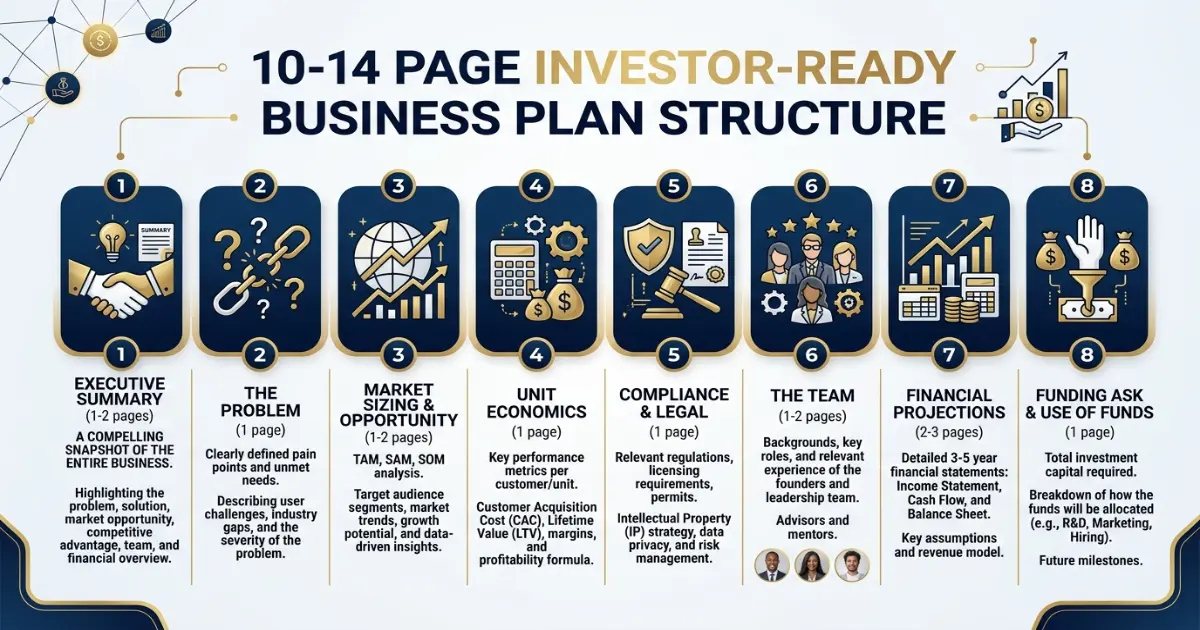
An investor-ready business plan Pakistan founders should aim for lands between 10 and 14 pages—excluding appendices. That’s the sweet spot. Long enough to cover substance, short enough to be read in one sitting. Here’s the structure that works:
- Executive Summary (1–2 pages) – The whole deal in miniature. If nothing else gets read, this must.
- Problem & Solution Clarity (1–2 pages) – What specific problem are you solving for Pakistanis, and why is your solution uniquely suited?
- Market Sizing & Opportunity (1–2 pages) – TAM, SAM, SOM with realistic, defensible numbers. Show your math.
- Business Model & Unit Economics (1–2 pages) – How do you make money? What’s your gross margin? Customer acquisition cost? Lifetime value?
- Go-to-Market & Distribution Strategy (1 page) – How will you actually reach customers in Pakistan? Digital? Retail? B2B partnerships?
- Competitive Landscape (1 page) – Who else is doing this, and why you win. Include informal competitors (e.g., the unorganized sector).
- Regulatory & Compliance Path (0.5–1 page) – What licenses, registrations, or approvals do you need? Timeline? Cost?
- Team & Founder-Market Fit (1 page) – Who’s building this, and why they’re the right people for this specific challenge.
- Financial Projections (2–3 pages) – Three-year realistic P&L, cash flow, and key assumptions clearly stated.
- Funding Ask & Use of Funds (0.5–1 page) – Exactly how much you’re raising, on what terms, and where every rupee goes.
The Executive Summary That Opens Doors
If your executive summary were the only page an investor read, would they call you? That’s the litmus test. A strong executive summary for a Pakistani investor contains these elements—in this order:
- One-sentence value proposition: What you do, for whom, and why it’s better. Example: “We help Karachi-based SMEs access same-day working capital loans using invoice discounting—without the 6-week bank wait.”
- The problem, localized: Don’t say “SMEs globally struggle with cash flow.” Say “Pakistan has 5.2 million SMEs; fewer than 7% have access to formal credit. The rest rely on informal lenders at 25–40% annualized rates.”
- Your solution & traction: What you’ve built, and what real-world validation you have. Even 50 paying customers or a successful pilot in two cities counts.
- Market snapshot: One tight paragraph with your TAM, SAM, and SOM—and why this market is ripe right now in Pakistan.
- Business model in one breath: “We charge a 3% flat fee per invoice discounted, with a 92% repeat rate.”
- The ask: “Raising USD 400,000 (or PKR equivalent) for 12% equity to expand to Lahore and Islamabad within 14 months.”
Financials That Build Credibility, Not Skepticism
This is where most Pakistani business plans implode. Founders either present numbers that are absurdly optimistic or so conservative they signal zero ambition. The middle path wins. Here’s what Pakistani investors specifically look for:
- Unit economics first, projections second: Before showing a P&L, show that you understand the economics of one transaction or one customer. What’s your gross profit per unit? How much does it cost to acquire that customer in Pakistan (Meta ads? Field sales? Referral commissions?)? What’s the payback period?
- Realistic pricing assumptions: If your product costs Rs. 3,500/month for a subscription, acknowledge that this is a considered purchase for most Pakistani households and your conversion funnel will reflect that.
- Currency and inflation notes: If your costs or revenues are USD-linked, say so. If you’re exposed to PKR depreciation, acknowledge it. Investors respect awareness over blind optimism.
- Runway calculation: How many months of operations does the funding give you? What milestones will you hit before the next raise?
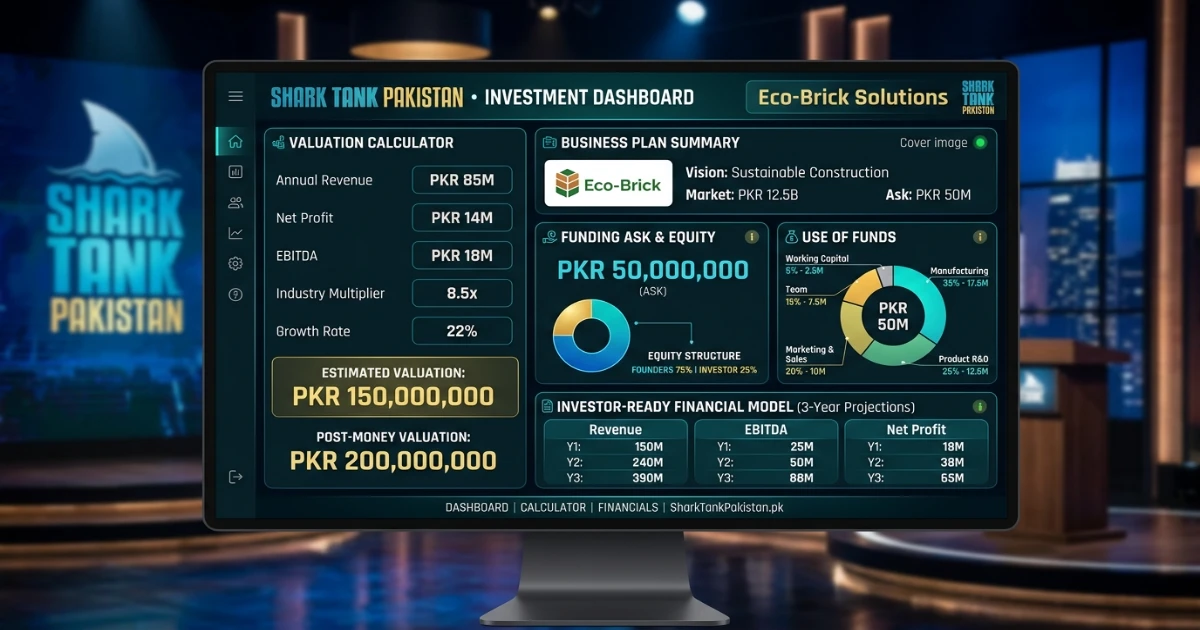
Also, open the SharkTankPakistan.pk Valuation Calculator and plug in your numbers. It’ll give you a reality check on whether your valuation ask is in the ballpark for Pakistani deals. Most first-time founders overvalue by 2× to 4×. The calculator helps correct that before you embarrass yourself in a meeting.

Traditional Plan vs. Investor-Ready Plan: A Side-by-Side Look
| Aspect | ❌ Traditional Academic Plan | ✅ Investor-Ready Plan for Pakistan |
|---|---|---|
| Length | 35–60 pages | 10–14 pages + appendices |
| Executive Summary | Generic mission statement, vague goals | Crisp: problem, solution, traction, ask—all localized |
| Market Sizing | Global stats copy-pasted from reports | TAM/SAM/SOM with Pakistani data sources and bottom-up logic |
| Financials | 5-year hockey stick, no unit economics | 3-year realistic, unit economics first, assumptions transparent |
| Competitor Analysis | Generic 2×2 matrix, ignores informal sector | Direct, indirect, and informal competitors with honest positioning |
| Regulatory Section | Often missing or one vague paragraph | Specific licenses, timelines, costs, and compliance roadmap |
| Tone | Corporate, impersonal, jargon-heavy | Direct, confident, conversational, grounded in local reality |
Market Sizing That Doesn’t Make Investors Roll Their Eyes
Let’s talk about the single most abused slide in Pakistani business plans: the market size page. “Pakistan has 240 million people. If we capture just 1%…” Stop right there. That’s not market sizing. That’s wishful thinking dressed up as math. Here’s how to do it properly:
Bottom-up, not top-down: Start with your specific target customer. How many of them exist in your launch city? What percentage can you realistically reach with your distribution model? Multiply by your average revenue per user. That’s your SOM (Serviceable Obtainable Market). Build upward from there—don’t drop a billion-dollar TAM from the sky.
Use Pakistani data sources: Reference the Pakistan Bureau of Statistics, State Bank reports, P@SHA surveys, Daraz seller data, Easypaisa/JazzCash transaction volumes—whatever is closest to your sector. When investors see you’ve done the legwork with local sources, credibility jumps.
Acknowledge the informal economy: Pakistan’s informal economy is estimated at 30–50% of GDP depending on methodology. If your competitor isn’t just the other app but also the kiryana store owner who extends informal credit, say so. That honesty sets you apart.
Situation-Based Adjustments: Your Plan Changes Depending on Where You Stand
If You’re Pre-Revenue
You don’t have traction numbers to show—and that’s okay. But you must compensate with depth. Include a detailed pilot or MVP plan with a clear timeline and budget. Show letters of intent from potential customers if you have them. Demonstrate deep primary research: surveys, interviews, or focus groups with your target Pakistani audience. Pre-revenue plans live and die on the quality of your evidence that demand exists.
If You’re Already Generating Revenue
Lead with traction. Revenue, customer count, retention rates, unit economics—these are your strongest cards. Don’t bury them on page 18. Put them in the executive summary. Pakistani investors are far more receptive when you’ve already proven someone in Lahore or Karachi will pay for what you’re selling. Your plan should read: “Here’s what we’ve validated. Now here’s how we scale it.”
If You’re a Tech Startup vs. a Traditional Business
Tech investors in Pakistan (VCs, Shark Tank Pakistan sharks with tech portfolios) care about scalability, defensibility, and eventual exit potential. Your plan should emphasize gross margins (60%+ is the signal), technology moat, and TAM. Traditional business investors (family offices, high-net-worth individuals, some angel groups) care more about cash flow predictability, asset backing, and steady returns. Your plan should emphasize payback period, breakeven timeline, and capital efficiency. Know your audience.
The Regulatory Section: The Page Most Founders Skip (And Investors Check First)
Pakistan’s regulatory landscape is complex. SECP registration, FBR tax registration, provincial revenue rules, sector-specific licenses (DRAP for health tech, PEMRA for media, SBP for fintech, PTA for telecom-adjacent services)—this isn’t optional knowledge. If your business plan Pakistan submission glosses over regulation, the investor assumes one of two things: you don’t know what you’re getting into, or you’re hoping to figure it out later. Both are deal-killers.
Dedicate at least half a page to one full page answering these questions:
- What is your legal entity structure (Pvt Ltd, LLP, sole proprietorship)?
- Which regulators oversee your industry?
- What licenses or approvals do you need before you can operate legally?
- How long does each approval take, and what’s the approximate cost?
- Are there any pending regulatory changes that could affect your business?
This section doesn’t need to be encyclopedic. It needs to show you’ve done the homework and you’re not walking into a regulatory ambush six months after launch.
Common Pitfalls & When to Ignore This Advice
🚩 Pitfall 1: Over-Polishing Before You’ve Validated Anything
Spending six weeks perfecting a business plan when you haven’t spoken to 20 potential customers is backwards. The plan should document what you’ve learned, not substitute for learning. Talk to customers first. Write the plan second.
🚩 Pitfall 2: Hiding Weaknesses
Every business has gaps. If you pretend yours doesn’t, investors will find them anyway—and they’ll wonder what else you’re hiding. Address risks honestly, then explain your mitigation strategy. Confidence isn’t pretending there are no risks. It’s showing you’ve thought them through.
🚩 Pitfall 3: Using the Same Plan for Every Investor
A Shark Tank Pakistan pitch deck needs to be visual, dramatic, and TV-friendly. A business plan for a formal VC fund needs deeper financial rigor. An angel investor might want more emphasis on the team and the vision. Customize. Don’t spray and pray.
⚠️ When to Ignore This Guide
If you’re a very early-stage startup with just an idea and no validation, a 14-page plan is overkill. Start with a 5-page lean business plan or a pitch deck. Use the Shark Tank Pakistan application guide to understand what the show’s screening team actually wants. Also, if you’re a lifestyle business that doesn’t intend to raise external funding, you don’t need an investor-ready plan—you need an operational roadmap. Different tool for a different job.
Put This Into Practice: Use the SharkTankPakistan.pk Tools
You don’t need to build your financial model from scratch in the dark. Head over to the Startup Valuation Calculator and input your revenue, growth rate, and industry. You’ll see instantly what a reasonable valuation range looks like for your stage in Pakistan—and whether your equity ask aligns with market norms. Then check the Equity vs. Loan Calculator to compare the long-term cost of equity dilution against debt financing. These tools exist because Pakistani founders kept making the same valuation mistakes. Use them before an investor uses your mistakes against you.
Real-World Lens: What a Shark Tank Pakistan Pitch Teaches About Business Plans
Watch a few episodes of Shark Tank Pakistan closely. Notice what the sharks interrupt for. It’s almost never the market size slide. It’s when the numbers stop making sense—when the valuation is disconnected from traction, when the founder can’t explain how they’ll spend the money, or when the business model doesn’t hold up to a simple “but what if” question. Your business plan needs to survive the same interrogation. Before you finalize it, have a brutally honest friend—preferably someone who’s raised money in Pakistan—tear it apart. Better to bleed on paper than bleed in the boardroom.
Frequently Asked Questions
- Do Pakistani investors prefer a business plan or a pitch deck?
- Most early-stage investors in Pakistan want a pitch deck first. If they’re interested, they’ll request a detailed business plan. For formal VC processes and larger raises (USD 500K+), have both ready. The pitch deck opens the door; the business plan Pakistan investors request next is what seals or sinks the deal.
- How long should my business plan be for Shark Tank Pakistan?
- For Shark Tank Pakistan, your on-air pitch is the priority. However, the application and due diligence process may require a concise 8- to 12-page plan. Focus heavily on traction, unit economics, and a clear funding ask. The sharks value clarity and honesty over document length.
- Do I need audited financials in my business plan?
- Not for early-stage startups. But if you’re revenue-generating, include at least management accounts (P&L and cash flow) reviewed by a qualified accountant. For pre-revenue startups, detailed financial projections with clear, defensible assumptions matter more than historical numbers.
- Should I write my business plan in English or Urdu?
- Write the formal business plan in English—it’s the standard language for investment documentation in Pakistan. However, if your target customers are primarily Urdu-speaking, include notes on how your marketing and communication will operate in Urdu or regional languages. Bilingual awareness signals local competence.
- What’s the biggest deal-killer in Pakistani business plans?
- Inconsistent numbers between sections. If your executive summary says one revenue figure, your financial projections say another, and your verbal explanation says a third—trust evaporates instantly. Triple-check every number across the entire document before sending it to anyone.
- Can I use a template for my business plan?
- Templates are fine for structure, but don’t let them dictate your thinking. A template won’t tell you to include a regulatory section specific to Pakistan, or to ground your market sizing in local data. Use a template as scaffolding, then customize aggressively. Generic plans lose to specific ones every time.
- How much detail should I include about my team?
- One focused page. Include each key team member’s name, role, relevant experience, and—crucially—why their background uniquely equips them for this specific business in Pakistan. Investors bet on people first. If your team page reads like generic LinkedIn summaries, rewrite it.
⚡ Your Fast-Track Cheat Sheet: Top 3 Actions to Take
- Cut your plan to 14 pages max. If it’s longer, you’re probably padding. An investor-ready business plan Pakistan founders should aim for is lean, focused, and scannable. Start with the executive summary and make it so compelling that the rest becomes mandatory reading.
- Ground every number in a Pakistani assumption. Don’t use global averages. Use local data, local pricing, local customer behavior. If you can’t defend a number with a source or a logical chain, replace it with one you can.
- Run your valuation through the SharkTankPakistan.pk calculator before you send anything. Misaligned valuation expectations are the fastest way to get a “no.” Fix that before the meeting, not during it.