Follow-Up After a Pitch Rejection: 5 Scripts to Turn a “No” Into a “Not Yet”
⚡ The Short Answer: A follow-up after a pitch rejection should be calm, brief and milestone-driven. Thank the investor, act on useful feedback, then return only when you have meaningful progress to share. A rejection may remain final, but professional follow-up keeps a suitable future conversation possible.
You walked out of the meeting, off the Shark Tank Pakistan stage, or ended the Zoom call with a polite but firm “we’ll pass for now.” After weeks of preparation, a rejection can feel personal.
Many founders either disappear completely or reply while emotions are still high. Neither response helps them preserve a valuable professional relationship.
A thoughtful follow-up after a pitch rejection is not a second pitch disguised as an email. It is a professional way to acknowledge feedback, keep building and return later with stronger evidence.
The goal is not to pressure an investor into reversing a decision. The goal is to make future updates welcome when your traction, valuation or timing genuinely improves.
This guide is built for Pakistani founders and Shark Tank Pakistan contestants who want practical next steps after hearing “no.” You will get five adaptable email scripts, a follow-up timeline and clear boundaries on when to stop contacting an investor.
Why a Follow-Up After a Pitch Rejection Matters
After hearing “no” from a senior investor, some founders feel that any follow-up could appear disrespectful. In reality, a concise professional message that accepts the decision and shares future progress can demonstrate maturity.
The opposite extreme is also harmful: responding within hours with a long emotional defence, a rushed valuation discount or a request to reconsider immediately. A rejection is feedback to process, not a negotiation to force while disappointment is fresh.
Do not bargain against yourself in the first response. If your valuation needs to change, make that decision later using evidence such as revenue, margins, comparable deals or a revised funding plan.
A useful follow-up after a pitch rejection is calm, structured and value-driven. Its first purpose is not to reverse the decision; it is to leave the investor comfortable receiving a future update when the business has materially progressed.
The Psychology of an Investor’s “No”
An investor may pass because of stage, sector fit, valuation, timing, traction or risk. Pay close attention to the reason they give you.
A comment such as “come back with revenue” or “show stronger retention” provides a measurable condition for a later update. A statement such as “this sector is outside my mandate” is a boundary to respect, not a challenge to overcome through repeated emails.
💡 Practical Founder Insight: A rejection does not always mean the business has no potential. Sometimes the missing piece is traction, timing, valuation clarity or investor fit. When you return with verifiable progress, you give the investor new information to assess rather than simply repeating the original pitch.
5 Follow-Up After a Pitch Rejection Scripts That Reopen Conversations
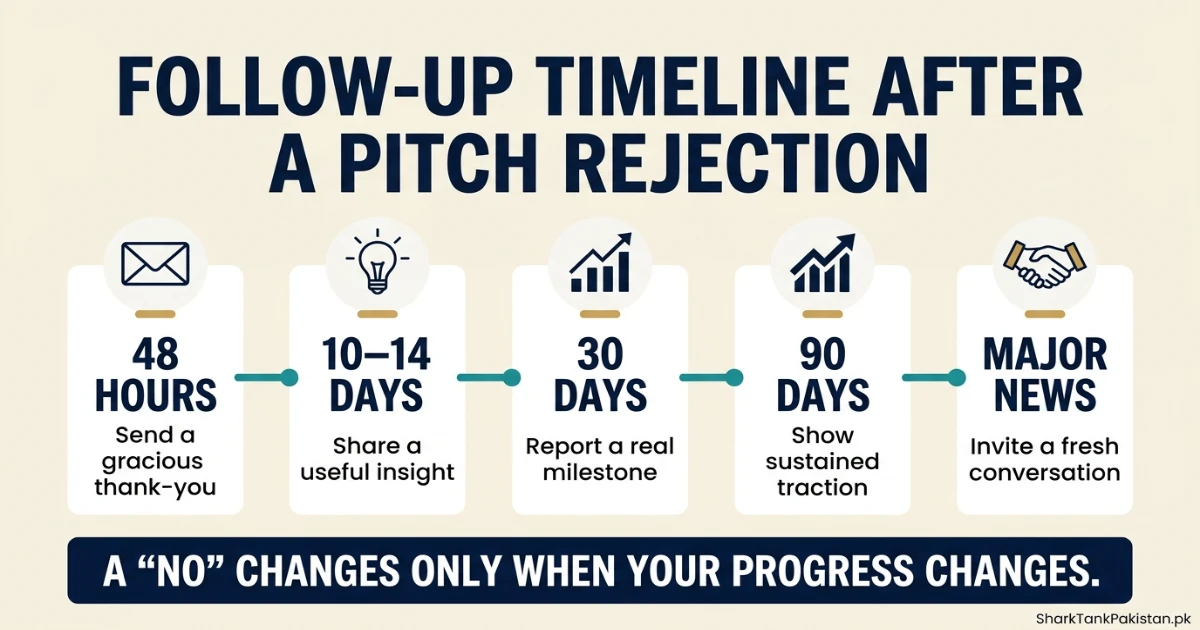
Forget generic “just checking in” emails. Each follow-up you send must serve a specific purpose, arrive at the right time, and move the investor incrementally from “I passed” to “I’m watching this.” Here is the sequence, with exact scripts you can adapt — right down to the subject lines. All scripts assume you received a rejection, whether in person, on a call, or on the show.
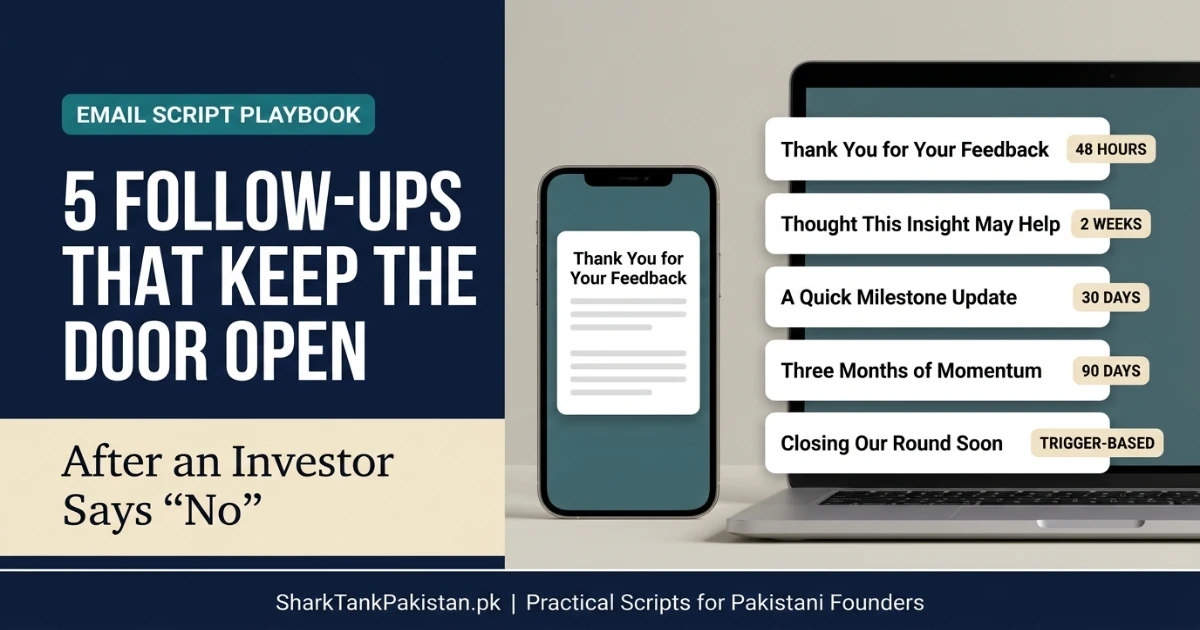
Script 1: The 48-Hour Thank-You (No Ask, Pure Class)
When to send: Within two days of the rejection.
Goal: Leave a positive impression that makes future emails welcome, not annoying.
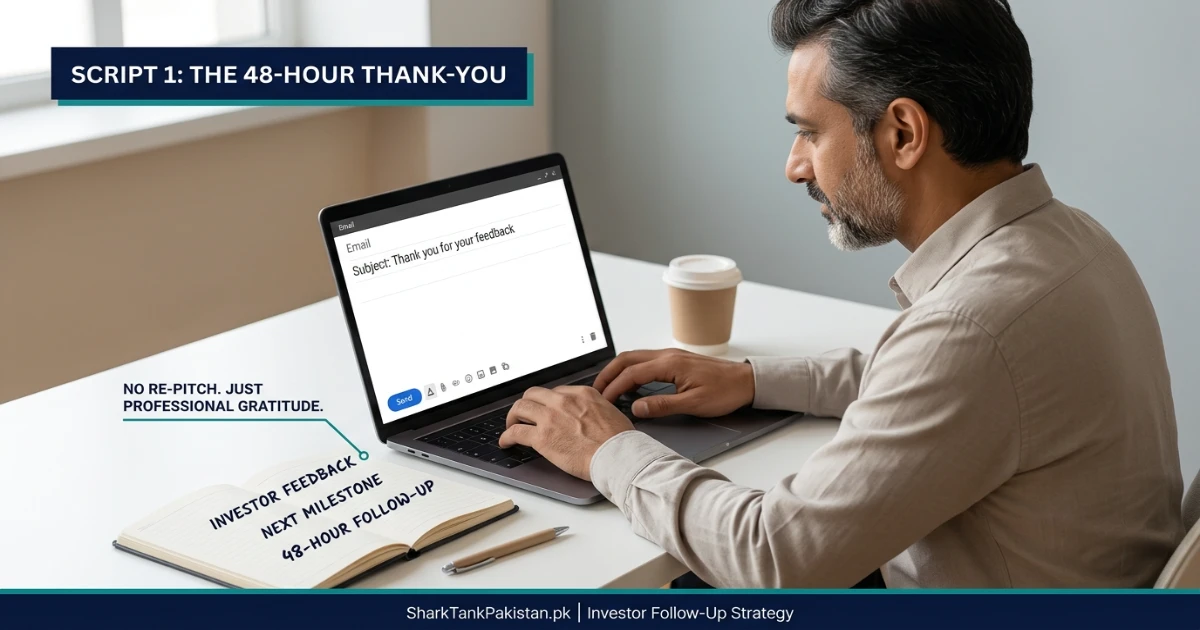
Subject: Grateful for your time and candour
Dear [Name],
Thank you for taking the time to hear our pitch — and for the direct feedback. I don’t take your honesty for granted. We’re using this moment to sharpen our focus, and I’d love to keep you posted on our progress over the coming months, if you’re open to it. No response needed — just wanted you to know we’re building with even more clarity now.
Best,
[Your Name]
This message presents you as a mature founder. You accept the decision, appreciate useful feedback and make no immediate demand.
An investor may or may not reply, but the tone makes a future milestone update more appropriate than an emotional re-pitch.
Script 2: The 2-Week Insight (Offer Value, Not a Pitch)
When to send: 10–14 days after the rejection.
Goal: Re-engage with something useful that demonstrates sector knowledge.
Subject: Thought of you when I saw this
Dear [Name],
I came across this [article/data point/industry shift] and remembered your comment about [something specific the investor mentioned during the pitch]. Thought it might be useful context. No update on our end just yet — still heads-down building — but wanted to share this.
Cheers,
[Your Name]
This type of follow-up is useful only when the insight directly connects to a concern raised during the pitch. For example, share a relevant market change after an investor questioned your sector timing.
Do not send generic news simply to appear active. Relevant value builds credibility; random links create noise.
Script 3: The 30-Day Milestone (Prove the Trajectory)
When to send: Roughly one month after rejection, but only if you have a tangible update.
Goal: Demonstrate that the business is progressing and that their rejection missed the curve.
Subject: A quick milestone — thought you’d want to know
Dear [Name],
When we pitched last month, we had [X]. Since then, we’ve [specific, quantified achievement — e.g., doubled our paying users, signed our first school contract, crossed Rs 1M in revenue, launched the Urdu version, cut churn to 4%]. No ask here — just wanted you to hear it from us first. I’ll check in again when we hit the next rung.
Best,
[Your Name]
A milestone email is strongest when it directly addresses the reason for rejection. If the investor wanted paying customers, report customers or revenue. If they worried about retention, report a real retention improvement.
Do not send this update because a month has passed. Send it because something measurable has changed.
Script 4: The 90-Day Traction Update (The Pattern Continues)
When to send: 2–3 months after rejection, with another milestone.
Goal: Show that the initial milestone wasn’t a fluke — it’s a trend.
Subject: Since we last spoke — 3 months of momentum
Dear [Name],
Three months ago you told us to come back when we had more proof. Here’s what’s happened since:
– [Milestone 1]
– [Milestone 2]
– [Milestone 3]
We’re now at [current status]. Our original ask has evolved slightly — we’re raising [new amount] on [new terms] given our updated traction. Would a 15-minute catch-up be valuable? If not, no problem — I’ll keep updating you.
Best,
[Your Name]
At the 90-day stage, a sequence of genuine milestones can show a trend rather than a one-off win. Keep the update factual and invite a short conversation only when the new information is substantial.
Even then, the investor may decline. The value of this approach is that your request is based on execution, not pressure.
Script 5: The Trigger-Based Outreach (Major News)
When to send: Any time a significant external event occurs — major partnership, competitor exit, regulatory change, or you’re closing a round.
Goal: Use urgency and social proof to prompt a decision.
Subject: Closing our round next week — wanted you to have the option
Dear [Name],
Since our last conversation, we’ve [major milestone]. We’re closing our seed round on [date] and have [X] already committed. Given your earlier interest in the space, I wanted to offer you a window before we finalise allocations. No pressure — just didn’t want you to hear about it later and wonder.
If there’s a time this week to chat, I’ll make it work. If not, I’ll look forward to updating you post-close.
Best,
[Your Name]
Use this email only when the round, commitment or deadline is genuine. Real momentum can justify a time-sensitive message; fabricated urgency can permanently damage trust.
A respectful closing update gives a previously interested investor a final opportunity to evaluate new information without creating false pressure.
| Follow-Up Type | Timing | Tone | Goal | Biggest Mistake |
|---|---|---|---|---|
| 48-Hour Thank-You | Within 2 days | Grateful, brief | Leave door open | Including a second pitch or arguing |
| 2-Week Insight | 10–14 days | Helpful, casual | Reframe you as a peer | Sending irrelevant or generic content |
| 30-Day Milestone | ~1 month | Confident, factual | Prove momentum | Sending without a real, measurable win |
| 90-Day Traction Update | 2–3 months | Data-driven, low-ask | Show trend, suggest catch-up | Over-asking for another full pitch meeting |
| Trigger-Based (Round Close) | As needed | Urgent, respectful | Prompt decision via scarcity | Fabricating scarcity or sending too frequently |
How to Adjust Your Follow-Up After a Pitch Rejection
The five scripts above form a useful sequence, but the correct next step depends on why the investor passed and what has changed since the pitch.
If You’re Pre-Revenue and Got Rejected for Lack of Traction
Do not send a milestone update merely because 30 days have passed. If you are still pre-revenue, meaningful proof can include pilot completions, letters of intent, waitlist growth with verified demand or engagement from a defined customer group.
If you have no material update, continue building rather than filling an investor’s inbox with optimism alone.
If You Received a Hard “No” vs. a Soft “Maybe Later”
A hard no — such as “this is outside our mandate” or “please do not contact me again” — is a boundary. Send a brief thank-you only when appropriate, then stop following up.
A soft rejection — such as “come back with more traction” — gives you a clear milestone to work toward. Follow up only after you can demonstrate that progress.
If You Were Rejected on Shark Tank Pakistan (On-Air)
A televised rejection does not prevent a professional later update, but it also does not create an expectation of investment. After the episode airs, a founder with meaningful new progress may send a concise private email acknowledging the feedback and sharing what has changed.
Keep the message focused on execution. An introduction, useful advice or a reopened discussion may be valuable outcomes even when no investment follows.
If You’re a First-Time Founder vs. a Serial Entrepreneur
First-time founders can build credibility through thoughtful market insight and measurable early validation. Serial entrepreneurs may have previous execution to reference, but they still need current evidence for the new business.
In either case, a follow-up after a pitch rejection works best when it contains information the investor did not have at the time of the original decision.
Common Pitfalls & When to Ignore This Advice
Even a well-written sequence can backfire if it ignores the investor’s boundary or offers updates that do not matter. Avoid these common mistakes.
Pitfall 1: Following Up Too Soon with Too Much Emotion. Sending an email within hours of a rejection, full of justifications and emotional pleas, is the fastest way to ensure the door stays shut. Give yourself at least 24 hours to process the rejection before you draft anything. If you’re still angry or defensive, wait another day. The tone you need is calm confidence, not wounded persistence.
Pitfall 2: Sending Updates That Aren’t Actually Impressive. “We changed our logo” is not a milestone. “We updated our website copy” is not a milestone. Every update you send must pass the test: would this change an investor’s mind about the business? If not, don’t send it. You get maybe three follow-ups before the investor starts ignoring you. Make each one count.
In Pakistan, WhatsApp is convenient and common in business conversations. However, unless the investor gave you a number for follow-up or invited messages, begin with email.
Email gives the investor professional distance and makes it easier for them to review your update when convenient.
Stop the sequence when the investor clearly says the opportunity is outside their mandate, requests no further contact, or repeatedly does not respond to useful updates.
Persistence should mean continuing to build the business, not repeatedly contacting someone who has indicated they are not a fit.
📊 The Follow-Up Principle
A structured update cannot guarantee funding. Its value is simple: it allows an investor to reassess your business using new evidence such as revenue, customer retention, signed pilots, improved unit economics or revised terms. Follow up when the evidence changes—not simply because the calendar moved.
Tools to Strengthen Your Follow-Up After a Pitch Rejection
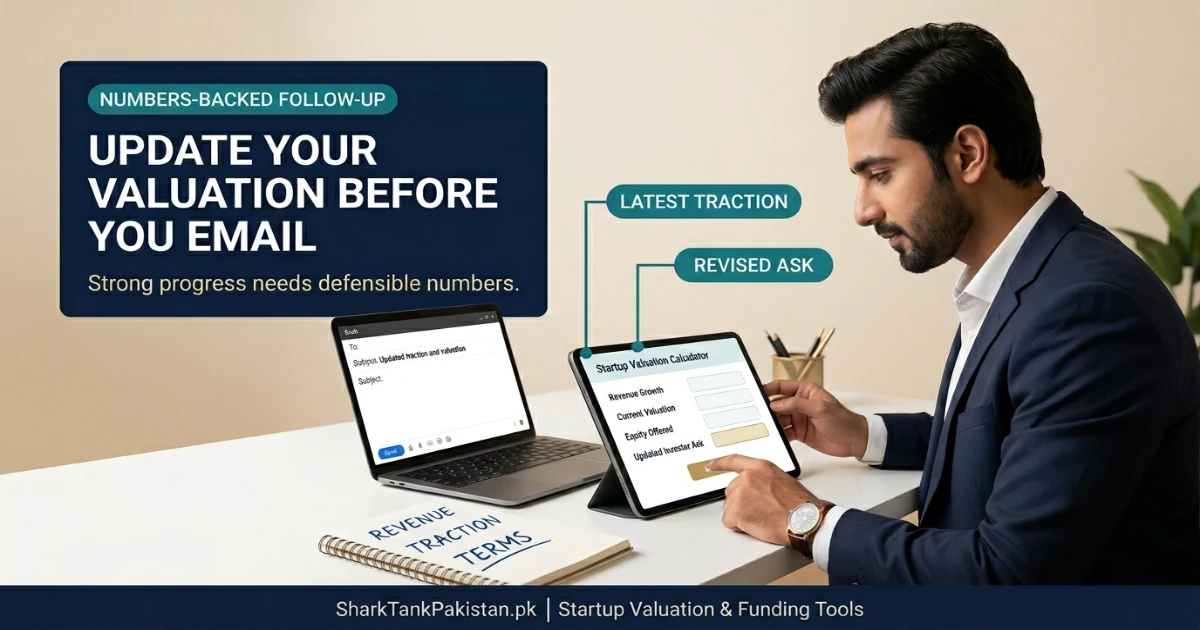
The scripts are your words; your numbers are the evidence. Before you send a milestone update, calculate whether your revised ask is supported by current revenue, profit, growth and funding needs.
The Business Valuation Calculator and Equity Loan Calculator on SharksTankPakistan.pk can help you model a defensible funding conversation before you contact an investor again.
If a rejection cited valuation, revisit your assumptions before your next email. A useful update might explain that revenue improved, margins strengthened or your funding structure changed after reviewing dilution and financing options.
That approach turns a general “we are doing better” message into an evidence-based conversation.
🧠 Try It Yourself: Before sending your next follow-up after a pitch rejection, use the Business Valuation Calculator Pakistan guide and review your latest numbers. Share progress that an investor can understand and verify—not a vague claim that the business is doing well.
A Practical Example: Turning Three “No” Responses Into One Conversation
Consider a realistic example: a Lahore-based agri-tech founder pitches a farm-to-retail supply-chain platform to three investors. Each passes for a different reason: the venture is too early, margins appear thin and the technology advantage is unclear.
Instead of arguing, the founder sends a brief thank-you message. Weeks later, he shares relevant market insight with the investor who questioned logistics economics. After signing a paid pilot with retailers, he sends a concise milestone update backed by revenue and margin data.
Three months later, the founder can send a consolidated update showing whether the pilot expanded, margins improved and a new round is forming. An investor who previously passed now has evidence to reassess.
This example does not promise a yes. It shows the point of a disciplined follow-up: the conversation is reopened by measurable execution, not by repeating the same request.
❓ Frequently Asked Questions About a Follow-Up After a Pitch Rejection
How soon should I follow up after a pitch rejection?
Send a brief thank-you within 48 hours. Do not include a new pitch or demand another meeting. Express gratitude for useful feedback and indicate that you will continue building. A professional opening message makes later updates less intrusive.
What if the investor explicitly said “no” and asked me not to contact them again?
Respect that boundary absolutely. Send one final gracious note thanking them for their clarity, then remove them from your list. A “no” that includes a direct request to cease contact is not an invitation to persistence — it’s a clear line. Continuing will damage your reputation, not build a relationship.
Can I follow up after being rejected on Shark Tank Pakistan?
Yes, when you have meaningful new progress to share. After the episode has aired and public attention has settled, send a concise private email that acknowledges the feedback and explains what has materially changed. Treat it as professional relationship-building, not an expectation of investment.
What should I never include in a follow-up email after a pitch rejection?
Never argue with the investor’s decision, never beg for another chance, and never offer to immediately reduce your valuation or give away more equity just to get a “yes.” Those moves signal desperation and a lack of conviction. Keep the tone confident, factual, and forward-looking, even if you feel disappointed.
How many follow-ups are too many?
If you’ve sent three value-adding emails (thank-you, insight, milestone) and received no response at all, pause. You can send a final trigger-based email if you have genuinely big news, but beyond that, continued silence means the investor is either not interested or not responsive. Shift your energy to other prospects.
Is it acceptable to follow up via WhatsApp in Pakistan?
Only if the investor gave you their WhatsApp number and explicitly invited messaging. Otherwise, stick to email. WhatsApp is considered more personal in Pakistan, and an unsolicited WhatsApp follow-up after a rejection can feel intrusive. Build the email relationship first; WhatsApp may come later naturally.
How do I show progress if I’m still pre-revenue and have no new numbers?
Share engagement metrics that weren’t available during the pitch: waitlist growth, pilot program completions, testimonials from test users, letters of intent from potential customers, or product development milestones. If nothing material has changed, wait until it has. Sending an update with no real progress is worse than sending nothing.
What if the rejection was about my personal background or team, not the business?
This is harder to fix with follow-ups, but not impossible. If the concern was about a lack of a technical co-founder, for example, your milestone update could announce a new hire. If the concern was about your industry experience, you could share that you’ve joined an advisory board or completed a relevant certification. Address the specific objection without being defensive.
🚀 Your Fast-Track Cheat Sheet: Top 3 Actions to Take
- Send a 48-hour thank-you after relevant investor rejections. Keep it brief, accept the decision and avoid re-pitching. A professional response preserves the relationship without applying pressure.
- Track meaningful milestones at 30, 90 and 180 days. Send an update only when revenue, pilots, retention, partnerships or funding terms have genuinely improved.
- Check your numbers before every funding update. A strong follow-up after a pitch rejection pairs progress with a valuation or funding structure that is clear, consistent and defensible.