How Much Equity Do Sharks Usually Take? A Realistic Breakdown of Average Equity on Shark Tank Pakistan
⚡ The Short Answer: On Shark Tank Pakistan, sharks typically ask for 15% to 35% equity in exchange for their investment — with most deals landing somewhere between 20% and 30%. Early-stage, pre-revenue startups should expect to give up more (25–40%), while established, profitable businesses with strong traction can sometimes negotiate down to the 10–18% range. The average equity on Shark Tank Pakistan deals is shaping up around 22–28% based on early season patterns, though every pitch is its own unique negotiation.
If you’re a Pakistani founder preparing to step into the tank — or simply someone who watches the show and wonders, “Wait, how much of their company did they just hand over?” — you’re asking one of the most important questions in startup fundraising. Equity isn’t just a number on a term sheet. It’s ownership. Control. Future upside. And get it wrong, and you could spend years building something you barely own anymore.
In Pakistan’s emerging startup ecosystem, where formal venture funding is still relatively young and many founders are navigating these waters for the first time, understanding realistic equity expectations isn’t just helpful — it’s essential armour for the negotiation table. This guide gives you the honest, numbers-backed breakdown that most generic articles skip. No sugar-coating. No recycled US stats. Just what Pakistani founders actually need to know about average equity on Shark Tank Pakistan and how to walk into that room prepared.
Why Equity Matters Even More in Pakistan’s Startup Landscape
In mature ecosystems like Silicon Valley, founders have dozens of funding pathways: angel syndicates, venture capital firms, revenue-based financing, accelerators, and more. In Pakistan, while the ecosystem is growing rapidly, the options are still comparatively limited — especially for early-stage companies outside of Karachi, Lahore, and Islamabad. That means when a shark offers you a deal on national television, the weight of that decision is magnified. You might not have five competing term sheets waiting in your inbox.
But here’s the flip side: Pakistani sharks often bring more than just cash. Many of them have built massive businesses in Pakistan’s unique regulatory and cultural environment. Their networks, distribution channels, regulatory know-how, and brand credibility can be worth far more than the cheque they write. So the equity conversation isn’t purely financial — it’s a value-exchange calculation that every founder needs to master.
What trips up many first-time Pakistani founders is treating equity like a simple percentage math problem. It’s not. A 25% stake given to a shark who can open doors to nationwide retail distribution, SECP navigation, and supplier relationships is fundamentally different from a 25% stake given to a silent investor who just writes a cheque. The average equity on Shark Tank Pakistan only tells part of the story — who you’re giving it to matters just as much as how much.
The Numbers: What the Data Actually Shows About Average Equity on Shark Tank Pakistan
Let’s get concrete. While Shark Tank Pakistan is building its deal history, we can draw meaningful insights from early season patterns and compare them with global benchmarks. Across the Shark Tank franchise — US, India, Australia, and now Pakistan — there are clear patterns that hold remarkably consistent, with local flavour layered on top.
The US Baseline (for context)
On Shark Tank US, across 14+ seasons, the average equity stake sharks secure ranges from 20% to 25% for closed deals. Deals below 10% are rare and typically involve later-stage companies with proven profitability. Deals above 40% happen but usually signal a distressed business or an exceptionally risky early-stage venture. The median hovers around 22%.
What We’re Seeing in Pakistan
On Shark Tank Pakistan, the numbers skew slightly higher for early-stage businesses — think 25% to 35% — for a few very specific reasons: smaller cheque sizes relative to valuation expectations, less mature financial documentation from founders, and a market where the sharks’ operational value-add is genuinely substantial. For revenue-generating Pakistani startups with clean books and clear traction, the range tightens to 15% to 25%, which is much closer to global norms.
| Factor | Shark Tank Pakistan | Shark Tank US | Shark Tank India |
|---|---|---|---|
| Typical equity range (early-stage) | 25% – 35% | 20% – 30% | 20% – 35% |
| Typical equity range (revenue-generating) | 15% – 25% | 10% – 20% | 12% – 25% |
| Median deal equity | ~24% (early data) | ~22% | ~25% |
| Sharks’ non-cash value emphasis | Very high — networks & regulatory access | Moderate — brand & retail connections | High — distribution & manufacturing |
| Common deal structure | Straight equity; some royalty hybrids | Equity; royalties; convertible notes | Equity; royalty + equity combos |
| Founder familiarity with term sheets | Mixed — many first-timers | Generally high | Growing rapidly |
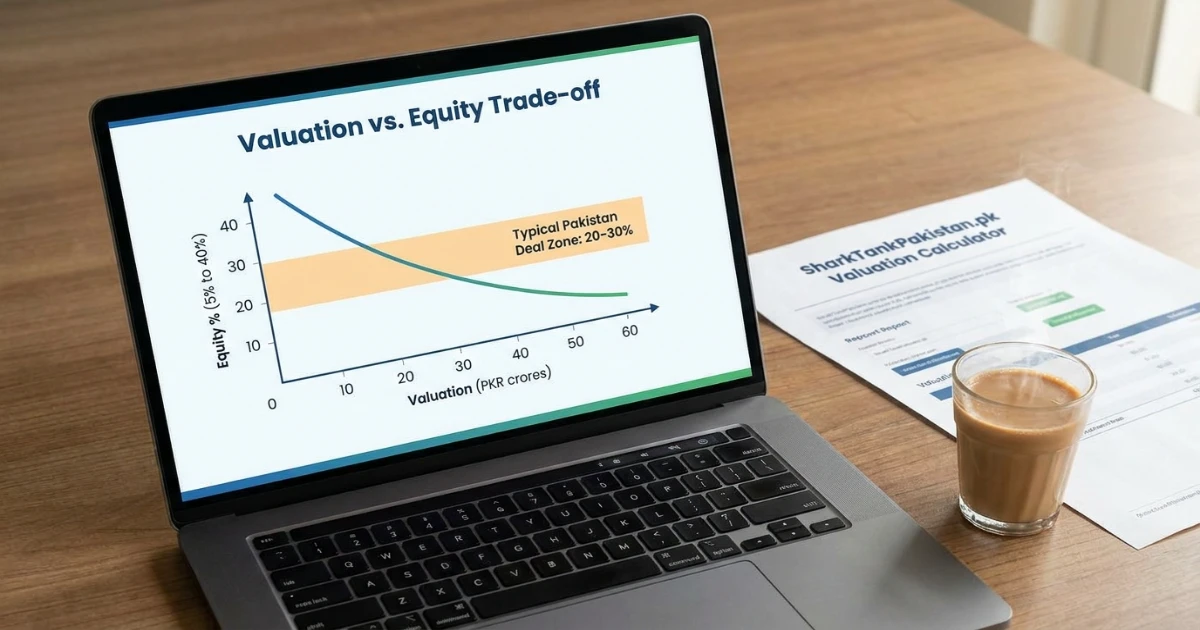
📊 Data Point — The Valuation-Equity Seesaw: On Shark Tank Pakistan, the single biggest driver of equity percentage isn’t the shark’s negotiation style — it’s the gap between the founder’s valuation ask and what the sharks believe the business is actually worth. When a founder asks for PKR 1 crore at a PKR 10 crore valuation (10%), and the sharks counter that the business is worth PKR 4 crore, the equity jumps to 25% for the same cheque. Understanding valuation mechanics — using tools like the SharkTankPakistan.pk Valuation Calculator — is your first line of defence against giving away too much.
What Actually Drives a Shark’s Equity Demand? (It’s Not Just Greed)
Founders sometimes walk away from the tank feeling like the sharks were being unreasonably aggressive. But seasoned investors — Pakistani sharks included — are pricing in risk the same way any smart capital allocator would. Understanding their calculus makes you a better negotiator.
1. Stage of the Business
A pre-revenue startup with a prototype and some early user interest carries massive execution risk. Sharks will demand more equity (30–40%) because the probability of failure is higher and their capital is doing the heavy lifting. A business already generating PKR 50 lakhs+ in annual revenue with consistent margins is in a completely different risk category — and equity demands drop accordingly (15–22%).
2. Quality of Financial Records
This is where many Pakistani founders stumble. If you walk in with incomplete books, no clear unit economics, and a vague sense of your numbers, sharks will — correctly — price in uncertainty by demanding more equity. Clean, auditor-verified financials are equity-saving superpowers. The difference between “I think we made about 40 lakhs last year” and “Here are our audited statements showing PKR 42.3 lakhs in revenue with 28% gross margins” can be 8–12 percentage points of equity.
3. Founder Experience & Team Strength
A solo founder pitching their first venture faces higher equity demands than a team of two or three founders with complementary skills and prior industry experience. Sharks know that execution risk drops when the founding team has depth. In Pakistan’s context, a founder who has previously built and exited a business — even a small one — carries a “de-risked” profile that directly translates to better equity outcomes.
4. Market Size & Defensibility
Is your business serving a niche market of 50,000 potential customers in Karachi, or is it addressable to 50 million across Pakistan and beyond? Is your product easily replicable by a competitor with deeper pockets, or do you have genuine moats — proprietary technology, exclusive supplier relationships, regulatory licences, or strong brand loyalty? Bigger, more defensible markets command lower equity asks from sharks because the upside potential justifies a higher valuation.
What Equity Should YOU Expect? A Situation-Based Guide
Generic advice is dangerous. Here’s how equity expectations shift based on where you actually stand as a Pakistani founder.
🟢 If You’re Pre-Revenue (Idea or Prototype Stage)
Expect to give up: 30% – 40%. At this stage, you’re selling vision, not numbers. Sharks are taking a gamble on you and your idea. The equity demand will be higher — and honestly, that’s fair. What you should negotiate for: clear milestones. If you’re giving up 35%, make sure the shark commits to specific introductions, operational support, or follow-on funding triggers. Don’t just take the money and a handshake. Action: Use the equity calculator to model what 35% dilution looks like across two future funding rounds — it’s eye-opening.
🟡 If You’re Early Revenue (PKR 10–50 Lakhs/Year)
Expect to give up: 20% – 30%. You’ve proven someone will pay for what you’re building. That’s a meaningful de-risking event. Sharks will still push for a significant stake because scale isn’t proven yet, but you have negotiating leverage. Key move: Bring month-on-month revenue growth data. A 15% monthly growth rate over 8 months is a powerful equity-reducing argument that few founders use effectively.
🔵 If You’re Established & Profitable (PKR 1 Crore+/Year)
Expect to give up: 10% – 20%. At this stage, you’re not desperate for capital — and sharks know it. Your negotiation position is strongest here. The question shifts from “Can this business survive?” to “How fast can we scale this together?” You can and should push back hard on equity demands above 20%. Pro tip: If a shark insists on 25%+ at this stage, ask specifically what they’ll deliver beyond the cheque to justify that premium. If the answer is vague, walk away — or counter with a lower equity + performance-based earn-in structure.
🧠 Why This Works: The most successful Pakistani pitchers on the show don’t just defend their valuation — they redirect the conversation to the shark’s non-monetary value. When a shark says “I want 30%,” a smart founder replies: “At 30%, here’s what I’d need from you beyond capital — distribution in Punjab, introductions to three key retailers, and quarterly strategy sessions. Can you commit to that?” This reframes the negotiation from a zero-sum percentage fight to a partnership alignment discussion.
Common Pitfalls & When to Ignore Generic Equity Advice
Not all “rules of thumb” about equity apply equally in Pakistan. Here’s where founders commonly go wrong — and when standard advice might actually hurt you.
❌ Pitfall 1: “Never Give More Than 20%”
This US-centric advice ignores Pakistani reality. If you’re pre-revenue and need PKR 50 lakhs to build your product, insisting on giving only 15% might mean no deal at all. A shark who offers PKR 50 lakhs for 30% of a business that currently has zero revenue and a prototype isn’t being unfair — they’re pricing risk. The better rule: Never give more than you can justify based on what the investor brings beyond capital.
❌ Pitfall 2: Obsessing Over Valuation Instead of Partnership Quality
We’ve seen Pakistani founders celebrate a “high valuation” deal on camera, only to later realise the shark is spread too thin across 15 portfolio companies and provides zero operational support. A PKR 2 crore valuation with a deeply engaged shark who opens 50 retail points is better than a PKR 4 crore valuation with a completely hands-off investor. Equity percentage is one variable in a multi-variable equation.
❌ Pitfall 3: Forgetting About Future Dilution
If you give 30% to a shark in your first funding round, and then 20% to a VC in your Series A, and then 15% in your Series B — your ownership can shrink below 40% faster than you’d think. Always model dilution across at least two future rounds before agreeing to any equity split. The SharkTankPakistan.pk calculators let you simulate this in minutes.
⚠️ When to Actually Ignore “Average Equity” Benchmarks
If your business is truly exceptional — proprietary technology with a patent pending, exclusive government contracts, or a brand with cult-like customer loyalty in Pakistan — throw the averages out. Exceptional businesses command exceptional terms. The “average equity on Shark Tank Pakistan” is a starting point for negotiation, not a ceiling or floor. Know the data, but don’t be enslaved by it.

How It Plays Out in Real Life: A Shark Tank Pakistan Scenario
Let’s walk through a realistic scenario — the kind that plays out repeatedly on the show — so you can see the equity mechanics in action.
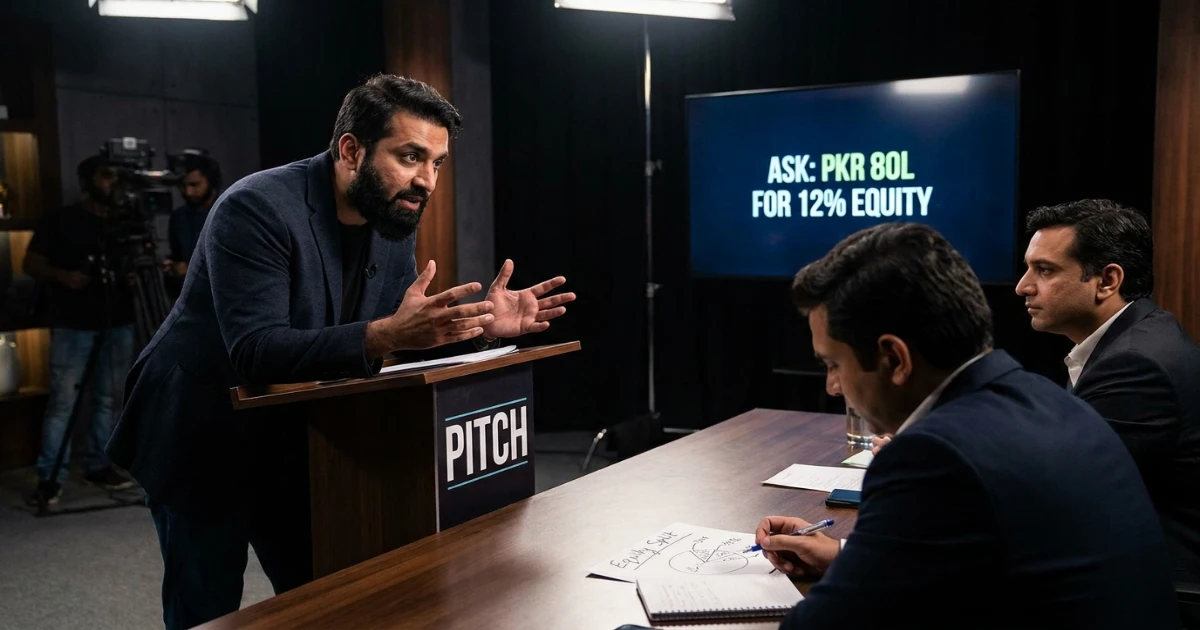
The Founder: Ayesha runs a direct-to-consumer skincare brand in Lahore. She’s been operating for 18 months, generated PKR 65 lakhs in revenue last year with 32% gross margins, and has 12,000 repeat customers. She’s asking for PKR 80 lakhs for 12% equity — implying a PKR 6.67 crore valuation.
The Sharks’ Pushback: They like the brand and the numbers, but they push back on valuation. Their counter: the business is worth PKR 3.5 crore based on comparable Pakistani D2C deals and the revenue multiple typical in the category (roughly 5–6x revenue for a brand of this size). At PKR 3.5 crore, PKR 80 lakhs buys 22.9% equity — nearly double the founder’s original offer.
The Negotiation: Ayesha holds firm on some points and concedes on others. She agrees the valuation was aggressive but demonstrates that her customer acquisition cost is declining month-over-month and her repeat purchase rate is 41% — both above category average. The final deal: PKR 80 lakhs for 18% equity (implied valuation of ~PKR 4.44 crore), with the shark committing to retail introductions at four major Karachi and Lahore department stores.
The Lesson: Ayesha landed at 18% — below the typical range for her stage — because she brought data the sharks couldn’t argue with. Data is the great equity equaliser.

Put This Into Practice: Use the SharkTankPakistan.pk Calculators
Reading about equity is one thing. Seeing your own numbers run through a proper valuation model is where the real clarity hits. Before you ever step into a pitch — whether it’s for Shark Tank Pakistan, an angel investor, or a VC — spend 20 minutes with these tools.
Open the Startup Valuation Calculator and plug in your actual revenue, growth rate, and industry. The output will show you a realistic valuation range — and from there, you can calculate exactly what equity you’d need to give up for your target raise amount. Then use the Equity & Loan Calculator to model dilution across multiple rounds. Five minutes of playing with these numbers can save you from a lifetime of regretting a hasty equity decision.
Frequently Asked Questions About How Much Equity Do Sharks Usually Take? on Shark Tank Pakistan
- What is the average equity on Shark Tank Pakistan?
- Based on early season data, the average equity stake sharks secure on Shark Tank Pakistan ranges from 22% to 28%. Early-stage, pre-revenue businesses tend toward the higher end (25–35%), while established, revenue-generating companies often negotiate down to 15–22%.
- Do Pakistani sharks take more equity than US sharks?
- Yes, slightly. Pakistani sharks typically ask for 2–8 percentage points more equity than their US counterparts for comparable-stage businesses. This reflects the smaller Pakistani venture market, higher perceived execution risk, and the significant non-cash value Pakistani sharks bring through local networks and regulatory expertise.
- Can I negotiate equity after the show?
- Yes — and this is critical to understand. The on-camera handshake is a preliminary agreement. Due diligence follows, and terms can and often do change. Financial discrepancies, legal issues, or deeper operational review can shift the final equity percentage. Never assume the on-air deal is the final deal.
- What’s the lowest equity a shark has ever accepted on Shark Tank Pakistan?
- While the show is building its history, deals below 10% are exceptionally rare — globally and in Pakistan. The lowest equity deals (8–12%) typically involve high-revenue, profitable businesses where the shark’s capital is more about acceleration than survival. For most Pakistani founders, targeting 12–18% is realistic only with strong financials and clear leverage.
- Is giving equity better than taking a loan for my Pakistani startup?
- It depends entirely on your business model. Equity means no repayment pressure — but you give up ownership and some control. Loans preserve ownership but require regular repayments regardless of revenue. For high-growth startups with uncertain early cash flows, equity is often more suitable. For stable, cash-flow-positive businesses, a loan or revenue-based financing might be the smarter, less dilutive choice.
- Do I need a registered company to discuss equity on Shark Tank Pakistan?
- Yes. You need a legally registered business entity in Pakistan — typically a private limited company with SECP — to formalise any equity deal. The sharks will not (and cannot) invest in an unregistered sole proprietorship. If you’re still operating informally, prioritise registration before applying. Our registration guide walks you through the entire process.
- How do I calculate how much equity to offer?
- Start with a realistic valuation (use the SharkTankPakistan.pk Valuation Calculator). Then divide your funding ask by that valuation. For example: asking PKR 50 lakhs at a PKR 2.5 crore valuation equals 20% equity. Always build in a negotiation buffer — offer 2–4% less than your maximum acceptable equity so you have room to concede while still landing at a number you can live with.
- What happens if I give away too much equity too early?
- Excessive early dilution is one of the hardest mistakes to undo. It reduces your ownership, limits your ability to raise future rounds, and can leave you with insufficient incentive to stay motivated over the long haul. Founders who give away 40%+ in their first round often struggle to attract follow-on investors, who worry the founder doesn’t have enough skin in the game. Model dilution carefully before you agree to any number.
⚡ Your Fast-Track Cheat Sheet: Top 3 Actions to Take
- Know your realistic valuation before you pitch. Use the SharkTankPakistan.pk Valuation Calculator with your actual financials. A defensible valuation is your single best tool for keeping equity demands reasonable. Don’t guess — calculate.
- Model dilution across at least two future rounds. Giving 25% now might feel fine — until you realise a Series A and Series B will push your ownership below 40%. Run the numbers on the Equity Calculator so your eyes are wide open.
- Negotiate on value, not just percentage. If a shark wants 30%, ask what they’ll deliver beyond the cheque. Distribution? Regulatory access? Supplier relationships? Higher equity should mean higher commitment. Make the partnership conversation bigger than the number.