Pitch on Shark Tank US from Pakistan: 7 Requirements Founders Must Know
⚡ The Short Answer: To pitch on Shark Tank US from Pakistan, a founder usually needs a U.S.-registered company, EIN or tax ID, U.S. business bank account, appropriate visa path, and real U.S. market relevance. Without these requirements, the application may fail before producers seriously review the pitch. For most Pakistani startups, Shark Tank Pakistan is the more accessible, sensible, and impactful stage.
Pitch on Shark Tank US from Pakistan is a dream search for ambitious founders who watch Shark Tank US and wonder, “Could I stand in that tank and walk out with a deal from Mark Cuban or Lori Greiner?” The allure is undeniable. The US show brings massive exposure, seven-figure investment offers, and access to the world’s largest consumer market. But between the dream and the reality lies a labyrinth of immigration law, business registration requirements, tax setup, banking rules, and production filters that most founders do not see until they start digging.
This pitch on Shark Tank US from Pakistan guide lays out exactly what it would take, what the real hurdles are, and — perhaps more importantly — whether chasing the US tank is even the smartest move for a Pakistani startup right now. We’ll compare Shark Tank US with Shark Tank Pakistan, walk through the legal structure you’d need, and give you a clear framework to decide where your energy is best spent. If you’re building something big, this is the clarity you need before you start filling out any application forms.
Pitch on Shark Tank US from Pakistan: The Hard Eligibility Filter
Let’s start with the non-negotiable facts that the casting website doesn’t spell out in bold letters but that every international applicant learns the hard way. Shark Tank US is an American television production, and its investment deals are structured under US law. That means the business pitching must be a US-registered entity, with a US bank account and a US federal tax ID (EIN). The sharks don’t write cheques to foreign entities — they invest in American companies because their deals are governed by US securities law and their funds are domiciled in the United States.
If your goal is to pitch on Shark Tank US from Pakistan while your startup is registered only with the SECP and has no US legal presence, your application can be rejected at the paperwork stage. The production team won’t even look at your pitch video. This is the single biggest misconception that trips up Pakistani founders. They assume a brilliant product and a compelling story can overcome the legal barrier. They can’t. The show’s legal team won’t allow a deal structure that involves cross-border regulatory complexity they don’t have time to untangle.

What a US-Registered Business Means Before You Pitch on Shark Tank US from Pakistan
You’ll need to form either a US Limited Liability Company (LLC) or a C-Corporation in a state like Delaware, Nevada, or Wyoming. This requires a registered agent in that state, an EIN from the IRS, and a US business bank account. Setting this up from Pakistan is doable — there are services like Stripe Atlas and Clerky that streamline it — but it costs money (typically $500–$2,000 in formation fees plus annual registered agent fees). More importantly, you’ll need to file US tax returns annually, even if the business generates no US income. That’s a permanent compliance obligation.
Then there’s the matter of ownership structure. If your Pakistani company owns the US entity, the sharks will still need clarity on how intellectual property, revenue, and decision-making flow across borders. That introduces complexity that many sharks — who typically take 5–20% equity — may not want to deal with unless your business is truly exceptional.
Visa Rules to Pitch on Shark Tank US from Pakistan
Even after you prepare to pitch on Shark Tank US from Pakistan, having a US-registered company does not automatically give you the right to enter the United States, appear on television, accept production-related obligations, or complete an investment deal. This is where things get legally nuanced.
A standard B1/B2 visitor visa does not permit “productive work” in the US, and the Department of Homeland Security has scrutinized whether reality TV appearances constitute work. Some international Shark Tank contestants have successfully appeared on B1 visas by framing the pitch as a business meeting (which is permitted), but the production’s legal team will require you to have your own immigration counsel confirm you’re authorized. Others have used O-1 visas (for individuals with extraordinary ability) or had existing US work authorization through a spouse or prior employment.
The bottom line: you cannot just fly to LA on a tourist visa, pitch on Shark Tank, sign a deal, and expect everything to be fine. The sharks’ deals involve active involvement — board seats, consulting arrangements, operational input — which could be considered work that violates visitor visa conditions. Founders who’ve navigated this successfully almost always had pre-existing US immigration status or applied specifically for an O-1 visa with legal support, which costs $5,000–$10,000+ in legal fees alone.
🧠 Why This Matters More Than You Think: Even if you get on the show and secure a handshake deal, the due diligence period after filming can fall apart if the sharks’ legal team concludes your immigration status creates risk for the investment. Deals have collapsed because of exactly this issue. You’re not just pitching for airtime — you’re entering a legal contract that must hold up to scrutiny.

Pitch on Shark Tank US from Pakistan vs. Shark Tank Pakistan
Setting aside the legal logistics for a moment, there is a deeper strategic question: even if you could pitch on Shark Tank US from Pakistan, should you? The answer depends heavily on your business, your market, and what you’re actually trying to achieve. Here’s how the two platforms stack up against each other for a Pakistani founder.
| Dimension | Shark Tank US | Shark Tank Pakistan |
|---|---|---|
| Legal Requirement | US-registered entity, US bank account | Pakistani-registered entity (SECP) |
| Visa/Immigration | Requires valid US work or business visa | No visa — you’re already in Pakistan |
| Typical Investment Size | $50,000–$2,000,000 | PKR 50 lakh–PKR 5 crore (roughly $18K–$180K) |
| Equity Ask Range | 5%–25% | 5%–30% |
| Market Focus | Primarily US consumer market | Pakistan, with some regional MENA/Asia interest |
| Shark Familiarity with Market | Low (most sharks unfamiliar with Pakistan’s nuances) | High (sharks understand local supply chains, consumer behavior, regulations) |
| Post-Deal Support | US-centric networks, retail, distribution | Local networks, regulatory guidance, regional expansion |
| Application Competition | 40,000+ applicants per season; extremely selective | Growing but still accessible; lower applicant volume |
💡 Insider Insight from Shark Tank Pakistan: Several sharks on the Pakistan panel have said privately that they actively prefer founders who understand the local market deeply over those who seem to be pitching a version of themselves calibrated for a foreign audience. Your authenticity on Shark Tank Pakistan — the ability to switch between Urdu and English naturally, to reference local pain points, to show you understand Pakistan’s distribution quirks — is a persuasion asset you can’t replicate on the US stage.
When It Makes Sense to Pitch on Shark Tank US from Pakistan
This is not a flat “don’t do it.” There are specific scenarios where a plan to pitch on Shark Tank US from Pakistan is a rational strategic move. Here’s how to think about it based on your context.
If You Already Have US Revenue and Want to Pitch on Shark Tank US from Pakistan
This is the threshold case. If your startup is already a Delaware C-Corp with paying US customers, a US co-founder, or significant US-based traction, then the legal barriers are already cleared. You’re not setting up a shell company just for the show — you’re a legitimate US-operating business that happens to have Pakistani roots. In this scenario, applying makes sense because the sharks can invest directly and your product already fits their market. You’re not asking them to take a bet on an unfamiliar geography.
If your product is globally scalable and needs US distribution…
Some Pakistani startups build products that are born global — SaaS platforms, digital health tools, fintech APIs. If your beachhead market is actually the US, and you need US retail connections, US marketing expertise, and US investor networks, then Shark Tank US offers an unmatched launchpad. But you must have the US entity and visa path already sorted. Don’t set those up just to apply; set them up because your business genuinely needs them, and then apply to the show as one distribution channel among many.
If you’re pre-revenue and your primary market is Pakistan…
Trying to pitch on Shark Tank US from Pakistan as a pre-revenue local-market startup is almost certainly a waste of energy. The sharks won’t understand your unit economics, your supply chain, or your competitive landscape. They’ll ask questions you can’t answer in terms they recognize. Meanwhile, Shark Tank Pakistan is right there — ready to evaluate you on your own turf, with investors who actually know what it means to build a business in Karachi or Lahore. Use the Shark Tank Pakistan application guide to prepare properly for a stage that’s designed for founders exactly like you.
If you’re a first-time founder without US connections…
Start with Shark Tank Pakistan. Build your credibility, get local investor backing, prove your model, and then — if global expansion genuinely demands it — consider whether you are ready to pitch on Shark Tank US from Pakistan in a later season. The sharks on Shark Tank Pakistan can become bridges to international networks if you earn their trust first. Trying to leapfrog straight to the US without that foundation usually wastes time and money that could have gone into building your actual business.

Common Mistakes When You Pitch on Shark Tank US from Pakistan
The startup world loves a “shoot for the moon” narrative. But when it comes to international TV pitches, that narrative can lead you into expensive dead ends. Here’s what usually goes wrong and when the standard ambition-first advice should be consciously ignored.
Pitfall 1: Incorporating in the US just to apply. You spend $2,000 on a Delaware LLC, another $1,500 on a registered agent, file a tax return showing zero revenue, and then get rejected because you have no US customer base. The production team can smell a shell company. The cost isn’t just financial — you’ve now got an ongoing US filing obligation forever. Only incorporate in the US if your business genuinely needs a US entity for operations, not as a show application prop.
Pitfall 2: Underestimating the cultural translation gap. Pakistani startups often succeed because they solve problems in a uniquely Pakistani way — cash-on-delivery logistics, informal trust networks, family-centric marketing. On Shark Tank US, those strengths become “weird edge cases” the sharks don’t relate to. You’ll spend your entire pitch explaining the context instead of selling the business. A product that makes sense instantly to Rabeel or Junaid on Shark Tank Pakistan might need a 10-minute preamble for a US shark who has never been to South Asia.
Pitfall 3: Assuming a US deal is automatically better than a Pakistani deal. A $100,000 investment from a US shark at a $1 million valuation might look flashy. But a PKR 1 crore investment from a Pakistani shark who introduces you to two retail chains and a manufacturing partner could grow your business faster and more sustainably. Value is local. Measure the deal by the doors it opens, not the currency it’s denominated in.
📊 Data Point: Of the few international startups that have successfully pitched on Shark Tank US, virtually all had a US co-founder or a significant US operational presence before applying. There is no publicly documented case of a purely Pakistan-based, Pakistan-registered startup getting on the show without a US entity and US market traction. That statistic alone should frame your expectations.
When to ignore the “stick to your own market” advice: If your startup is genuinely a global-first business — a mobile app that serves users in 50 countries, a B2B SaaS tool where the US is your largest revenue source — then the “stay local” advice holds you back. In that case, invest seriously in the US entity, build a US advisory board, get US customer logos, and treat Shark Tank US as a marketing channel you’re ready for, not a lottery ticket you’re hoping wins.
How to Prepare to Pitch on Shark Tank US from Pakistan or Pakistan
Whether you ultimately apply to Shark Tank Pakistan, Shark Tank US, or both, the preparation fundamentals overlap more than they differ. A founder who wants to pitch on Shark Tank US from Pakistan still needs the same core discipline: clear numbers, a defensible valuation, strong traction, and a simple story. And the tools on this site are built to serve that preparation, no matter which stage you’re eyeing.
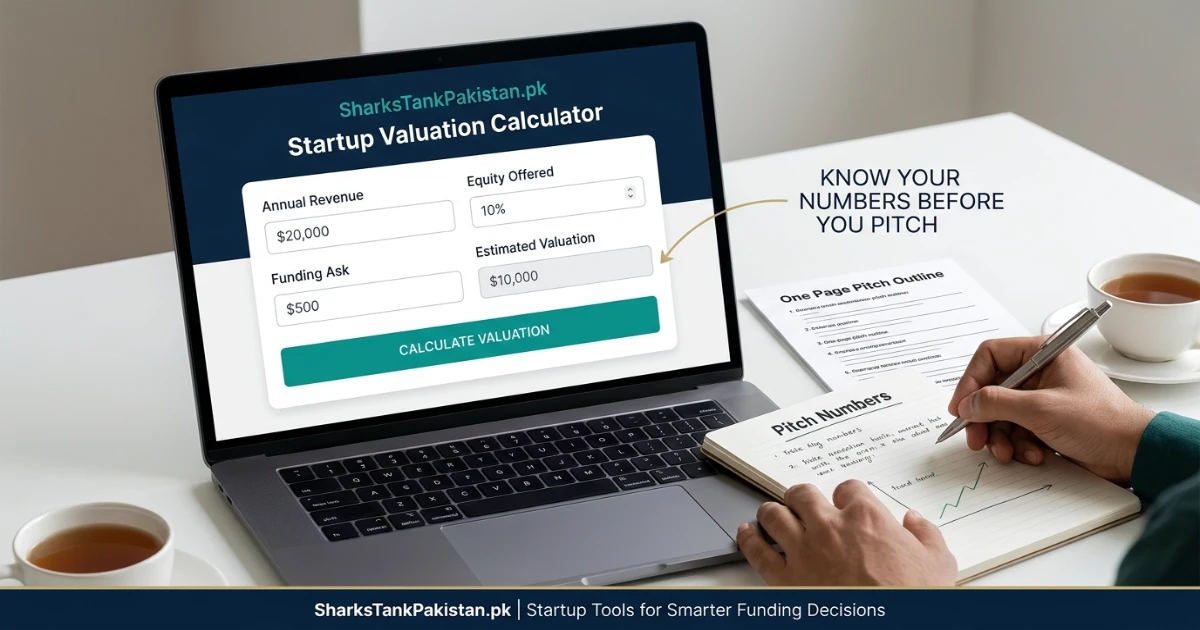
- Valuation Calculator: Before you pitch anywhere, your valuation must be defensible. Run your revenue, growth rate, and comparable multiples through the Startup Valuation Calculator. If the output doesn’t match the ask you’re planning, adjust before you walk into any room — US or Pakistani sharks will challenge inflated numbers in seconds.
- Equity-Loan Calculator: If you’re considering a mixed deal structure (common on both shows), model the dilution and return implications using this tool. Understanding how a 10% equity stake with a convertible note plays out over five years shows sharks you’ve thought beyond the handshake moment.
- Pitch Application Guide: The comprehensive guide to applying for Shark Tank Pakistan walks you through the paperwork, the video requirements, and the common reasons applications get rejected. Many of those lessons — clarity, storytelling, demonstrating traction — transfer directly to any pitch setting.
Don’t let the calculators gather dust. Open them now, plug in your real numbers, and see where you stand. The confidence that comes from knowing your numbers cold is the same confidence that projects persuasively on screen, whether the cameras are in Lahore or Los Angeles.
7-Point Example: A Realistic Pitch on Shark Tank US from Pakistan
Let’s imagine a Karachi-based B2B SaaS company that has organically acquired 40% of its paying customers in the United States. The founding team already established a Delaware C-Corp two years ago for US contracts, has a US bank account, and one co-founder holds an O-1 visa based on tech industry recognition. Their product — an AI-powered logistics optimization tool — serves mid-market US trucking companies.
This is the profile that could credibly pitch on Shark Tank US from Pakistan. Their application would highlight US customer logos, US revenue (not just “global aspirations”), and the fact that the legal and immigration pieces are already solved. If they got on the show, their pitch would center on the US market opportunity, not on explaining Pakistan. The sharks would recognize the industry, the customer base, and the unit economics.
Now contrast that with a Lahore-based clothing brand doing PKR 3 crore in annual sales entirely within Pakistan, with no US entity, no US customers, and the founder holding only a Pakistani passport with no US visa history. That founder’s application to Shark Tank US would be dead on arrival. But on Shark Tank Pakistan? That same business could shine — the sharks understand local textile advantages, retail distribution, and the aspirational Pakistani consumer. The business isn’t weaker; it’s just on the wrong stage.
This is the lens through which to evaluate your own situation before you try to pitch on Shark Tank US from Pakistan. It’s not about your ambition level. It’s about whether the infrastructure to support that ambition already exists.
FAQs About How to Pitch on Shark Tank US from Pakistan
- Can a Pakistani citizen pitch on Shark Tank US from Pakistan with no US visa?
- You can submit the online application, but without an existing US visa path or US entity, your application will almost certainly be filtered out during the legal review stage. The show requires certainty that you can enter the US for filming and that the investment structure is legally sound.
- What business structure is needed to pitch on Shark Tank US from Pakistan?
- A US LLC or C-Corporation registered in a state, with an EIN and a US business bank account. Without these, the sharks cannot write you a cheque under US law. The entity must be fully formed and operational, not just a shell.
- Has any Pakistani founder ever pitched on Shark Tank US?
- As of now, there is no widely documented case of a purely Pakistan-based startup appearing on Shark Tank US without a prior US footprint. Founders of Pakistani origin who have pitched on the US show were typically US residents with US-registered businesses.
- Is it easier to get on Shark Tank Pakistan than Shark Tank US?
- Yes, significantly. Shark Tank Pakistan accepts Pakistani-registered businesses, requires no international visa, and the application pool is smaller. For most Pakistani founders, it’s the more achievable and relevant platform.
- Do I need a US co-founder to pitch on Shark Tank US?
- Not strictly, but it helps enormously. A US co-founder can navigate the legal, tax, and visa dimensions with greater ease and signals to the production team that the business has genuine US roots, not just ambition.
- Can I apply to both Shark Tank US and Shark Tank Pakistan at the same time?
- Yes, there’s no rule against it. But realistically, the two applications require different preparation and legal setups. If you’ve already built the US infrastructure, applying to both is fine. If you haven’t, focus your energy on the show that fits your current reality.
- How long does it take to set up a US entity from Pakistan?
- Using services like Stripe Atlas or Clerky, you can form a Delaware C-Corp in 1–3 weeks and get an EIN within a few more weeks. However, opening a US bank account remotely can take longer and often requires a US visit or a partner bank with remote onboarding.
- What happens if I get a deal on Shark Tank US but my visa is denied later?
- The deal would likely collapse. The sharks’ investment is contingent on your ability to participate actively in the business’s US growth. Without legal presence, you can’t fulfil board roles or operational responsibilities, and the sharks will walk away.
📋 Your Fast-Track Cheat Sheet: Top 3 Actions to Take
- Audit your US readiness honestly. Before you pitch on Shark Tank US from Pakistan, ask: do you have a US-registered entity, a US bank account, US customers, and a visa path? If even one of these is missing, put Shark Tank US on the back burner and channel your effort into Shark Tank Pakistan — where the barriers are zero and the investor fit is natural.
- Use the SharkTankPakistan.pk Valuation Calculator before any application. Whether you target the US or Pakistan, knowing your defensible valuation number changes the power dynamic in the room. Run your figures, adjust your ask, and walk in with a number you can own.
- Build your business, not your TV strategy. The best way to become eligible for any Shark Tank stage is to build a company that generates revenue, serves customers, and creates value. Focus on that, and the right stage will be waiting when you’re genuinely ready — whether that’s in Lahore or Los Angeles.