

Post Deal Legal Steps Pakistan: What to Do After the Shark Tank Pakistan Handshake
⚡ The Short Answer: Immediately after a handshake deal on Shark Tank Pakistan, secure a signed term sheet, engage a corporate lawyer and a tax consultant familiar with SECP and FBR regulations, and begin organizing every financial and legal record for due diligence. The romance of the moment ends when the legal work begins — and the majority of deals that fail do so because founders weren’t ready for the paperwork.
You’ve done it. The Shark leaned forward, looked you in the eye, and said the words every Pakistani entrepreneur dreams of: “I’m making you an offer.” The handshake, the smile, the applause — for a few moments, it feels like the finish line. But anyone who has been through the process, or advised founders who have, will tell you the truth: the handshake is the beginning of a completely new race. One where the opponent isn’t a skeptical Shark, but a mountain of legal documents, tax registrations, due diligence requests, and small print that can quietly undo everything you just celebrated.
This guide is built for that moment. Whether you’re still preparing your application, waiting for a callback, or already have a deal on the table, understanding the post deal legal steps Pakistan entrepreneurs must navigate will save you from becoming a statistic. Across global versions of Shark Tank, roughly 30% to 40% of on-air deals never actually close. In Pakistan, where informal business structures, family-run accounts, and incomplete tax histories are common, the gap between handshake and wire transfer can be even wider. Let’s close that gap.
The First 72 Hours: Actions That Set the Tone for Everything Else
The adrenaline of a handshake deal can push founders into one of two dangerous directions: either they freeze, overwhelmed by what comes next, or they rush to announce the deal publicly without securing the legal foundation. Neither is wise. The first three days after the handshake should be a flurry of controlled, deliberate steps.
1. Confirm the Deal Terms in Writing — Immediately
A verbal agreement on national television is a beautiful moment. It is not, however, a legally binding contract in Pakistan. Before you post anything on social media, before you celebrate with your team, get the basic terms written down and acknowledged. A simple one-page term sheet — stating the investment amount, equity or royalty percentage, any conditions precedent, valuation, and timeline for signing definitive agreements — signed by both parties, can prevent memory lapses and misaligned expectations later. If the Shark’s team doesn’t provide one within a day or two, draft a summary yourself and email it for confirmation. This small document is your anchor.
2. Assemble Your Professional Support Team
You need two people on speed dial right now: a corporate lawyer experienced with SECP compliance and private company transactions, and a chartered accountant who understands startup taxation and FBR regulations. Not your uncle who handles property files. Not the general practice lawyer who helped with a rental agreement. You need specialists who have closed investment deals before. If you don’t have these contacts, ask other founders, reach out to startup incubators, or contact the Pakistan Bar Council for references. This is not where you save a few thousand rupees.
3. Pause Public Announcements Until the Deal Is Real
It’s tempting to post the handshake photo and start taking congratulatory messages. Resist. Until definitive agreements are signed and the investment is funded, the deal is at risk. Announcing prematurely can create awkwardness if the deal falls apart, and some term sheets or production agreements may restrict publicity without the Shark’s consent. Let the lawyers guide the communication timeline.

Structuring the Investment: What the Deal Actually Means Legally
On Shark Tank Pakistan, you’ll hear terms like “I’ll give you 10 million rupees for 20% equity” or “I want a royalty of 50 rupees per unit until I recoup my investment.” These casual phrases conceal a web of legal and tax implications. The structure you agree to will dictate everything from your SECP filings to your withholding tax obligations.
| Deal Structure | Legal Mechanism in Pakistan | Tax Implications for Founder | Common in Shark Tank Pakistan? |
|---|---|---|---|
| Pure Equity | Issuance of new shares under Companies Act 2017; Share Subscription Agreement (SSA) + Shareholders’ Agreement (SHA). | Capital receipt generally not taxable; future dividends taxed. Transfer of shares later may attract capital gains. | Yes, especially for scalable startups. |
| Equity + Royalty | Equity portion as above; royalty governed by a separate Royalty Agreement, often linked to revenue or unit sales. | Royalty payment is a deductible expense for company; withholding tax under Section 153 of Income Tax Ordinance likely applies. | Very common — Sharks frequently ask for royalty until investment recouped. |
| Convertible Note / SAFE | Debt instrument convertible into equity at future round; rarer in Pakistan but possible. Requires careful drafting. | Interest, if any, is taxable; conversion treated as share issuance. Complex withholding and reporting. | Rare — simpler structures dominate. |
| Loan with Profit Sharing | Essentially a Musharika or loan agreement; not true equity. Shark may get profit share. | Profit share taxed as income for Shark; company may deduct expense. Withholding tax on profit payment. | Occasional, for established businesses with predictable cash flow. |
Your legal team will translate the televised deal into one of these structures, ensuring it complies with the Companies Act 2017, SECP regulations, and foreign exchange rules if the investor is an overseas Pakistani or foreign entity. Pay special attention to anti-dilution clauses, liquidation preference, and board representation — these terms live in the Shareholders’ Agreement and can shape your control for years.
Legal Steps: From Handshake to Signed Agreements
This is the core sequence of post deal legal steps Pakistan founders must walk through. It is not optional, and it is not fast. Expect the process — from handshake to fully executed agreements and fund transfer — to take anywhere from 4 to 12 weeks, sometimes longer if your business wasn’t legally structured beforehand.
Step 1: Incorporate a Private Limited Company (If Not Already Done)
Many Shark Tank Pakistan applicants operate as sole proprietors or informal partnerships. A Shark will almost always require the business to be housed in a private limited company registered with the Securities and Exchange Commission of Pakistan (SECP). The incorporation process involves name reservation, submission of Memorandum and Articles of Association, filing of Form 1, Form 21, and other declarations, and payment of the requisite fee (typically PKR 10,000 to 25,000 depending on authorized capital). You’ll need digital signatures and possibly a physical visit to the SECP facilitation center. Allow 2-4 weeks for this step, and engage a lawyer or company secretary to handle it.
Step 2: Conduct Legal and Financial Due Diligence
The Shark’s team will scrutinize your business. Expect requests for: audited or reviewed financial statements for at least the last two years, bank statements, sales records, intellectual property ownership proof (trademark registrations, copyrights, patents), all existing contracts, employee records, and tax filings. If your business has a messy history — mingled personal and business expenses, unregistered trademarks, missing tax returns — this is where it will surface. Remediate what you can before the process starts: register your trademark with the Intellectual Property Organization of Pakistan (IPO Pakistan), file any overdue tax returns, and separate your business bank account. A clean due diligence folder signals professionalism and speeds up the close.
Step 3: Negotiate and Sign the Definitive Agreements
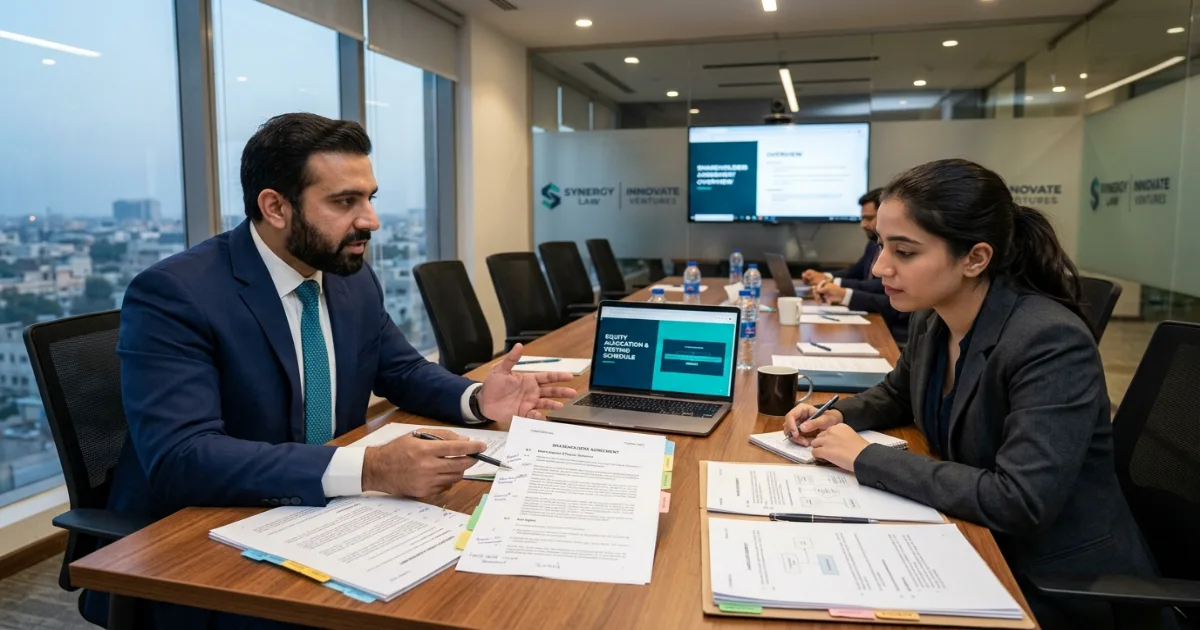
With due diligence complete, the lawyers draft the definitive agreements. Typically, you’ll sign:
- Share Subscription Agreement (SSA): Governs the issuance of new shares, payment terms, representations and warranties, and conditions to closing.
- Shareholders’ Agreement (SHA): Governs the relationship among shareholders: board composition, voting rights, transfer restrictions, drag-along and tag-along rights, dispute resolution.
- Royalty Agreement (if applicable): Defines the royalty calculation, payment schedule, audit rights, and termination.
Never sign these without your own independent lawyer reviewing every line. The Shark’s lawyer represents the Shark, not you. A clause that seems harmless — like a broad non-compete or an aggressive redemption right — can haunt your startup later.
Step 4: Complete SECP Filings and Issue Shares
After signing, file the necessary returns with SECP: Form 3 for allotment of shares, Form 29 for change of directors or registered address if applicable, and updated particulars of directors and shareholders. The company must issue share certificates to the investor and update its register of members. These filings are not just formalities — they are the legal proof that the investor now owns a stake, and they must be accurate.
Tax Steps: What the FBR Will Expect From You
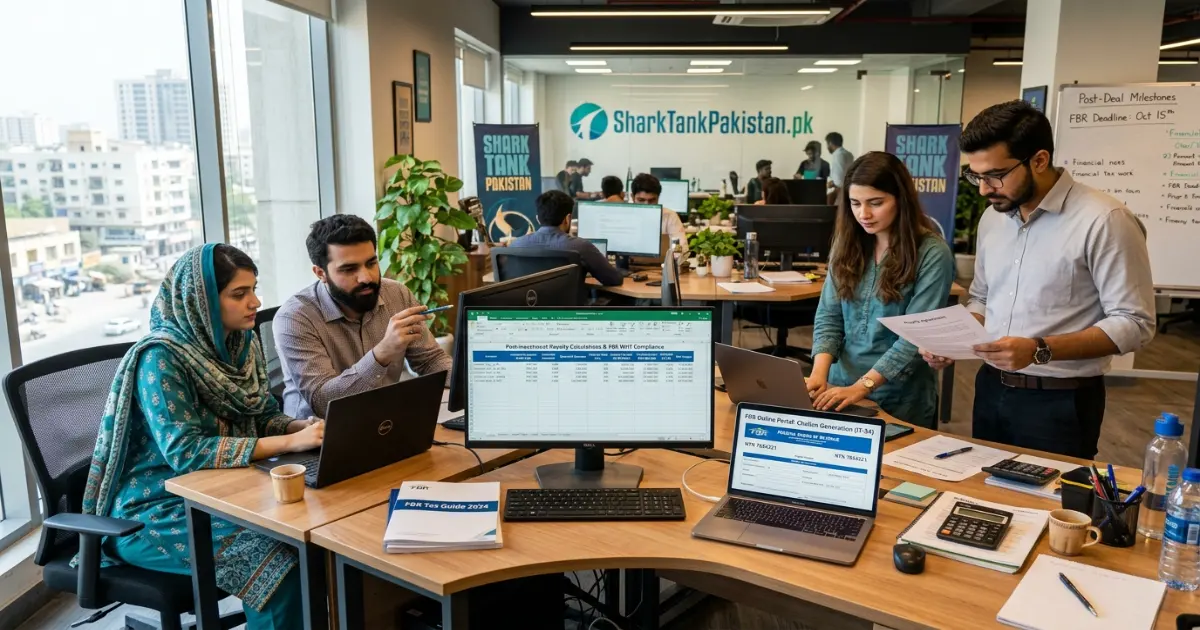
Tax compliance in Pakistan is not something you can postpone until after the celebration. The moment your company receives investment, several tax doors open. Here’s what you need to handle.
Income Tax on Investment Proceeds
Good news: the receipt of equity investment by a company is generally treated as a capital receipt and is not subject to income tax. However, you must document the source of funds clearly to satisfy any future FBR inquiry under the anti-money laundering framework. Maintain a copy of the SSA, bank statements showing the incoming transfer, and a letter from the investor confirming the nature of the funds. If the investment comes from an overseas Pakistani, comply with foreign exchange regulations through a designated bank account.
Withholding Tax on Royalty Payments
If your deal includes a royalty, every payment you make to the Shark is likely subject to withholding tax under Section 153 of the Income Tax Ordinance (for payments to residents) or other applicable sections. The rate varies but can be around 10-15%. You must deduct this tax at source, deposit it with the FBR, and file withholding statements. Missing this can attract penalties and interest, and the tax liability doesn’t disappear just because you forgot.
Sales Tax Registration and Implications
If your business turnover crosses the registration threshold (currently PKR 10 million for goods, PKR 5 million for services, though thresholds can change), you must register for sales tax with the FBR and start charging sales tax on taxable supplies. Investment itself is not a supply, but the capital injection often enables growth that quickly pushes you past the threshold. Register proactively if you expect to cross it within the financial year — backdated registrations can be messy.
Employee Taxes and New Hirings
With fresh funding, you’ll likely expand your team. Every employee salary above the taxable threshold requires monthly withholding tax deductions and filing. Register as an employer with the FBR, obtain a National Tax Number (NTN) if you haven’t already, and set up payroll compliance from day one. The Sharks expect financial discipline; tax compliance is the most visible expression of it.
Situation-Based Adjustments: Your Post-Deal Path Depends on Where You Started
If You’re a Sole Proprietor or Unregistered Partnership
Your first priority is incorporating a private limited company and transferring the business assets, contracts, and intellectual property into it. This requires a formal business transfer agreement and possibly fresh contracts with suppliers and customers. The tax authority will view the transfer as a disposal by you and an acquisition by the company, which may trigger capital gains and stamp duty implications if not structured carefully. Get professional advice on the most tax-efficient method — often, a transfer at book value with no cash exchange is possible, but must be documented correctly. Expect this step to add 4-6 weeks to your timeline.
If You Already Have a Private Limited Company
Your path is smoother but not frictionless. Focus on updating your register of members, filing SECP returns, and amending your Articles of Association if needed to reflect new share classes or rights. Also, review any existing shareholders’ agreements — earlier angel investors or co-founders may have consent rights, pre-emptive rights, or tag-along rights that are triggered by the Shark’s investment. Ignoring them can lead to disputes that stall the deal.
If You’re a Tech Startup with Intellectual Property
IP due diligence is intense. The Shark’s team will verify that your company actually owns the code, designs, patents, or trademarks you’re pitching. If you developed the core technology before incorporation, or if contractors wrote code without assigning IP rights in writing, you have a gap. Fix this immediately: execute IP assignment agreements from founders and contractors to the company. File trademark applications if you haven’t. A startup that can’t prove it owns its own product is a deal-breaker.
Common Pitfalls — And When to Bend These Rules
Pitfall 1: Using a generic template agreement instead of tailored legal documents. A free Shareholders’ Agreement template from the internet will not protect you against the specific dynamics of a Shark Tank Pakistan deal — royalty structures, media obligations, mentorship provisions. Pay for customization.
Pitfall 2: Underestimating the time and cost of compliance. Legal fees, SECP filing costs, trademark registration, and tax consultant charges can easily total PKR 200,000 to 500,000 or more for a well-structured deal. Budget for this. It’s a fraction of the investment you’re receiving and far cheaper than litigation later.
Pitfall 3: Promising the Shark something that your current legal structure can’t deliver. For example, offering a board seat when your Articles of Association have no provision for appointing investor directors. Your lawyer can fix this, but it takes time. Don’t make structural promises you haven’t verified.
When to (Slightly) Ignore This Advice: If you’re receiving a very small, friends-and-family-sized investment outside the Shark Tank process, some steps can be streamlined. But for any deal involving external investors and legal obligations, don’t skip the fundamentals. The cost of fixing a broken deal far exceeds the cost of doing it right the first time.
How SharkTankPakistan.pk Tools Support Your Post-Deal Execution
Our site’s calculators aren’t just for pitch prep. After the deal, use the Startup Valuation Calculator to double-check the equity percentage against the current valuation — sometimes the excitement of the handshake obscures the math. The Equity vs Loan Calculator can model the long-term dilution impact of your deal, especially if royalty or convertible features are involved. And our startup legal checklist offers a broader view of compliance beyond this article. Use these resources alongside your legal team — they’re your independent sanity check.
Real-World Snapshot: A Deal That Almost Died in Due Diligence
A Season 1 Shark Tank Pakistan contestant — a promising snack brand from Lahore — walked out of the tank with a 15 million rupee deal for 22% equity and a royalty. The celebration lasted one weekend. The following Monday, the Shark’s due diligence team discovered that the business was still operating under a sole proprietorship, the brand name wasn’t trademarked, and the financial records mixed household and business expenses for two years. The founder had assumed these were minor details. They weren’t. The Shark paused the deal and gave a 60-day window to fix the issues: incorporate a company, transfer assets, register the trademark, and produce clean financials.
The founder spent nearly PKR 400,000 on lawyers and accountants and worked around the clock. The deal eventually closed, but the stress nearly broke the relationship. The founder later said, “If I had spent that 400,000 before the tank, I would have walked out with the money in weeks, not months.” That’s the value of reading a guide like this before you need it.
Frequently Asked Questions: Post Deal Legal Steps Pakistan
Do I really need a lawyer immediately after a handshake deal?
Yes. A corporate lawyer protects your interests in the term sheet and definitive agreements. The Shark has legal counsel; you need your own. Waiting even a week can result in signing something you later regret. It’s not a cost — it’s insurance.
How long does the entire post-deal legal process take in Pakistan?
Typically 6 to 12 weeks from handshake to fund transfer. Factors include how quickly you can incorporate (if needed), the speed of due diligence, SECP processing times, and the complexity of negotiation. Rushed processes often miss critical details.
What taxes do I pay when my company receives investment?
Equity investment itself is not taxable for the company. However, royalty payments to the investor are deductible expenses for the company but subject to withholding tax. Additionally, your company may need to register for sales tax once turnover increases post-investment.
What if my business is not yet a registered company?
You must incorporate a private limited company with SECP before the deal can legally close. The process takes 2-4 weeks and requires name reservation, documentation, and fees. Plan for this early — it’s the most common bottleneck in Pakistani startup deals.
Can the Shark back out after the on-air handshake?
Yes, until definitive agreements are signed and funds are transferred, the deal is non-binding. Due diligence findings, undisclosed liabilities, or a change in circumstances can cause the investor to walk away. This is why transparency and preparation are critical.
What is a Shareholders’ Agreement and why does it matter so much?
It governs the rights and obligations of shareholders — board seats, veto powers, share transfer restrictions, dispute resolution. It’s often more important than the share subscription agreement because it controls your relationship with the Shark for years. Negotiate it carefully.
Do I need to trademark my business name before the deal closes?
Strongly recommended. Trademark registration with IPO Pakistan protects your brand and reassures the investor. If you haven’t filed, the due diligence team will flag it as a risk. Filing is relatively quick (2-3 months for preliminary acceptance) and costs under PKR 10,000.
How much should I budget for legal and tax fees after a deal?
Expect to spend between PKR 200,000 and PKR 500,000 for competent legal and accounting services to close a typical Shark Tank Pakistan deal. It varies by complexity. This is an investment in the deal’s survival — not a place to cut corners.
🚀 Your Post-Deal Legal Cheat Sheet: Top 3 Actions to Take Now
1. Get a signed term sheet and hire a corporate lawyer within 48 hours. The term sheet locks the essential deal points. Your lawyer will then shepherd you through incorporation (if needed), negotiation of the SSA and SHA, and SECP compliance. Time is your enemy here — move deliberately.
2. Prepare a clean due diligence file — today. Organize your financials, tax returns, contracts, IP registrations, and corporate documents into a single digital folder. If gaps exist, fix them now before the investor’s team finds them. This act alone can shave weeks off your closing timeline.
3. Understand your tax obligations before the first rupee arrives. Clarify withholding tax on royalties, sales tax registration thresholds, and employee tax compliance with your accountant. Set up systems to deduct and deposit taxes on time. The FBR doesn’t care that you were busy celebrating — penalties accrue regardless.