TikTok Marketing Strategy for Pakistani Retailers (2026): A No-Nonsense Growth Playbook
⚡ The Short Answer: TikTok marketing in Pakistan is no longer optional for retailers. In 2026, the platform has overtaken traditional social channels for product discovery among 18-to-40-year-old Pakistani consumers. The retailers winning right now are not the ones with the biggest ad budgets — they are the ones publishing consistent, culturally-rooted short-form content, leveraging TikTok Shop’s expanding local integrations, and treating their TikTok presence like a retail channel, not a vanity project. Start with three pieces of content per week, use the Creator Marketplace for nano-influencers in your city, and measure everything against actual sales lift, not just views.
If you run a retail business in Karachi, Lahore, Islamabad, Faisalabad, or even a smaller city like Sialkot or Multan, you have probably already heard someone say: “Bas TikTok par aa jao, sales apne aap hon gi.” The problem? That is only half-true. TikTok can unlock explosive growth for Pakistani retailers, but the platform punishes businesses that treat it casually. The algorithm rewards consistency, cultural fluency, and an actual understanding of how Pakistani consumers behave on the app.
This guide is built specifically for Pakistani retail founders — whether you sell fashion, home goods, beauty products, mobile accessories, or packaged food. It is grounded in what is actually working in the local market as of 2026, not recycled advice from North American marketing blogs. And since this is SharkTankPakistan.pk, we are also going to look at this through the lens of building a business that could one day walk into the Tank and impress the Sharks with your customer acquisition engine.
Why TikTok Matters Specifically for Pakistani Retailers Right Now
Let us get one thing clear: TikTok is not just “another social media platform” for Pakistani businesses. As of early 2026, the app’s monthly active user base in Pakistan has crossed 55 million, and the demographic that actually makes purchasing decisions — urban and peri-urban adults aged 20 to 45 — now spends an average of 68 minutes per day on the platform, according to multiple local digital behavior studies.
More importantly, TikTok’s in-app shopping behavior in Pakistan has matured. Where 2023 and 2024 were about experimentation, 2026 is about execution. Pakistani consumers now routinely discover products through TikTok videos, check reviews in the comments section, and complete purchases either through TikTok Shop directly or by messaging the seller on WhatsApp. This is a full-funnel retail channel now.
The retailers who recognized this shift 18 months ago are already reaping outsized rewards. A Lahore-based modest fashion brand we spoke with — one that has grown from a single-room operation to a 22-employee business — attributes 57% of its 2025 revenue to TikTok-originated customers. That is not a fluke. It is a pattern.
The Core TikTok Marketing Framework for Pakistani Retailers
There is a lot of noise out there about TikTok strategy. Most of it is either too generic to be useful or too focused on markets like the US and UK, where consumer behavior and platform features differ from Pakistan. Here is a framework that actually works for Pakistani retail in 2026:
1. Content That Converts: Stop Selling, Start Showing
The single biggest mistake Pakistani retailers make on TikTok is treating the platform like a classified ad section. Videos that simply say “Buy our lawn collection, DM for price” perform terribly. The Pakistani TikTok audience has developed a sophisticated filter for content. They scroll past obvious sales pitches in under a second.
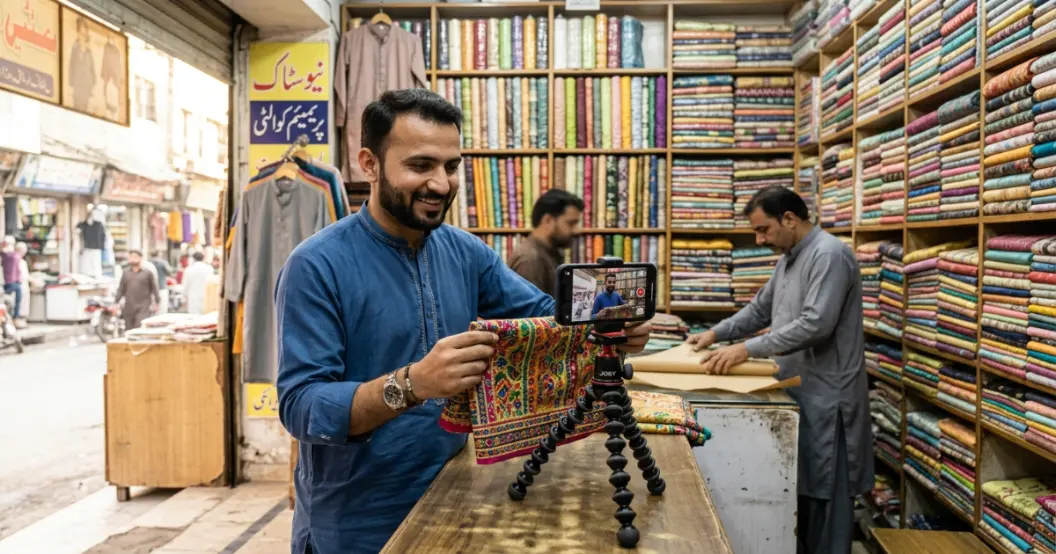
What works instead is showing the product in context. A retailer selling frying pans should show someone making a perfect paratha in under 40 seconds with Urdu voiceover narration. A clothing brand should show three different ways to style a single kameez, filmed in natural light somewhere recognizable like a rooftop in Peshawar or a street in Gulberg. The product is the star, but the story is what stops the scroll.
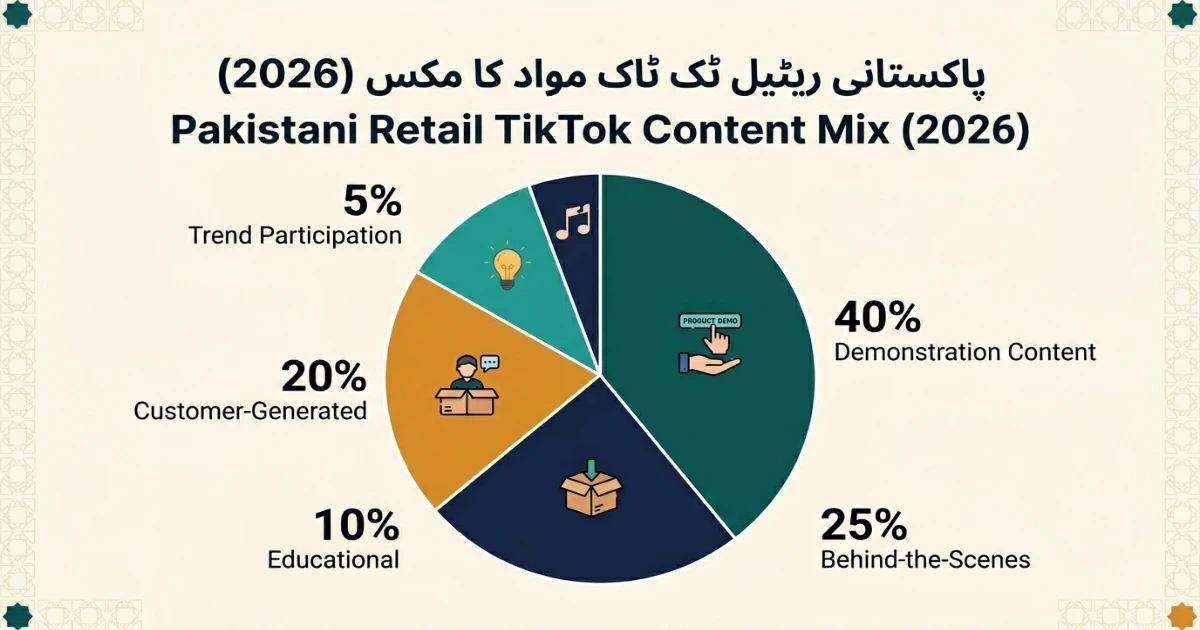
The 2026 content mix that is delivering results for Pakistani retailers looks roughly like this:
- 40% demonstration content — product in use, real results, no filters
- 25% behind-the-scenes content — packing orders, sourcing materials, team culture
- 20% customer-generated content — reposting real buyers, unboxing clips
- 10% educational content — tips related to your niche (e.g., “how to care for hand-embroidered fabric”)
- 5% trend participation — using trending sounds or formats, but only when they align with your brand
2. TikTok Shop Pakistan: The Infrastructure Has Finally Arrived
For years, Pakistani retailers using TikTok had to funnel customers through clunky workarounds — Instagram DMs, WhatsApp numbers, makeshift Google Forms. That friction killed conversion rates. In 2026, TikTok Shop’s local integration has matured significantly. Pakistani sellers can now list products directly, process payments through local gateways including Easypaisa and JazzCash, and fulfill orders without redirecting buyers off-platform.
If you are not yet using TikTok Shop for your retail business, you are leaving money on the table. The platform’s in-app checkout reduces drop-off by an estimated 40% compared to external link-based funnels, based on case studies from early-adopting Pakistani sellers.
Setting up TikTok Shop in Pakistan as of 2026 is reasonably straightforward. You need a registered business (or at minimum a sole proprietorship with an NTN), a verified TikTok account with at least 1,000 followers, and banking details linked for payouts. The approval process typically takes 3 to 7 business days.
💡 Insider Insight from Pakistan’s Retail Ecosystem
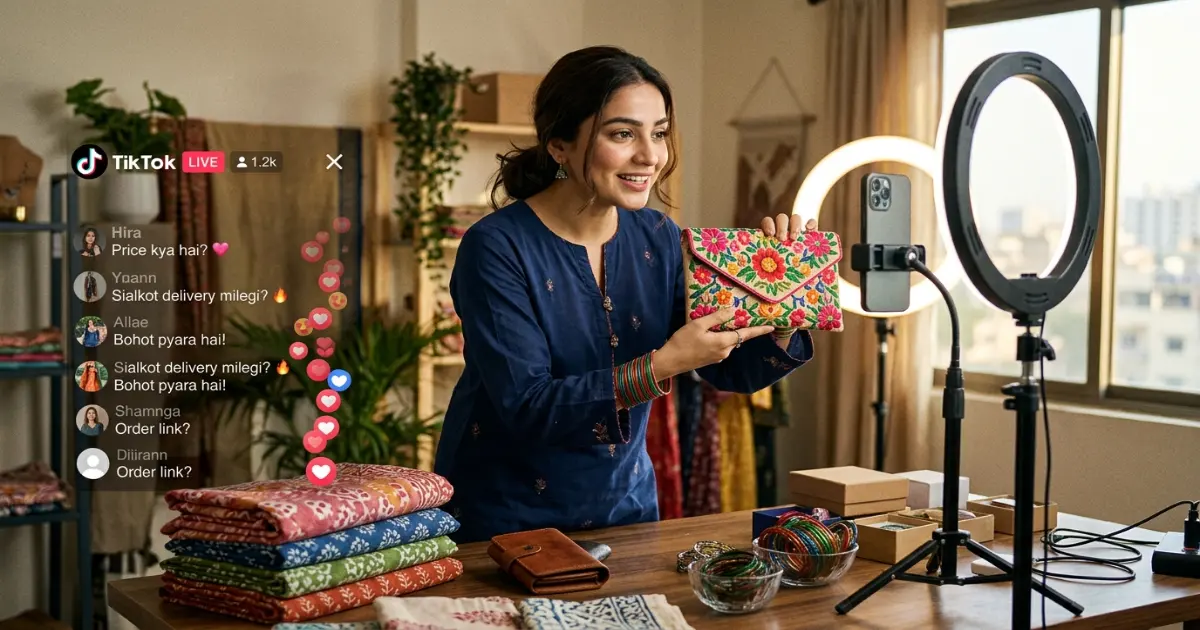
- Do not sleep on live shopping. Pakistani retailers running 60-to-90-minute TikTok Live sessions twice a week are seeing per-session revenues of PKR 40,000 to PKR 250,000, depending on product category and audience size. The key is having a confident, articulate host who speaks Urdu naturally and can answer questions in real time.
- Nano-influencers outperform celebrities for retail. A Karachi-based skincare brand tested a campaign with a mid-tier celebrity (PKR 300,000 for two posts) against 15 nano-influencers (PKR 15,000 each, total PKR 225,000). The nano-influencer cohort drove 3.2x more attributable sales. Pakistani consumers trust relatable creators more than distant stars.
3. The Algorithm, Demystified for Pakistani Contexts
TikTok’s algorithm in Pakistan does not care about your follower count. It cares about watch time, completion rate, and re-watches. A retailer with 400 followers can get 250,000 views on a single video if the content hooks viewers in the first 1.5 seconds and keeps them watching through the end. This is fundamentally different from Instagram, where reach is more tightly coupled to follower count.
The practical implication for Pakistani retailers: do not waste months trying to “build a following” before you start selling. Post product content from day one. The algorithm distributes each video independently. A well-made video showing a Rs. 800 handbag in natural light, filmed on a decent smartphone, can outperform a professionally produced brand film if the hook is stronger and the content feels native to the platform.
Comparison: TikTok Organic vs. TikTok Paid vs. Traditional Social for Pakistani Retail
| Dimension | TikTok Organic | TikTok Paid (Spark Ads) | Facebook / Instagram Ads |
|---|---|---|---|
| Cost per acquisition (2026 avg.) | Near zero (time investment only) | PKR 180–450 per sale | PKR 350–900 per sale |
| Audience reach potential | Unlimited (algorithm-driven) | Targeted, scalable | Declining organic; paid essential |
| Content shelf life | Short (24–72 hours peak) | Extended by ad spend | Short to medium |
| Trust factor with Pakistani buyers | High (feels authentic) | Moderate (labeled as sponsored) | Low to moderate (ad fatigue) |
| Best for | Building brand, testing products | Scaling proven products | Retargeting, older demographics |
| Pakistani payment integration | TikTok Shop (seamless) | TikTok Shop | External (Shopfy, WhatsApp) |
The takeaway: Start with organic TikTok. Once you identify which products and content formats are resonating, use Spark Ads (boosting existing organic videos that are already performing) to scale. Do not make the mistake of running cold paid ads on TikTok without first proving the product-content fit organically.
Situation-Based Strategy: What Your TikTok Approach Should Look Like Right Now
If You Are a Single-Location Retailer Doing Under PKR 2 Million Monthly Revenue
Your priority is not polish. It is consistency and volume. Post five to seven times per week. Film on your phone. Use CapCut for basic editing. Show your products, your shop, your team packing orders. Respond to every comment. Your goal is to find one or two product-content combinations that consistently get over 10,000 views. Once you find those, double down. Open TikTok Shop and list those specific products. Run a 30-minute live session once a week where you showcase the bestsellers.
At this stage, do not hire an agency. Do not invest in production equipment. Do not overthink the strategy. The algorithm needs data, and the only way to feed it data is through volume. An Islamabad-based home décor retailer we tracked went from PKR 180,000 monthly TikTok-attributed sales to PKR 1.4 million in five months purely by increasing posting frequency from twice a week to daily.
If You Are a Multi-Location or E-Commerce Brand Doing PKR 5 Million+ Monthly
Your game changes. Consistency is still important, but you now need to layer in structured influencer partnerships, a content calendar mapped to product launches, and dedicated TikTok Shop management. Hire or assign at least one full-time person to manage TikTok operations — content scheduling, influencer coordination, live session hosting, and performance tracking.
At this scale, you should also be A/B testing systematically. Film two versions of the same product video — one with an Urdu hook, one with a mix of Urdu and English — and see which resonates. Test different posting times. The Pakistani TikTok audience has clear peak activity windows: roughly 9 PM to midnight on weekdays, and 2 PM to 6 PM on weekends.
If You Are Pre-Revenue or Just Launching
TikTok is your best friend, but your content strategy should focus on demand validation before inventory investment. Post videos showcasing product samples or concept mockups. Gauge reaction through comments, saves, and shares. If a video gets strong engagement, use that as a signal to produce a small batch and test actual sales. This approach has saved multiple Pakistani startup founders from sinking capital into inventory nobody wants.
Common Pitfalls Pakistani Retailers Make on TikTok (And When to Ignore This Advice)
Over the past three years of watching Pakistani businesses navigate TikTok, several patterns of failure have become predictable. Avoiding these is more important than getting anything fancy right.
Pitfall 1: Chasing viral trends that have zero connection to the product. A fashion retailer dancing to a trending audio track without showing any clothing in an interesting way is just entertainment. It attracts views but does not attract customers. Every piece of content must connect back to what you sell, even if the connection is subtle.
Pitfall 2: Inconsistent posting followed by bursts of panic-posting. The algorithm rewards sustained, predictable activity. A retailer that posts three times a day for a week and then goes silent for a month confuses the system and loses momentum. One post every weekday beats seven posts on a single Saturday.
Pitfall 3: Buying followers or engagement. Pakistani retailers are frequently targeted by services promising “10,000 followers in 48 hours.” This is destructive. Purchased followers are almost always bot accounts from regions completely irrelevant to your business — they destroy your account’s signal quality with the algorithm, making it harder for your real content to reach real buyers.
Pitfall 4: Neglecting the comments section. Pakistani TikTok users treat the comments section as a discovery tool. They check comments to see if a product is legitimate, if the seller is responsive, and if previous buyers are satisfied. A retailer that does not reply to comments within a few hours is undermining their own credibility.
When to ignore conventional TikTok advice: Much of the “best practice” content around TikTok marketing comes from creators in North America or Europe. When that advice says “post in English to reach a global audience,” ignore it if your product is primarily for Pakistani consumers. Urdu, Punjabi, and even code-switched content consistently outperforms pure English content for local retail. Similarly, advice about “polished production value” often backfires in Pakistan — content that looks too produced can feel like an ad, and Pakistani users scroll past ads instinctively.
How This Ties Back to Shark Tank Pakistan
You might be wondering why a TikTok marketing guide belongs on a Shark Tank Pakistan resource site. The connection is direct: customer acquisition strategy is one of the first things the Sharks interrogate during a pitch. When a founder walks into the Tank and says, “Our customer acquisition cost is PKR 120 and our primary channel is TikTok organic,” the Sharks pay attention. That is a defensible moat in the Pakistani market right now.
Several businesses that have appeared on Shark Tank Pakistan in recent seasons have built their early traction through TikTok. The Sharks understand this channel. They ask about follower counts, engagement rates, conversion metrics, and TikTok Shop revenue. If you are preparing to apply to the show, your TikTok presence is not just a marketing asset — it is a key piece of evidence that proves you understand how to reach Pakistani consumers cost-effectively.
Even if you are not planning to pitch on the show, the discipline of building a TikTok-driven retail business forces you to develop skills that make any Pakistani retail business stronger: knowing your customer intimately, creating content that resonates culturally, and measuring everything against actual revenue.

Building Your TikTok Retail Engine: A Practical 30-Day Launch Plan
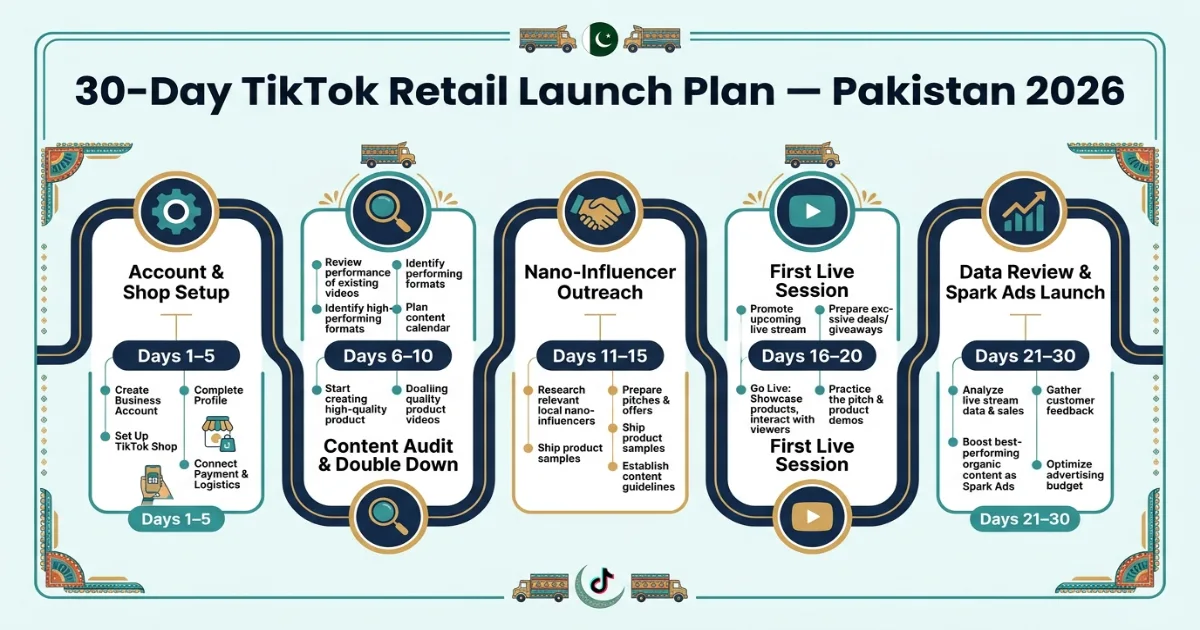
If you are starting from zero or close to it, here is a realistic, no-hype 30-day plan to build the foundation of a TikTok retail engine for your Pakistani business:
Days 1–5: Set up your TikTok account (or audit your existing one). Convert to a Business Account. Ensure your profile clearly states what you sell, your city, and how to order. If you qualify, apply for TikTok Shop. Film and post one piece of content per day — do not overthink it. Just start.
Days 6–10: Review your first batch of content. Identify which videos got above-average views and engagement. Analyze why — was it the hook, the product, the time of posting? Double down on what worked. Increase to 8–10 posts per week.
Days 11–15: Identify 3 to 5 nano-influencers in your niche (1,000 to 15,000 followers) who are based in Pakistan. Reach out with a simple proposal: free product in exchange for honest review content. Track which influencers drive engagement and inquiries.
Days 16–20: Host your first TikTok Live session. Keep it simple — 45 minutes, showcasing 5 to 7 products, answering questions in real time. Promote the live session 24 hours in advance through your regular posts.
Days 21–30: Review all data from the first three weeks. Identify your top 3 performing content formats. Build a content calendar for the next 30 days based on what worked. Begin experimenting with Spark Ads on your highest-performing organic posts with a small daily budget (PKR 500–1,000/day).
This plan is deliberately unsexy. It rewards execution over strategy. The retailers who follow it and resist the temptation to skip ahead to “viral hacks” are the ones who build sustainable TikTok revenue streams.
Frequently Asked Questions About TikTok Marketing in Pakistan
Is TikTok marketing effective for Pakistani retailers in smaller cities?
Yes, often more effective than in major metros. Smaller-city audiences on TikTok tend to have higher engagement rates and lower competition for attention. Retailers in cities like Sialkot, Multan, and Abbottabad are reporting strong results by creating hyper-local content in regional languages.
How much should I budget for TikTok marketing in Pakistan as a small retailer?
Start with zero ad spend. Organic content is the foundation. Once you have validated product-content fit, allocate PKR 15,000–40,000 per month for Spark Ads and nano-influencer partnerships. Scale budget only after you have clear cost-per-sale data.
Do I need a registered company to sell on TikTok Shop in Pakistan?
As of 2026, TikTok Shop Pakistan accepts both registered businesses and sole proprietors with a valid NTN. A formal company registration (Pvt Ltd or sole proprietorship) is recommended but may not be strictly required for all categories. Check the latest TikTok Shop Pakistan seller guidelines.
What type of content works best for selling fashion products on TikTok in Pakistan?
Styling videos, outfit-of-the-day formats, and “three ways to wear” demonstrations consistently outperform catalog-style product showcases. Content filmed in recognizable Pakistani settings — homes, streets, markets — resonates more than studio-shot videos.
How long does it take to see sales results from TikTok marketing in Pakistan?
Retailers posting consistently (5+ times per week) typically see their first TikTok-attributed sales within 3 to 6 weeks. Accounts that pair organic content with TikTok Shop listings and live sessions tend to see results faster than those using content alone.
Can I run TikTok ads in Pakistan without a large following?
Yes. TikTok Spark Ads allow you to boost organic posts regardless of follower count. You can also run standard in-feed ads targeting Pakistani audiences with as little as PKR 500 per day. A following is not a prerequisite for paid reach.
What are the biggest mistakes Pakistani retailers make on TikTok?
The most common mistakes: posting inconsistently, using only English when their audience prefers Urdu or regional languages, buying fake followers, ignoring comments, and copying trends without connecting them to their products in a meaningful way.
🚀 Your Fast-Track Cheat Sheet: Top 3 Actions to Take This Week
- Film and post one product video today. Use your phone, natural light, and speak in Urdu. Show the product in use. Do not overthink it. The algorithm needs data, and your first video is the most important one.
- Check your TikTok Shop eligibility. If you have over 1,000 followers and a business bank account, apply for TikTok Shop Pakistan integration. In-app checkout is the single biggest conversion lever available to Pakistani retailers on the platform right now.
- Identify three nano-influencers in your niche. Search TikTok for creators in your city with 2,000–15,000 followers who post content relevant to your product category. Send them a genuine, no-pressure message offering free product in exchange for honest content. Start small, measure results, and scale what works.
Last updated: May 2026 | SharksTankPakistan.pk — Pakistan’s most trusted startup resource