
Competitor Website Analysis Pakistan: Free Tools to Check Traffic and Win Investor Confidence
Competitor website analysis Pakistan gives founders a practical way to estimate competitor traffic, uncover keywords, and strengthen investor-facing market claims. Free tools including Similarweb, Semrush, Google Trends, and Ubersuggest can help you compare digital demand before pitching on Shark Tank Pakistan or planning your next growth move.
~11 minutes
Pakistani founders, digital marketers, Shark Tank Pakistan applicants
Similarweb, Semrush, Ubersuggest, Google Trends, Ahrefs Webmaster Tools
Beginner-friendly, but interpreting data requires a market lens
Competitor website analysis Pakistan can turn a founder’s market claim into a data-backed conversation. Imagine standing in front of the Sharks on Shark Tank Pakistan and saying, “Our top competitor attracts strong online demand, but we have found a customer gap they have not filled.” Suddenly, you are not just guessing — you are presenting evidence. Most founders assume this type of research requires expensive software or a dedicated data team. It does not.
A handful of free tools can help you estimate competitors’ website traffic, identify top-performing content, and understand where visitors may come from. In a market like Pakistan, where detailed digital sector reports are not always easy to access, these insights can give your pitch clearer context. This guide explains which tools to use, how to read the estimates carefully, and how to present the findings responsibly to investors.
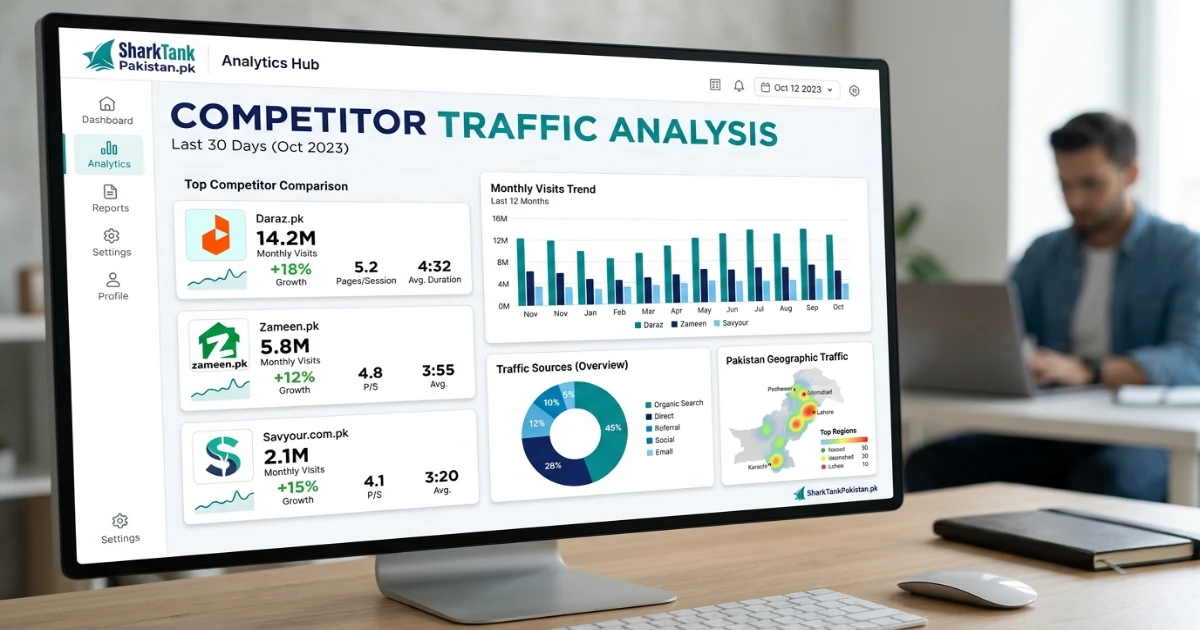
Why Competitor Traffic Analysis Matters Specifically in Pakistan
Pakistan’s internet user base crossed 130 million recently. Yet detailed, sector-specific traffic data is rarely published openly. Traditional market research firms charge PKR 200,000+ for a report that might already be six months out of date. Free digital tools, on the other hand, refresh monthly and let you directly observe your competitors’ online performance. This is gold if you’re building an e-commerce brand, a fintech app, or any business that lives online. When you negotiate equity with investors, citing third-party traffic estimates from a recognized tool is far more convincing than saying “I think the market is big.” It shows you’re data-driven, resourceful, and acutely aware of the competitive landscape.
The Best Free Tools for Competitor Website Analysis in Pakistan
Not all tools work equally well for Pakistani domains. Some have better coverage of local sites than others. Here’s a breakdown of the top free options, ranked by usefulness for Pakistani-specific research.
1. Similarweb (Free Browser Extension & Website)
Similarweb gives you a snapshot of any website’s estimated monthly visits, traffic sources, top referring sites, and even a list of similar competitors. For Pakistani websites, it works best for well-known e-commerce portals, news sites, and larger startups. The free tier limits you to a few data points, but that’s often enough to understand scale. Pro tip: install the Similarweb Chrome extension so you can see traffic stats while you browse a competitor’s site.
2. Semrush Free Account (Limited, But Powerful)
Semrush is a paid SEO tool, but its free account lets you perform 10 searches per day, showing estimated organic traffic, top keywords, and backlinks. For Pakistani domains, Semrush has surprisingly good keyword data, including Urdu-English mix terms. Use it to uncover which search terms are actually driving visits to your competitors — insights you can replicate for your own content.
3. Ubersuggest (Neil Patel’s Tool)
Ubersuggest is extremely beginner-friendly. It gives you an overview of a website’s organic traffic, top pages, and keyword rankings. The free version is generous enough for initial competitor website analysis Pakistan. The interface makes it easy to spot seasonal traffic patterns — valuable for retail businesses.
4. Google Trends (Perfect for Local Comparison)
Google Trends doesn’t show exact traffic numbers, but it shows relative search interest over time and across regions. You can compare up to five competing brand names and filter by Pakistan. This is excellent for proving to an investor that your startup is riding an upward trend, not a dying one.
5. Ahrefs Webmaster Tools (Free Verified Site Owner Access)
If you verify your own website, Ahrefs gives you access to its Site Explorer lite, including some data on competing sites. It’s particularly strong for backlink analysis, which can reveal where Pakistani competitors are getting their referral traffic.

Tool Comparison: Which Free Tool Is Best for Pakistani Websites?
| Tool | Best For | Data Coverage in Pakistan | Free Limitations |
|---|---|---|---|
| Similarweb | Quick traffic snapshot, traffic source breakdown | Good for larger domains; weaker for very small blogs | Limited to ~5 results per month, partial data |
| Semrush | Keyword research, organic traffic estimates | Surprisingly robust for local Urdu/English queries | 10 searches/day, no historical data in free tier |
| Ubersuggest | Overall traffic trends, top pages | Moderate; works well for established sites | Limited daily queries, some features behind paywall |
| Google Trends | Search interest comparisons, regional breakdowns | Excellent for Pakistan-specific filtering | No absolute traffic numbers, only relative trends |
| Ahrefs Webmaster Tools | Backlink analysis, site health | Good if you verify your own site first | Competitor data limited unless you have a paid plan |
💡 Insider Insight from Shark Tank Pakistan Prep Sessions: Several founders who successfully auditioned used free tools to compile a competitor traffic slide in their pitch deck. One Karachi-based fashion startup showed a Google Trends chart proving their brand was being searched 3x more than a known competitor in Lahore. The Sharks leaned in. Free data, when presented with context, signals hustle.
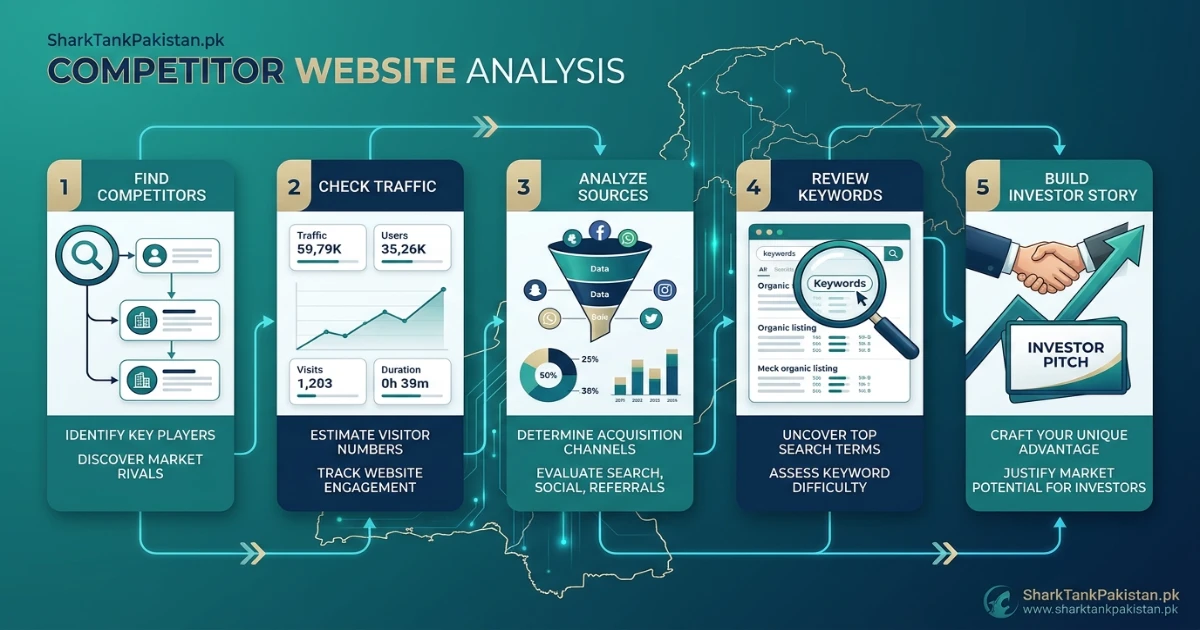
How to Perform Competitor Website Analysis Pakistan in 5 Steps
Follow this sequence to turn raw data into actionable intelligence.
Step 1: Identify Your Real Competitors
Don’t just guess. Use Google to search for your main product keywords in Pakistan (e.g., “buy kurta online Pakistan”) and note the top 5 organic results. Add two larger regional or global players that serve Pakistan. This is your analysis set.
Step 2: Gather Traffic Estimates with Multiple Tools
Plug each competitor into Similarweb and Ubersuggest to get baseline monthly visit estimates. Cross-reference them — if both tools agree roughly, the number is more reliable. If only one tool shows data, treat it as directional.
Step 3: Analyze Traffic Sources and Geography
Check Similarweb’s “Traffic Sources” breakdown (direct, organic search, social, paid). If a competitor gets 60% from social, they rely heavily on Instagram — a weakness you might exploit with better SEO. Also, confirm what percentage of their traffic actually comes from Pakistan.
Step 4: Uncover Top Keywords and Content
Use Semrush or Ubersuggest to see which keywords drive the most organic visits. Are they ranking for generic English terms or Urdu-mix phrases? This reveals their content strategy and potential gaps you can fill.
Step 5: Turn Data into a Narrative for Investors
Summarize your findings into one clear slide: “Competitor X has 30,000 monthly visits but a 70% bounce rate; we target the underserved segment with localized content.” Investors don’t need a 20-page report. They need to see that you understand the playing field.
Situation-Based Advice: How to Interpret Competitor Traffic Data for Your Business Stage
If You’re Pre-Launch
Use the data to validate demand. If competitor A has been growing 20% month-over-month for a year, there’s a proven market. Present this in your pitch to show you’re not building in the dark. Use the free data to size the market opportunity.
If You’re Already Running and Scaling
Benchmark yourself monthly. If your traffic growth outpaces a competitor’s, capture a screenshot and add it to your investor update deck. This visual proof of momentum can be more persuasive than financial projections alone.
For E-commerce vs. SaaS vs. Content Businesses
An e-commerce site cares about conversion, so pair traffic data with insights on average order value from other sources. A SaaS business should focus on how competitors acquire users — via organic content or paid ads. A content platform should analyze top-performing articles using Ubersuggest’s “Top Pages” report. Each business type pulls different levers from the same raw data.
📊 Data Point: According to a survey of Pakistani digital agencies, only about 15% of small and medium businesses regularly analyze competitor traffic. That means if you do it, you’re immediately in the top tier of informed founders.
Common Pitfalls & When to Ignore the “Free Tool” Advice
- Pitfall: Taking traffic estimates as absolute truth. All free tools use sampling and algorithms. The actual numbers could be 30–50% off. Use them for relative comparison, not as a bank statement.
- Pitfall: Ignoring mobile app traffic. In Pakistan, many businesses get significant orders through WhatsApp or their own apps, which these tools can’t track. Supplement with app store download estimates if relevant.
- Pitfall: Overlooking offline competitors. A traditional kiryana store chain won’t appear in these tools. Don’t let online data blind you to the 85% of retail that still happens offline in Pakistan.
- When to ignore free tools: If you’re in a highly specialized B2B niche serving 50 corporate clients in Pakistan, website traffic isn’t a meaningful metric. Focus on contracts and relationships instead.
- Pitfall: Drawing wrong conclusions from limited data. A competitor’s spike in traffic might be from a single viral post, not sustained growth. Look at trends over 6–12 months, not a single month.
How SharkTankPakistan.pk Tools Help You Turn Traffic Data into Valuation
Once you’ve mapped your competitors’ digital footprint, the next question is: “What does this mean for my company’s worth?” Use the Startup Valuation Calculator to plug in your market share estimates derived from the traffic analysis. If you can show that your nearest competitor at 30,000 visits/month is valued at X, you can justify your own valuation more confidently. The Equity vs Loan Calculator then helps you model what giving away a certain percentage means if your traffic catches up to theirs. Data grounds the negotiation, and the calculators translate that into real numbers.
Real-World Spark: How an Islamabad-based E-commerce Startup Used Free Tools to Win an Angel Investment
An organic skincare startup from Islamabad needed to raise PKR 2.5 million. Instead of a generic “the beauty market is growing” slide, they used Similarweb to show that a competitor in Lahore had 15,000 monthly visits, with 60% coming from Instagram. They then presented their own Instagram engagement rate — which was 4x higher — and argued they could capture traffic with a fraction of the ad spend. The angel investor later admitted that specific data point made him confident the founders understood digital marketing. The deal closed within a week.
FAQs: Competitor Website Analysis in Pakistan
Can I really check a competitor’s website traffic for free in Pakistan?
Yes, using tools like Similarweb, Ubersuggest, and Semrush’s free tiers. They provide estimated traffic, traffic sources, and keyword rankings. While not perfectly precise, they’re excellent for strategic comparison.
Which free tool gives the most accurate traffic data for Pakistani websites?
Similarweb tends to have the broadest panel data for Pakistani domains, while Semrush excels at keyword-level insights. Using both and comparing gives the most reliable picture.
How do I find out which keywords my Pakistani competitors rank for?
Semrush and Ubersuggest allow you to enter a competitor’s URL and view their top organic keywords. Filter by location “Pakistan” to see local search performance.
Can I see my competitor’s social media traffic specifically?
Similarweb’s free version breaks down traffic sources, including social. It shows the percentage of visits from Facebook, Instagram, Twitter, etc., helping you understand their channel mix.
Is it legal to analyze a competitor’s website traffic in Pakistan?
Yes. These tools use aggregated, anonymized data from third-party panels and public sources. You are not hacking or accessing private analytics accounts, so it’s entirely legal.
How often should I check competitor traffic?
Monthly, at minimum. Before an investor meeting or Shark Tank Pakistan audition, pull a fresh dataset. Markets move quickly, and outdated data can undermine your credibility.
Do these tools work for Urdu-language websites?
Partially. They detect traffic regardless of language, but keyword data for pure Urdu may be limited. If a site uses Roman Urdu or a mix, the tools often capture it.
What if the free tools show no data for my Pakistani competitor?
If a site is very small or new, free tools may lack sufficient data. In that case, use Google Trends for brand search volume and manually assess their social media following and engagement as a proxy.
✅ Your Fast-Track Cheat Sheet: Top 3 Actions to Take
1. Pick three competitors and run them through Similarweb and Ubersuggest this week. Save the traffic estimates and top keywords into a spreadsheet. Do this once, and you’ll have more market intelligence than most founders.
2. Translate the numbers into one “So What?” slide. For example: “Our nearest competitor gets 20,000 visits/month but has no blog — we can capture that traffic.” Investors don’t care about raw numbers; they care about the opportunity they reveal.
3. Validate your valuation assumptions. Use the traffic data to estimate realistic market share, then plug it into the SharkTankPakistan.pk Valuation Calculator. A data-backed ask always lands better than a hopeful guess.