Shark Tank Pakistan Deals Tracker: Season 1 Offers, Sharks & Founder Lessons
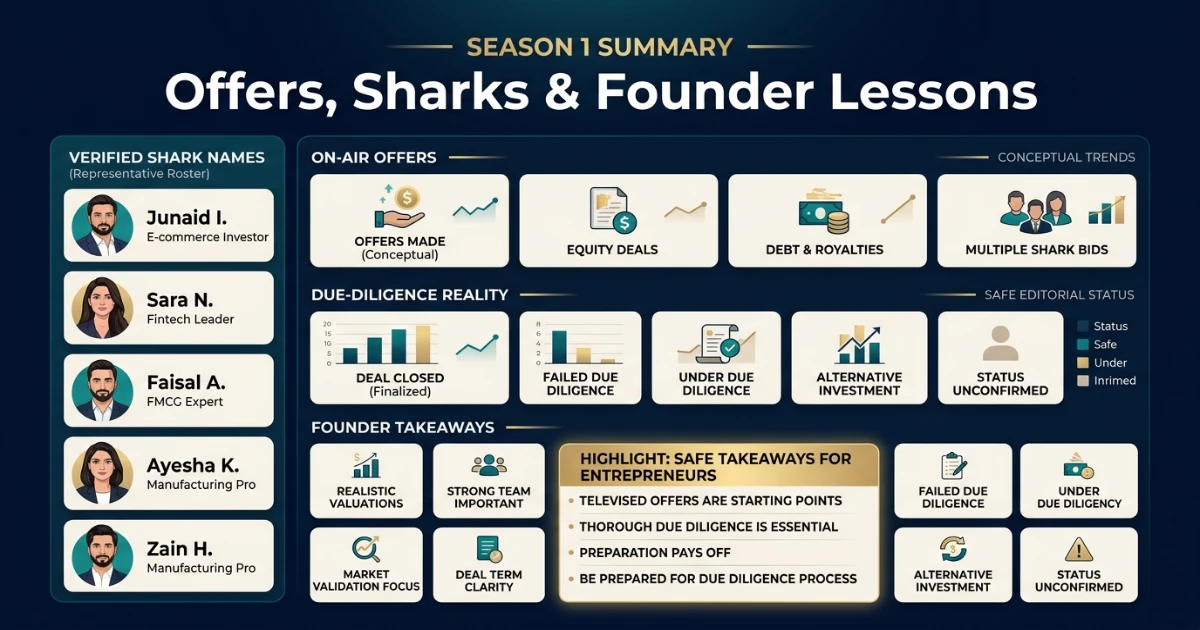
Quick Answer: This Shark Tank Pakistan Deals Tracker reviews Season 1 investor offers, shark activity, pitch patterns, and founder lessons from the show. Because on-air handshakes can change during due diligence, this tracker separates public offers from confirmed post-show funding wherever reliable information is available.
Accuracy Note: Shark Tank Pakistan deal information can change after filming. This page should be read as a public pitch and offer analysis, not as legal confirmation that every on-air handshake resulted in completed funding. The Saraaf PKR 1.5 billion case is treated as a disputed or non-materialized offer, not a completed investment.
If you have been following the Shark Tank Pakistan Deals Tracker conversation since the show launched, you already know Season 1 was more than entertainment. It gave Pakistani founders a public look at valuation pressure, equity negotiation, investor objections, and the hard difference between a good pitch and an investable business.
This page is designed as a safer Season 1 tracker. It reviews public pitch patterns, shark activity, announced offers, and due-diligence realities. Where a deal was only shown as an on-air handshake, it should be treated as an announced offer until final funding is independently confirmed.
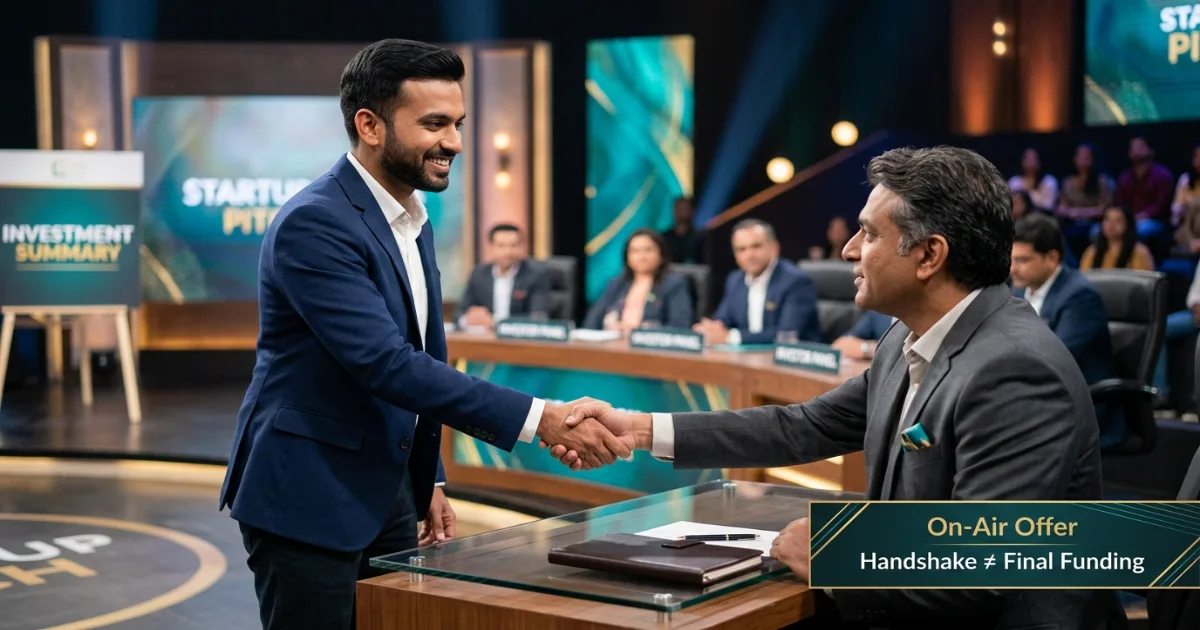
That distinction matters. In startup investing, a handshake is not the same as wired funds. Due diligence, legal review, founder documentation, cap-table issues, and revised terms can all change the final outcome.
Who Were the Sharks in Shark Tank Pakistan Season 1?
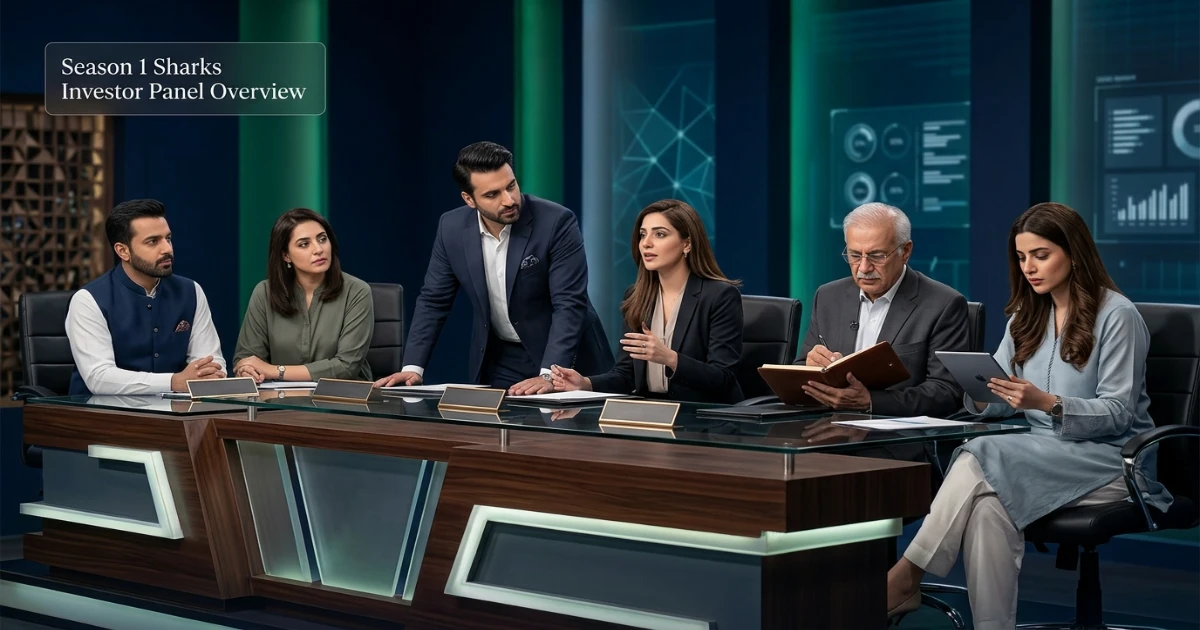
The publicly listed Season 1 shark panel included Aleena Nadeem, Faisal Aftab, Junaid Iqbal, Karim Teli, Rabeel Warraich, Romanna Dada, and Usman Bashir. These names are safer to use than older draft names that appeared in the previous version of this article.
For founders, this matters because a strong pitch is not only about money. A founder should understand which shark brings relevant strategic value, such as venture funding experience, distribution support, consumer-brand insight, food-sector knowledge, education-finance expertise, or operational scaling.
| Shark | Publicly Known Role / Background | Why Founders Study Their Questions |
|---|---|---|
| Aleena Nadeem | Founder and CEO of EduFi | Useful for education, fintech, affordability, and structured consumer-finance discussions. |
| Faisal Aftab | Founder and General Partner at Zayn VC | Often associated with venture-scale thinking, tech startups, market size, and growth discipline. |
| Junaid Iqbal | Founder and CEO of Salt Ventures | Relevant for operators, platform businesses, scaling strategy, and founder execution quality. |
| Karim Teli | Managing Director of Igloo Pakistan | Important for food, FMCG, manufacturing, consumer demand, and distribution-led businesses. |
| Rabeel Warraich | Founder and CEO of Sarmayacar | Relevant for startups seeking VC-style questions on traction, economics, and investability. |
| Romanna Dada | Founding Partner at Women Collective | Helpful lens for founder story, consumer behavior, brand positioning, and women-led ventures. |
| Usman Bashir | CEO of BrakeTime | Relevant for food-service operations, retail scaling, execution, and unit-level business discipline. |
Why Tracking Shark Tank Pakistan Deals Matters Beyond the Show
The most useful part of any Shark Tank Pakistan Deals Tracker is not simply counting offers. The real value is understanding how sharks react to valuations, unclear books, weak margins, unrealistic growth claims, and founder confidence under pressure.
For founders, these public offers create negotiation benchmarks. They also show that startup funding is not finalized on camera. Even when an offer looks exciting, the final result depends on documents, legal structure, revenue proof, liabilities, ownership clarity, and the shark’s final term sheet.
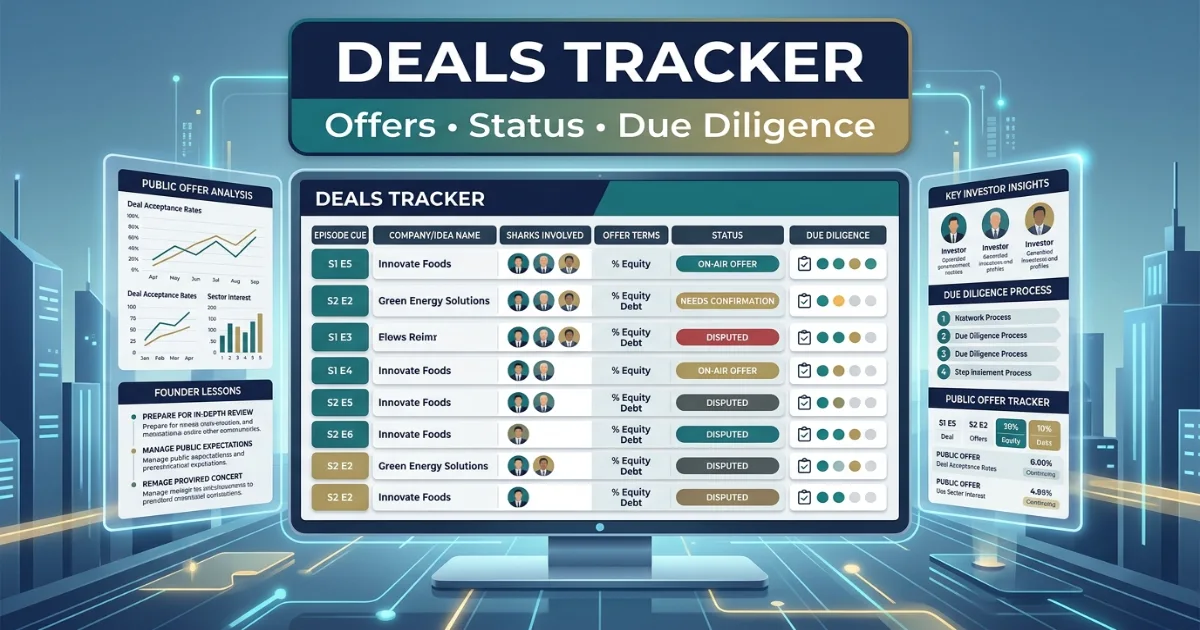
Shark Tank Pakistan Deals Tracker: Public Offers and Verification Status
The earlier version of this article listed 27 “closed deals,” exact totals, and several startup names that could not be safely verified. This corrected version removes those risky claims and uses a safer tracker format. It separates public pitch references, announced offers, and post-show confirmation status.
| Pitch / Deal Reference | Publicly Discussed Amount | Shark(s) / Panel Context | Status Label | Safe Editorial Note |
|---|---|---|---|---|
| Saraaf | PKR 1.5 billion offer was widely discussed | Reported as a major Shark Tank Pakistan offer | Disputed / not materialized | Do not count this as completed funding. Use it as a due-diligence case study showing why “announced offer” and “funded deal” are not the same. |
| Khaas Foods | Public clips describe a PKR 5 million grant-style moment | Multiple sharks appeared involved in public clip coverage | Public clip / grant-style support | Safer to describe as public support shown on the program, not a standard equity investment unless final terms are verified. |
| Bio Energy | Public startup lists mention a funding ask and shark involvement | Junaid Iqbal appears in public startup-list references | Needs final confirmation | Useful for sector analysis, but do not present as completed wired funding without founder/shark confirmation. |
| Other Season 1 Pitches | Varies by episode and founder ask | Different sharks by pitch | On-air offer / needs source | For a complete table, add only rows where each startup name, ask, offer, shark, and final status can be sourced from a public episode page, official clip, founder announcement, or reliable report. |
Why the PKR 1.82 Billion Claim Was Removed
The previous draft claimed that Shark Tank Pakistan Season 1 closed 27 deals with total committed investments exceeding PKR 1.82 billion. That wording is risky because it combines unverified rows with the disputed Saraaf PKR 1.5 billion case.
When one very large offer is later reported as not materialized, it can distort the entire season total. A safer article should not build its headline, quick answer, or schema around that number. This corrected page avoids a fixed total unless every deal has final confirmation.
For SEO and trust, this is stronger. Google can tolerate uncertainty when the page is transparent. It is less forgiving when a page presents disputed investment numbers as settled fact.
Post-Show Reality: Why On-Air Deals Can Change
The most important lesson from this Shark Tank Pakistan Deals Tracker is that an on-air handshake is not always the final funded deal. After filming, sharks usually review legal documents, financial records, founder ownership, liabilities, revenue proof, and operational claims.
If the numbers do not match the pitch, the final term sheet can change. In some cases, the investment may be reduced, delayed, restructured, or cancelled. This does not mean the show is fake. It means startup investing requires due diligence after the excitement of the pitch.
For founders, the takeaway is simple: prepare clean books, legal registration, tax documents, cap-table clarity, and proof of revenue before applying. The pitch may win attention, but documentation closes the round.
What Founders Should Learn from Shark Tank Pakistan Offers
1. Do Not Treat a TV Offer as Cash in the Bank
A televised offer can open doors, but founders should not announce expansion plans, hiring, or inventory commitments until money is actually wired or a binding agreement is signed.
2. Keep Your Cap Table Clean
Messy founder ownership, informal family loans, undisclosed investors, or unregistered partnerships can scare off sharks after filming. Clean documentation makes post-show closing easier.
3. Defend Your Valuation with Real Numbers
Sharks may like the founder and the product, but valuation still needs support. Revenue, margin, retention, purchase frequency, customer acquisition cost, and payback period matter more than excitement.
4. Match the Right Shark to the Right Need
The best offer is not always the biggest cheque. For many Pakistani founders, distribution, manufacturing help, retail access, hiring support, and investor credibility can be more valuable than a slightly higher valuation.
How to Use This Tracker for Your Own Pitch
This Shark Tank Pakistan Deals Tracker should be used as a preparation tool, not just a recap. Study the investor questions, not only the final offer. The first objections usually reveal what sharks care about most.
- If you are pre-revenue: show pilot data, waitlists, letters of intent, or working prototypes.
- If you have revenue: show monthly sales trend, gross margin, repeat purchase rate, and customer acquisition cost.
- If you are a traditional business: show distribution strength, supplier stability, production capacity, and export potential.
- If you are a tech startup: show retention, active users, monetization path, and how the product scales beyond one city.
Common Mistakes to Avoid When Writing About Shark Tank Pakistan Deals
Using “Closed Deal” Too Early
Use “closed” only when the final investment has been confirmed. Otherwise, say “on-air offer,” “announced offer,” “handshake offer,” or “reported offer.”
Adding Unsourced Startup Names
Do not add fictional startup names to make the table look complete. It is better to have a shorter verified tracker than a long table that looks manufactured.
Counting Disputed Offers in the Total
Large disputed offers should be explained separately. They should not be added into total season funding unless the funding has been confirmed after due diligence.
Using Wrong Shark Names
Wrong panel names weaken trust quickly. Use the verified Season 1 panel names: Aleena Nadeem, Faisal Aftab, Junaid Iqbal, Karim Teli, Rabeel Warraich, Romanna Dada, and Usman Bashir.
Related Resources on SharksTankPakistan.pk
Frequently Asked Questions About Shark Tank Pakistan Deals
What does this Shark Tank Pakistan Deals Tracker cover?
This Shark Tank Pakistan Deals Tracker covers Season 1 public offers, shark activity, due-diligence realities, pitch lessons, and safe editorial notes for founders studying the show.
Were all Shark Tank Pakistan Season 1 deals fully funded after the show?
Not every on-air offer should be treated as completed funding. Like other Shark Tank formats, deals can change after due diligence when investors review documents, revenue proof, legal status, ownership, and liabilities.
Why did this page remove the PKR 1.82 billion total?
The earlier total was risky because it relied on unverified rows and could include disputed offer value. This corrected version avoids fixed totals unless every deal has reliable post-show confirmation.
Who were the Shark Tank Pakistan Season 1 sharks?
The publicly listed Season 1 sharks were Aleena Nadeem, Faisal Aftab, Junaid Iqbal, Karim Teli, Rabeel Warraich, Romanna Dada, and Usman Bashir.
What is the safest way to describe a Shark Tank Pakistan deal?
Use “on-air offer” or “announced offer” unless the founder, shark, official platform, or reliable news source confirms that the final funding was completed after due diligence.
What should founders learn from Shark Tank Pakistan offers?
Founders should prepare clean financials, legal registration, cap-table clarity, valuation logic, and proof of traction before applying. A strong pitch can win interest, but due diligence closes the investment.
Your Fast-Track Cheat Sheet: Safe Takeaways
1. Say “on-air offer,” not “closed deal,” until funding is confirmed. This protects the article from misleading claims and makes the tracker more trustworthy.
2. Do not include the Saraaf PKR 1.5 billion case in completed investment totals. Treat it as a disputed or non-materialized offer unless reliable final funding proof appears.
3. Use verified shark names only. The Season 1 panel should be listed as Aleena Nadeem, Faisal Aftab, Junaid Iqbal, Karim Teli, Rabeel Warraich, Romanna Dada, and Usman Bashir.