Shark Tank Pakistan vs Dragons’ Den: Key Differences for Founders
Both shows put entrepreneurs in front of serious investors, but the right platform depends on your market, legal setup, stage, pitch style and the kind of investor network your business needs after the cameras stop rolling.
Quick answer: Shark Tank Pakistan is usually the stronger fit for founders whose customers, supply chain, retail partners and regulatory questions are mainly in Pakistan. Dragons’ Den can be useful for founders who already have a UK or international business angle, but it brings a different production process, investor context and market expectation. The biggest difference is not only “sharks vs dragons” — it is local-market relevance versus broader international positioning.
Many founders search for shark tank pakistan vs dragons den because the shows look similar on the surface: entrepreneurs pitch, investors question them, and a deal may be offered. But for a Pakistani founder, the practical difference can be huge. A TV deal is not just about getting a cheque. It is about whether the investor understands your customer, your margins, your distribution bottlenecks, your legal setup and the pace at which your market actually moves.
This guide corrects the most common confusion around the two formats. Instead of treating one show as automatically “better,” it explains which platform is better for which type of founder.
Pakistani founders usually do not fail in the pitch because the idea is weak. They often struggle because the room does not instantly understand the market reality behind the idea — and that is exactly why choosing the right investor platform matters.

The Origin: Same Pitch-TV Family, Different Local Execution
Dragons’ Den is one of the best-known investor pitch formats in the world. The UK version launched on the BBC in 2005 and follows a serious, investor-led format where entrepreneurs present their business to a panel of “Dragons.” The wider format traces back to Japan’s Money Tigers, which later inspired multiple international versions.
Shark Tank became the more entertainment-driven version of the format in the United States, with brighter staging, faster editing and a more dramatic negotiation style. Shark Tank Pakistan follows that Shark Tank franchise approach, adapted for Pakistani entrepreneurs, Pakistani viewers and local business realities.
That local adaptation matters. A founder selling through Pakistani kiryana stores, social commerce, marketplaces, distributors, pharmacies or informal retail networks needs investors who understand those channels without a long explanation. This is where Shark Tank Pakistan has a clear advantage for many local founders.
Important correction
The correct show name is Dragons’ Den, not “Dragon’s Den,” when referring to the UK programme. You can still use “dragon” naturally in sentence-level writing, but the title should use Dragons’ Den.
Panel Dynamics: Sharks vs Dragons
Shark Tank Pakistan panel context
Shark Tank Pakistan’s investor panel has included Pakistani entrepreneurs and investors such as Faisal Aftab, Rabeel Warraich, Aleena Nadeem, Romanna Dada, Junaid Iqbal, Karim Teli and Usman Bashir. Their value is not limited to capital. For Pakistani startups, their stronger advantage is local market interpretation: consumer trust, payment behaviour, distribution, hiring, pricing, brand building and fundraising in Pakistan.
For example, a Pakistani food, fashion, health, logistics, education or fintech startup may need guidance on issues that are deeply local: cash-on-delivery behaviour, city-wise demand, wholesale channel margins, family-led purchase decisions, Urdu/English positioning, influencer trust, regulatory sensitivity or retail shelf access. A local shark can often understand these signals quickly.
Dragons’ Den panel context
The UK Dragons’ Den panel changes by season, but familiar names across recent seasons include investors such as Peter Jones, Deborah Meaden, Steven Bartlett and Touker Suleyman, alongside other regular or guest Dragons depending on the series. The strength of this room is deep experience in UK and international markets, retail distribution, product scaling, manufacturing discipline and brand expansion.
That can be powerful for a Pakistani founder with genuine international traction. But if your business is still mostly dependent on Pakistani demand, the Dragons may need more context before they can judge the opportunity. That can reduce the time spent on deal-making and increase the time spent explaining the basics of your market.
Pitch Style: Energy, Storytelling and Questioning
Shark Tank Pakistan is better suited to founders who can combine emotion, story, numbers and confidence in a fast-moving pitch. The room is designed for television, so clarity matters immediately. You need a sharp opening, a simple business model, clean numbers and a founder story that viewers can remember.
Dragons’ Den usually feels more restrained. The pitch may feel less dramatic, but that does not mean it is easier. Dragons often focus heavily on details: sales proof, gross margin, intellectual property, manufacturing reliability, stock levels, cash flow and route-to-market. A founder who cannot defend the numbers will struggle in either room, but the UK format can feel especially intense because the questions may be more forensic.
| Comparison point | Shark Tank Pakistan | Dragons’ Den UK |
|---|---|---|
| Investor title | Sharks | Dragons |
| Founder advantage | Local-market understanding and Pakistan-specific networks | UK/international business experience and mature-market scaling |
| Best-fit founder | Founder building mainly for Pakistan or South Asian consumers | Founder with a UK, export, IP or global expansion angle |
| Pitch tone | High-energy, emotional, founder-story friendly | More formal, detailed and investor-analysis focused |
| Market explanation needed | Lower for Pakistan-specific behaviour | Higher if the business depends on Pakistani consumer context |
| Deal focus | Usually framed around equity, valuation and strategic mentorship | Often framed around equity, risk, proof, margins and investor fit |
| Legal and filming practicality | More practical for Pakistan-based founders | Requires checking current UK casting, filming and eligibility rules |
| Audience benefit | Direct awareness among Pakistani customers and partners | Broader UK/international credibility, depending on business fit |
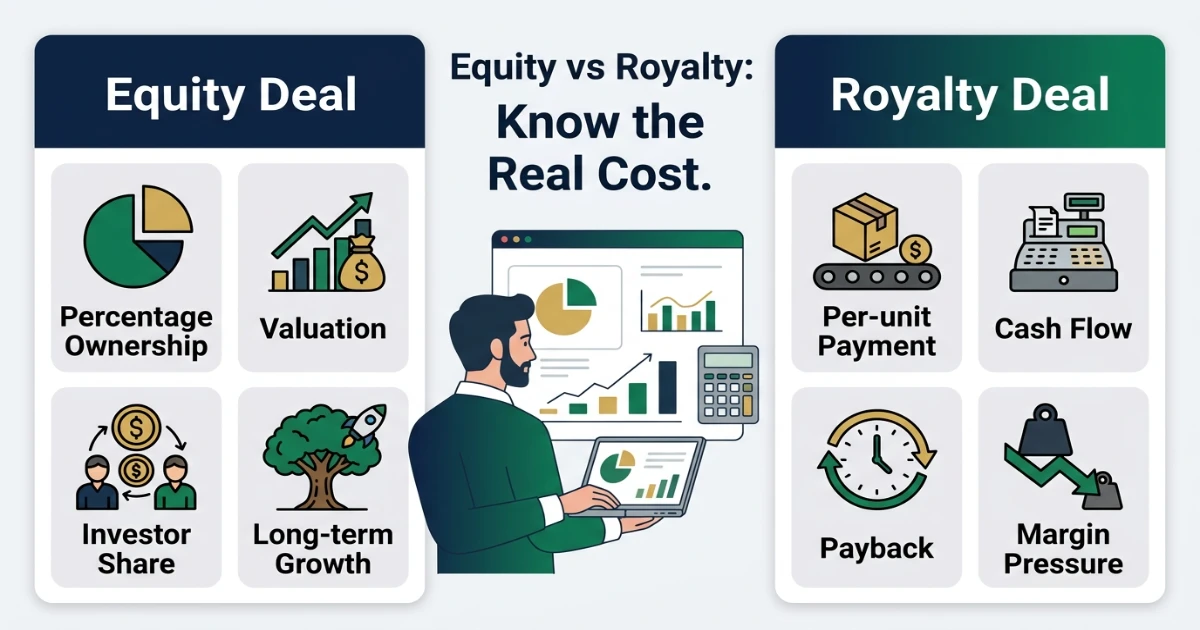
Deal Structures: Equity, Royalties and Real Cost of Capital
Founders often compare only the headline amount: “How much money can I raise?” That is the wrong starting point. The better question is: what does the capital cost you over time?
On Shark Tank-style shows, offers are usually discussed as cash in exchange for equity. For example, an investor may offer Rs. 1 crore for 10% of the company. That implies a post-money valuation of Rs. 10 crore. But founders must remember that TV offers are typically conditional until due diligence is complete. A handshake on set is not always the final legal closing.
Dragons’ Den deals are also investment offers subject to due diligence. Some Dragons may structure offers creatively depending on the risk profile, product margin and cash flow. Any equity, royalty, loan-style repayment or combined structure should be modelled carefully before accepting. A deal that looks smaller on equity may still become expensive if it pulls cash from every sale.
Founder warning
Do not accept a deal because the TV moment feels exciting. First model your valuation, dilution, investor control, royalty impact, repayment pressure and worst-case cash flow. A “yes” on camera can become a painful structure if your margins are thin.
Why Local Market Relevance Matters So Much for Pakistani Founders
Pakistan has a different startup operating environment from the UK. Many businesses still depend on cash-on-delivery, WhatsApp orders, informal retailer networks, city-wise distributors, platform trust, seasonal spending and family-influenced purchase decisions. A founder may understand this instinctively, but an international investor may need a full explanation before they can assess the opportunity.
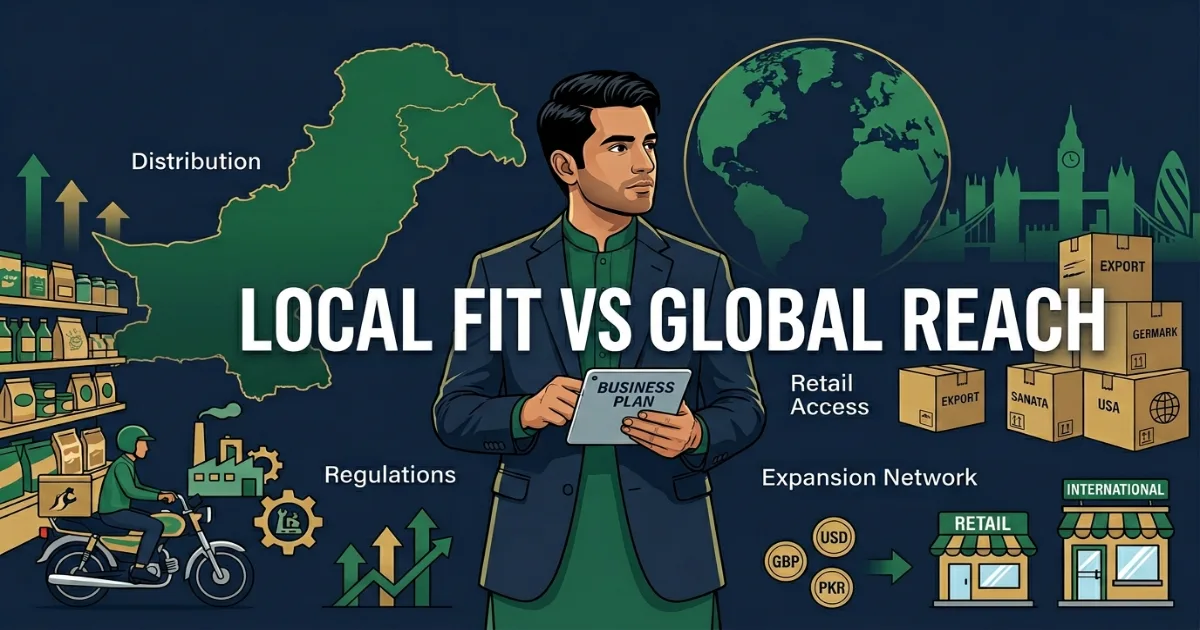
This is not a weakness of Dragons’ Den. It is simply a market-context gap. If your business model is built around Lahore, Karachi, Islamabad, Multan, Faisalabad or Peshawar demand, a Shark Tank Pakistan investor may understand the growth logic faster. If your product is export-ready, patentable, software-led or already selling in the UK, then Dragons’ Den may be more relevant.
Which Platform Should You Choose?
Choose Shark Tank Pakistan if your next growth phase is local
If your next two to three years depend on Pakistani consumers, distributors, retailers, restaurants, clinics, schools, local apps, logistics or domestic brand trust, Shark Tank Pakistan is usually the better fit. You will spend less time explaining the market and more time negotiating the actual opportunity.
Consider Dragons’ Den if your business already has a UK or international angle
Dragons’ Den may make sense if you have existing export revenue, a UK customer base, a strong product IP angle, a scalable software business, international manufacturing proof or a realistic path into UK retail. Without that, the platform may look prestigious but deliver less practical value.
Stay off both shows if your numbers are not ready
Television exposure can amplify a weak business as quickly as a strong one. Before applying anywhere, know your revenue, gross margin, net margin, customer acquisition cost, repeat purchase rate, stock position, production capacity, valuation logic and exact use of funds.
A 5-Step Decision Framework for Founders
Step 1: Define your primary market for the next 24 months
If most of your growth will happen in Pakistan, prioritise Shark Tank Pakistan. If your growth depends on UK or international buyers, assess Dragons’ Den more seriously.
Step 2: Match the investor network to your bottleneck
Need Pakistani retail, distributor access or local credibility? Sharks may help more. Need UK retail, export validation or international brand positioning? Dragons may fit better.
Step 3: Model the deal before the pitch
Use your own spreadsheet or a valuation calculator to test equity, dilution and investor return scenarios before accepting any offer.
Step 4: Prepare two versions of your pitch
For Shark Tank Pakistan, lead with local pain, traction and emotional clarity. For Dragons’ Den, lead with proof, margins, defensibility and market size.
Step 5: Check the latest application rules
Application windows, eligibility, filming location and legal requirements can change. Always verify them through the current official application or broadcaster channels before planning around any show.
Common Mistakes in the Shark Tank Pakistan vs Dragons’ Den Debate
Mistake 1: Thinking international automatically means better
A global platform can look attractive, but prestige does not automatically solve local distribution, local pricing, compliance, hiring or customer trust. For many Pakistani founders, a local investor with the right network can be more valuable than a larger international name.
Mistake 2: Comparing only the cheque size
A bigger cheque with more dilution, complex repayment or poor investor fit can be worse than a smaller cheque with strategic value. The best deal is not the largest deal; it is the deal that accelerates growth without damaging founder control or cash flow.
Mistake 3: Assuming a TV handshake means the money is guaranteed
Investment offers on pitch shows normally go through due diligence after filming. Founders should treat on-screen deals as conditional until documents are signed, diligence is complete and funds are actually transferred.
Mistake 4: Using the same pitch for both rooms
A pitch built for a Pakistani audience may need adjustment for a UK investor panel. Translate local terms, explain customer behaviour clearly, convert currency where needed, and remove assumptions that only a local viewer would understand.
How SharksTankPakistan.pk Tools Can Help Before You Apply
Before approaching any investor room, your numbers should be clean. Use the Startup Valuation Calculator guide to pressure-test your valuation and the Equity & Loan Calculator guide to compare dilution, repayment and funding scenarios. These tools help you enter a pitch with confidence instead of guessing under pressure.
You should also read How to Apply to Shark Tank Pakistan and What Happens After Shark Tank Pakistan so your preparation covers both the pitch and the post-show reality.
Source and accuracy note
This comparison is written for Pakistani founders and avoids treating TV investment offers as guaranteed funding. Investor panels, application windows, filming locations and legal requirements can change by season, so founders should verify current casting details through official show or broadcaster channels before applying.
Frequently Asked Questions
Is Shark Tank Pakistan the same as Dragons’ Den?
No. Both belong to the investor-pitch TV family, but Shark Tank Pakistan follows the Shark Tank franchise style and is adapted for Pakistani entrepreneurs and audiences. Dragons’ Den is the UK format with a different tone, panel history and market context.
Which show is better for Pakistani founders?
Shark Tank Pakistan is usually better for founders focused mainly on Pakistan. Dragons’ Den may be better only when the business already has a serious UK, export or international growth angle.
Can a Pakistani entrepreneur apply to Dragons’ Den?
Possibly, but founders should verify the latest eligibility, filming and legal requirements through current official casting information. Do not assume old application rules are still valid.
Do Dragons offer better valuations than Sharks?
Not automatically. A valuation depends on traction, market size, risk, margins, growth potential and investor appetite. Founders should compare the full deal structure, not only the headline valuation.
Are Shark Tank Pakistan deals guaranteed after filming?
No TV investment offer should be treated as final until due diligence is completed, legal documents are signed and funds are transferred.
What should founders prepare before pitching?
Prepare your revenue, margins, valuation logic, use of funds, customer acquisition cost, supply chain, legal documents, founder roles and growth plan. A clear pitch without clean numbers is not enough.
Should I pitch locally first or internationally first?
If your product is built mainly for Pakistan, pitch locally first. If you already have international validation or a UK-ready business model, then an international platform may be worth considering.
Final Verdict: Local Fit Beats Global Hype
The shark tank pakistan vs dragons den decision should not be based on which show sounds bigger. It should be based on where your business will grow next.
- Choose Shark Tank Pakistan if your customers, distribution and partnerships are mainly in Pakistan.
- Consider Dragons’ Den if your business already has a UK or international expansion case.
- Prepare your numbers first because investor confidence comes from traction, margins and clarity — not only passion.
For most Pakistan-first founders, Shark Tank Pakistan offers more relevant exposure, more familiar investor context and a better chance of practical post-show support.