Startup Tax in Pakistan: What Every New Founder Must Know in 2026
💡 The Short Answer: Most Pakistani startups don’t pay a single rupee in income tax during their first 2–3 years if structured correctly and registered with the SECP as a private limited company. But the real risk isn’t the tax you pay — it’s the compliance mistakes that trigger penalties, freeze your bank accounts, and scare away investors. Get your NTN, understand sales tax on services, and never treat tax filing as optional. The FBR’s digital surveillance in 2026 is sharper than ever.
You’ve built the MVP. You’ve pitched three angels. Maybe you’re even preparing a Shark Tank Pakistan application. And then someone at a co-working space in Gulberg or Clifton asks: “Bhai, tax file kholi hai?” — and your stomach drops.
Here’s the truth most Pakistani startup content skips: startup tax Pakistan 2026 isn’t just about how much you owe. It’s about whether your company looks investable on paper. It’s about whether your bank account survives an FBR notice. And it’s about whether a Shark — on the show or off it — walks away because your financial house isn’t in order.
I’ve worked with enough Pakistani founders to know this: the ones who treat tax as an afterthought lose deals. The ones who build tax literacy early sleep better and raise faster. This guide covers everything — from registration and exemptions to Shark Tank deal taxation — in plain, actionable language.
Why Startup Tax in Pakistan Is Different in 2026
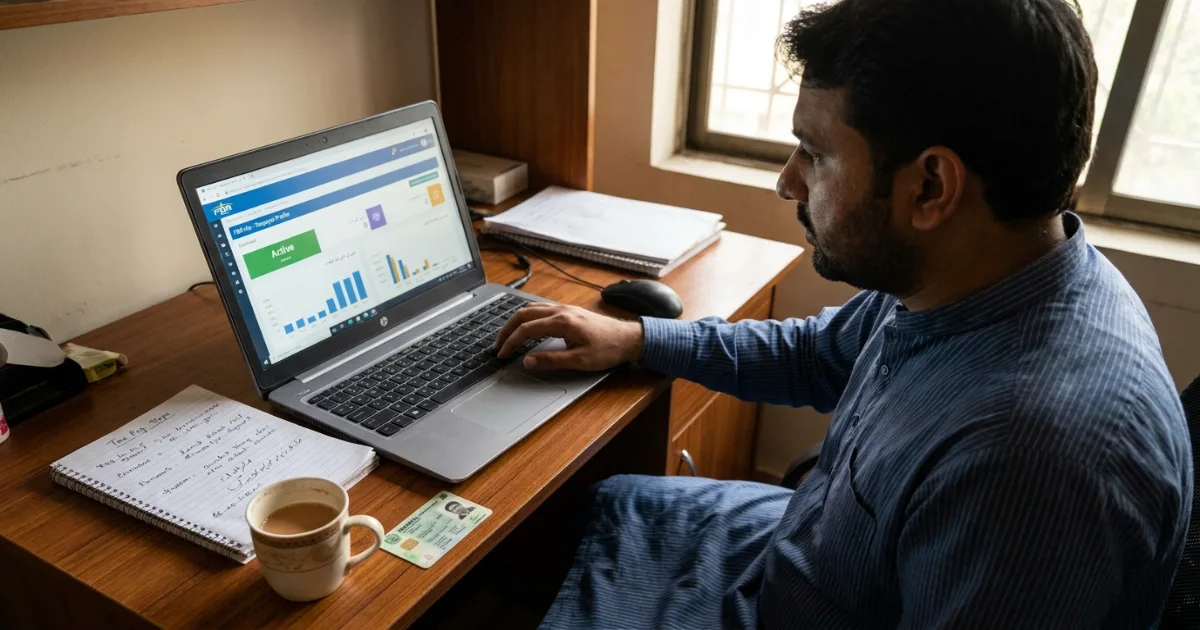
Three years ago, you could fly under the radar. Today, the FBR’s PRAL-integrated data systems cross-match your bank transactions, utility bills, travel records, and even social media marketplace activity. In 2025 alone, the FBR issued over 180,000 automated compliance notices to non-filers. Pakistan’s tax net is widening — and startups are squarely in its sights.
For founders, this changes the playbook. You can’t “figure it out later.” Later means penalties. Later means frozen accounts. Later means an investor’s due diligence lawyer advising them to pass on your deal because of unresolved tax exposure. The good news? Pakistan has genuinely startup-friendly provisions — if you know where to look and file on time.
This shift matters doubly if you’re planning to appear on Shark Tank Pakistan. Several Sharks have publicly stated they check SECP and FBR records before finalizing any handshake deal. Your tax posture is part of your pitch, whether you mention it or not.
The Business Structure Decision: Where Tax Strategy Begins
Before you touch a single tax form, your legal structure determines almost everything — your tax rate, your filing obligations, your ability to take investment, and your personal liability. Pakistani founders typically face three real options:
| Structure | Tax Rate (2026) | Investor Readiness | Compliance Burden | Best For |
|---|---|---|---|---|
| Sole Proprietorship | 0–35% (individual slab) | ❌ Very low | Low | Testing an idea solo, pre-revenue |
| AOP (Partnership) | 0–35% (individual shares) | ⚠️ Moderate | Medium | Small teams, no external funding plans |
| Private Limited (Pvt Ltd) | 29% (corporate rate), plus potential exemptions | ✅ High — required by most investors | Higher but manageable | Startups seeking funding, Shark Tank applicants |
The corporate tax rate for private limited companies sits at 29% for tax year 2026. But — and this is where most generic guides get it wrong — most early-stage Pakistani startups report taxable losses, not profits. When your expenses (salaries, cloud hosting, marketing, office rent) exceed revenue, your taxable income is zero or negative. You still file. You just don’t pay income tax that year. The filing itself builds a clean record that investors and banks trust.
Tax Registration: The 4 Steps Every Founder Must Complete
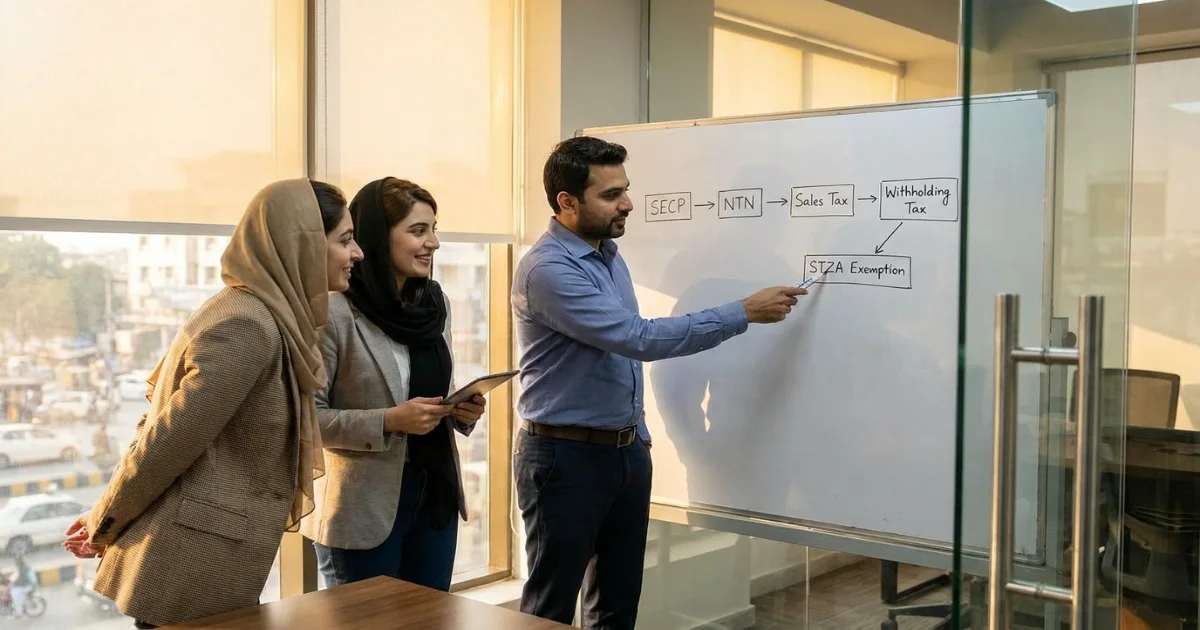
Let’s get practical. Here’s your registration checklist, ordered by urgency:
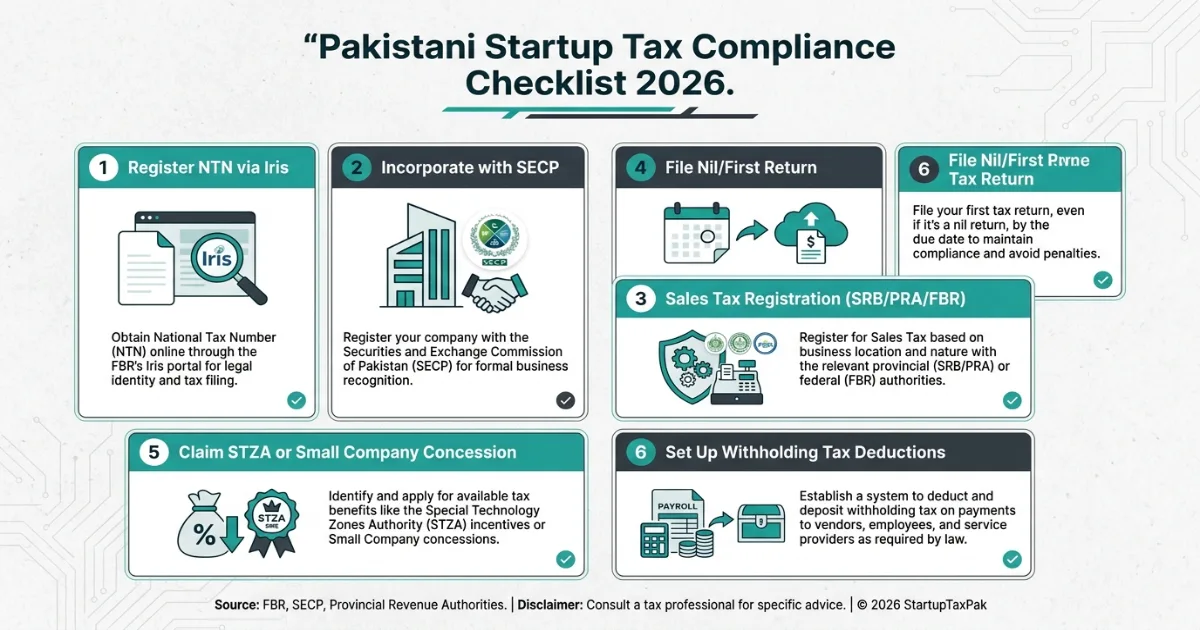
- NTN (National Tax Number) — Day 1: Register on the FBR Iris portal. Even pre-revenue founders need this. Without an NTN, your bank may flag transactions, and you can’t issue tax-compliant invoices to B2B clients. Registration is free and online.
- Sales Tax Registration — Before First B2B Invoice: If your startup provides services (software, consulting, design, marketing), you likely need provincial sales tax registration. Sindh (SRB) and Punjab (PRA) have different portals and rates — typically 13–16%. Tech startups in Islamabad fall under the Islamabad Capital Territory and deal directly with FBR for sales tax.
- SECP Incorporation — Before Taking Any Investment: Registering as a private limited company with the SECP costs roughly PKR 25,000–40,000 through a lawyer or digital facilitator. The process now takes 3–7 working days. You’ll need a digital signature, CNIC copies of directors, and a registered office address.
- Professional Tax Registration — If Applicable: Certain professions and locations require an additional professional tax registration with the local excise and taxation department. This varies by city — check with a local tax advisor.
Tax Exemptions and Incentives Pakistani Startups Overlook
Pakistan’s tax code contains several provisions that directly benefit technology startups and small businesses. Yet in my experience, fewer than 20% of first-time founders claim them. Here’s what you’re probably missing:
1. Technology Zone Exemptions
Startups registered under Pakistan’s Special Technology Zones Authority (STZA) can access significant tax holidays — including income tax exemptions for up to 10 years, customs duty exemptions on imported equipment, and reduced withholding tax rates. Islamabad’s National Science and Technology Park and Lahore’s Arfa Software Technology Park are examples. If your startup qualifies, this single registration can save you millions of rupees over a decade.
2. Small Company Concession
The FBR defines a “small company” as one with annual turnover below PKR 250 million. Qualifying small companies enjoy a reduced corporate tax rate of 20% instead of the standard 29%. This isn’t automatic — you must claim it in your annual return with proper documentation. Most early-stage startups qualify but never file the election.
3. Tax Credit for New Employment
Hiring full-time employees? You may claim a tax credit equal to a percentage of salaries paid to new hires, provided they’re registered with EOBI and social security where applicable. The exact credit percentage varies by year; for 2026, consult the Finance Act or a tax advisor. This credit directly reduces your tax liability — it’s not a deduction, it’s a credit.
4. R&D Tax Credits
Startups investing in genuine research and development — software product development, engineering innovation, biotech research — may qualify for R&D tax credits under the Income Tax Ordinance. The process requires pre-approval from the relevant ministry, but the payoff is substantial for deep-tech startups.
How Shark Tank Pakistan Deals Are Taxed — What Founders Get Wrong
This is the section that directly connects startup tax Pakistan 2026 with the world of Shark Tank Pakistan. When you accept a deal on the show — or from any angel investor — the tax treatment depends entirely on how the money enters your company.
Equity Investment: When a Shark invests cash in exchange for equity (shares), this is generally not taxable income for the company. It’s capital. The company issues new shares, the investor subscribes, and the money lands on your balance sheet as equity — not revenue. No immediate income tax. However, the SECP filing for share issuance carries its own fees and documentation requirements.
Convertible Notes / Loan: If the deal is structured as a loan (even a “friendly” one from a Shark), the interest payments become a deductible expense for the company — but the Shark may owe tax on the interest income they receive. More importantly, loan-based deals trigger withholding tax obligations the moment you repay any portion.
Royalty Arrangements: Some Sharks negotiate royalty deals — a percentage of revenue until they recoup their investment plus a return. Those royalty payments are a deductible business expense for the startup, but the startup must withhold tax on those payments at the prescribed rate (typically 15% for royalty payments to residents, higher for non-residents).
Situation-Based Tax Strategy: What Changes Based on Your Stage
If You’re Pre-Revenue (Building the Product)
Your priorities are registration and record-keeping, not tax payments. Register your NTN. Incorporate with SECP if you’re serious about funding. Keep every expense receipt — cloud subscriptions, freelance developer payments, co-working space rent, even the chai for client meetings (entertainment expenses have partial deductibility). File nil returns each year. A nil return is a signal — it tells the FBR, “I exist, I’m compliant, I just don’t have taxable income yet.” That signal matters when you suddenly deposit PKR 10 million in investment and the algorithm flags it.
If You’re Generating Revenue (But Not Profitable)
You now have two parallel tax obligations: income tax filing (even if nil or loss) and sales tax on services. If your annual turnover crosses the PKR 10 million threshold for services or PKR 25 million for goods, you must register for sales tax and file monthly or quarterly returns. Missing a sales tax return — even one — triggers automatic penalties in 2026. The FBR’s system now blocks input tax claims for non-filers, which means your B2B clients may refuse to work with you if you’re not sales-tax compliant.
If You’re Profitable and Seeking Investment
This is when professional tax advisory stops being optional. You need advance tax planning: structuring expenses to maximize deductions, claiming every available exemption, timing large purchases for depreciation benefits, and ensuring your financial statements are audit-ready. Investors — including Sharks — will ask for two to three years of audited accounts. If those accounts show unexplained tax liabilities or pending notices, the deal gets complicated fast.
If You’re a Freelancer Transitioning to a Startup
Pakistan has a special tax regime for freelancers registered with PSEB (Pakistan Software Export Board). Freelancers earning in foreign currency may qualify for a 0.25% final tax regime on export receipts — meaning you pay a tiny fraction of your revenue as tax, and it’s considered “final,” with no further income tax on that amount. When you transition to a startup, you lose this freelancer status and enter the regular corporate or individual tax system. Plan this transition carefully. Don’t shut down your freelancer registration until your company structure is fully in place.

Withholding Tax: The Hidden Trap for Pakistani Startups
If there’s one topic that blindsides Pakistani founders, it’s withholding tax. The basic rule: whenever your startup makes certain payments — salaries, contractor fees, rent, dividends, professional services — you must deduct a percentage as withholding tax and deposit it with the FBR. The rates vary:
- Salary: Deduct according to the employee’s annual tax slab, averaged monthly.
- Contractor/Freelancer payments: Typically 3–7.5% for residents, higher for non-residents.
- Rent: 5–10% depending on the property type and landlord’s tax status.
- Professional services: 7.5–15% depending on the nature of the service.
Miss these deductions, and the FBR holds your company liable for the un-deducted tax plus penalties. Even if the contractor already paid their own tax. The law doesn’t care — the withholding agent (you) bears primary responsibility. For a fast-growing startup paying 10 freelancers monthly, this can become a six-figure-rupee problem within a quarter.
Common Pitfalls & When to Ignore Generic Advice
Not all tax advice applies equally. Here’s where Pakistani founders routinely stumble — and when standard guidance leads you astray:
- “Just use a chartered accountant at year-end.” — Waiting 12 months to look at your tax posture is a recipe for irreversible mistakes. By the time your CA sees a problematic transaction, the quarter for filing corrections may have passed. Engage a tax advisor quarterly, even if just for a 30-minute review.
- “Register as a sole proprietor — it’s simpler.” — It is simpler. It’s also a deal-killer. Sole proprietorships can’t issue shares, can’t take equity investment cleanly, and expose your personal assets to business liabilities. Simplicity has a ceiling.
- “Don’t file until you’re profitable.” — This is the single most damaging piece of advice circulating in Pakistani founder circles. Never filing = invisibility to the FBR, which is not the same as protection. When your bank reports a large deposit (and they will, under anti-money-laundering rules), an unregistered recipient faces far worse consequences than a filer with a nil return.
- “Sales tax doesn’t apply to software exports.” — It’s more nuanced. Software exports are zero-rated for sales tax, meaning you charge 0% but can still claim input tax credits. But software sold to Pakistani clients? That’s taxable at the standard rate. Misclassifying domestic sales as exports is a fast route to an audit.
- “Tax exemptions are automatic.” — None of them are. Every exemption, concession, and reduced rate requires an explicit claim, election, or certificate. You opt in through paperwork, not by wishing.
How to Use SharkTankPakistan.pk Tools for Tax- Aware Planning
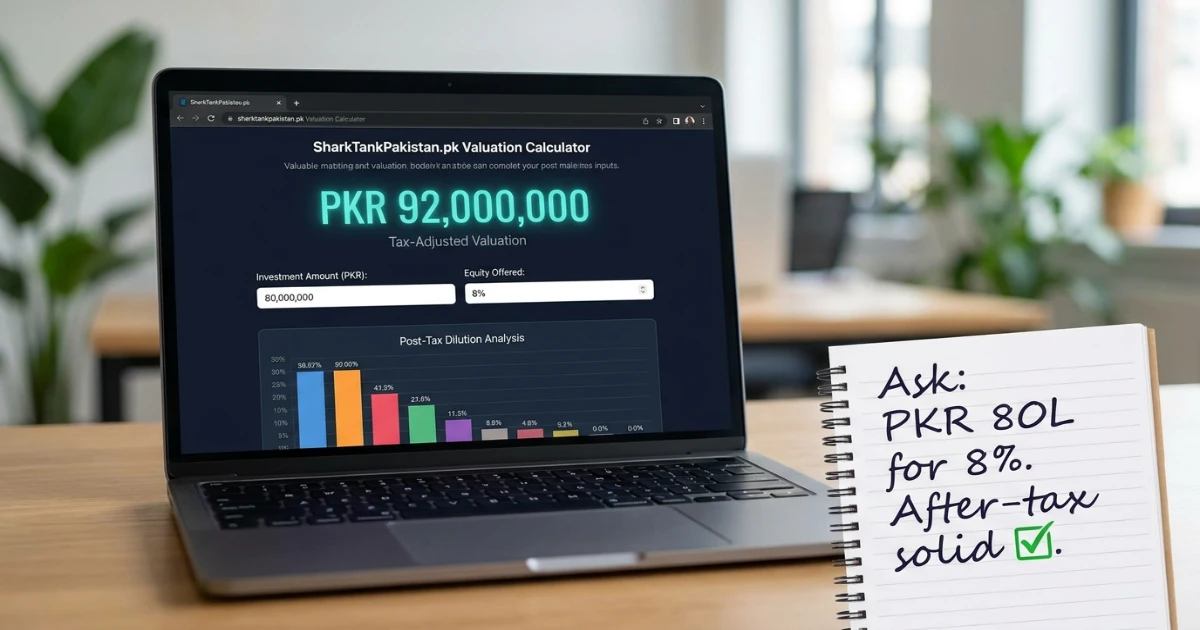
Tax doesn’t exist in a vacuum — it’s intertwined with your valuation, your funding ask, and your deal structure. The calculators on SharkTankPakistan.pk help you see the full picture before you walk into any investor meeting:
- Valuation Calculator: Understand your pre-money and post-money valuation. If you’re giving up 20% equity for PKR 5 million, your implied valuation affects future share issuances — and the tax basis of those shares matters for both you and your investors.
- Equity vs. Loan Calculator: Compare the after-tax cost of equity dilution versus debt servicing. Loan interest is deductible; equity dilution isn’t — but equity doesn’t require monthly repayments that strain cash flow. The calculator quantifies this trade-off.
- Salary & Tax Calculator: If you’re hiring your first employees, understand the total cost-to-company including withholding tax, EOBI contributions, and any provincial levies. A PKR 150,000 monthly salary costs your company closer to PKR 170,000–180,000 after all statutory obligations.
Open the Valuation Calculator right now. Plug in your numbers. See how a realistic, tax-informed ask changes the conversation with investors. A founder who says “I’ve factored in our tax position and here’s how our ask reflects that” sounds dramatically more competent than one who says “we’ll figure out tax later.”
Real-World Context: What Happens When Tax Goes Wrong
Consider a Lahore-based edtech startup — let’s call them “LearnNow” — that raised PKR 8 million from an angel investor in 2024. They didn’t issue shares properly. They didn’t file the SECP return of allotment. The money sat in the founder’s personal account for six months before moving to a company account. In 2025, the FBR’s automated system flagged the personal account deposit. The resulting inquiry took four months to resolve, cost PKR 380,000 in legal and accounting fees, and the angel investor nearly pulled out. All of it was avoidable with proper documentation from day one.
On the flip side, a Karachi-based logistics startup that filed diligently — nil returns for two years, then modest profit filings — sailed through due diligence when a Shark Tank Pakistan Shark expressed interest post-show. Their clean record became a selling point. The founder told me: “Meri tax filing meri pitch ka silent partner thi.” — “My tax filing was my pitch’s silent partner.”
Frequently Asked Questions About Startup Tax Pakistan 2026
Do I need to pay tax if my startup hasn’t made any profit yet?
You likely won’t owe income tax if you have no taxable profit. But you still must file your annual income tax return — even if it’s a nil or loss return. Filing preserves your compliance history and protects you from penalties. Sales tax obligations may still apply if you’re generating revenue, regardless of profitability.
How are Shark Tank Pakistan deals taxed for the founder?
Equity investments in exchange for company shares are generally not taxable income — they’re capital contributions. But you must document the share issuance properly with SECP and in your company records. If the deal involves loans or royalties, different withholding tax rules apply. Consult a tax advisor before finalizing any funding structure.
What is the tax rate for a private limited startup in Pakistan in 2026?
The standard corporate tax rate is 29% for tax year 2026. Small companies with turnover under PKR 250 million can elect a reduced 20% rate. Technology zone-registered startups may qualify for more substantial exemptions. The effective rate for most early-stage startups is 0% because they report losses, not profits.
Can a freelancer operating in Pakistan claim the 0.25% tax rate while running a startup?
The 0.25% final tax regime applies specifically to qualifying freelancers registered with PSEB and earning foreign export receipts. Once you incorporate a company, the company is a separate legal entity and the freelancer regime doesn’t apply to it. You can maintain both — but their tax treatments stay separate. Don’t mix the two without professional advice.
What happens if I never registered for tax and received investment money?
This is a serious compliance gap. The FBR can reclassify unexplained bank deposits as undeclared income and tax them at rates up to 35% plus penalties. Your investors may also face questions. Voluntary compliance — registering and filing even after the fact — is almost always better than waiting for an FBR notice. Contact a tax lawyer immediately.
Does Shark Tank Pakistan require contestants to show tax documents?
The show’s due diligence process typically includes a review of the company’s legal and tax standing. Sharks routinely request financial statements and tax returns before finalizing any on-air deal. One Shark has publicly stated they personally check FBR active taxpayer lists before committing. Clean records matter.
Is sales tax applicable on software services sold to Pakistani clients?
Yes. Software and IT services sold to clients within Pakistan are generally subject to provincial sales tax (13–16%, depending on the province). Software exports are zero-rated — you charge 0% but must still file returns. Misclassification carries penalties. Register with the appropriate provincial revenue authority before invoicing domestic clients.
📋 Your Fast-Track Cheat Sheet: Top 3 Actions to Take This Week
- Get your NTN if you don’t have one. Go to the FBR Iris portal. It’s free, it’s online, and it takes under an hour. Without it, every other step is blocked. Your NTN is the foundation of your startup’s tax identity in 2026.
- Decide your structure — and commit. If you plan to raise any external funding (Shark Tank or otherwise), incorporate as a private limited company with the SECP. The PKR 30,000–40,000 cost is trivial compared to the deals you’ll lose as a sole proprietor. Do it before you pitch, not after.
- File your first return — even if it’s nil. A nil return filed today is worth more than a perfect return filed after a notice. Compliance history is an asset. Start building yours now, not when an investor asks.
🔗 Then: Open the SharkTankPakistan.pk Valuation Calculator and model your funding ask with tax implications included. A tax-aware ask is a stronger ask.