
Pre-Money vs Post-Money Valuation Pakistan: A Powerful Calculator Guide
⚡ The Short Answer: Pre-money vs post-money valuation Pakistan means understanding your startup’s value before investment and after new cash is added. Pre-money is your value before funding; post-money is pre-money plus the investment. On Shark Tank Pakistan, this calculation directly determines the equity a shark receives. If you ask for Rs 5 crore at a Rs 25 crore pre-money valuation, you are offering 16.7% equity after investment.
Pakistani founders walk into pitch rooms with a number in their head. Maybe it’s Rs 10 crore. Maybe Rs 50 crore. But ask them whether that number is pre-money or post-money, and many glance sideways. That hesitation costs deals. On Shark Tank Pakistan, valuation is the quiet battlefield underneath every handshake. And understanding pre-money vs post-money valuation Pakistan isn’t just an accounting chore — it’s the difference between retaining founder control and waking up a minority shareholder in your own dream.
Before you open the SharksTankPakistan.pk valuation calculator or step in front of a camera, use this pre-money vs post-money valuation Pakistan guide to understand your equity numbers clearly and avoid giving away more ownership than intended.
Why Pre-Money vs Post-Money Valuation Pakistan Trips Up Smart Founders
The confusion is universal, but pre-money vs post-money valuation Pakistan becomes especially important in a startup ecosystem shaped by family businesses and traditional SMEs. Many local founders learned valuation as fixed assets plus goodwill. In tech and scalable ventures, valuation also reflects future potential, revenue multiples, and market size — concepts that become concrete as soon as an investor puts a price tag on them.
Add the adrenaline of a televised pitch, and it’s easy to say, “I’m valuing my company at Rs 20 crore,” without specifying whether that includes the investment you’re asking for. A shark will immediately clarify — and often use the ambiguity to their advantage.
Here’s the bedrock: when you accept investment, you sell new shares. The price per share is derived from the pre-money valuation. After the money hits the bank, your company’s worth increases by exactly the investment amount — that’s your post-money valuation. Nothing magical, but the stakes are high.
Pre-Money vs Post-Money Valuation Pakistan: The Core Calculation
Let’s make pre-money vs post-money valuation Pakistan tangible with a startup scenario. Suppose you run a Karachi-based agri-tech platform and are pitching for Rs 3 crore. You and the shark agree on a post-money valuation of Rs 20 crore. What just happened?
Step 1: Pin Down the Post-Money First (Sharks Usually Start Here)
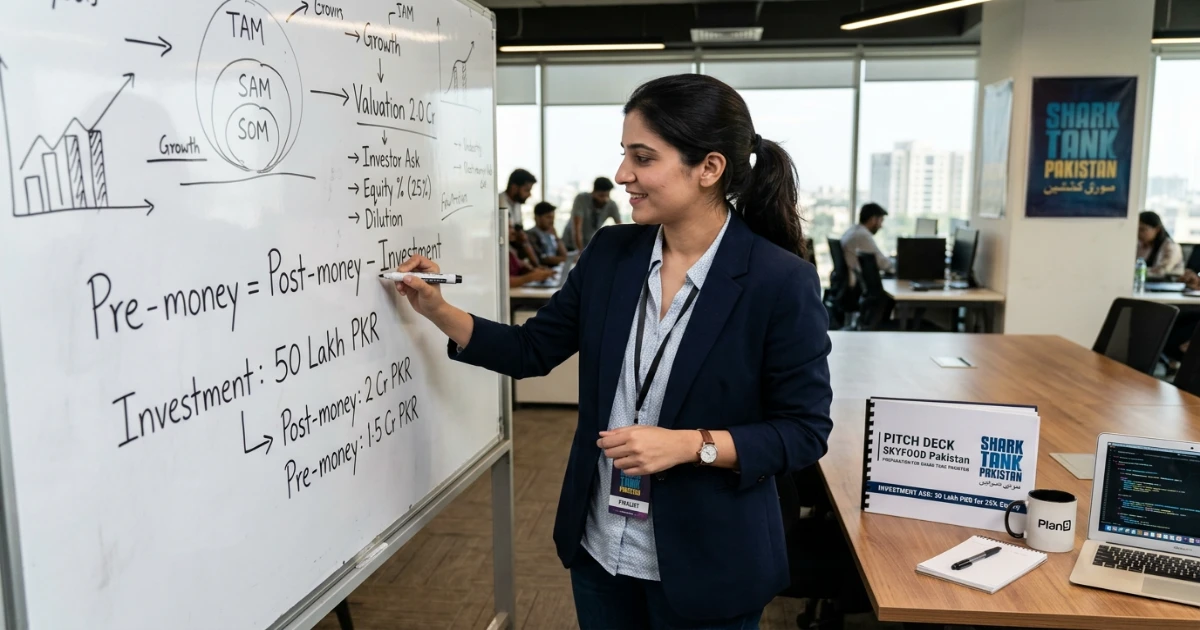
Post-money valuation = pre-money valuation + investment amount. But often the equity percentage is the anchor. If the shark gets 15% equity for Rs 3 crore, then post-money = Investment / Equity% = Rs 3 crore / 0.15 = Rs 20 crore. That means right after the deal, your company is worth Rs 20 crore.
Step 2: Extract the Pre-Money
Pre-money = Post-money – Investment = Rs 20 crore – Rs 3 crore = Rs 17 crore. This is what the shark implicitly valued your business at before they put money in.
Step 3: The Dilution Reality Check
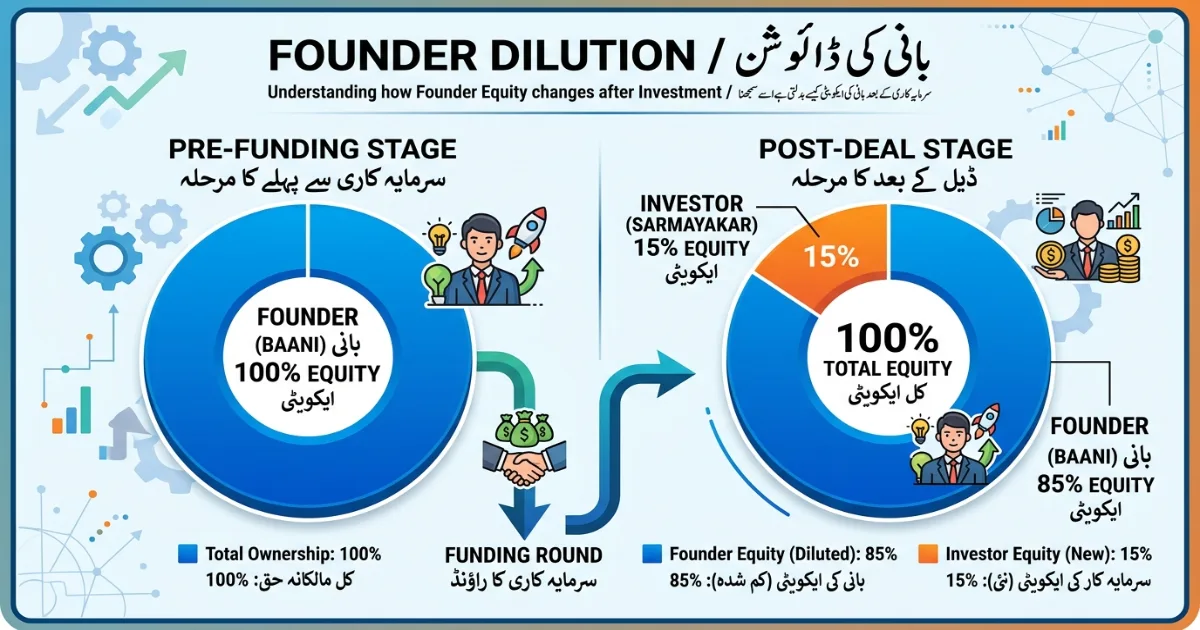
Before funding, you own 100%. After giving 15% to the investor, you own 85%. But remember: future funding rounds will dilute you further. That’s why pre-money matters — a higher pre-money means you give away less equity for the same cash. However, an inflated pre-money backfires if you can’t grow into it.
Formula cheat sheet:
- Post-money = Pre-money + Investment
- Pre-money = Post-money – Investment
- Equity% = Investment / Post-money (and also = (Post-money – Pre-money) / Post-money)
- Investment = Post-money × Equity%
Pre-Money vs Post-Money Valuation Pakistan Comparison Table
| Term | What It Tells You | When It Matters Most | Pakistani Founder Mistake |
|---|---|---|---|
| Pre-money valuation | Company worth before new cash | Negotiating equity stake, comparing offers | Quoting a pre-money number but meaning post-money |
| Post-money valuation | Company worth after investment lands | Determining investor ownership percentage | Ignoring that dilution is calculated from post-money |
| Investment amount | Cash injected by investor | Sizing the runway needed | Asking for too little and running out of cash before next milestone |
| Equity offered | Ownership sold to investor | Founder control and future dilution | Not accounting for ESOP pool expansion beforehand |
Calculate Pre-Money vs Post-Money Valuation Pakistan with the Tool
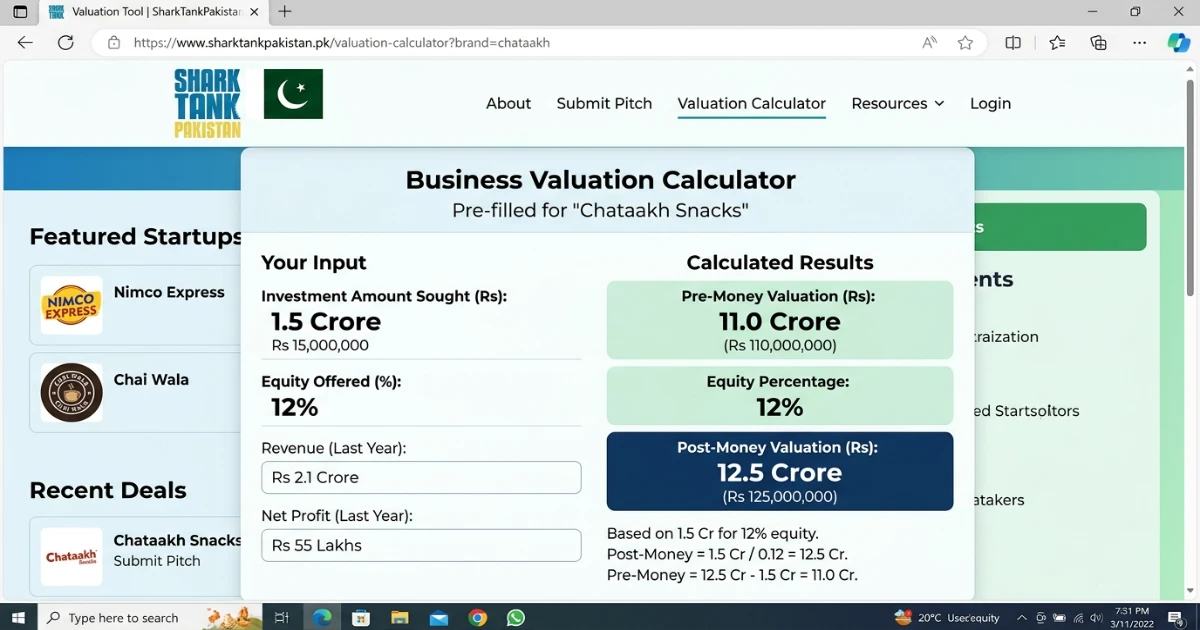
Reading formulas is one thing; modelling pre-money vs post-money valuation Pakistan with live numbers is where real intuition builds. The site’s free calculator lets you adjust the investment ask, equity offered, or pre-money valuation and instantly see how the other figures shift. Let’s run a realistic scenario for a Pakistani direct-to-consumer snack brand.
Calculator Walkthrough: ChaiWala Snacks
Imagine you’ve built a healthy snacks brand with Rs 2.8 crore in trailing revenue and Rs 45 lakh profit. You need Rs 1.5 crore to expand distribution. You’re willing to give 12% equity.
- Open the calculator (find it under the “Business Calculators” menu on SharksTankPakistan.pk).
- Enter the investment: Rs 1.5 crore.
- Enter the equity offered: 12%.
- Hit calculate.
The tool instantly shows: Post-money = Rs 12.5 crore, Pre-money = Rs 11 crore. That’s roughly 3.9x revenue — within a reasonable range for a growing FMCG brand in Pakistan. If a shark counters at 18% equity for the same money, the post-money drops to Rs 8.33 crore. Suddenly your pre-money looks less impressive. The calculator lets you model both sides in seconds.

Situation-Based Guidance: Your Stage Changes the Math
Pre-money vs post-money valuation Pakistan is not uniform across every startup stage or sector. Here is how to calibrate expectations depending on where your business stands.
If You’re Pre-Revenue or Idea Stage
Valuation here is almost entirely narrative-driven. Without revenue, sharks and angels look at team pedigree, prototype traction, market size, and comparable deals. In Pakistan, a pre-revenue tech startup might realistically pitch a pre-money between Rs 3 crore and Rs 8 crore if the team has solid experience and the market is large. Don’t pluck a Rs 20 crore number from thin air unless you have letters of intent or pilot data that de-risk the bet.
If You’re Generating Consistent Cash Flow
This is where the conversation becomes numbers-driven. Profit multiples or revenue multiples take over. For a traditional manufacturing business in Punjab, investors might pay 3–5x annual net profit. For a SaaS company with 90% margins, ARR multiples of 6–10x are defensible. Use the calculator to work backwards: what pre-money gives the shark a 5x–7x return in 5 years? In Pakistan, that return expectation often matters more than a generic multiple.
Pitching on Shark Tank Pakistan vs a Private Angel
The show adds pressure, but also brand visibility. Some founders accept a slightly lower valuation because the marketing bump alone is worth crores. A private angel won’t give you nationwide TV exposure. Factor that into your negotiation floor. On the show, be prepared to drop your valuation by 15–25% from your ideal, but never go below what you genuinely need for dilution comfort.
Common Pitfalls & When NOT to Rely on Standard Valuation Math
Even when you know the formulas, context can flip the script. Here’s where Pakistani founders stumble — and when it’s smart to ignore the textbook.
1. Forgetting the ESOP Pool Expansion
If you create or expand an employee stock option pool before the investment, it effectively lowers your pre-money valuation from the investor’s perspective. Always clarify whether the equity you’re offering the shark is on a fully diluted basis, including the ESOP.
2. Mixing Up Pakistani Rupee and Dollar Multiples
Some founders quote US SaaS multiples (like 20x ARR) without adjusting for Pakistan’s currency risk, smaller total addressable market, or higher cost of capital. A Lahore-based B2B platform might deserve a premium, but not at Silicon Valley levels. Use Pakistani comparable transactions, not just Crunchbase headlines.
3. When NOT to Obsess Over Valuation
If a shark brings distribution partnerships, regulatory expertise, or an export channel that can 10x your business, a slightly lower valuation can be a brilliant trade. Similarly, if you’re running out of cash and the alternative is shutting down, take the deal that keeps you alive — valuation ego kills companies.
4. The Post-Money Trap in Convertible Notes
With convertible notes or SAFE agreements (still rare in Pakistan but emerging), valuation caps aren’t the same as a priced round’s pre-money. Misunderstanding this can lead to unexpected dilution later. If you’re using any instrument beyond simple equity, get a local startup lawyer to model the conversion.

How This Plays Out in a Real Shark Tank Pakistan Pitch (Hypothetical, But Realistic)
Let’s reconstruct a pitch that could have happened. A Islamabad-based ed-tech platform, “IlmX,” comes in asking for Rs 2 crore for 10% equity. That sets a post-money of Rs 20 crore and pre-money of Rs 18 crore. The sharks like the product — 50,000 active learners, Rs 80 lakh in revenue, growing 20% month-over-month.
One shark counters: “I’ll give you Rs 2 crore, but for 20%.” Now the post-money drops to Rs 10 crore. The pre-money becomes Rs 8 crore. The founder panics internally — that’s less than half the original valuation. But they counter with 15% for Rs 2 crore, landing at Rs 13.33 crore post-money. Still a haircut, but the brand exposure and mentorship close the gap.
This negotiation pattern is exactly why founders should master pre-money vs post-money valuation Pakistan before entering a pitch room. The calculator helps you prepare counteroffers instantly and understand the ownership cost of every revised term.
Your Pre-Money vs Post-Money Valuation Pakistan Action Plan
- Gather your financials: revenue, profit, assets, growth rate, and any letters of intent or traction data.
- Pick a valuation method: revenue multiple, profit multiple, or comparable transactions. For pre-revenue, build a bottom-up market-sizing story.
- Open the SharksTankPakistan.pk Valuation Calculator. Plug in your ideal ask and equity range. Note the pre-money and post-money outputs.
- Stress-test negotiations: model three scenarios — your dream outcome, a realistic mid-ground, and your walk-away floor. Print them out or keep them on your phone before any meeting.
Frequently Asked Questions: Pre-Money vs Post-Money Valuation Pakistan
What is the difference between pre-money and post-money valuation?
Pre-money is the company’s worth before a funding round adds cash. Post-money is that value plus the new investment. If a shark invests Rs 2 crore for 20%, post-money is Rs 10 crore, and pre-money is Rs 8 crore.
How do I calculate pre-money valuation from the investment amount and equity stake?
First find post-money: Investment ÷ Equity% (e.g., Rs 3 crore ÷ 0.15 = Rs 20 crore). Then subtract the investment: Rs 20 crore – Rs 3 crore = Rs 17 crore pre-money.
What valuation multiple should Pakistani startups use?
It depends on the sector. Tech/SaaS with recurring revenue might use 5–10x ARR, while traditional FMCG or manufacturing often sees 2–4x annual net profit. Pre-revenue startups rely on comparable deals and team strength.
Do sharks on Shark Tank Pakistan use pre-money or post-money when negotiating?
They almost always talk in terms of post-money, because it directly gives them the equity percentage. A founder quoting a high pre-money might inadvertently promise a bigger stake than intended if the maths isn’t clarified.
Is a higher valuation always better for my startup?
Not always. A very high pre-money sets expectations for rapid growth. If you can’t hit those numbers by the next round, you risk a down round, which hurts morale and founder ownership. Sometimes a fair, grounded valuation builds trust.
Can I negotiate valuation after receiving a shark’s offer?
Absolutely. Most deals on Shark Tank Pakistan involve counteroffers. Know your walk-away equity limit beforehand. Use the calculator to instantly see what raising your valuation does to the equity offer.
Where can I find a reliable pre-money vs post-money calculator for Pakistan?
SharksTankPakistan.pk provides a free, dedicated startup valuation calculator that factors in investment, equity, and valuation in PKR. It’s built with Pakistani deal structures in mind.
⚡ Your Fast-Track Cheat Sheet: Top 3 Actions
1. Always anchor to post-money: When you say “my company is worth Rs X crore,” clarify whether that’s before or after the investment. Sharks think post-money, so you should too.
2. Run the real numbers now: Use the SharksTankPakistan.pk Valuation Calculator to model your ask. Tweak the equity slider and see how your pre-money shifts. That muscle memory will save you in the pitch room.
3. Build a negotiation range, not a single number: Prepare your dream valuation, your realistic middle, and the absolute floor below which you walk away. Write them down. Refer to them when adrenaline hits.