
EdTech Business Pakistan: Where to Build a Successful Education Startup in 2026
⚡ The Short Answer: The most profitable EdTech business Pakistan opportunities right now sit where mass accessibility collides with verified outcomes — affordable K-12 supplementary learning, skills-based certification for 18-to-30-year-olds, and vernacular-first digital tools that work on low-bandwidth mobile connections. The winners won’t be generic course marketplaces. They’ll be niche platforms that solve one painful, specific problem for a clearly defined Pakistani audience — and prove their impact with data.
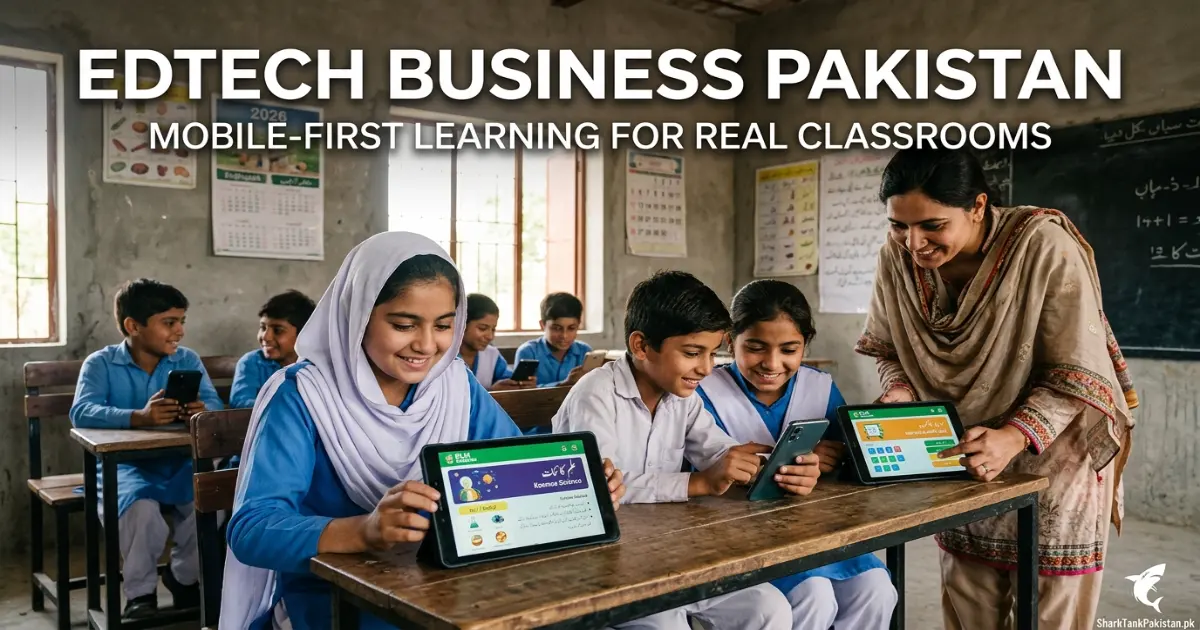
Pakistan’s education system is stretched so thin that opportunity lives in every crack. Over 22 million children are out of school. Those who are enrolled often sit in overcrowded classrooms where one teacher manages 45 students. At the same time, smartphone penetration has crossed 85 million users, and 4G coverage now blankets tier-2 and tier-3 cities that barely had reliable internet five years ago. The gap between what the formal system delivers and what families actually need has never been wider — and that gap is precisely where an EdTech business Pakistan entrepreneurs build today can scale into something genuinely transformative.
But here’s what most aspiring founders get wrong: they assume EdTech means building yet another tutoring marketplace or a generic video-course library. That playbook was tired in 2021. In 2026, the opportunity is sharper. It’s in micro-credentialing for freelancers, hybrid models that blend physical touchpoints with digital delivery, and tools that solve uniquely Pakistani friction — like Urdu-English code-switching, offline-first learning for areas with patchy electricity, and payment models that work for households earning Rs 60,000 a month.
If you’re reading this, you’re probably sizing up whether EdTech is the right sector for your next venture — or you’re actively shaping an idea and want to know which niches actually have room to grow. You might also be thinking about how a pitch for an EdTech business Pakistan would land on Shark Tank Pakistan. What would the sharks ask? What traction would they demand? That lens — investor-readiness — runs through everything that follows.
The Education Crisis That Creates Billion-Rupee Opportunities
Let’s get the uncomfortable numbers out of the way first — because these aren’t just statistics, they’re demand signals. Pakistan spends less than 2.5% of its GDP on education. Learning poverty — the share of 10-year-olds who cannot read a simple text — hovers above 70% in rural areas. The teacher shortage runs into the hundreds of thousands. And yet, Pakistani families spend an estimated $5–7 billion annually on out-of-school education: private tuition, academy fees, test-prep centres, and, increasingly, digital subscriptions.
This disconnect — a collapsing public system alongside fierce household willingness to pay for alternatives — is the engine behind every successful EdTech business Pakistan has produced so far. Names like SABAQ, Taleemabad, Knowledge Platform, and Noon Academy (which started in the region) proved that digital-first education doesn’t need to wait for government reform. It can go directly to parents and students.
But the landscape has matured. Early players burned cash chasing user growth without unit economics. Some collapsed. Others pivoted hard into B2B — selling to schools and corporate training departments instead of relying on fickle consumer subscriptions. The lesson for anyone entering now: distribution matters more than content. Anyone can record lessons. The hard part is getting them into the hands of the right users, consistently, at a cost that makes the math work.
Why 2026 Is Different — and Better — for EdTech Founders
Three structural shifts have changed the game since the 2020–2022 EdTech boom-and-correction cycle:
- Mobile data costs have plummeted. Pakistani users now consume more mobile data per capita than ever — and at some of the lowest per-GB rates in the world. An EdTech product that runs smoothly on a Rs 25,000 Android phone with a patchy 3G connection is now technically feasible.
- Digital payments are no longer a blocker. JazzCash and Easypaisa handle billions in monthly transactions. A mother in Gujranwala can pay Rs 499/month for her child’s learning app without touching a bank account.
- Employers now accept alternative credentials. The stigma around online certifications has cratered. Pakistani freelancers on Upwork and Fiverr routinely win contracts based on Coursera and niche platform certificates. An EdTech business that issues verifiable, employer-recognized credentials can charge premium prices.
Where the Real Money Is: 6 EdTech Niches Ready to Scale in Pakistan
Not all EdTech segments are created equal. Some are overcrowded. Others are too niche to ever reach venture scale. The sweet spot — big enough to matter, specific enough to defend — sits in these six spaces right now:
1. K-12 Supplementary Learning (Urdu + Provincial Language Layers)
The dominant opportunity. Parents in Pakistan’s middle class — roughly 40 million households — are obsessed with their children’s academic performance. They already pay for tuition centres. A well-designed digital alternative that maps to the Punjab, Sindh, and Federal Board curricula, offers practice tests, and sends weekly progress reports to parents’ WhatsApp can command Rs 800–1,500/month. The key differentiator: vernacular depth. Most existing platforms default to English-heavy content, alienating the majority of students who think and learn better in Urdu or their regional language.
2. Freelancer Upskilling & Micro-Credentialing
Pakistan is the world’s fourth-largest freelance workforce. Every year, hundreds of thousands of young Pakistanis create Upwork and Fiverr profiles — and most fail to land their first client because they lack verified, in-demand skills. A platform that offers short, intensive courses in web development, graphic design, AI-assisted content creation, and virtual assistance — then issues a blockchain-verifiable certificate that freelancers can attach to their profiles — solves a painful, urgent problem. Pricing works here because the ROI is immediate: one decent freelance gig pays for a year of learning.
3. Exam Prep for CSS, MDCAT, ECAT, and NTS
Pakistan’s competitive exam economy is massive and emotionally charged. Families spend lakhs on preparation academies in Lahore, Karachi, and Islamabad. A digital-first alternative with adaptive testing, past-paper analytics, and live doubt-clearing sessions can undercut physical academies by 60–70% while serving students in cities like Rahim Yar Khan and Dera Ismail Khan who currently have zero access to quality prep. The model here is freemium with high-conversion paid tiers — free daily quizzes, paid full-length mock tests and mentorship.
4. Teacher Professional Development (B2B)
Pakistan has roughly 1.7 million teachers. The majority in government schools receive inadequate training. Private school chains like Beaconhouse and The City School invest in PD, but smaller private schools — which educate the bulk of urban students — have nothing. A B2B platform that sells bite-sized, Urdu-friendly teacher training modules to school owners on a per-teacher, per-month basis taps into a recurring revenue stream that consumer EdTech can only dream of. Sell to 200 schools with 20 teachers each, and you’ve got 4,000 seats at Rs 400/month — Rs 1.6 million in monthly recurring revenue.
5. Special Needs & Inclusive Education Tech
Wildly underserved. Parents of children with dyslexia, ADHD, autism, or speech delays in Pakistan face a brutal shortage of specialists and almost no digital tools in local languages. An app offering speech therapy exercises in Urdu, or a platform connecting parents with remote special educators for one-on-one sessions, enters a market with near-zero competition and intense, emotionally driven willingness to pay. This is a smaller total addressable market but one where you can build a loyal, defensible business without fighting for attention in a crowded niche.
6. Corporate & SME Training (B2B EdTech)
Pakistani companies are waking up to the need for structured employee upskilling — especially in AI literacy, data analytics, and soft skills. Banks, telecoms, and manufacturing firms have L&D budgets that go underutilized because they lack locally relevant, cost-effective training partners. A platform offering Urdu/English blended corporate training with measurable outcomes can close enterprise deals worth Rs 2–10 million annually per client. This is the least “sexy” EdTech niche — and potentially the most profitable.
| EdTech Niche | Target User | Revenue Model | Scalability | Competition Level |
|---|---|---|---|---|
| K-12 Supplementary (Vernacular) | Parents of school-age children | Subscription (Rs 800–1,500/mo) | ⭐⭐⭐⭐⭐ | Medium – few strong vernacular players |
| Freelancer Upskilling | 18–30-year-old aspiring freelancers | Course fees + certificate upsells | ⭐⭐⭐⭐ | Medium-High – global platforms compete |
| Exam Prep (CSS/MDCAT/ECAT) | Students aged 16–25 | Freemium + paid mock tests | ⭐⭐⭐⭐ | High – fragmented but many local players |
| Teacher PD (B2B) | School owners & administrators | Per-teacher/month SaaS | ⭐⭐⭐ | Low – wide open for early movers |
| Special Needs EdTech | Parents of neurodivergent children | Subscription + teletherapy fees | ⭐⭐⭐ | Very Low – almost no digital competitors |
| Corporate/SME Training | HR/L&D departments | Annual contracts (Rs 2–10M+) | ⭐⭐⭐ | Low-Medium – few localized providers |
💡 Insider Insight from Shark Tank Pakistan: If you pitch an EdTech business on Shark Tank Pakistan, expect the sharks to zero in on two numbers: customer acquisition cost (CAC) and lifetime value (LTV). Pakistani sharks — many of whom have built consumer businesses from scratch — know that the biggest EdTech killer is spending Rs 3,000 to acquire a customer who pays Rs 1,500 once and never returns. Come armed with retention data, not just download numbers. A 90-day active user rate above 40% speaks louder than any revenue projection.

The EdTech Founder’s Playbook: How to Build Right from Day One
Most Pakistani EdTech startups fail before they’ve built anything worth failing. They spend six months perfecting an app, launch to crickets, and wonder why “the market wasn’t ready.” The market is ready. The approach usually isn’t. Here’s a five-step framework that separates the ones who figure it out from the ones who burn out:
Step 1: Pick One Pain Point and Become Obsessive About It
Do not build “a platform for learning.” Build “a way for FSc students in Sargodha to practice MDCAT biology MCQs with instant explanations in Urdu.” Specificity is your moat. The narrower your starting point, the easier it is to design a product that actually works, market it with precision, and charge a meaningful price. Generalists get ignored. Specialists get recommended.
Step 2: Validate with a Manual, Offline Prototype
Before you write a single line of code, run a WhatsApp group or a small in-person cohort. Teach 20 students manually. Gather feedback. Figure out what they actually pay attention to versus what they ignore. The insights from a scrappy, manual pilot will save you from building features nobody needs. One Lahore-based founder I know delivered MDCAT prep entirely through WhatsApp voice notes for three months before building her app — and she had 400 paying users before launch day.
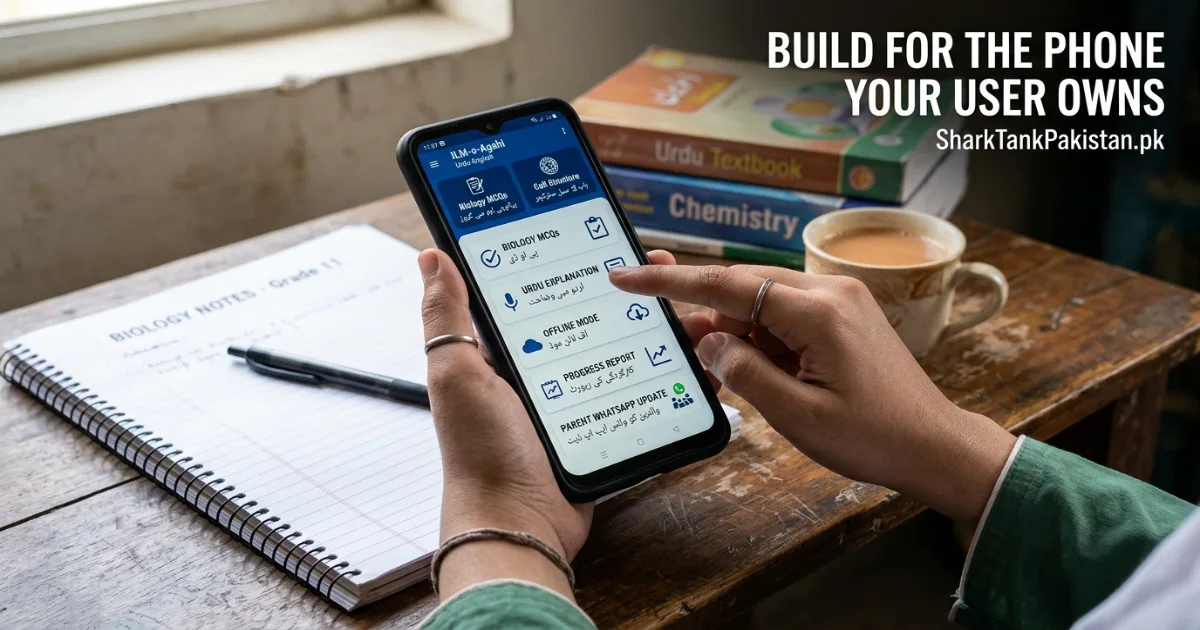
Step 3: Design for the Cheapest Android Phone on a Weak Connection
Your app must work on a phone with 2GB RAM, 16GB storage, and a fluctuating 3G signal. Offline mode is not optional — it’s table stakes. Keep video sizes small. Compress everything. Test on actual low-end devices, not just your flagship phone. If it takes more than 4 seconds to load a lesson on a Rs 22,000 phone, your churn rate will reflect that.
Step 4: Build a WhatsApp-First Distribution Engine
Pakistan runs on WhatsApp. Mothers share homework help in WhatsApp groups. Teachers send assignments. Students trade notes. Your growth strategy should treat WhatsApp as a first-class distribution channel — think shareable progress reports, referral incentives delivered via WhatsApp, and content snippets designed to be forwarded. A well-crafted, shareable weekly progress PDF that parents proudly forward to relatives is one of the cheapest acquisition tools in Pakistani EdTech.
Step 5: Monetize on Outcomes, Not Access
The era of “pay to unlock the next video” is ending. Users expect core content to be accessible. They’ll pay when your platform demonstrably improves results — higher grades, a passed exam, a landed freelance gig. Design your monetization around premium feedback, personalized coaching, verified credentials, and outcome guarantees. If a student passes their MDCAT after using your platform, they’ll pay you five times what they’d pay a generic video library.
📊 Data Point: What Pakistani EdTech Users Actually Pay
Based on surveys of active users across multiple Pakistani EdTech platforms, the median monthly willingness-to-pay for a supplementary learning app is Rs 700–1,200 for K-12 products and Rs 1,500–3,000 for career-upgrading courses. One-time course purchases for freelancing skills reliably convert at Rs 4,000–12,000. Anything above Rs 15,000 requires a strong brand or verified placement track record.
Situation-Based Adjustments: How Your Playbook Changes
The advice above isn’t one-size-fits-all. Your strategy should shift based on your context. Here’s how:
If You’re Bootstrapped and Pre-Revenue
Ignore the “scale fast” playbook. Your only job is to get 50 paying users at a price that covers your costs. Run manual cohorts. Use Google Forms and WhatsApp. Charge Rs 500/month for a live weekly Zoom session. Prove that someone, somewhere, will pay for what you’re offering. Until you have those 50 users, do not spend a rupee on ads, branding, or app development. Cash-first validation beats deck-first fundraising every time.
If You’re Funded or Have Runway
You can afford to invest in platform development earlier — but guard against the temptation to overbuild. Even with funding, launch with a minimum viable product within 8 weeks. Use the extra resources to run parallel experiments: test two pricing tiers, two different messaging angles, two different user onboarding flows. Funded founders have the luxury of learning faster, not of skipping the learning.
If You’re B2C (Selling to Parents or Students)
Trust is everything. Pakistani parents are skeptical of digital products that claim to improve their child’s grades. Overcome this with visible social proof: testimonials from recognizable local figures (school principals, known teachers), before/after grade improvements, and a generous free tier that lets them experience value before paying. Your first 1,000 users will come from word-of-mouth, not ads. Invest in making those early users so happy they become evangelists.
If You’re B2B (Selling to Schools or Companies)
Decision cycles are long. A school owner might take 3–6 months to sign a contract. Budget accordingly. Build relationships with school associations and education officers. Offer a free pilot to 5 schools in exchange for testimonials and case studies. The B2B EdTech sales playbook in Pakistan is relationship-first, proof-second, pricing-third. If you walk into a meeting with a generic pitch deck and no local references, expect a polite “we’ll get back to you” followed by silence.
Common Pitfalls & When to Ignore This Advice
Every EdTech opportunity article paints a rosy picture. Here’s where the paint cracks — and when you should consciously disregard what I’ve written above.
Pitfall 1: Assuming “digital” means “cheaper to deliver.” Digital delivery reduces some costs, but customer support, content updates, server infrastructure, and — most painfully — user acquisition all scale with complexity. An EdTech business with 10,000 free users and 200 paying ones can haemorrhage cash on support tickets alone. Plan your support costs before you plan your revenue.
Pitfall 2: Targeting “everyone.” Founders routinely say their product is for “all students in Pakistan.” That’s 50 million people. You cannot serve them all. You cannot market to them all. The broader your target, the vaguer your messaging, the weaker your conversion. Pick a specific city, grade level, or exam. Dominate it. Then expand.
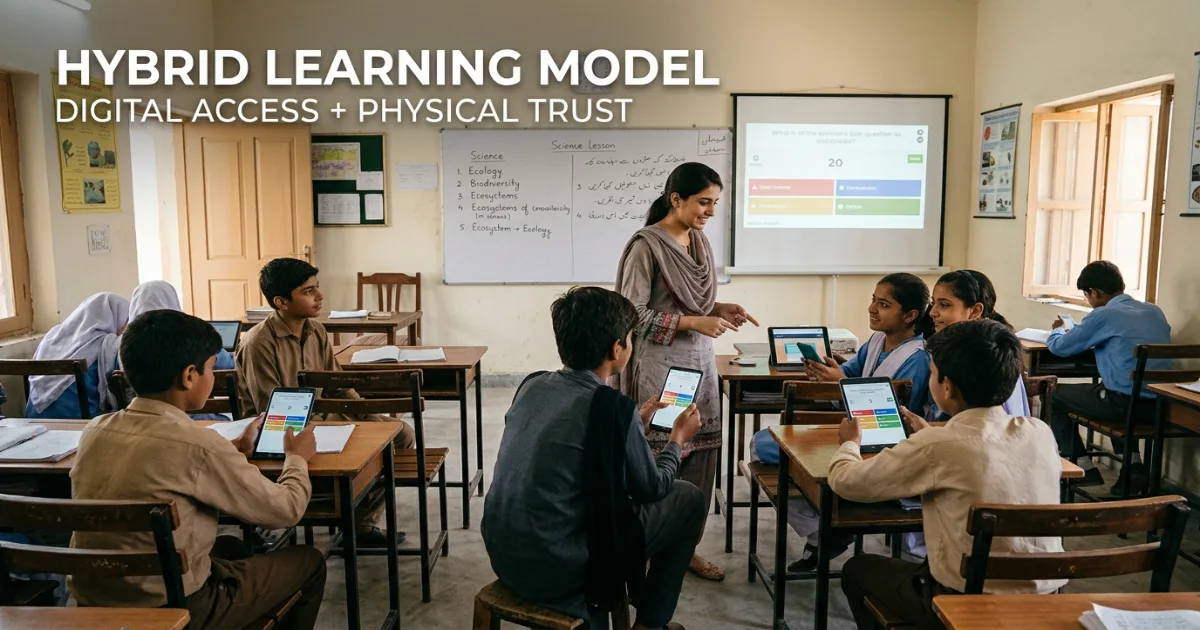
Pitfall 3: Ignoring the offline-online hybrid reality. Pakistan’s most successful education businesses — like the tutoring centre chains — are physical-first. Pure digital plays still struggle with trust and retention. Consider a hybrid model: digital content paired with monthly in-person workshops, or an app that complements (not replaces) a student’s existing tuition centre. The future of Pakistani EdTech is blended, not purely virtual.
When to ignore this article’s advice: If you have a genuinely novel model — perhaps AI-driven adaptive tutoring that personalizes every lesson, or a hardware-plus-software bundle for schools — some of the “start small, validate manually” guidance may slow you down. Deep-tech EdTech plays require upfront R&D investment. Similarly, if you’re targeting the Pakistani diaspora (e.g., Urdu language learning for overseas Pakistanis’ children), the distribution channels and pricing psychology are completely different. Adjust accordingly.
How SharkTankPakistan.pk Tools Help EdTech Founders
If you’re building an EdTech business Pakistan and planning to raise funding — whether from sharks, angels, or VCs — the calculators on SharkTankPakistan.pk are more than just widgets. They force you to confront the numbers that investors will interrogate.
Open the Startup Valuation Calculator. Plug in your current monthly revenue, your growth rate, and your ask. The output will show you whether your valuation expectations are realistic — or whether you’re about to walk into a pitch room and ask for Rs 2 crore against 5% equity when the math says your business is worth Rs 4 crore total. That disconnect kills deals instantly.
Use the Equity vs Loan Calculator to model different funding scenarios. If you’re generating steady cash flow from school contracts or consumer subscriptions, debt might be cheaper than dilution. If you’re pre-revenue and need growth capital, equity is likely your only path — but the calculator shows you exactly how much of your company you’re giving up over time.
These aren’t theoretical exercises. Pakistani sharks and investors are numerically literate. They’ve seen hundreds of pitches. They can spot an inflated valuation in seconds. Walking in with calculator-backed, defensible numbers signals that you’re serious.
🧠 Try It Yourself: Go to the SharkTankPakistan.pk Valuation Calculator right now. Enter your EdTech startup’s projected Year 1 revenue and see what a reasonable pre-money valuation looks like. You might be surprised — and that surprise could save your pitch.
A Real-World Example: What a Pakistani EdTech Winner Looks Like
Consider a hypothetical but realistic case — let’s call it “ParhoSmart” — that mirrors what successful founders in this space have actually done. ParhoSmart started as a WhatsApp group for MDCAT prep in Faisalabad. The founder, a former medical student, posted daily biology quizzes. Within four months, the group had 800 members. She began charging Rs 600/month for access to a private group with detailed answer explanations and weekly live doubt-clearing Zoom calls. At 300 paying members, she was generating Rs 180,000/month — with zero ad spend.
She then built a lightweight Android app that automated quiz delivery and added a leaderboard. Retention improved because students could see their ranking. She expanded to ECAT and CSS prep. After 18 months, she had 1,400 paying subscribers across three exam categories, generating Rs 8.4 lakh/month. When she pitched investors — including a Shark Tank Pakistan-style panel — her numbers told a clean story: CAC under Rs 200 (all organic via WhatsApp and student referrals), monthly churn below 6%, and a clear path to 5,000 subscribers. She raised Rs 3.5 crore at a Rs 18 crore valuation. The sharks didn’t ask about her “vision.” They asked about retention. She had the data.
That’s the template. Not a flashy launch. Not a bloated app. A tight, validated, numbers-backed EdTech business Pakistan founders can replicate across niches.

❓ Frequently Asked Questions About EdTech in Pakistan
Do I need a registered company to launch an EdTech business in Pakistan?
Not on day one. You can start as a sole proprietor, test your idea manually, and generate revenue. But before you take outside funding, sign contracts with schools, or issue formal certificates, register with SECP — typically as a Private Limited Company. It protects you personally and makes your business fundable.
What’s the biggest mistake first-time EdTech founders make in Pakistan?
Building too much before validating. Founders spend months perfecting an app with polished video content, only to discover that their target users wanted something simpler and cheaper. Validate with a manual prototype first — WhatsApp groups, Google Forms, live Zoom sessions. Code comes after proof of demand.
How much equity do investors typically take in a Pakistani EdTech startup?
For seed-stage EdTech startups in Pakistan, investors typically take 10–25% equity depending on traction. Pre-revenue with just an MVP, expect to give up 18–25%. With 12+ months of consistent revenue and growth, you can negotiate down to 10–15%. Shark Tank Pakistan deals often cluster around the 15–25% range for early-stage education ventures.
Is B2C or B2B better for an EdTech business Pakistan launch?
B2C is easier to start — you can reach parents and students directly through WhatsApp and social media. But B2B (selling to schools) offers more predictable recurring revenue and higher contract values. Many successful founders start B2C to build a user base and brand, then layer in B2B once they have credibility.
What regulatory approvals does an EdTech business need in Pakistan?
For most EdTech niches, no specific education board approval is required to operate a learning platform. However, if you issue formal diplomas or degrees, you may fall under HEC or provincial board regulations. For K-12 supplementary content, aligning your curriculum to the national or provincial board standards is a trust signal — not a legal requirement, but a powerful marketing advantage.
Can I pitch an EdTech business on Shark Tank Pakistan without any revenue?
You can — but you shouldn’t. Sharks on Shark Tank Pakistan, like investors anywhere, are far more likely to invest when you have traction. Revenue, even modest revenue from 50–100 paying users, changes the conversation from “interesting idea” to “proven demand.” If you’re pre-revenue, at minimum bring a live product with strong user engagement metrics and a clear monetization plan.
What tech stack works best for a Pakistani EdTech app targeting low-end devices?
Lightweight progressive web apps (PWAs) often outperform native apps for Pakistani audiences on budget devices. They use less storage, load faster on weak connections, and work offline. If you build native, optimize aggressively — compress assets, minimize API calls, and test on a Rs 20,000–25,000 Android phone with 2GB RAM. React Native or Flutter can work, but only if you prioritize performance over feature bloat.
🚀 Your Fast-Track Cheat Sheet: Top 3 Actions to Take
- Pick one narrow niche from the six listed above and run a manual pilot within the next 30 days. Use WhatsApp, Google Forms, and live sessions. Get 20–50 paying users before you build anything. Revenue now beats a perfect app later.
- Run your projected numbers through the SharkTankPakistan.pk Valuation and Equity vs Loan Calculators. Know your realistic valuation range and how much dilution each funding path creates. Walk into every investor conversation with these figures memorized.
- Design your entire product experience for the median Pakistani user — a student on a budget Android phone with intermittent internet. Offline mode, compressed content, Urdu/vernacular interface options, and WhatsApp-based distribution are not nice-to-haves. They are the difference between a business that survives and one that never finds product-market fit.