How the Gaming Industry is Growing in Pakistan and How to Invest
⚡ The Short Answer: The gaming industry in Pakistan is expanding at a compound annual rate exceeding 18%, driven by 200+ million mobile connections, a young demographic (median age 22), and a fast-growing esports scene. The most accessible entry points for investors are equity stakes in game development studios, esports team sponsorships, and publishing partnerships — but the highest-upside opportunities currently sit with studios building original IP for the global mobile market.
If someone told you five years ago that a Karachi-based gaming studio would raise six-figure funding from international VCs, or that a Lahore esports team would fill an arena for a PUBG Mobile final, you might have raised an eyebrow. Today, it’s not speculation — it’s the new normal. The gaming industry Pakistan narrative has shifted from “nascent potential” to “accelerating reality,” and the numbers are starting to speak loudly enough that even cautious investors are paying attention.
But here’s the nuance most headlines skip: Pakistan’s gaming boom isn’t following the same trajectory as Silicon Valley, Seoul, or even Bangalore. It has its own shape, its own bottlenecks, and its own specific pockets of value. If you’re reading this as an investor, a founder building a gaming startup, or someone preparing a pitch that might one day land on Shark Tank Pakistan, understanding that shape is everything. Generic advice about “investing in gaming” won’t cut it — you need the local playbook.
This guide walks you through exactly what’s happening in Pakistan’s gaming sector, where the real investment opportunities sit, how to evaluate them with clear-eyed pragmatism, and which mistakes keep tripping up smart people who should know better. We’ll pull in lessons from startup pitches, valuation dynamics familiar to any Shark Tank Pakistan viewer, and the tools you can use right now to sharpen your decision-making.
Why the Pakistani Gaming Market Is Turning Heads Right Now
Let’s anchor this in numbers that actually mean something for an investor. Pakistan currently has over 200 million mobile subscribers and more than 120 million broadband users, according to PTA data. Smartphone penetration crossed 55% in 2025 and continues climbing. When you layer on a population where nearly 64% is under 30, you get one of the world’s largest addressable gaming audiences that has barely been monetized.
Mobile gaming dominates — and that’s not a weakness, it’s an advantage. Unlike markets that need expensive console or PC ecosystems to grow, Pakistan leapfrogged straight to mobile. Games like PUBG Mobile, Free Fire, and locally developed titles routinely clock millions of active users. A single hit game from a Pakistani studio can reach a global audience through the App Store and Google Play without building domestic distribution infrastructure.
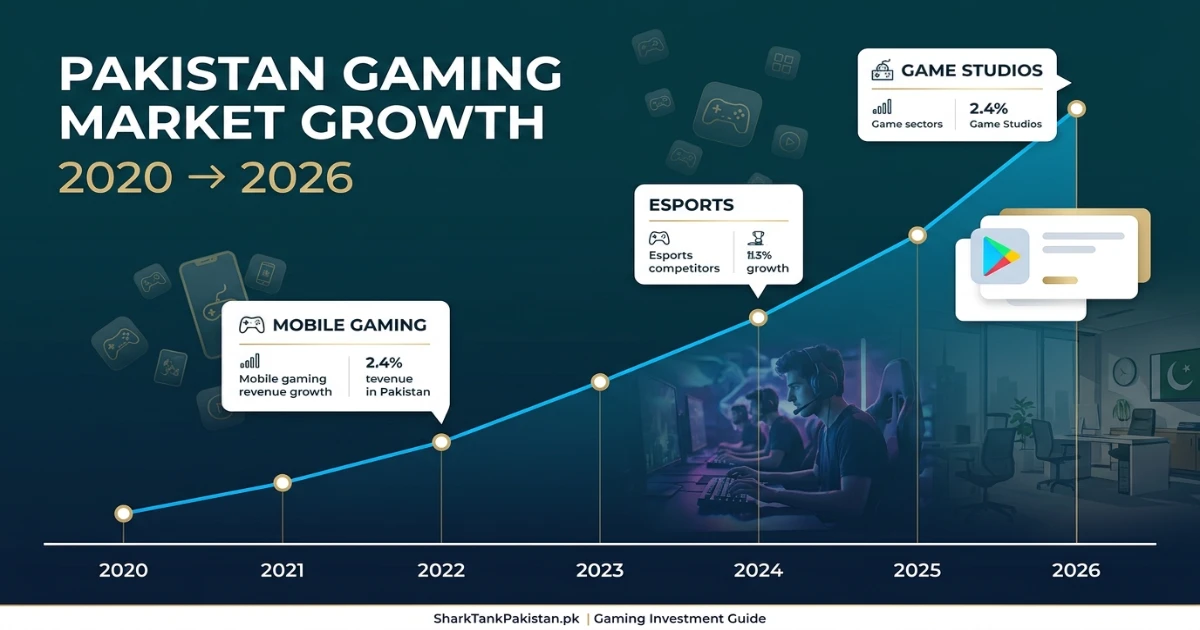
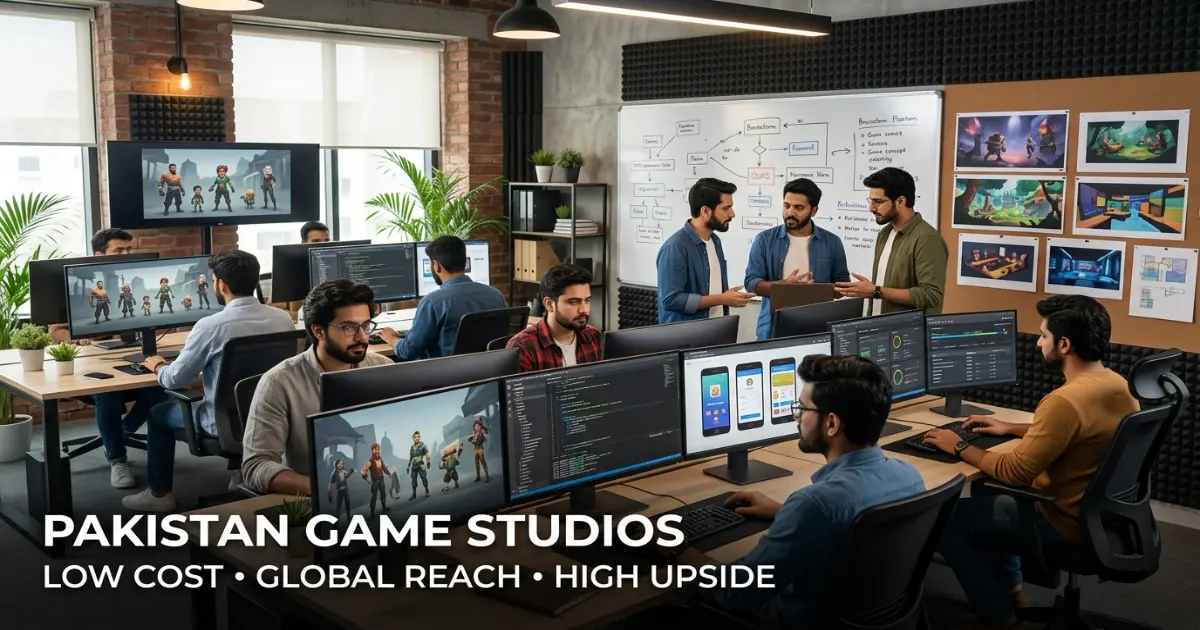
But there’s a second layer most analysts miss: Pakistan isn’t just a consumer market — it’s becoming a production hub. Studios like Mindstorm Studios (acquired by a global publisher), WeRPlay, Gamestorm, and Frag Games are shipping titles that compete internationally. Development costs in Pakistan run at a fraction of North American or European equivalents — think 60% to 80% lower for comparable talent — while the quality gap is closing fast. For an investor, that cost arbitrage translates directly into longer runway per dollar deployed.
💡 Insider Insight from Shark Tank Pakistan: The “cost arbitrage plus global distribution” pitch is one sharks listen to closely. When a gaming founder can demonstrate that their burn rate is one-third of a comparable Silicon Valley studio but their App Store reach is identical, the valuation math shifts dramatically in their favor. Several sharks have publicly noted they’re actively watching the gaming and interactive entertainment space for precisely this reason.
The Four Investment Avenues That Actually Exist in Pakistan
Not all “gaming investments” are created equal. Confusing a studio equity play with an esports sponsorship is like confusing a fintech SaaS startup with a payment processing franchise — they share a thematic label but operate on completely different economics. Here are the four real paths:
1. Game Development Studio Equity
This is the purest startup-style investment. You take an ownership stake in a studio building original games or doing work-for-hire for global publishers. Revenue models include in-app purchases, ad monetization, premium sales, and publishing advances. The exit path is typically acquisition by a larger publisher or a strategic buyer. Studios with original IP command higher multiples.
2. Esports Team Sponsorship and Ownership
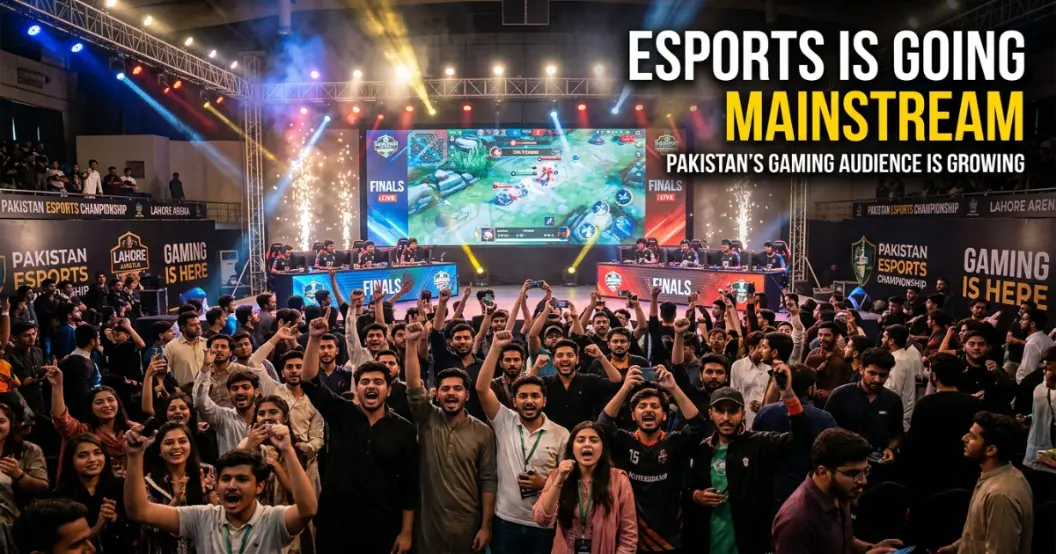
Pakistan’s esports scene — particularly around PUBG Mobile, CS:GO, and Valorant — has exploded. Teams like Team Bablu, iQOO Soul, and various university-backed squads compete regionally and globally. Investment here looks more like sports franchise ownership: you fund operations, player salaries, and tournament travel in exchange for prize pool shares, sponsorship revenue, and brand equity. Returns are tied to sustained competitive performance and audience growth.
3. Publishing and Distribution Partnerships
Some investors enter as publishing partners — providing marketing, localization, and user acquisition funding for games built by Pakistani studios in exchange for a revenue share. This is lower-risk than pure equity because you’re backing a specific title with measurable unit economics rather than betting on the studio’s long-term survival.
4. Gaming Infrastructure and Platform Plays
This is the least crowded lane. Pakistan still lacks robust local gaming infrastructure — payment gateways optimized for in-game purchases, local cloud gaming servers, tournament platforms with Urdu-language support, and gaming-focused content networks. Building or backing infrastructure creates a toll-booth position in a growing ecosystem.
| Investment Type | Typical Entry Capital | Return Horizon | Risk Profile | Best For |
|---|---|---|---|---|
| Studio Equity | $25,000–$300,000 | 4–7 years | High (hit-driven) | Angel investors, VCs comfortable with startup risk |
| Esports Sponsorship | $5,000–$80,000/year | 1–3 years | Moderate | Brands, high-net-worth individuals, corporate marketing budgets |
| Publishing Partnership | $15,000–$150,000 per title | 6 months–2 years | Moderate-Low | Investors wanting faster feedback loops |
| Infrastructure / Platform | $50,000–$500,000+ | 3–6 years | Moderate-High | Strategic investors, operators with domain experience |
How to Evaluate a Gaming Investment in Pakistan
This is where most newcomers get lost. They apply generic startup evaluation frameworks — TAM slides, revenue multiples, competitor matrices — and miss the metrics that actually predict success in gaming. A game studio is not a SaaS company, and treating it like one leads to expensive misjudgments.
Here’s the framework that seasoned gaming investors in the region are using:
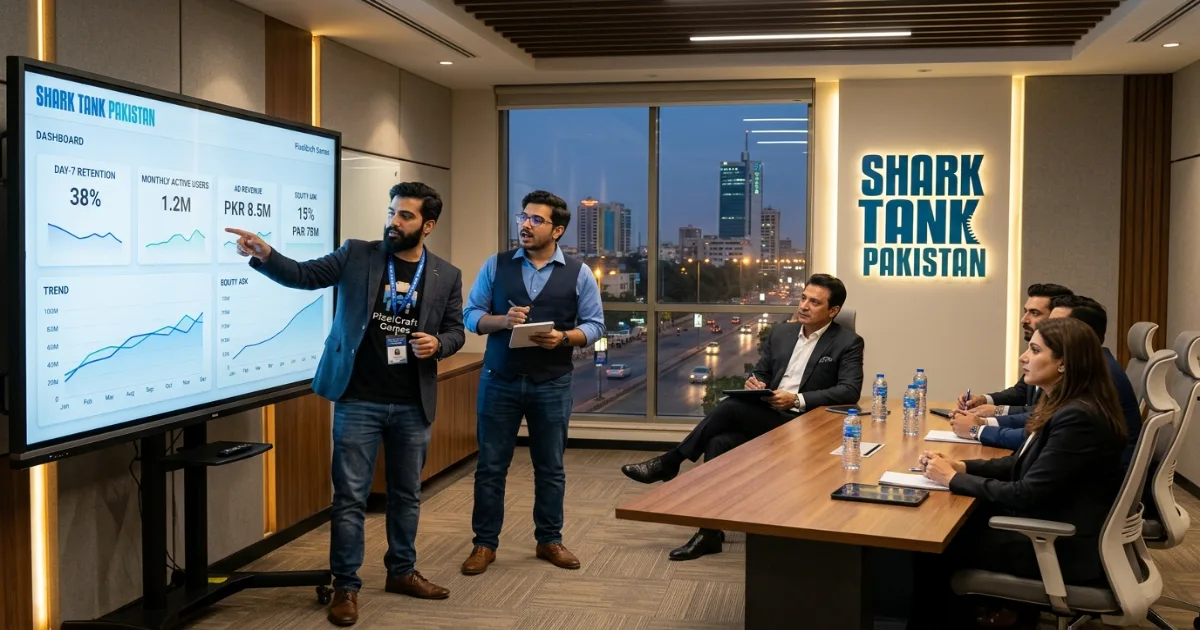
- Check retention before revenue. Day-1, Day-7, and Day-30 retention rates reveal whether players actually want the product. A studio with modest revenue but 35%+ Day-7 retention is far more investable than one with decent sales and 8% retention. Revenue can be fixed with monetization tuning; retention problems usually mean the core game isn’t fun.
- Look at the team’s production track record, not just ideas. Has the team shipped anything? Even a small title on the Play Store that got 50,000 organic downloads tells you more than a polished pitch deck. Pakistan has plenty of “idea founders” — fewer who’ve navigated Apple’s app review process, pushed a live update, and responded to player reviews at 2 AM.
- Understand the platform risk. A studio building exclusively for a single platform (especially one dependent on a single publisher’s ad network) carries concentration risk. The strongest Pakistani studios diversify across iOS, Android, and sometimes Steam.
- Assess whether the IP travels. Does the game concept work across cultures, or is it tightly coupled to local references? Local flavor can be a strength, but for investors seeking global-scale returns, the math favors culturally universal themes with local production cost advantages.
📊 Data Point: According to industry estimates, the average seed-stage valuation for a Pakistani game studio with a shipped title and 100,000+ downloads currently ranges between $400,000 and $1.2 million. Studios pre-launch with only a prototype are typically valued between $150,000 and $350,000. These figures are significantly lower than comparable US or European studios, reflecting both the cost advantage and the perceived market risk discount that savvy investors can exploit.
Situation-Based Advice: Which Path Fits Your Profile?
The right move depends entirely on who you are as an investor or founder. Here’s how the guidance shifts:
If you’re a first-time angel investor with $10,000–$30,000 to deploy…
Don’t try to lead a studio equity round. Your sweet spot is publishing partnerships or joining a syndicate with an experienced lead investor who handles due diligence. Alternatively, esports team sponsorships at the regional tournament level let you learn the ecosystem without betting on a single product’s commercial success. Think of this as your “learning capital” phase — expect education, not outsized returns, in the first 18 months.
If you’re an institutional investor or family office looking to place $100,000+…
Studio equity is your primary vehicle, but only with proper due diligence. At this check size, you should be looking for teams with at least one shipped title, verifiable retention metrics, and a clear monetization roadmap. Insist on board observation rights or at minimum quarterly operational reviews. The Pakistani gaming sector still lacks standardized reporting norms — you’ll need to define the KPIs you track rather than accepting whatever the founder presents.
If you’re a gaming founder preparing to raise…
Your investor deck needs to lead with retention data, not market size slides. Every shark and angel investor in Pakistan has seen the “200 million mobile users” statistic. What they haven’t seen is your Day-30 retention curve. Lead with product traction. If you’re pre-launch, lead with your team’s shipped-title history and a playable prototype. And before you name a valuation, run your numbers through the SharkTankPakistan.pk Valuation Calculator — walking into a pitch with a defensible, calculator-backed valuation changes the entire conversation.
If you’re building a gaming-adjacent platform or tool…
Your narrative is different from a studio’s. You’re selling infrastructure, not hits. Investors will want to see ecosystem-level traction: how many studios or players are already using your product, what switching costs look like, and whether your revenue model aligns with the growth curve of the broader market. The infrastructure play rewards patience — but it also creates defensibility that hit-driven studios rarely achieve.
Common Pitfalls & When to Ignore the Hype
Some of the sharpest investors in Pakistan have still stumbled in gaming. Here’s what keeps going wrong — and when the standard advice genuinely doesn’t apply.
Mistake 1: Overvaluing downloads without monetization. A game with 2 million downloads and no revenue model is not a business — it’s a hobby with a marketing budget. Downloads are a vanity metric until paired with ARPDAU (average revenue per daily active user). If a founder can’t tell you their ARPDAU within five seconds, that’s a red flag.
Mistake 2: Underestimating live operations costs. Shipping a game is step one. Running it — server costs, community management, content updates, anti-cheat, customer support — is the ongoing expense that burns through capital. Studios that budget only for development and not for live ops typically run out of money within 9 months of launch.
Mistake 3: Chasing the last hit genre. If every studio in Lahore is suddenly building a battle royale because PUBG succeeded, run the other direction. By the time a genre is saturated locally, the window for outsized returns has usually closed. The real opportunities sit in genres that are growing globally but haven’t yet attracted a crowd of Pakistani developers — think cozy games, hyper-casual with strong ad monetization, or mid-core RPGs with MENA-region cultural resonance.
Mistake 4: Ignoring the regulatory vacuum. Pakistan’s gaming sector sits in a gray zone. There’s no formal game rating system, no clear esports governance body with legal recognition, and tax treatment of in-app purchase revenue is inconsistently applied. This ambiguity creates risk — particularly for platforms handling player funds or studios dealing with international payment processors. Factor legal and compliance costs into any investment thesis.
🧠 When to Ignore the “Wait for More Maturity” Advice: Conventional wisdom says to wait until a market has clearer regulation and proven exits before deploying capital. But in Pakistan’s gaming sector, that waiting period is exactly when the best entry valuations disappear. The studios that will command $10M+ valuations in 2028 are raising at $500K–$1.5M today. If you have the risk tolerance and domain knowledge to evaluate teams directly, the current window — imperfect as it is — offers cost bases that won’t be available once international publishers and regional VCs fully arrive.
How Shark Tank Pakistan Fits Into the Gaming Investment Picture
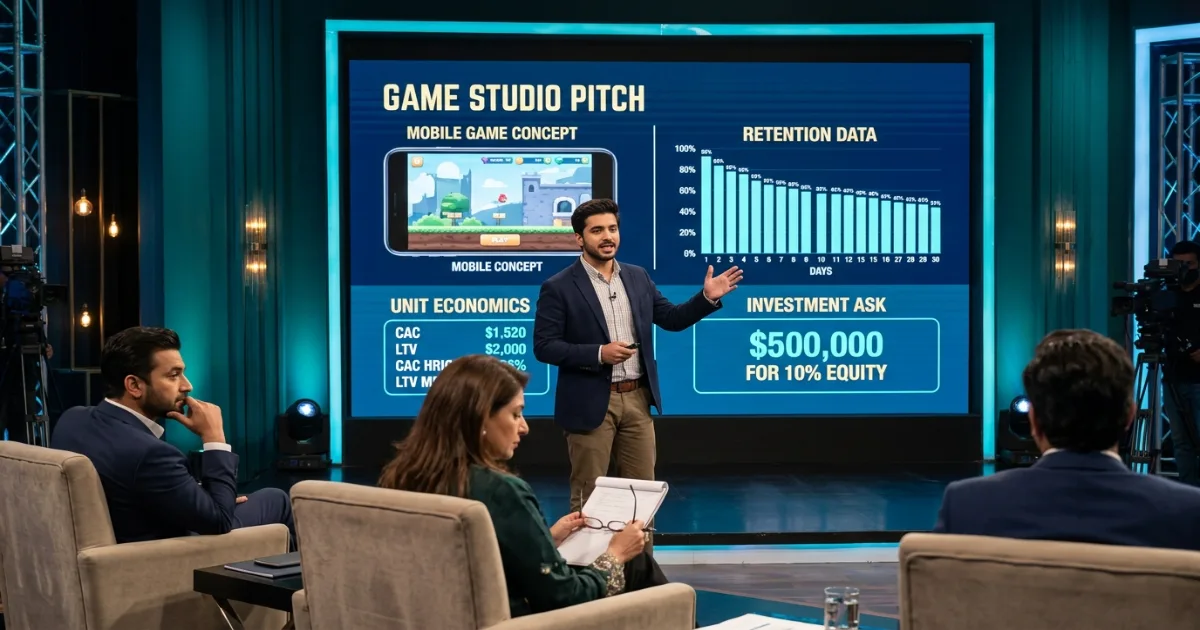
At first glance, a reality TV pitch show and the gaming industry might seem like separate worlds. They’re not — and the connection is becoming tighter each season. Shark Tank Pakistan has already featured adjacent pitches in edtech, app development, and interactive media. A dedicated gaming studio pitch is not a matter of “if” but “when.”
For gaming founders considering the show, the pitch needs to translate gaming metrics into the language sharks understand: unit economics, defensibility, and exit potential. Sharks don’t care about your K/D ratios or esports rankings — they care about how you acquire users profitably, what your LTV looks like, and whether someone will acquire your studio in five years. Frame everything in those terms.
For investors watching the show, the gaming pitches that get deals share a pattern: the founders demonstrate product-market fit with data, they ask for a specific amount tied to a clear milestone (not “we need money to grow”), and they’ve already thought through their valuation using tools like the calculators available on this site. The pitches that get declined almost always fail on valuation realism or an inability to explain the business model in 90 seconds.
Put This Into Practice: Using the Calculators and Tools
You don’t need to be a financial analyst to evaluate a gaming investment opportunity. The tools on SharksTankPakistan.pk are built precisely for this purpose — they turn complex valuation math into clear, actionable outputs.
Start with the Valuation Calculator. Whether you’re an investor sizing up a deal or a founder preparing your ask, plug in the studio’s revenue (or projected revenue), growth rate, and comparable company multiples. The calculator will give you a defensible valuation range grounded in the same methodology sharks use on the show. For gaming studios, the revenue multiple method tends to work best for studios with live titles generating consistent in-app purchase or ad revenue.
Then use the Equity-Loan Calculator. If you’re structuring a deal that blends equity with a convertible note or loan component — increasingly common in Pakistani gaming deals — this tool helps you visualize how different structures affect founder dilution and investor returns over time. Many first-time gaming investors over-dilute founders early, which kills motivation and hurts retention of key creative talent. The calculator helps you find the balance.
Open the Startup Valuation Calculator now, drop in some rough numbers from a studio you’re evaluating, and you’ll immediately see how a realistic ask can make or break the pitch — and the investment.
Real-World Snapshot: What a Pakistani Gaming Deal Looks Like
Consider a composite example drawn from real deal structures circulating in the ecosystem: A Lahore-based studio with a hyper-casual title that reached 500,000 organic downloads on the Play Store and is generating $8,000/month in ad revenue. The three-person founding team has prior experience at a larger regional publisher. They’re raising $120,000 for a 15% equity stake — implying an $800,000 post-money valuation.
At first glance, 15% for $120,000 might seem expensive for a studio doing under $100K annualized revenue. But the retention data tells a different story: Day-30 retention sits at 18%, well above the hyper-casual average of 8–12%. The team has identified a monetization optimization that could 2.5x ARPDAU with minor tweaks. And their pipeline includes two more titles at prototype stage, de-risking the single-game concentration problem.
That’s the kind of deal that makes sense when you dig past the headline numbers — and exactly the kind of analysis the sharks would perform before making an offer. The tools on this site are designed to help you replicate that depth of evaluation.
Frequently Asked Questions About Gaming Industry Pakistan
- Is the gaming industry in Pakistan actually profitable or just hype?
- It’s a mix. A few studios are genuinely profitable, generating $50K–$300K+ annually from ad revenue and in-app purchases. But many are still pre-revenue or break-even. The profitability signal is strongest in hyper-casual mobile studios with efficient user acquisition and ad monetization loops. The hype exists around esports and metaverse-adjacent projects, where revenue is less proven.
- How much does it cost to start a game studio in Pakistan?
- A lean studio with 3–5 developers, basic equipment, and a small office in Lahore or Karachi can launch for $20,000–$50,000 in initial capital. This covers 6–9 months of runway to ship a minimum viable product. Studios targeting higher production values or console/PC titles will need $100,000+.
- Can a Pakistani gaming startup get on Shark Tank Pakistan?
- Absolutely. The show accepts applications from any legally registered Pakistani business. A gaming studio with a shipped product, user traction, and a clear revenue model fits the profile sharks evaluate. Preparation is key — your pitch must translate gaming metrics into investor-friendly business terms. Review the application guide for full requirements.
- What’s the biggest gaming segment in Pakistan right now?
- Mobile gaming dominates by user count and revenue. Within mobile, hyper-casual and battle royale genres lead. PUBG Mobile alone has an estimated 30+ million players in Pakistan. But the highest growth rate is now in mid-core mobile RPGs and simulation games, which offer better monetization per user than hyper-casual titles.
- Do I need a registered company to invest in a Pakistani gaming studio?
- Not necessarily as an individual angel investor, but it’s strongly recommended for legal protection and tax clarity. If you’re investing through an entity or syndicate, a registered company structure — typically a Private Limited company with SECP — is standard practice. Consult a local corporate lawyer to structure the investment properly.
- How do Pakistani gaming studios make money?
- Primarily through in-app purchases (IAP), in-app advertising (IAA), and publishing advances from international partners. A smaller number generate revenue through premium game sales on Steam or console stores. The most sustainable studios blend IAP and IAA to create multiple revenue streams that aren’t dependent on a single platform’s algorithm changes.
- What’s the exit potential for gaming investments in Pakistan?
- Exits are still rare but increasing. The primary path is acquisition by a global publisher (as seen with Mindstorm Studios) or a regional strategic buyer. IPO exits are not yet realistic for Pakistani gaming companies. Investors should underwrite a 5–7 year hold period and plan for acquisition as the most probable liquidity event.
- Are there tax incentives for gaming companies in Pakistan?
- Currently, Pakistan lacks specific tax incentives for game development, unlike countries such as Malaysia or Turkey that offer production rebates. However, IT and IT-enabled service exporters can access certain tax concessions through PSEB registration. Gaming studios that structure part of their revenue as service exports may qualify. This area is evolving, so consult a tax advisor familiar with the tech sector.
📋 Your Fast-Track Cheat Sheet: Top 3 Actions to Take
- Pick your lane before you deploy capital. Studio equity, esports sponsorship, publishing partnerships, and infrastructure plays are fundamentally different asset classes. Don’t mix them in your head — each demands its own evaluation framework, return expectations, and risk tolerance. Start with the one closest to your existing expertise.
- Lead every evaluation with retention data, not revenue projections. A studio with strong Day-7 and Day-30 retention metrics but modest current revenue is far more investable than one with decent sales and weak retention. Use the Valuation Calculator to ground your offer in real metrics, not founder optimism.
- Move before the window narrows. Pakistan’s gaming sector is in a transitional moment — costs are low, talent is maturing, and international capital hasn’t fully arrived. The valuation discounts available today are unlikely to persist beyond 2027–2028. If you’re serious about this space, the best time to start diligencing opportunities is now.