Shark Tank Pakistan Best Pitches: 10 Verified Season 1 Lessons for Founders
Not every viral pitch should be called a “confirmed deal.” This corrected guide looks at publicly reported Shark Tank Pakistan Season 1 offers, standout founder moments, and the practical pitch lessons Pakistani entrepreneurs can actually use.
Quick Answer: The Shark Tank Pakistan best pitches were not only the ones with the biggest cheques. The strongest Season 1 pitches combined a real Pakistani problem, visible traction, clear unit economics, practical founder confidence, and a deal structure the sharks could defend. Saraaf, Kangaroo Care AI, Arshad Khan Chaiwala, Knock Sports, Pink Salt, Aashi Herbs, Agri Green Seeds, TRE CYCLE, Digi Lawyer, and Khaas Foods all offer useful pitch lessons — but public articles should describe these as reported or on-air offers unless post-show completion is confirmed.
The first version of this article had a serious problem: it used startup names, founder names, and deal numbers that were not safely verifiable from public Shark Tank Pakistan Season 1 coverage. That kind of content may look polished, but it weakens trust fast. Search engines, founders, and viewers can compare a claim against public trackers within seconds.
This updated version keeps the useful founder coaching angle but removes unsupported pitch names. It now focuses on publicly reported Season 1 startups and separates “best pitch lesson” from “official final deal.” That distinction matters because many TV offers can still change after due diligence.
Important trust note: This is an editorial ranking for learning purposes, not an official Shark Tank Pakistan ranking. Deal details below should be treated as publicly reported on-air offers unless a founder, shark, show platform, or reliable news source confirms post-show completion.
- How this list was corrected
- Top 10 pitch lessons
- Reported offer comparison
- 5-step pitch framework
- Mistakes founders should avoid
- FAQs
How This Shark Tank Pakistan Best Pitches List Was Corrected
A strong Shark Tank article needs two things: excitement and accuracy. The temptation is to create a dramatic countdown with perfect founder stories, perfect revenue numbers, and perfect endings. The problem is that fictional precision is worse than a short article. It can damage reader trust, trigger corrections, and make the site look careless.
For this corrected guide, the ranking is based on four safer signals: public reporting, size or uniqueness of the on-air offer, founder story strength, market relevance in Pakistan, and the usefulness of the lesson for future applicants. That is why the list includes a mix of record-breaking deals, social-impact innovations, consumer brands, and operationally strong businesses.
Method used: Public startup trackers, news coverage, episode summaries, and reported Shark Tank Pakistan panel information were used to rebuild this page. Where the public record is limited, the article avoids fake exact revenue, fake founder quotes, and unverified “all sharks confirmed” language.
Who Were the Sharks in Shark Tank Pakistan Season 1?
The commonly reported Shark Tank Pakistan Season 1 shark panel included Aleena Nadeem, Faisal Aftab, Junaid Iqbal, Karim Teli, Rabeel Warraich, Romanna Dada, and Usman Bashir. That is important because saying “all five sharks” across the whole season is not accurate for Pakistan’s first season. Some pitches may have had five sharks actively involved in a specific episode or deal, but the safer page-level wording is “the sharks,” “multiple sharks,” or the exact investor names where available.
Top 10 Shark Tank Pakistan Best Pitches — Corrected Season 1 Lessons
Saraaf — The Pitch That Made Shark Tank History
Saraaf deserves the top spot because it became the headline pitch people associated with Shark Tank Pakistan’s ambition. Public coverage reported a massive investment commitment connected to Saraaf, including a large equity component and a credit-line or royalty-style structure. The pitch showed that Pakistani startups can present at a scale far beyond small consumer products when the market, supply chain, and trust problem are large enough.
Founder lesson: Big valuations only work when the problem is big, the operating model is serious, and the founder can explain why the shark’s capital creates an advantage beyond money.
Kangaroo Care AI — A Social-Impact Pitch With Real Hardware Need
Kangaroo Care AI stood out because it targeted a painful healthcare gap: affordable neonatal care and incubator access. The strongest part of this pitch was not only the product; it was the urgency of the problem. A business that can save hospitals money, improve access, and create local manufacturing capability has a stronger emotional and economic case than a generic gadget.
Founder lesson: In Pakistan, a pitch becomes powerful when impact and economics support each other. Don’t pitch “social good” alone; show how the model can survive, scale, and serve institutions.
Arshad Khan Chaiwala — Viral Fame Converted Into a Brand Story
Arshad Khan Chaiwala’s pitch had what many founders wish they had: instant public recognition. But recognition alone does not close a deal. The reason this pitch belongs in a best-pitches article is that it showed how a viral identity can be shaped into a scalable food and beverage brand. For viewers, it was memorable. For founders, it was a lesson in turning audience attention into business credibility.
Founder lesson: If your business has a story, don’t overact it. Connect the story to outlets, franchises, repeat customers, margins, and expansion logic.
Agri Green Seeds — Agriculture Still Has the Biggest Founder Problems to Solve
Pakistan’s agriculture sector gives founders a huge opportunity, but it also exposes weak business models quickly. Agri Green Seeds earned attention because agriculture is not a vanity market; it touches yield, input cost, trust, rural distribution, and repeat purchasing. A pitch in this space works only when the founder understands farmer behaviour and the channel deeply.
Founder lesson: When pitching agri-business, avoid vague “Pakistan is an agricultural country” claims. Show yield improvement, farmer retention, dealer network, seasonality, and cash-flow timing.
Knock Sports — A Cricket Pitch Built Around Craft and Demand
Knock Sports worked because cricket is not just a category in Pakistan; it is a culture. A handcrafted cricket equipment brand can create strong emotional appeal, but sharks still need proof that demand, quality control, and distribution can scale. This pitch showed how a focused niche can become investable when the founder explains the product advantage clearly.
Founder lesson: A niche is not small if the buyer passion is high. Bring product samples, cost of production, retail pricing, and a channel plan.
Pink Salt — A Simple Product With Export-Friendly Positioning
Pink Salt is a useful case because it sits at the intersection of Pakistani origin, consumer packaging, and export potential. The pitch lesson is not that pink salt itself is new. The lesson is that a common resource can become a stronger business when branding, quality control, packaging, and channels are presented properly.
Founder lesson: If the product is familiar, the pitch must prove differentiation. Packaging, margins, shelf velocity, export readiness, and quality assurance become the real story.
Aashi Herbs — Founder Resilience Meets Demand Proof
Aashi Herbs became memorable because the founder story was emotionally strong, but the pitch also showed demand for the product. Personal hardship can make an audience listen, but traction makes investors stay. In beauty and wellness, trust is everything, so founder authenticity is a real business asset when paired with repeat purchases and consistent product claims.
Founder lesson: Your story opens the door; numbers keep it open. Bring sales units, repeat purchase rate, production cost, and customer reviews.
TRE CYCLE — Waste, Art, and Sustainability With a Local Angle
TRE CYCLE belongs in this list because sustainability pitches can easily become vague. The stronger version is local, visible, and commercial: what waste is collected, what it becomes, who buys it, and what margin survives after labour and logistics. A creative pitch becomes investable when the founder explains how the supply of waste and demand for finished products connect.
Founder lesson: Don’t pitch sustainability as a slogan. Pitch the supply chain, buyer profile, product margin, and measurable environmental benefit.
Digi Lawyer — AI and Legal Access in a Trust-Heavy Category
Digi Lawyer is important because AI-based businesses need extra clarity. Legal help is a trust-heavy category, especially when users are worried about cost, documentation, and reliability. A legal-tech pitch must explain what the product can safely automate, where humans are involved, how quality is controlled, and how liability is managed.
Founder lesson: If you pitch AI, don’t hide behind buzzwords. Show workflow, human oversight, pricing, accuracy limits, and why customers will trust the output.
Khaas Foods — Food Businesses Still Win When the Basics Are Strong
Khaas Foods is a reminder that food businesses do not need to pretend to be tech companies. A strong food pitch can win attention by showing customer demand, kitchen capacity, consistency, gross margin, delivery economics, and expansion discipline. Investors may love the taste, but they invest when the operation is repeatable.
Founder lesson: For food and catering, your best slide is often not the menu. It is the margin sheet, production capacity, order frequency, and route to controlled expansion.
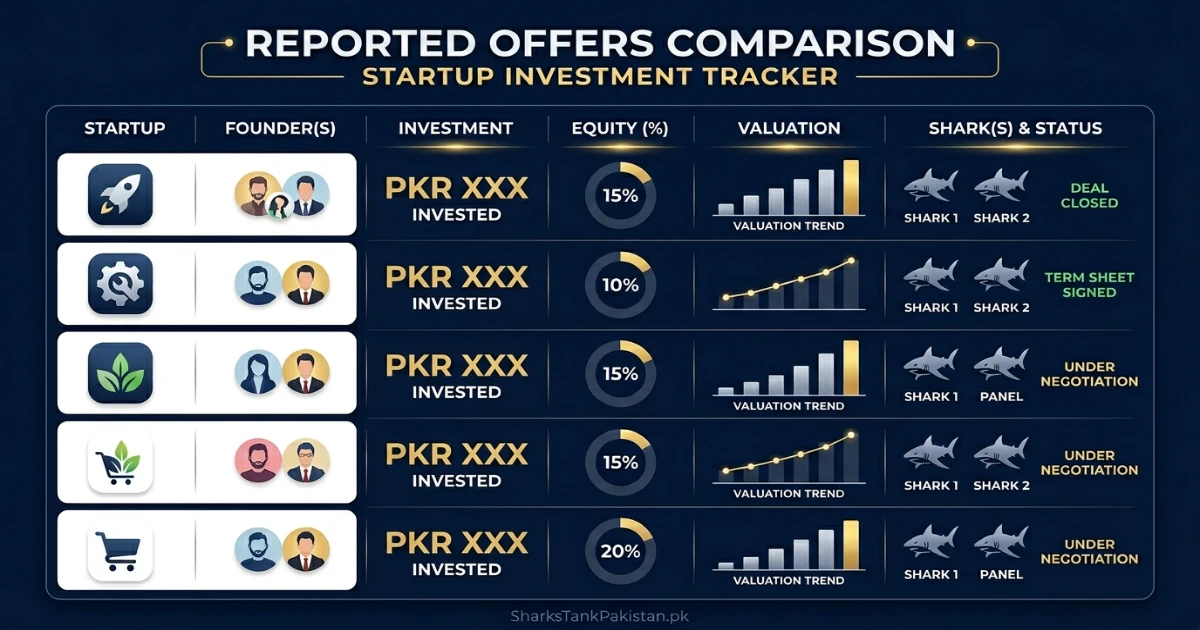
Reported Offer Comparison for Shark Tank Pakistan Best Pitches
The table below is designed for editorial safety. It uses publicly reported or tracker-listed figures and avoids presenting every offer as fully closed after due diligence.
| Startup | Category | Reported / on-air offer | Equity / royalty note | Core pitch lesson |
|---|---|---|---|---|
| Saraaf | Commodity trading | Record-scale reported commitment | Public reports mention equity plus credit/royalty-style component | Big ask needs big market logic |
| Kangaroo Care AI | Baby healthcare | Rs. 3 crore reported offer | Tracker-listed at 25% equity | Impact plus economics is powerful |
| Arshad Khan Chaiwala | Food & beverages | Rs. 1 crore reported offer | Tracker-listed at 24% equity | Brand story must connect to scale |
| Agri Green Seeds | Agriculture | Rs. 50 million tracker-listed offer | Tracker-listed at 25% equity | Rural distribution is a moat |
| Knock Sports | Sports goods | Rs. 7.5 million tracker-listed offer | Tracker-listed with royalty component | Passionate niche can be investable |
| Pink Salt | Food | Rs. 8 million tracker-listed offer | Tracker-listed with royalty component | Commodity needs branding and channels |
| Aashi Herbs | Natural hair care | Rs. 20 lakh tracker-listed offer | Tracker-listed at 10% equity | Founder story needs demand proof |
| TRE CYCLE | Waste-to-art | Rs. 50 lakh tracker-listed offer | Tracker-listed at 20% equity | Sustainability must show margin |
| Digi Lawyer | Legal tech | Rs. 14 crore tracker-listed offer | Tracker-listed at 20% equity | AI pitches need trust controls |
| Khaas Foods | Restaurant & catering | Tracker-listed offer | Public tracker marks all-shark interest but equity not clearly listed | Operational discipline beats food hype |
SEO trust tip: Don’t claim “average equity across all best pitches” unless you have a clean verified dataset. It is safer to say “public trackers show several Season 1 offers in the 10%–30% equity range, with some royalty or credit-line structures.”
How to Pitch Like a Shark Tank Pakistan Top Contender
The best pitch structure is not complicated. What matters is that each part answers a question the sharks already have in their heads. Use this framework before applying, meeting investors, or recording a pitch video.
Step 1: Start with one sharp Pakistani problem
Do not begin with a generic dream. Start with a concrete pain: rural healthcare access, cricket equipment quality, farmer input trust, legal document confusion, or food-business expansion. The sharper the problem, the faster the sharks understand the opportunity.
Step 2: Show the product or proof early
Physical samples, live app demos, real customer orders, production photos, signed purchase orders, or shop/franchise proof make a pitch feel real. A founder who only talks for five minutes loses momentum.
Step 3: Explain traction in simple numbers
Use clear numbers: monthly sales, gross margin, repeat purchase rate, customer acquisition cost, production capacity, pending orders, and refund or complaint rate. If you cannot explain your numbers simply, the valuation will feel weak.
Step 4: Defend the valuation without arrogance
Say exactly why your business deserves the valuation: revenue multiple, inventory value, contracts, IP, growth rate, or strategic assets. Avoid fantasy valuation claims that make the sharks laugh instead of negotiate.
Step 5: Tell the shark why their help changes the business
A good ask is not “we need money.” A better ask is “we need your distribution, manufacturing experience, retail network, legal understanding, or fintech expertise to cross the next milestone.”

Common Mistakes That Make Shark Tank Pakistan Pitches Look Weak
Many pitches fail not because the idea is bad, but because the founder creates doubt. These are the biggest mistakes future applicants should avoid.
- Using fake precision: Don’t invent exact market share, revenue, profit, or valuation logic. A confident estimate is better than a fake number.
- Confusing sales with profit: Sharks will ask about cost of goods, wastage, salaries, logistics, returns, and cash tied in inventory.
- Overvaluing a small business: A high valuation can work for strong IP, contracts, or fast growth. It does not work just because the founder is passionate.
- Not knowing the customer: Saying “everyone is our customer” usually means the founder has not chosen a clear market.
- Ignoring post-show execution: A TV offer creates visibility, but the real business still needs operations, fulfilment, compliance, and cash-flow discipline.
What Founders Should Learn From These Best Pitches
The real lesson from Shark Tank Pakistan is that Pakistani founders do not need to copy Silicon Valley language to impress investors. The best pitches speak the language of the local customer. They understand price sensitivity, trust barriers, supply-chain issues, family purchasing behaviour, and the difference between social media attention and repeat revenue.
A founder preparing for the next season should study these pitches by category. If you are in food, study Arshad Khan Chaiwala, Pink Salt, and Khaas Foods. If you are in impact or healthcare, study Kangaroo Care AI. If you are in a market with big operational complexity, study Saraaf and Agri Green Seeds. If you are in tech or AI, study Digi Lawyer but be extra careful with trust and compliance claims.
Source Notes for Editorial Safety
For final publication, keep these source links inside your editorial workflow or source box. Public data can change when founders or sharks clarify whether an on-air offer closed after due diligence.
FAQs About Shark Tank Pakistan Best Pitches
What was the biggest reported Shark Tank Pakistan pitch or deal?
Saraaf is widely reported as the record-breaking Shark Tank Pakistan deal, with public coverage describing a very large investment commitment. Because TV offers can change after due diligence, a source-safe article should say “reported offer” unless final completion is independently confirmed.
Were there five sharks or seven sharks on Shark Tank Pakistan Season 1?
The commonly reported Season 1 panel included seven sharks: Aleena Nadeem, Faisal Aftab, Junaid Iqbal, Karim Teli, Rabeel Warraich, Romanna Dada, and Usman Bashir. Some individual deals may involve fewer active investors, so wording should be specific.
Which Shark Tank Pakistan pitches were best for founders to study?
Founders can study Saraaf for big-market logic, Kangaroo Care AI for social impact plus economics, Arshad Khan Chaiwala for brand storytelling, Agri Green Seeds for rural distribution, and Digi Lawyer for AI trust positioning.
Should I copy a Shark Tank Pakistan pitch structure exactly?
No. Use the structure, not the script. Your pitch should match your own market, customer, product stage, and numbers. Copying another founder’s emotional story or valuation logic can make your pitch look weak.
What is the safest way to write about Shark Tank Pakistan deals?
Use terms like “reported offer,” “on-air offer,” or “publicly listed offer” unless a reliable source confirms that the investment was completed after due diligence. This protects the article from overclaiming.
What makes a Shark Tank Pakistan pitch impressive?
An impressive pitch solves a clear Pakistani problem, shows traction, explains margins, defends valuation, and makes the shark’s role obvious. The best founders are confident without pretending to know everything.
Final Takeaway: Accuracy Is the Real Shark Tank Advantage
The strongest Shark Tank Pakistan best pitches article is not the one with the most dramatic claims. It is the one founders can trust. Use real Season 1 startups, avoid unsupported deal completion language, explain why each pitch mattered, and turn the article into a practical playbook for Pakistani entrepreneurs.
- Use verified names only. Do not invent founder names, startup names, or financial numbers.
- Label offers carefully. “Reported” and “on-air” are safer than “closed” unless confirmed.
- Teach through the pitches. Readers stay longer when the article gives practical founder lessons, not just a countdown.