
How to Build a Pitch Deck That Gets a Yes on Shark Tank Pakistan
A winning pitch deck for Shark Tank Pakistan is not about flashy design — it’s about telling a clear, numbers-backed story that answers the only question every shark is silently asking: “Can I make money from this, and how fast?” Your deck needs 10–12 slides, rock-solid unit economics, a realistic valuation, and a deep understanding of the Pakistani market. Skip the jargon. Lead with traction. And never walk in without knowing your numbers cold.
If you’re reading this, you’re probably serious about landing a deal on Shark Tank Pakistan. Maybe you’ve already watched every episode. Maybe you’ve seen pitchers walk out with a handshake and a cheque — and others walk out with nothing but polite applause. The difference between those two outcomes almost always starts weeks before the cameras roll. It starts with the deck.
Here’s what most Pakistani founders get wrong: they think a pitch deck is a presentation about their business. It’s not. A pitch deck for Shark Tank Pakistan is a persuasion tool. Every slide, every number, every sentence has one job — to move a shark from skepticism to curiosity, and from curiosity to conviction. This guide will show you exactly how to build that kind of deck, slide by slide, with the Pakistani startup landscape in mind.
Why Most Pitch Decks Fail Before You Even Open Your Mouth
Before we build anything, let’s talk about failure. I’ve reviewed dozens of pitch decks from Pakistani founders — some destined for Shark Tank Pakistan, others for angel investors and VC firms. The majority fail for the same handful of reasons, and the frustrating part is that almost all of them are preventable.
The most common killer? Fuzzy numbers. Pakistani entrepreneurs — especially those running traditional businesses like food brands, textile units, or retail chains — often rely on rough estimates instead of clean, auditable financials. If you can’t tell a shark your gross margin within two seconds, you’ve already lost. Another fatal mistake is valuation inflation. Asking for PKR 2 crore at a PKR 20 crore valuation when you’ve generated PKR 15 lakh in lifetime revenue isn’t ambitious — it signals you don’t understand how valuations work. Sharks will mentally dismiss you before slide three.
Then there’s the story problem. Too many decks read like a textbook: “Company overview, mission statement, market size, product features.” That’s a report. A pitch deck for Shark Tank Pakistan needs to feel like a story — one where the shark can picture herself as a character. Where’s the tension? What insight did you discover that nobody else saw? Why now? If your deck doesn’t answer those questions, it’s forgettable.
Sharks on the Pakistani panel — including VCs like Rabeel Warraich of Sarmayacar and operators like Junaid Iqbal of Salt Ventures — consistently lean toward founders who demonstrate capital efficiency. A founder who turned PKR 10 lakh into PKR 50 lakh in revenue is far more impressive than one who burned PKR 5 crore to reach the same point. Your deck should highlight how efficiently you use money, not just how much you’ve raised or spent.
The Anatomy of a Shark Tank Pakistan Pitch Deck
Time is brutally short on the tank. You’ll have roughly 90 seconds to deliver your opening pitch, followed by a Q&A where sharks dig into the details. Your deck needs to support both — a crisp narrative upfront and detailed slides you can reference when the questions come.
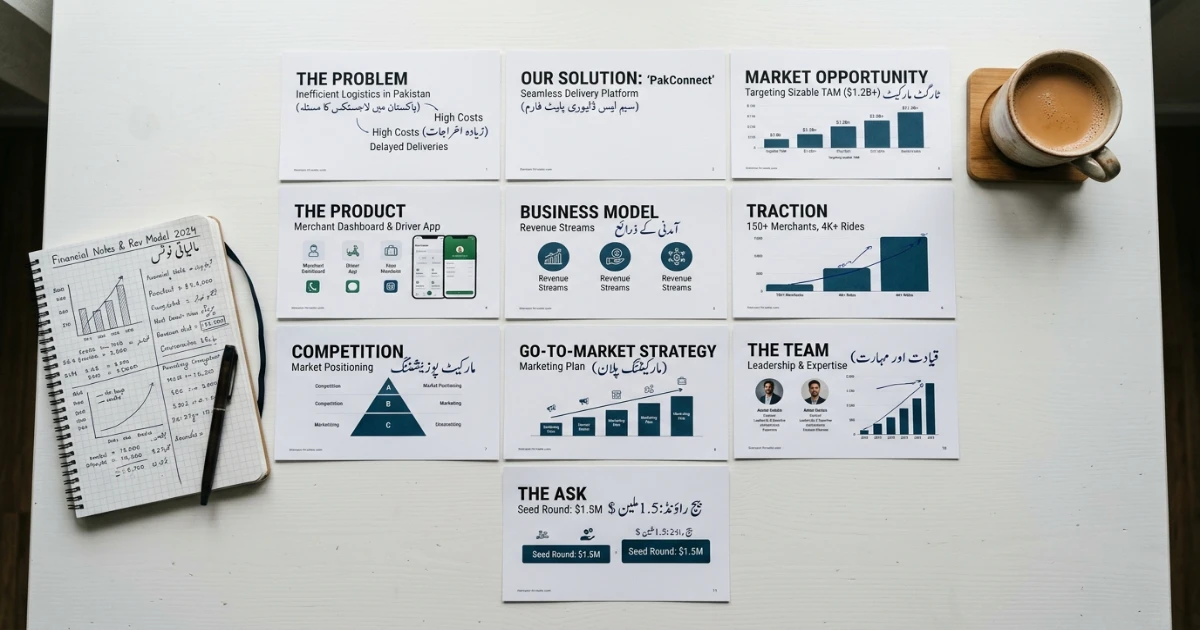
Here’s the 11-slide structure that has proven effective for Pakistani startups across tech, consumer goods, and services:
Slide 1: The Hook (Title Slide)
One sentence that captures what you do and why it matters. Avoid generic taglines. “Revolutionizing logistics” means nothing. “Same-day delivery for Kiryana stores in Tier-2 Punjab cities” — that’s specific and intriguing. Include your company name, logo, and your name. Keep design minimal.
Slide 2: The Problem
Describe the pain point you’re solving. Ground it in Pakistani reality. If you’re building a fintech app, talk about the 60 million unbanked adults. If you’re launching a food brand, talk about the gap between imported premium snacks and local affordability. Use one powerful statistic or anecdote — not five.
Slide 3: Your Solution
Show — don’t just tell — how you solve the problem. A product image, a demo screenshot, or a before-and-after comparison works better than three paragraphs of text. Explain in plain Urdu-mix English if that’s how your customers talk. Authenticity wins.
Slide 4: Market Opportunity
Pakistani sharks want to know the addressable market. But skip the lazy “Pakistan is a 240-million-person market” slide. Break it down: Total Addressable Market → Serviceable Addressable Market → Serviceable Obtainable Market. Show you understand your specific niche. A shark investing in a Lahore-based D2C skincare brand doesn’t care about the global cosmetics market — she cares about the urban Pakistani women aged 20–40 who buy skincare online.
Slide 5: Traction & Milestones
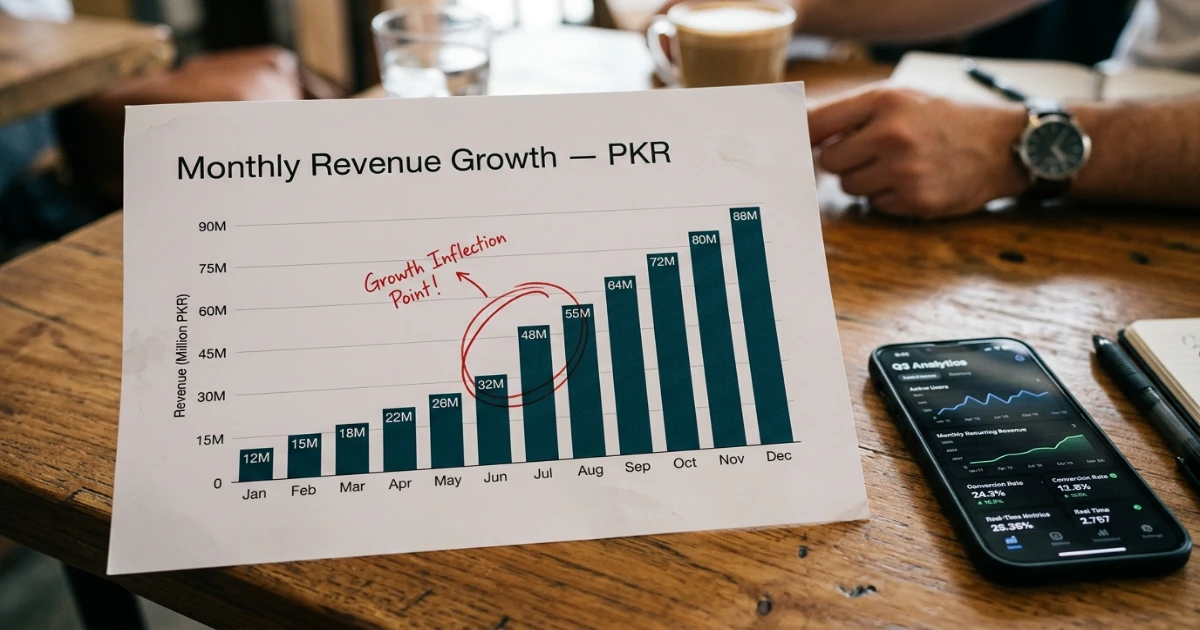
This is the most important slide in your entire pitch deck for Shark Tank Pakistan. Traction can be revenue, users, partnerships, letters of intent, pilot results, or even pre-orders. Whatever you have, put it here. If you’re pre-revenue, show user waitlist numbers, social proof, or pilot feedback. A graph showing month-over-month growth is gold. If the line goes up and to the right, make sure the sharks see it.
Slide 6: Business Model & Unit Economics
How do you make money? Be specific. If you sell a product, what’s your cost per unit, selling price, and gross margin? If you’re a marketplace, what’s your take rate? Pakistani sharks are exceptionally focused on unit economics because local margins can be razor-thin. Show that you know your Customer Acquisition Cost and Lifetime Value. Even rough estimates are better than blank stares.
Slide 7: The Competitive Landscape
Use a simple 2×2 matrix or a comparison table. Acknowledge competitors — pretending they don’t exist signals naivety. Then show your unfair advantage. Maybe it’s your supply chain relationships in Faisalabad. Maybe it’s your proprietary data on consumer behaviour in Karachi. Make it clear why you’ll win.
Slide 8: The Team
Highlight relevant experience. If your co-founder previously scaled a business to PKR 10 crore in revenue, say so. If someone on your team has deep industry connections, name them. Pakistani sharks invest in people as much as ideas. A committed, complementary founding team reduces perceived risk dramatically.
Slide 9: Financial Projections
Show three years of projected revenue, expenses, and profit — but keep it realistic. Nothing erodes credibility faster than a hockey-stick projection with no basis in your current traction. If you’re projecting PKR 5 crore in Year 3 after doing PKR 20 lakh in Year 1, be ready to explain exactly how.
Slide 10: The Ask
State clearly: “We’re raising PKR [X] for [Y]% equity, at a valuation of PKR [Z].” Then explain in one line how you’ll use the funds. “PKR 1.5 crore will fund inventory for our Karachi launch and a three-month marketing campaign targeting 50,000 new customers.” Specificity builds trust.
Slide 11: Closing & Contact
End with your name, phone number, email, and a memorable closing line. Thank the sharks. Keep it brief.
Shark Tank Pakistan vs. Shark Tank US: What’s Different for Your Pitch Deck
Many Pakistani founders study American pitch decks as reference material. That’s useful — but only if you understand the key differences in expectations. Here’s a direct comparison:
| Dimension | Shark Tank Pakistan | Shark Tank US |
|---|---|---|
| Valuation Expectations | More conservative; sharks expect 3–6x revenue multiples for established businesses; pre-revenue valuations rarely exceed PKR 3–5 crore | Higher multiples accepted; pre-revenue tech startups can command $2–5M valuations with strong IP or traction |
| Deal Structure Preference | Sharks often prefer equity plus royalty structures or convertible notes; pure equity deals are less common for early-stage | Straight equity deals are standard; royalties are rarer and typically reserved for established cash-flowing businesses |
| Documentation Rigour | Sharks expect SECP registration, FBR tax filings, and clean financial records as a baseline; informal businesses face scrutiny | LLC or C-Corp registration expected; financial rigour demanded but less emphasis on tax compliance history upfront |
| Market Framing | Sharks value deep local market insight; “we understand Pakistani consumer behaviour” matters more than global ambitions | Sharks often look for scalability to US-wide or global markets; local-only plays face tougher questions |
| Pitch Tone & Style | Relationship-forward; respect, humility, and coachability matter; overly aggressive pitching can backfire culturally | Confidence and boldness are rewarded; directness and assertiveness are expected and rarely penalised |
The Numbers That Actually Matter to Pakistani Sharks
You can have the most beautiful deck in the world, but if your numbers don’t hold up, you’re done. Here are the specific metrics Pakistani sharks consistently probe — and what you need to have ready:
Gross Margin. For product businesses, sharks want to see at least 40–60% gross margins. Anything below 30% raises red flags unless you have massive volume. For service businesses, 50–70% is the sweet spot. Know your margin per unit, not just in aggregate.
Customer Acquisition Cost. How much do you spend to get one paying customer? If your CAC is PKR 2,000 and your customer’s lifetime value is PKR 3,000, you’re walking a tightrope. Pakistani sharks look for an LTV-to-CAC ratio of at least 3:1.
Monthly Burn Rate. Especially for tech startups, know how much cash you’re burning each month and how many months of runway you have left. Walking in with less than six months of runway without a clear plan is a deal-breaker.
Revenue Concentration. If 70% of your revenue comes from one client, say so. Sharks will find out anyway, and hiding it destroys trust. Diversification matters, but honesty matters more.
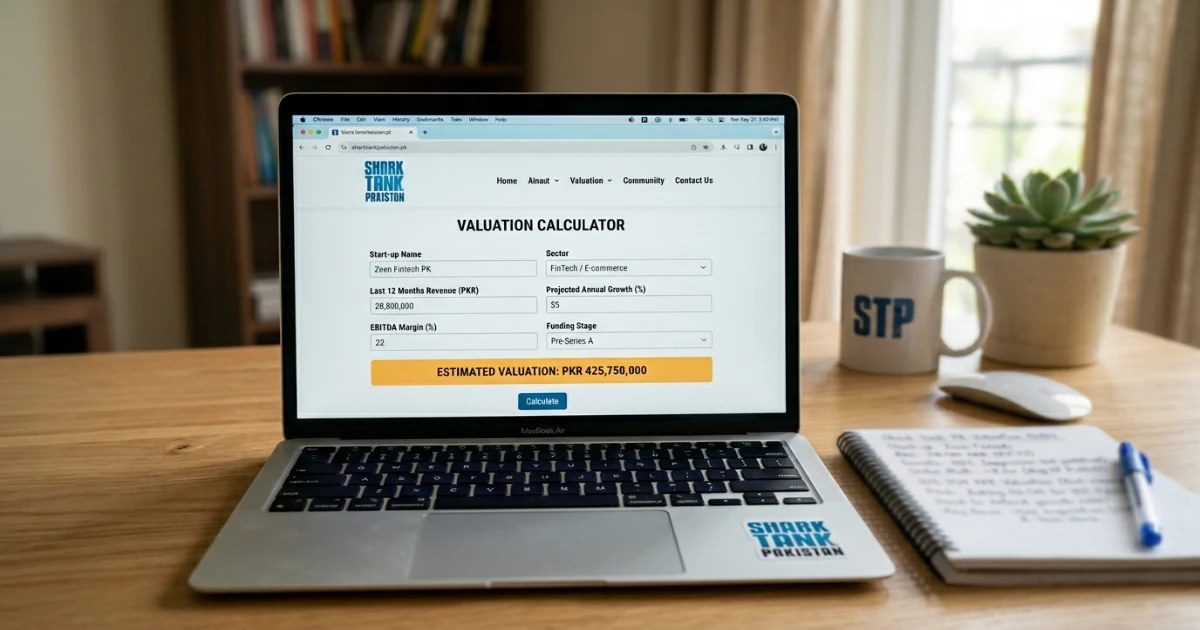
Based on patterns from the first season of Shark Tank Pakistan and comparable regional shows, most deals fall in the PKR 30 lakh to PKR 3 crore range, with equity stakes between 10% and 35%. The average equity given up is roughly 20–25%. Pre-revenue startups rarely secure deals above PKR 1 crore unless the founding team has exceptional credentials or proprietary technology. Use the SharkTankPakistan.pk Valuation Calculator to benchmark your own ask before finalising your deck.
How Your Pitch Deck Should Change Based on Your Stage
Not every founder walks into the tank from the same starting line. Your deck’s emphasis needs to shift depending on where you are in your journey. Here’s how to adjust:
If You’re Pre-Revenue
You don’t have sales figures, so you need to sell conviction. Your deck must over-index on: the problem’s urgency, your team’s unique qualifications, early signals of demand (waitlists, LOIs, pilot feedback), and a detailed, believable plan for how the shark’s money will unlock the first revenue. Be humble on valuation. A pre-revenue Pakistani startup asking for PKR 5 crore is almost always dead on arrival.
If You’re Generating Consistent Revenue (PKR 50 Lakh – PKR 3 Crore Annual)
This is the sweet spot. You have proof the business works. Your deck should lead with traction — put your revenue graph on slide 5 or earlier. Sharks will still probe unit economics, but the conversation shifts from “does this work?” to “how fast can this scale?” Your valuation can be more assertive, but keep it grounded in revenue multiples.
If You’re an Established Profitable Business (PKR 3 Crore+ Annual Revenue)
You’re in a strong position, but you face a different challenge: convincing sharks that you need them beyond just their money. Your deck should emphasise the strategic value a shark brings — distribution networks, regulatory navigation, brand elevation. If all you need is cash, a bank loan might be cheaper than giving up equity. Be ready to answer: “Why a shark, and why now?”
Tech Startup vs. Traditional Business
A SaaS startup pitching PKR 2 crore at a PKR 12 crore valuation with 80% gross margins is a very different conversation from a textile manufacturer pitching the same amount. For tech, emphasise scalability and defensibility (IP, network effects). For traditional businesses, emphasise cash flow stability, asset backing, and market share. Both are fundable — but the deck’s narrative must match the business model’s strengths.
Common Mistakes Pakistani Founders Make in Their Pitch Decks
I’ve seen the same errors surface repeatedly — across Karachi, Lahore, Islamabad, and beyond. Here are the ones that consistently kill deals:
- The “We Have No Competitors” Claim. Every business has competitors — even if they’re indirect substitutes. Claiming otherwise makes you look either dishonest or uninformed. Instead, say: “Here’s who else is in the space, and here’s why we’ll capture share.”
- Inflated Valuations with No Justification. “We’re valued at PKR 15 crore because we believe in our vision.” That’s not a valuation methodology. Use revenue multiples, discounted cash flow, or comparable transactions — and be ready to explain your reasoning.
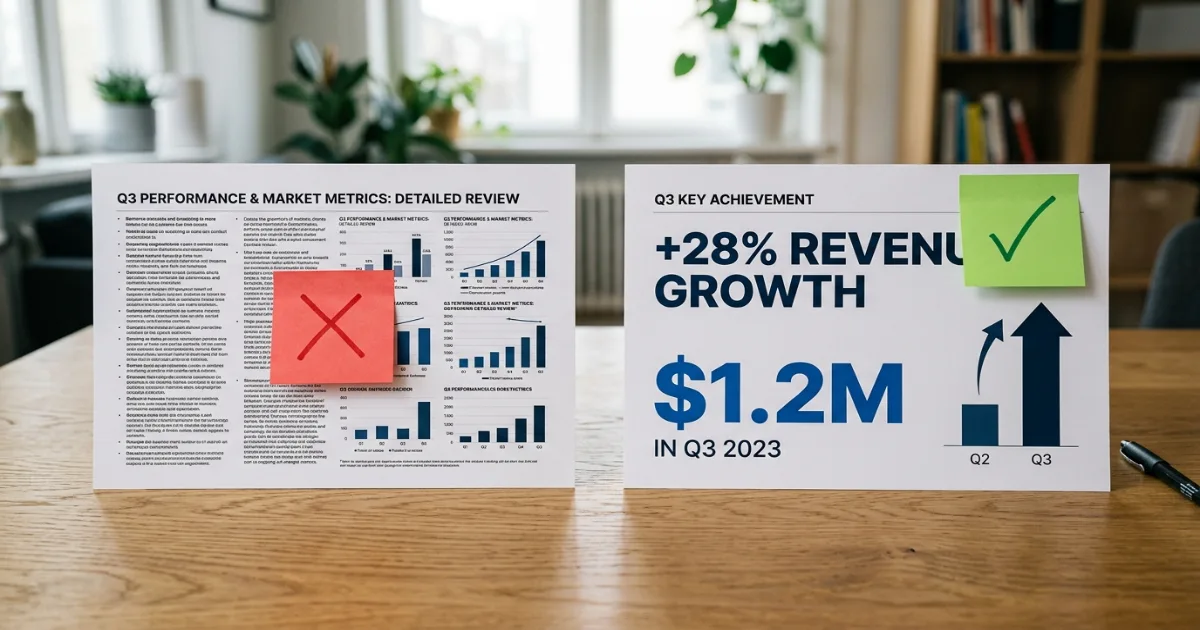
- Overloading Slides with Text. A slide with 12 bullet points of 10-point font is unreadable — and it signals you can’t prioritise information. One idea per slide. Use large fonts. Let your spoken words do the heavy lifting.
- Ignoring the Regulatory Elephant in the Room. If you’re in fintech, healthtech, or edtech, Pakistani sharks will ask about regulatory compliance — SECP, SBP, PTA, DRAP, or provincial laws. If your deck doesn’t address this, you look unprepared. Add a brief compliance note if your industry is regulated.
- No Clear Use of Funds. “We’ll use the money for growth” is meaningless. Break it down: 40% inventory, 30% marketing, 20% team hires, 10% working capital. Sharks appreciate precision.
When to Ignore This Advice (And Trust Your Instincts)
Every rule has exceptions. Here are scenarios where deviating from the standard pitch deck formula might actually work in your favour:
- You have a product so visually compelling that a live demo beats slides. If you’ve built hardware, a physical product, or an app with a stunning UI, leading with a demo can be more powerful than any slide. Just make sure you have backup slides for the Q&A.
- Your personal story IS the business. Some of the most memorable Shark Tank Pakistan pitches are founder-driven. If you overcame extraordinary odds, built something from nothing in a Tier-3 city, or possess rare domain expertise, opening with your story might connect emotionally in ways a problem-slide never could.
- You’ve already been approached by another investor. If you have a term sheet from a known VC or angel, leading with that creates instant FOMO. It changes the entire dynamic of the negotiation. Just be prepared to show proof.
- Your business defies conventional unit economics — and you can prove it. Maybe your CAC is negative because of viral word-of-mouth. Maybe your margins are 90% because of a proprietary process. If your numbers are legitimately unusual, break the standard slide order and lead with the anomaly — then explain it.
The key is intentionality. Don’t break the rules because you were lazy. Break them because your specific situation demands a different approach, and you’ve thought it through.
Pressure-Test Your Deck Using SharkTankPakistan.pk Tools
Before you walk into the tank — or even submit your application — you need to stress-test your assumptions. The calculators and resources on SharkTankPakistan.pk are built specifically for this purpose.
Step 1: Run the Valuation Calculator. Plug in your revenue, profit margins, growth rate, and industry. The calculator will give you a realistic valuation range based on Pakistani market norms. If your ask falls far outside this range, reconsider before you face the sharks — they’ll do the same math in their heads within seconds.
Step 2: Use the Equity-Loan Calculator. Not sure whether to offer pure equity, a royalty deal, or a convertible note? This tool helps you model different structures and see how much you’d actually give up over time. Many Pakistani founders underestimate the long-term cost of royalty deals — run the numbers.
Step 3: Rehearse with Real Feedback. While no calculator replaces human judgment, building a mock Q&A session using questions sharks commonly ask (available in our How to Apply guide) will expose weak spots in your deck.
Real-World Example: A Pitch Deck That Worked
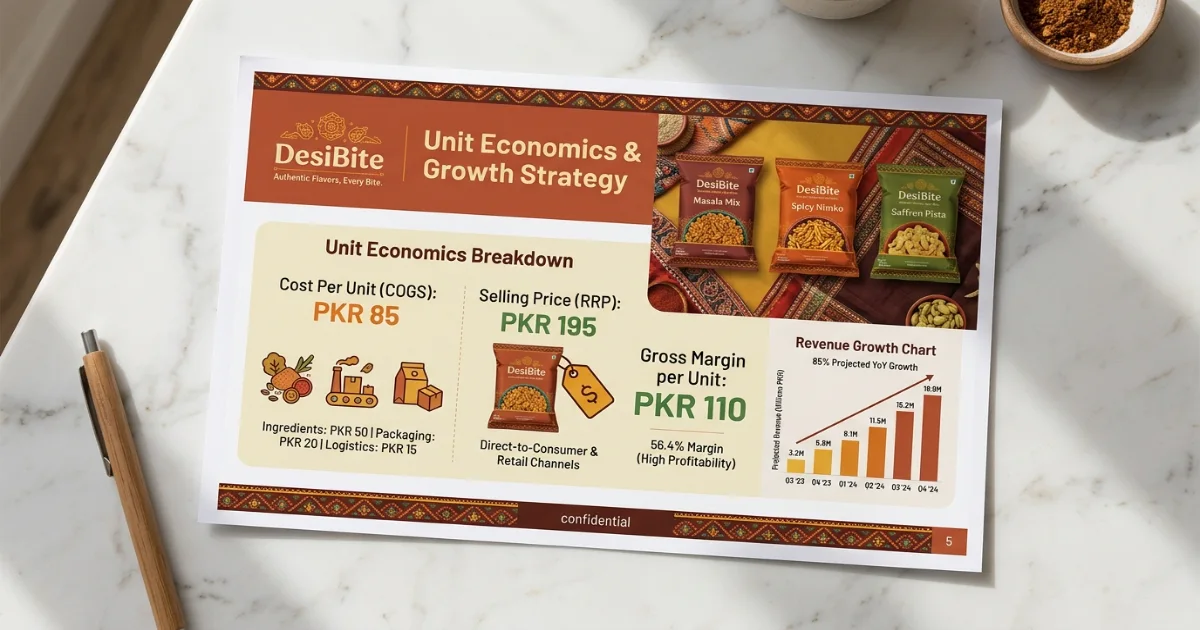
Let’s look at a composite example inspired by successful Shark Tank Pakistan pitches — a Lahore-based D2C snack brand we’ll call “DesiBite.” The founder walked in with PKR 60 lakh in annual revenue, 45% gross margins, and a clear ask: PKR 80 lakh for 15% equity.
Her deck led with a powerful problem slide: “Pakistani consumers spend PKR 40 billion annually on imported packaged snacks — but 80% find them either too expensive or culturally irrelevant.” The solution slide showed her product line with clear pricing and packaging. Traction came on slide 4 — a simple bar chart showing revenue growing from PKR 8 lakh to PKR 60 lakh over 18 months, with 60% repeat purchase rate. Unit economics were crystal clear: cost per unit PKR 85, selling price PKR 195, gross margin PKR 110 per unit.
She got two competing offers and closed a deal. Why? Because her pitch deck for Shark Tank Pakistan didn’t try to impress with buzzwords — it told a simple, verifiable story with numbers the sharks could trust. That’s the benchmark.
Frequently Asked Questions
What should a pitch deck for Shark Tank Pakistan include?
A complete pitch deck for Shark Tank Pakistan should include: a hook/title slide, problem statement, solution, market opportunity, traction, business model with unit economics, competitive landscape, team, financial projections, the funding ask, and a closing slide. Keep it to 10–12 slides total. Every slide must support your core narrative — if a slide doesn’t build the case for investment, cut it.
How many slides should a Pakistani pitch deck have?
Aim for 10–12 slides. Less than 8 looks underprepared; more than 15 and you’ll lose attention. The sharks have limited time and patience — your deck should be tight enough to present in 90 seconds with room for a deeper dive during Q&A.
Do I need a registered company to pitch on Shark Tank Pakistan?
Yes — or at minimum, you need to be in the process of registration. Pakistani sharks expect SECP registration, an NTN from FBR, and basic tax compliance. An unregistered sole proprietorship will face tough questions. If you’re not yet registered, prioritise this before applying. Sharks view registration as a basic signal of seriousness.
How much equity do sharks typically take on Shark Tank Pakistan?
Most deals on Shark Tank Pakistan fall in the 10%–35% equity range, with 20%–25% being the most common sweet spot. The exact percentage depends on your valuation, revenue stage, growth potential, and negotiation dynamics. Pre-revenue startups often give up more equity; profitable businesses can negotiate lower stakes.
Can I pitch on Shark Tank Pakistan if I’m pre-revenue?
Yes, pre-revenue startups can and do pitch — but the bar is higher. You’ll need exceptional traction signals (waitlists, LOIs, pilots, strong team credentials) and a realistic valuation. Pre-revenue founders asking for high valuations with no proof of demand rarely receive offers. Focus your deck on demonstrating demand, team capability, and a clear path to first revenue.
What financial documents do I need ready for my pitch?
Have your profit and loss statements, balance sheets, cash flow statements, tax returns (at least 2 years if available), and unit economics breakdown ready. Even if these don’t all appear in your deck, sharks will ask. Clean, consistent financial records signal professionalism and reduce perceived investment risk dramatically.
What’s the biggest mistake Pakistani founders make in pitch decks?
The biggest mistake is inflated valuations with no defensible logic behind them. Close behind: vague or missing unit economics, claiming no competitors exist, and overloading slides with text. Pakistani sharks value honesty, clarity, and financial literacy — a clean, numbers-backed deck that acknowledges risks stands out positively.
Your Fast-Track Cheat Sheet: Top 3 Actions to Take Right Now
- Build your 11-slide deck following the structure above — start with the traction slide first (it’s the hardest and most important), then work outward. Don’t design anything until the content is locked.
- Run your numbers through the SharkTankPakistan.pk Valuation Calculator and the Equity-Loan Calculator to arrive at a defensible ask. If your valuation doesn’t align with market norms, adjust before you pitch — sharks will do this math instantly.
- Rehearse your 90-second opening until it’s muscle memory — then record yourself, watch it back, and cut anything that sounds like filler. The best pitch decks in the world can’t save a founder who can’t deliver the story with clarity and conviction.