Shark Tank Pakistan Quotes: 50 Founder Lessons for Startups
Editorial note: This guide is built as a safe, founder-focused collection of quote-style lessons inspired by Shark Tank Pakistan themes. Unless a line is linked to an official clip or transcript, it should be treated as a paraphrased business lesson — not a verified word-for-word quote from any shark.
Shark Tank Pakistan quotes help founders think clearly about valuation, traction, negotiation, funding, customer trust, and execution. This Shark Tank Pakistan quotes guide collects 50 safe, quote-style founder lessons that help entrepreneurs prepare stronger pitches without relying on fake direct attributions.
Shark Tank Pakistan quotes gave local founders a practical way to think about investor pressure, business clarity, and the difference between ambition and evidence. Pakistan’s startup ecosystem needed a public room where valuation, margins, customer trust, and investor questions were discussed in plain language.
Many articles online turn these moments into fake “viral quotes” and attach them to sharks without proof. That creates a trust problem. This page takes a cleaner approach. It keeps the search intent around Shark Tank Pakistan quotes, but presents the lines as practical lessons inspired by common Shark Tank Pakistan themes unless an official clip confirms the exact wording.
Shark Tank Pakistan Quotes Need Safe Attribution
The safest way to publish a Shark Tank Pakistan quotes article is to separate exact quotes from paraphrased lessons. Exact quotes need official clips, transcripts, or clear source proof. Paraphrased lessons can still be useful, but they should not be written as if a specific shark said the line word-for-word.
Before the Shark Tank Pakistan Quotes: The Correct Season 1 Panel
For Season 1, the publicly listed Shark Tank Pakistan sharks were Faisal Aftab, Rabeel Warraich, Aleena Nadeem, Romanna Dada, Junaid Iqbal, Karim Teli, and Usman Bashir. This matters because wrong names make the whole article look unreliable, especially on a topic where readers expect accuracy.
| Shark | Known business background | What founders can learn |
|---|---|---|
| Faisal Aftab | Venture capital and technology investment | Market size, venture logic, scalable models |
| Rabeel Warraich | Technology and startup investing | Unit economics, traction, defensibility |
| Aleena Nadeem | Fintech and education-focused entrepreneurship | Purpose, systems, customer problem clarity |
| Romanna Dada | Investment, founder support, and community-building | Founder resilience, brand trust, relationships |
| Junaid Iqbal | Startup leadership and scaling experience | Operations, market expansion, execution |
| Karim Teli | Consumer goods and established business operations | Distribution, supply chains, margins |
| Usman Bashir | Retail and service business experience | Ground execution, cash flow, operating discipline |
50 Shark Tank Pakistan Quotes and Founder Lessons
These Shark Tank Pakistan quotes are written as memorable founder lessons. They are not presented as exact transcripts. That keeps the post useful for readers without risking fake attribution.
Valuation is a claim until revenue, margins, and repeat customers support it.
A big market sounds exciting, but a clear first customer is more convincing.
If your numbers change under pressure, the whole pitch loses trust.
Growth without margin is not strength; it can be a faster way to run out of cash.
Founders should know burn rate, runway, gross margin, and customer acquisition cost without checking notes.
The best ask explains exactly how the money will be used and what milestone it unlocks.
A lower valuation with the right strategic partner can beat a higher valuation with no support.
Pre-revenue businesses need stronger proof: pilots, letters of intent, repeat users, or credible distribution.
A founder who can defend unit economics calmly looks more investable than one who only shows passion.
Equity is expensive; give it away only when the investor changes the business outcome.
Pakistan is not a copy-paste market; payment habits, trust, logistics, and price sensitivity matter.
Cash-on-delivery, reseller networks, and offline retail are realities founders must plan around.
Winning Karachi is not the same as winning Lahore, Multan, Peshawar, Quetta, or smaller cities.
A product that needs too much customer education may require a bigger marketing budget than the founder expects.
Local language clarity matters; if customers cannot understand the offer quickly, conversion suffers.
A founder should know whether the business is built for premium buyers, value buyers, or mass adoption.
Good storytelling helps, but unclear operations will still break the deal.
A family business can be powerful when roles, ownership, and decision-making are documented.
Founder resilience matters, but investors still need evidence that lessons from past failure were applied.
The strongest founders listen, answer directly, and do not become defensive when challenged.
A beautiful brand cannot hide weak sales, poor margins, or unclear demand.
If co-founder equity is unclear, investors will see future conflict before they see growth.
A founder who hides bad news loses more trust than a founder who explains it early.
Real traction is not vanity metrics; it is paying customers, repeat orders, retention, or profitable channels.
The best pitches make the customer problem obvious before explaining the product.
Do not negotiate just to look tough; negotiate around value, milestones, and strategic contribution.
A counteroffer should improve the deal logic, not simply protect ego.
A televised handshake is not the final deal; due diligence can still change or cancel terms.
Debt, equity, and royalty all create different pressure on the business; founders should know the trade-off.
If two sharks offer different types of help, compare networks and execution support, not only percentage equity.
A clear use of funds makes negotiation easier because investors can see what their money buys.
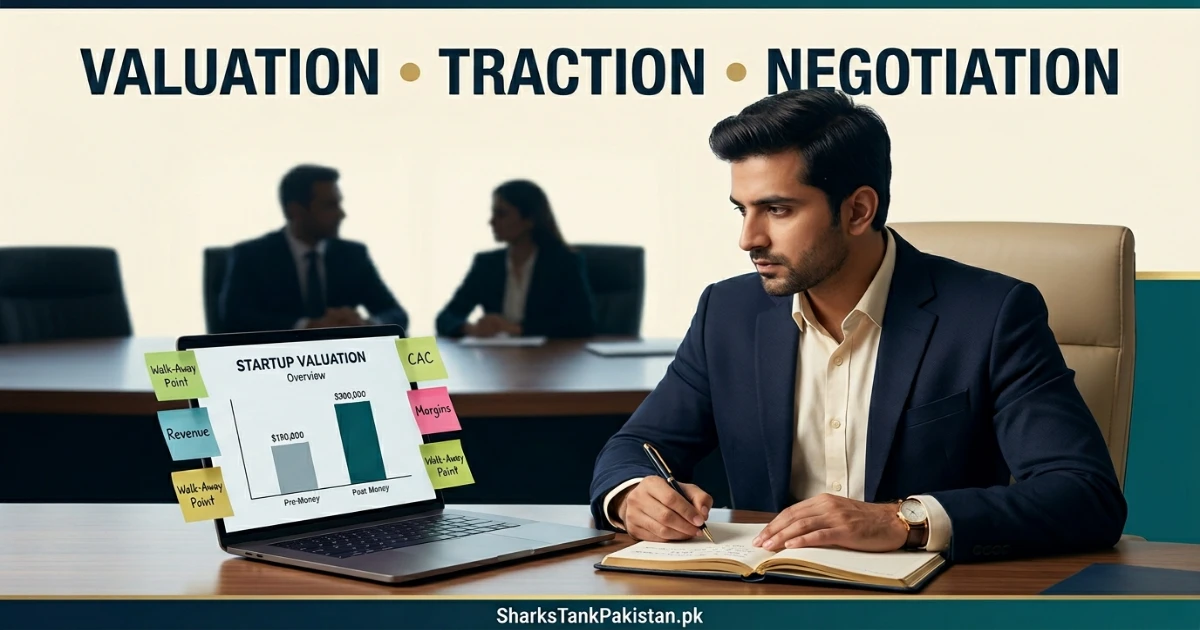
Founders should enter the tank knowing their walk-away point before emotion takes over.
A strong no can still be useful if it exposes the weakest part of the business.
Not every business needs venture-style money; some are better built through cash flow.
A founder who knows inventory cycles, supplier terms, and working-capital needs sounds operationally mature.
Distribution beats theory; the founder who can show actual selling channels has an advantage.
Pakistan’s trust gap is real, so proof, reviews, refunds, and after-sales service are part of the model.
The best founders simplify complex businesses into one clear customer promise.
A pitch should make the shark understand what happens in the next 12 months after investment.
If a founder cannot explain why now is the right time, urgency feels manufactured.
Purpose is valuable when it is connected to a sustainable business model.
Female founders should not be reduced to their struggle story; the strongest pitch still leads with business fundamentals.
A local manufacturing edge matters only if quality, supply, and margins can be maintained at scale.
Technology is not a moat by itself; adoption, data, partnerships, and execution create defensibility.
A founder should prepare for blunt questions without treating them as personal attacks.
Investors respect ambition more when it is matched by operating discipline.
A good product demo should prove the benefit quickly, not distract from the numbers.
If the business depends on one supplier, one influencer, or one marketplace, risk is too concentrated.
The founder’s calm under pressure can become a signal of leadership.
The best post-show outcome is not viral attention; it is disciplined follow-through after due diligence.
Founder takeaway: The most useful “quote” is the one that exposes a weak spot in your own business. If one of these Shark Tank Pakistan quotes makes you uncomfortable, turn it into a checklist item before your next investor meeting.
How to Use Shark Tank Pakistan Quotes Without Misusing Them
The biggest mistake is using investor quotes as decoration. A quote on a pitch deck will not make weak numbers stronger. A quote on social media will not replace customer proof. The right use is diagnostic: take the line, turn it into a question, and test your business against it.
If you are pre-revenue
Focus on proof. Your strongest assets are pilot results, customer interviews, waitlists, signed letters of intent, repeat user behavior, or early distribution commitments. Without revenue, you need evidence that demand is real.
If you already have sales
Focus on margins, retention, repeat orders, cash cycle, acquisition cost, and working-capital pressure. Revenue is a good start, but investors want to know whether growth improves the business or simply increases stress.
If you are negotiating a deal
Know your walk-away point before the meeting. Decide how much equity you can give, what kind of investor help you need, and which deal structure creates the least pressure on your next 12 months.
Common Pitfalls With Shark Tank Pakistan Quotes
- Do not invent direct quotes. If you cannot verify exact wording from an official clip, call it a lesson or paraphrase.
- Do not attach lines to the wrong shark. Wrong attribution damages trust faster than a missing quote.
- Do not use quotes as legal or financial advice. Every startup deal needs its own due diligence, documents, and professional review.
- Do not copy a TV negotiation style blindly. The tank is edited television. Real fundraising is slower, deeper, and more document-heavy.
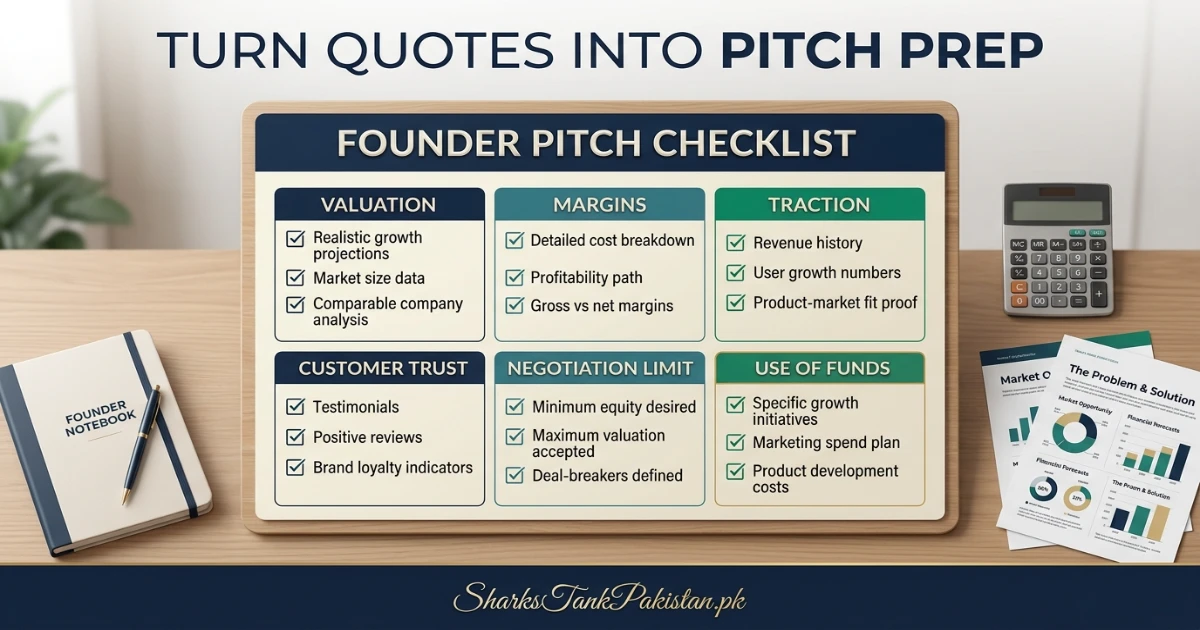
Mini Checklist: Turn Shark Tank Pakistan Quotes Into Better Pitch Preparation
| Question to ask yourself | Why it matters | What to prepare |
|---|---|---|
| Can I explain my valuation in one minute? | Investors challenge weak valuation logic quickly. | Revenue, margins, growth rate, comparable deals, use of funds. |
| Do I know my customer acquisition cost? | Growth is only attractive when customer acquisition is sustainable. | Channel-by-channel CAC, conversion rate, payback period. |
| What happens if sales double next month? | Growth can break inventory, supply, and customer support. | Supplier terms, fulfillment plan, team capacity, cash cycle. |
| What deal would I reject? | Pressure can push founders into bad terms. | Walk-away equity limit, preferred investor role, non-negotiables. |
| What uncomfortable truth should I disclose early? | Hidden risks usually appear in due diligence. | Co-founder issues, debt, pending legal items, concentration risk. |
FAQs About Shark Tank Pakistan Quotes
Are these exact Shark Tank Pakistan quotes?
No. This corrected guide presents quote-style lessons inspired by Shark Tank Pakistan themes. Exact word-for-word quotes should only be used when verified from official clips or transcripts.
Who were the Season 1 sharks on Shark Tank Pakistan?
The publicly listed Season 1 sharks were Faisal Aftab, Rabeel Warraich, Aleena Nadeem, Romanna Dada, Junaid Iqbal, Karim Teli, and Usman Bashir.
Can I use these Shark Tank Pakistan quotes in a pitch deck?
You can use these lessons as internal preparation prompts. For public marketing or deck slides, avoid implying endorsement from a shark unless you have permission or a verified source.
What is the safest way to publish a Shark Tank Pakistan quotes page?
Use verified direct quotes only when you can cite an official clip. For unverified lines, label them as lessons, paraphrases, or founder takeaways instead of direct quotes.
How should founders apply these Shark Tank Pakistan quotes?
Turn each line into a diagnostic question. For example, “Do I know my margins?” or “Can I defend my valuation?” Then fix the weak area before pitching.
Fast-Track Cheat Sheet
- Use verified quotes carefully: direct attribution needs proof from an official source.
- Use paraphrased lessons freely: they are safer and often more useful for founders.
- Fix the original article’s biggest risk: remove fake names, fake quotes, broken schema, and unsupported “internal analysis” claims.