Shark Tank Pakistan Success Stories 2026: Verified Wins, Saraaf Deal & Founder Lessons
A publication-safe guide to Shark Tank Pakistan success stories, the reported Saraaf record offer, post-show due diligence, and the practical founder lessons viewers can trust.
Quick Answer: The safest way to cover Shark Tank Pakistan success stories is to separate verified on-air offers from proven post-show business outcomes. Saraaf’s reported PKR 1.5 billion offer is the best-known Shark Tank Pakistan deal story, but some reporting later questioned whether the funding actually materialized. This guide focuses on confirmed context, careful wording, and useful founder lessons.
Shark Tank Pakistan success stories are exciting because they give founders hope that one pitch can change a business. But hope should not turn into fake case studies. The earlier version of this article included startup names, revenue jumps, user growth, and follow-on funding claims that could not be safely verified from public sources. For final publication, those claims needed to be removed or rewritten.
This corrected version keeps the search intent strong while protecting reader trust. Instead of inventing five “made it big” startups, it explains what is publicly known, what should be treated carefully, and how founders can use the show as a learning tool without assuming every televised offer became a closed deal.
Important correction: Do not publish fake startup examples, exact revenue multiples, “20–25% deals became success stories,” or “30% of growth came from shark involvement” unless you have public sources, founder interviews, audited figures, or official post-show updates. A safe article should use terms like “reported offer,” “on-air deal,” “publicly discussed,” and “requires post-show verification.”
What Counts as a Shark Tank Pakistan Success Story?
A real success story is not just a viral episode, a large valuation, or an emotional handshake. For a startup to be called a confirmed post-show success, readers should see evidence such as new retail distribution, fresh funding, public revenue updates, verified user growth, founder interviews, official brand announcements, or independent business coverage after the episode.
That distinction matters because Shark Tank-style shows have two layers. The first layer is the televised offer: a shark agrees to invest on screen. The second layer is the post-show process: due diligence, legal documents, cap table review, product checks, and final closing. A deal can look historic on TV and still require weeks or months of verification before it becomes a completed investment.
Editorial rule: Use “on-air offer” when you are talking about what viewers saw in the episode. Use “closed deal” only when the founder, shark, company, or credible reporting confirms that the transaction actually completed after due diligence.
The Most Publicly Discussed Shark Tank Pakistan Success Story: Saraaf
Saraaf is the standout example that can be discussed safely because the deal was widely reported and covered by public sources. LUMS reported that Syed Muhammad Ismail, a LUMS BSc Management Science graduate and co-founder of Saraaf, secured a US$5.4 million deal on Shark Tank Pakistan, describing it as a major milestone. Dawn’s Aurora also described the PKR 1.5 billion commitment to Saraaf as the deal that put Shark Tank Pakistan on the map.
That makes Saraaf one of the strongest anchors for any Shark Tank Pakistan success stories article. Still, the wording must remain precise. It is safe to discuss Saraaf as a widely reported record offer or investment commitment. It is risky to say the company “10x’d after the show,” “closed every term,” or “became a guaranteed multi-crore success” unless you have later verification. Nukta later reported that the Saraaf funding did not materialize after filming, so this article should present both the milestone and the uncertainty instead of hype.
| Story | Safe wording | Risky wording to avoid | What to verify next |
|---|---|---|---|
| Saraaf’s reported record offer | “Saraaf received a widely reported US$5.4 million / PKR 1.5 billion investment commitment on Shark Tank Pakistan.” | “Saraaf definitely received all funds and became the biggest post-show success.” | Final closing, updated revenue, operational growth, founder/shark confirmation. |
| Other on-air deals | “Several founders received on-air offers and national visibility.” | “These deals all closed and created multi-crore businesses.” | Founder updates, company announcements, post-show interviews, independent reporting. |
| Viral pitches | “Some pitches became widely discussed online.” | “Viral attention automatically became commercial success.” | Sales lift, distribution growth, investor follow-through, repeat customer data. |
Why We Removed the Fake “Top 5 Startups” Section
The original draft named startups such as “The Desi Pantry,” “SmartBachay,” “RungJee,” “KhetiApp,” and “PaisaWise” with detailed revenue figures, user counts, funding rounds, and founder names. Without public proof, those details create a serious trust problem. They read like real case studies, but if readers cannot verify them, the entire article looks fabricated.
For a site trying to build topical authority around Shark Tank Pakistan, accuracy is more valuable than drama. A cautious article can still rank because it answers the real user question: which Shark Tank Pakistan success stories are confirmed, which ones are only on-air offers, and how should founders judge post-show outcomes?
Verified vs. Unverified: A Safer Success-Story Framework
Use this framework whenever you publish deal or alumni content. It allows the article to stay useful even when public data is limited.
What Shark Tank Pakistan Has Already Achieved for Founders
Even if every post-show deal is not fully verified, the show’s ecosystem impact is real enough to discuss. Arab News reported that Grenlit Studios acquired the rights to bring Shark Tank to Pakistan with the goal of repositioning Pakistan’s business image. Dawn’s Aurora later framed the show as a high-stakes experiment for Pakistan’s startup and media ecosystem.
That means the strongest success story may not be a single company yet. It may be the broader effect: Pakistani founders getting national visibility, families watching investment conversations on television, and business terms like equity, valuation, revenue, margins, and due diligence becoming part of mainstream discussion.
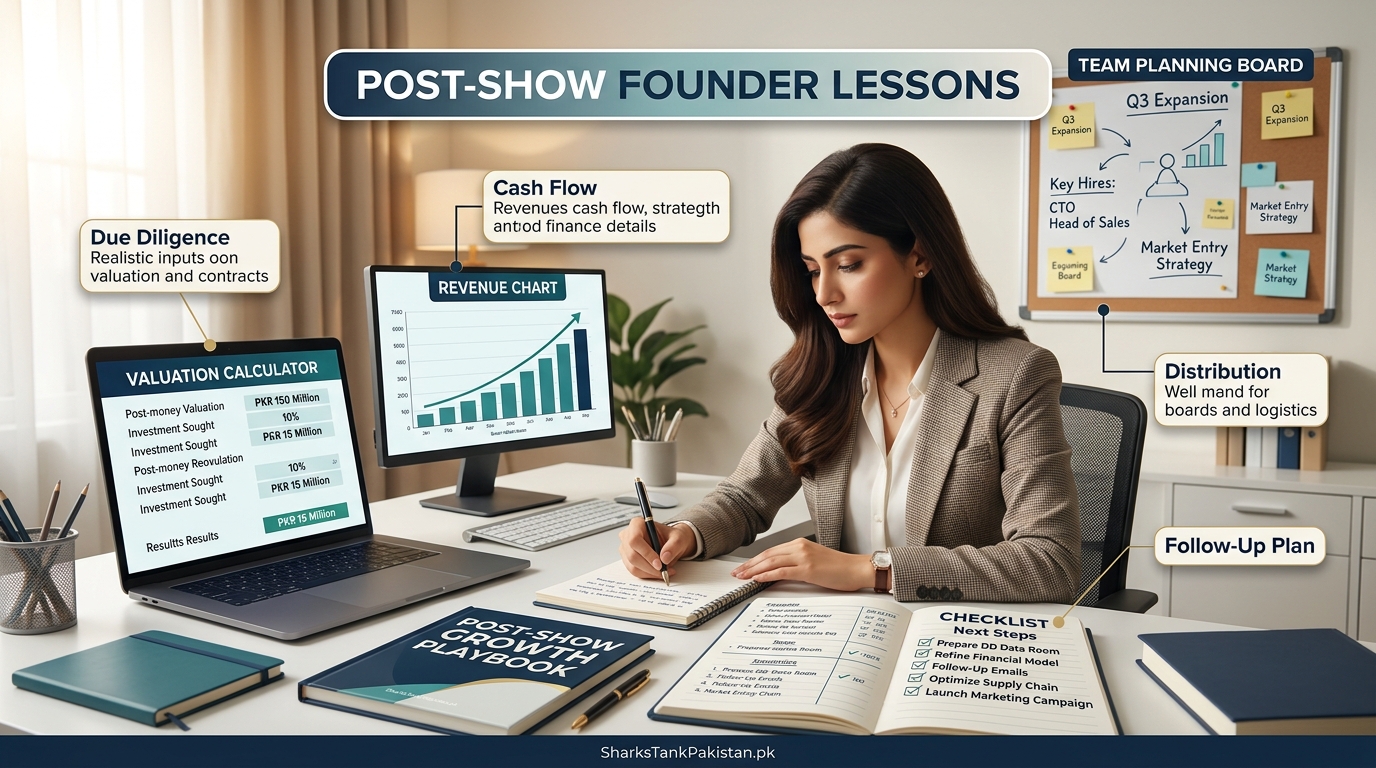
Founder Lessons From Real Shark Tank Pakistan Success Signals
Until more closed-deal data becomes public, founders should focus on lessons that are visible from the format itself. These lessons apply whether a startup received a cheque, a rejection, or simply national exposure.
1. A Big Offer Is Not the Finish Line
The real work starts after the cameras stop. Founders must pass due diligence, align with investor expectations, clean up documents, and prove that the numbers shared on the show can survive legal and financial review.
2. Visibility Can Be as Valuable as Capital
A founder may benefit from national attention even without a closed deal. The show can bring customers, partners, distributors, hiring leads, and investor conversations. That attention only becomes a success story when the founder converts it into measurable progress.
3. Local Market Understanding Matters
The best Shark Tank Pakistan pitches are not just imported startup language. They explain Pakistani customers, payments, logistics, trust barriers, retail behavior, and pricing power in a way investors can believe.
4. Clean Numbers Build Trust
Founders should know revenue, gross margin, net margin, customer acquisition cost, inventory pressure, debt, and equity split before entering any investor conversation. A confident pitch can collapse quickly if the financials are unclear.
How to Track Future Shark Tank Pakistan Success Stories
This page can become stronger over time if you update it with real evidence instead of invented growth. Build a simple tracker and update it whenever credible new information appears.
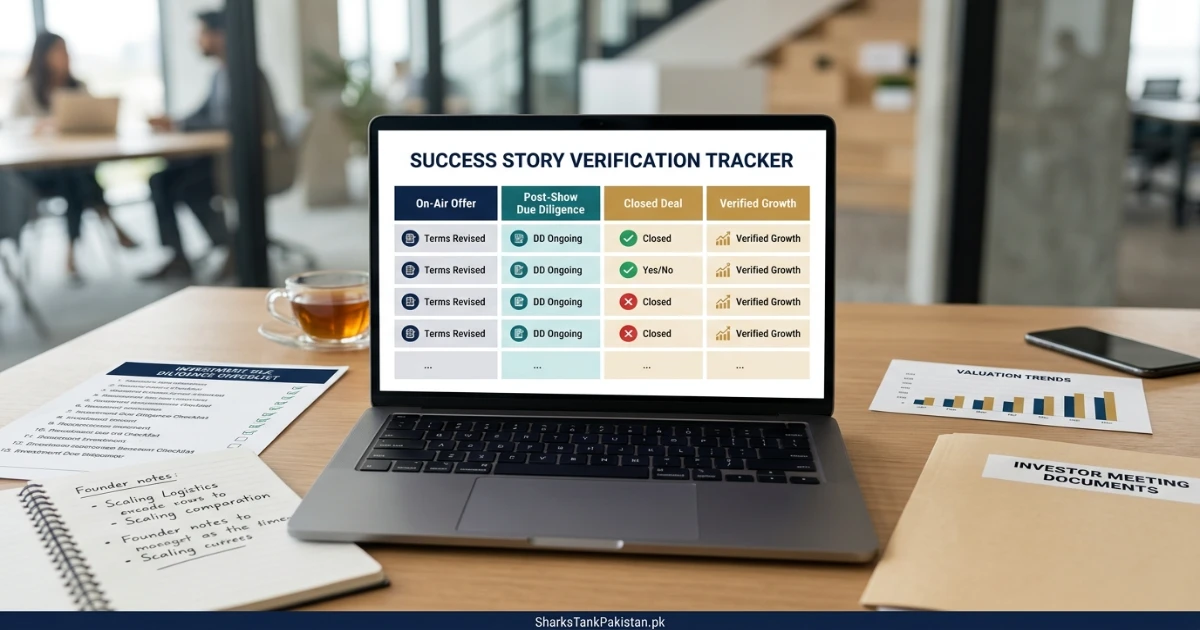
| Signal to Track | Why It Matters | Best Source |
|---|---|---|
| Deal closing confirmation | Separates TV offers from completed investments. | Founder/shark announcement, official company update, credible interview. |
| Distribution expansion | Shows the business is growing beyond publicity. | Retail partner announcements, marketplace listings, company posts. |
| Funding update | Shows investor confidence after the show. | VC announcement, startup press release, credible media coverage. |
| Revenue or user growth | Supports “success story” claims with measurable progress. | Founder interview, audited report, investor update, public dashboard. |
| Product or hiring expansion | Shows operational progress after the episode. | Company website, LinkedIn, official social updates. |
Common Mistakes in Shark Tank Pakistan Success Stories Articles
Mistake 1: Treating every on-air handshake as a closed deal. A televised agreement can still change after due diligence. Use “agreed on-air” or “reported offer” unless completion is confirmed.
Mistake 2: Inventing alumni growth numbers. Revenue, users, margins, and follow-on funding should come from public sources or be clearly labeled as founder-reported.
Mistake 3: Ignoring controversy or uncertainty. A balanced article can say a deal was widely discussed while also noting that post-show closing and long-term outcomes require verification.
Mistake 4: Using fake startup names as case studies. If a startup cannot be connected to an episode, public clip, founder profile, or official page, do not present it as real.
Mistake 5: Overpromising overnight transformation. The show can create visibility, but sustainable growth still depends on product quality, operations, margins, customer trust, and execution.
How SharksTankPakistan.pk Can Make This Page Stronger Over Time
For SEO, the best long-term move is to turn this page into a living success-story tracker. Add a small update whenever a founder posts verified growth, a shark confirms deal completion, or credible media reports follow-on funding. Each update should include the source, date, and wording that separates confirmed information from commentary.
Internally, link this page to your Shark Tank Pakistan deals tracker, startup valuation calculator, equity vs loan calculator, and post-deal reality guide. This creates a useful cluster around deal verification, founder preparation, and startup outcomes.
FAQs: Shark Tank Pakistan Success Stories
- 1. What is the biggest Shark Tank Pakistan success story?
- Saraaf is the most widely discussed case because public reporting described its Shark Tank Pakistan offer as a US$5.4 million / PKR 1.5 billion investment commitment. Long-term post-show success should still be tracked through later verified updates.
- 2. Are all Shark Tank Pakistan on-air deals confirmed after the show?
- No. An on-air offer is not always the same as a fully closed deal. Shark Tank-style offers can require due diligence, legal checks, and final documentation after filming.
- 3. Why were some startup examples removed from this article?
- They were removed because the names, revenues, users, funding rounds, and growth claims were not publicly verifiable. Publishing them as real success stories would create a trust and accuracy problem.
- 4. How should I write about Shark Tank Pakistan success stories safely?
- Use verified sources, distinguish on-air offers from closed deals, avoid invented numbers, and update the article whenever founders, sharks, or credible media publish new post-show information.
- 5. Can a startup benefit from Shark Tank Pakistan without closing a deal?
- Yes. National visibility, customer attention, distributor interest, hiring leads, and investor conversations can all help a founder. Those benefits become a true success story only when they lead to measurable growth.
- 6. What should founders learn from Shark Tank Pakistan?
- Founders should learn to explain valuation, margins, customer acquisition, use of funds, and negotiation limits clearly. The show rewards clarity, proof, and preparation more than hype.
✅ Final Takeaway
- Use Saraaf carefully: It is a widely reported record offer, but avoid claiming unverified post-show results.
- Do not invent success stories: Fake startup names and growth numbers will damage topical authority.
- Make this a living tracker: Update the page only when credible post-show evidence appears.
— Updated by the SharksTankPakistan.pk editorial team for safer facts, stronger SEO, and better reader trust.