Pakistani Sharks Comparison: 6 Key Differences vs International Shark Investors
⚡ The Short Answer: Pakistani shark investors operate with smaller average cheque sizes than their US counterparts but bring deeper regional market intelligence, stronger local supply-chain networks, and a more patient, relationship-first mentorship approach. For a Pakistani founder, a local shark’s sector-specific guidance and regulatory know-how often outweigh a bigger international valuation in real, long-term business value.
If you’ve watched even a handful of pitches on Shark Tank Pakistan, you’ve probably caught yourself wondering: Are these sharks tougher than the US ones? Do they ask for more equity? Would my business get a better deal in Dubai or India?
These aren’t idle questions. A Pakistani sharks comparison isn’t just fan curiosity — it’s a genuine strategic exercise for any founder weighing where to seek investment, how to structure a pitch, and what kind of partnership will actually help the business grow inside Pakistan’s unique economic landscape. Having watched virtually every major regional shark tank franchise and advised Pakistani startups on their funding journeys, I can tell you this: the differences are sharper than most people assume, and they directly affect which deals close and which ones collapse.
This guide unpacks exactly how Pakistani shark investors compare to their US, Indian, and Dubai counterparts across six dimensions that matter to founders — equity expectations, negotiation style, mentorship depth, sector bias, risk tolerance, and post-deal involvement. No fluff. No generic observations. Just the practical breakdown that will help you walk into any pitch room with your eyes fully open.
Why This Pakistani Sharks Comparison Matters for Founders
A shark is not just a cheque-writer. On Pakistani soil, a shark investor doubles as a regulatory navigator, a distribution-matchmaker, and sometimes even a cultural gatekeeper who can open doors a foreign investor simply cannot reach. The moment you treat all sharks as interchangeable sources of capital, you’ve already lost half the strategic advantage of being on the show.
Consider the structural reality: Pakistani startups operate in a high-inflation, currency-volatile environment where interest rates hover far above what US or European founders contend with. A shark who understands how to price products for a market where the rupee’s purchasing power shifts quarterly brings value that a Silicon Valley angel — however brilliant — cannot replicate from 12,000 kilometres away.
But that doesn’t mean international sharks are irrelevant to the comparison. Far from it. Understanding where Pakistani sharks sit on the global spectrum helps you calibrate expectations, negotiate more effectively, and avoid the mistake of either over-romanticising local investors or underestimating their sophistication.

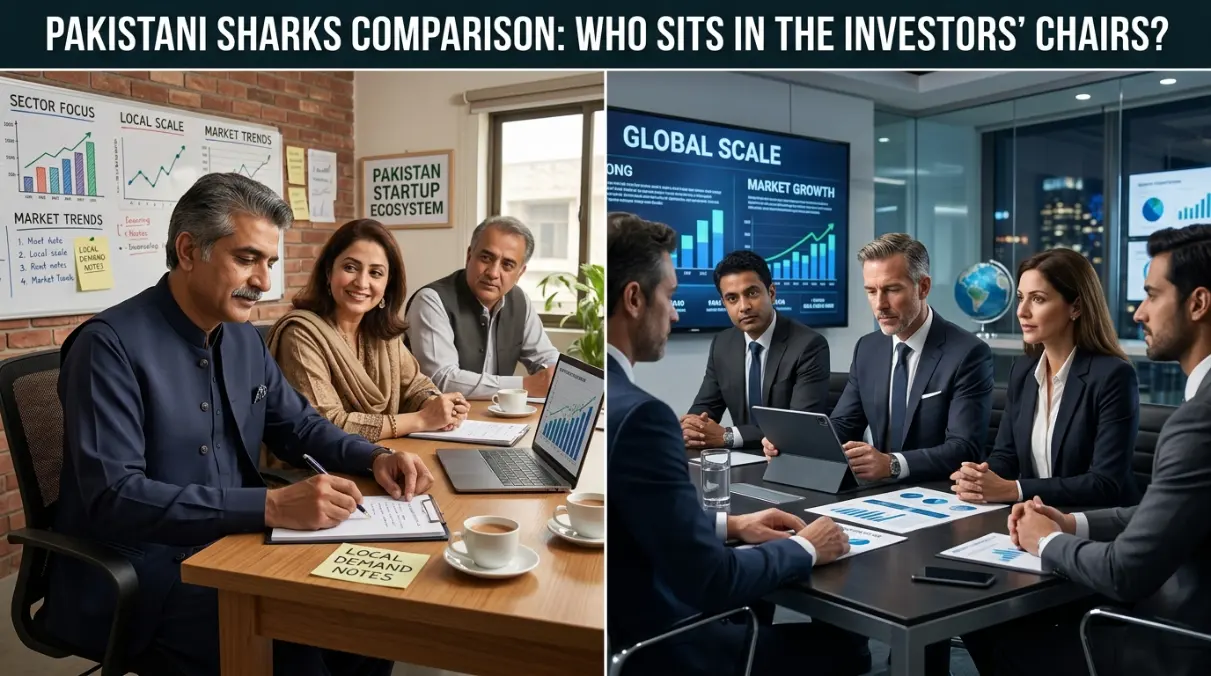
Pakistani Sharks Comparison: Who Sits in the Investors’ Chairs?
Let’s start with the obvious structural difference. The US Shark Tank panel draws from a vast, mature venture ecosystem — you get a mix of tech billionaires (Mark Cuban), retail empire builders (Lori Greiner), branding gurus (Barbara Corcoran), and ruthless financiers (Kevin O’Leary). The diversity of operational backgrounds is staggering, which means almost any business category can find a genuinely expert shark.
Pakistan’s shark panel, by necessity, draws from a smaller but arguably more concentrated pool of business leaders. These are typically individuals who have built dominant positions in specific Pakistani sectors: textiles and apparel, food and agri-processing, logistics and distribution, retail chains, real estate, and increasingly, fintech and digital services. The sector coverage is narrower, but within those lanes, the expertise often runs deeper and more locally specific than what a generalist US shark could offer.
For a Pakistani founder pitching a D2C food brand, this is actually an advantage. A local shark who has navigated Pakistan’s provincial food authority regulations, built cold-chain logistics through Punjab’s infrastructure, and understands the margin structure of kiryana-store distribution will give you operational advice that no international investor could match. The trade-off? If you’re building a deep-tech AI startup with global ambitions, the local panel might lack the specific scaling experience a Silicon Valley shark brings.
In Season 1, multiple sharks revealed that they regularly co-invest alongside each other on deals that require blended expertise — something less common on the US show where sharks often compete head-to-head. This collaborative instinct reflects Pakistan’s tighter-knit business community and can result in a founder getting two heavyweight mentors for the price of one equity stake. Smart founders recognise this dynamic and pitch to a potential coalition, not just an individual shark.
Pakistani Sharks Comparison: Equity Expectations Across Markets
This is the question every founder Googles at 2 a.m.: How much equity will they demand? The answer varies more by market maturity than by individual shark personality, and Pakistan occupies a fascinating middle ground.
On US Shark Tank, equity asks typically range from 5% to 30%, with 10–20% being the most common closing zone for early-stage deals. The valuations implied often reflect a frothy, capital-rich market where growth potential is priced aggressively. Indian Shark Tank (Shark Tank India) sees equity demands that skew slightly higher — 15–35% is not unusual — reflecting both higher perceived execution risk and a smaller exit market. Dubai’s shark equivalents (from the regional investment circuit) often structure deals with royalty components layered on top of equity, a hybrid approach that reflects the Gulf’s preference for cash-flow visibility.
Pakistani sharks tend to operate in a 10–30% equity band for early-stage deals, but the structure is where things get distinct. Pakistani sharks are more likely to propose convertible notes, revenue-sharing tilts, or earn-in structures that tie additional equity to performance milestones. This isn’t greed — it’s a rational response to a market where valuation discovery is still maturing and where inflation-adjusted returns demand tighter downside protection.
| Dimension | Pakistan Sharks | US Sharks | India Sharks | Dubai / Gulf Investors |
|---|---|---|---|---|
| Typical Equity Ask | 10–30% (often with earn-in clauses) | 5–30%, commonly 10–20% | 15–35% | 10–25% equity + royalty component |
| Average Cheque Size | PKR 5–50 million (≈ $18K–$180K) | $50K–$500K+ | ₹25 lakh–₹2 crore (≈ $30K–$240K) | $50K–$300K+ |
| Negotiation Style | Relationship-led, persistent but respectful | Direct, time-pressured, competitive | Blend of warmth and hard bargaining | Formal, structure-heavy, royalty-focused |
| Post-Deal Involvement | High — often weekly or biweekly check-ins | Moderate — brand leverage, occasional calls | Moderate-to-high — varies by shark | Structured — formal board or advisory roles |
| Risk Tolerance | Moderate — prefers proven traction | Higher — comfortable with pre-revenue bets | Moderate — strong preference for unit economics proof | Moderate-low — cash-flow visibility matters |
| Decision Speed | Moderate — may deliberate across episodes | Fast — often decided within the pitch | Moderate-fast | Slower — legal structuring adds time |
| Sector Sweet Spot | FMCG, agri-food, textiles, logistics, fintech | Consumer products, tech, D2C, health | Consumer brands, edtech, healthtech, D2C | Real estate, food, logistics, luxury, tech |
Negotiation Philosophy: The Cultural Layer Most Founders Underestimate
Here’s something rarely discussed but critically important: Pakistani sharks negotiate differently because the social cost of a failed deal carries more weight in a smaller, reputation-driven business ecosystem.
On US Shark Tank, a shark can eviscerate a pitch, walk away, and never think about the founder again. The market is vast, anonymous, and forgiving. In Pakistan, the business community is tighter. A shark who develops a reputation for being unreasonable or dismissive will find that reputation trailing them into boardrooms, industry associations, and family-business circles. This doesn’t make Pakistani sharks soft — far from it. But it does mean their tough questions tend to be wrapped in more constructive language, and they’re more likely to leave the door open for a revised pitch than to deliver a theatrical “I’m out” for the cameras.
For founders, this creates both opportunity and risk. The opportunity: you can recover from a shaky opening if you demonstrate coachability and market awareness. The risk: misreading cultural politeness as lack of conviction, and overestimating your negotiating leverage when a shark is simply being gracious.
Mentorship Depth vs. Brand Amplification: Two Very Different Value Propositions
When a US shark invests, part of the value is the instant brand halo. A “Shark Tank US” deal announcement triggers media coverage, social-media buzz, and a consumer trust signal that can drive thousands of first-time customers to a website overnight. The shark’s personal brand acts as a growth accelerant.
Pakistani sharks offer a different kind of multiplier — one that is less visible but often more durable in the local context. A Pakistani shark’s value frequently lies in operational unlock: introductions to the right distributor in Karachi’s wholesale markets, help navigating SECP compliance for a regulatory shift, or a phone call that resolves a supply-chain bottleneck in Faisalabad. These interventions don’t make headlines, but they keep businesses alive through the grinding realities of scaling in Pakistan.
Neither model is inherently superior. A D2C brand aiming for mass consumer awareness might benefit more from the US-style brand lift. A B2B logistics startup navigating Pakistan’s provincial tax regimes needs the local shark’s operational depth far more than a Twitter following. The key is knowing which type of value your business actually needs at its current stage.

Sector-Specific Bias: Where Pakistani Sharks Excel and Where They Hesitate
Every shark panel develops a collective personality shaped by the market it serves. Pakistani sharks have shown a clear and rational preference for sectors where Pakistan has structural advantages: agri-value-addition, textiles and apparel innovation, halal food processing, domestic logistics, and fintech solutions addressing the unbanked majority.
Compare this to US sharks, who gravitate toward scalable consumer products, SaaS platforms, and health-tech innovations — sectors buoyed by massive domestic markets and deep capital pools. Indian sharks share some overlap with Pakistan (D2C, food, fintech) but benefit from a significantly larger digital-consumer base and more developed venture-debt infrastructure.
The implication for Pakistani founders: if your business sits in a sector aligned with local shark expertise, you’re pitching to investors who can genuinely evaluate your unit economics and operational plan. If you’re in a frontier sector — say, climate-tech hardware or enterprise AI — expect a tougher room. The sharks aren’t dismissing your idea; they’re acknowledging their own circle of competence, which is actually a sign of integrity.
If you’re a first-time founder with a consumer brand: A Pakistani shark’s hands-on operational mentorship and distribution connections are likely more valuable than a slightly higher valuation from an international investor who won’t be in the trenches with you. Prioritise fit over valuation.
If you’re a serial entrepreneur with a scalable tech platform: You may be better served by a syndicate approach — bring in a Pakistani shark for local credibility and regulatory navigation, while simultaneously courting international angels for larger follow-on rounds and global network access.
If you’re pre-revenue with a concept-only pitch: Pakistani sharks are generally more conservative on pre-revenue bets than US sharks. Your best path is to demonstrate a clear path to early revenue within 6–9 months, ideally backed by a pilot, LOI, or small-scale validation data.
If you’re generating steady cash flow: You’re in the sweet spot. Pakistani sharks love a business with proven unit economics, and you’ll have stronger negotiating leverage on equity terms than a pre-revenue founder.
Post-Deal Involvement: The Double-Edged Sword of a Close-Knit Ecosystem
Ask any founder who has taken investment from both a Pakistani shark and an international investor, and they’ll tell you the same thing: the Pakistani shark calls more often. Sometimes a lot more often.
This intensity stems from the same cultural proximity that makes the mentorship valuable. A Lahore-based shark can physically visit your operations, attend your team meetings, and personally walk your product through a retailer’s buying process. The engagement is immersive in a way that a Zoom call from New York or Dubai simply cannot replicate. For early-stage founders who need guidance, this is gold. For founders who value autonomy and prefer a light-touch investor, it can feel constraining.
International sharks — particularly US investors — tend to operate on a quarterly or milestone-based check-in rhythm. They trust the metrics dashboard more than the gut-feel site visit. Dubai investors fall somewhere in between, often formalising involvement through board seats and structured reporting requirements rather than informal weekly calls.
The takeaway isn’t that one style is better. It’s that you need to be honest with yourself about what kind of investor relationship you actually want. A Pakistani shark will treat your business like a family investment. That comes with warmth, urgency, and occasional intrusiveness. If that energises you, lean into it. If it would frustrate you, factor that into your choice.
Common Pitfalls & When to Ignore This Comparison Advice
Every framework has its limits, and this Pakistani sharks comparison is no exception. Here’s where founders most commonly misapply the analysis — and when you should deliberately set it aside.
Pitfall 1: Over-indexing on equity percentage. A 20% stake given to a shark who triples your distribution reach is cheaper than a 10% stake given to a name-brand investor who never picks up the phone. Focus on the post-deal business size, not the pre-deal ownership split.
Pitfall 2: Assuming all Pakistani sharks behave the same way. The panel includes diverse personalities — some are operators at heart, others are financiers. Generalising from this comparison without studying individual shark track records will lead to poorly tailored pitches.
Pitfall 3: Dismissing international sharks because “they don’t understand Pakistan.” Some international investors have dedicated emerging-market teams with deep Pakistan experience. Judge the individual, not the geography.
When to ignore this comparison entirely: If you already have a strong, trust-based relationship with a specific investor — Pakistani or international — that relational fit almost always trumps any generalised market comparison. Chemistry and shared vision beat statistical averages every single time.
When the comparison is most useful: When you’re still building your investor pipeline and need a strategic framework to prioritise whom to approach, how to structure your pitch, and what terms to consider reasonable.
Try the Calculators Yourself: See the Numbers in Real Time
One of the best ways to internalise this comparison is to actually run your numbers through the tools on SharkTankPakistan.pk. Take your current revenue, growth rate, and funding ask, and plug them into the Valuation Calculator. Then experiment: what equity percentage would a Pakistani shark likely demand for that valuation? How does that compare to the implied valuation for a similar US deal?
Next, open the Equity vs. Loan Calculator and model out different scenarios. A Pakistani shark might propose a convertible note with a 20% discount; an international investor might offer straight equity at a higher valuation. The calculators let you see which structure actually leaves you with more ownership and control over time — often the answer surprises founders.
These aren’t theoretical exercises. They’re exactly the kind of modelling that separates the founders who get favourable terms from those who accept whatever is offered because they haven’t done the homework.
Frequently Asked Questions About Pakistani Sharks Comparison
Do Pakistani sharks ask for more equity than US sharks?
Generally, yes — Pakistani sharks typically ask for 10–30% equity versus the US range of 5–30%, but the difference narrows for businesses with strong traction. The real distinction lies in deal structure: Pakistani investors more frequently add earn-in clauses tied to milestones rather than taking all equity upfront.
Which international shark panel is most similar to Pakistan’s?
Shark Tank India’s panel is the closest parallel in terms of equity expectations, sector preferences, and cultural negotiation style. Both markets favour consumer brands, food businesses, and fintech, and both panels balance warmth with hard-nosed bargaining. The Indian market, however, offers significantly larger scale potential.
Are Pakistani sharks more risk-averse than international sharks?
On average, yes — particularly toward pre-revenue businesses and unproven tech concepts. This reflects Pakistan’s macroeconomic volatility and less liquid exit environment, not a lack of ambition. Pakistani sharks want evidence of demand before committing; US sharks are more willing to bet on vision alone.
Can international sharks invest in Pakistani startups?
Yes, but the regulatory pathway is more complex than a domestic deal. Foreign investors typically need to route through a registered entity, comply with SECP foreign investment regulations, and manage currency repatriation rules. Some international sharks have done this successfully, but the friction means local sharks often close faster.
What is the average deal size on Shark Tank Pakistan?
Deal sizes on Shark Tank Pakistan have ranged from approximately PKR 3 million to over PKR 50 million (roughly $11,000 to $180,000 USD), with the sweet spot falling between PKR 8–25 million for early-stage consumer and tech-enabled businesses that show clear unit economics.
Do Pakistani sharks provide better mentorship than international ones?
For operational challenges specific to Pakistan — distribution, regulatory compliance, local hiring — yes, the mentorship is typically more hands-on and relevant. For global scaling, brand building, and follow-on fundraising, international sharks often bring broader networks and deeper pockets.
How should I adjust my pitch for a Pakistani shark panel?
Lead with traction and unit economics rather than vision alone. Be prepared to discuss your supply chain, regulatory status, and distribution plan in granular detail. Pakistani sharks also appreciate humility and coachability — a defensive founder rarely gets a deal, even with strong numbers.
Is Shark Tank Pakistan harder to get a deal on than the US version?
Statistically, the deal-conversion rate on Shark Tank Pakistan is not dramatically different from the US, but the criteria differ. Pakistani sharks place more weight on near-term revenue potential and operational feasibility; US sharks are more willing to bet on scalable ideas with longer paths to profitability.
📋 Your Fast-Track Cheat Sheet: Top 3 Actions to Take
- Match your ask to the market reality. Before pitching, run your numbers through the SharkTankPakistan.pk Valuation Calculator so you understand what equity range is reasonable in the Pakistani context — and how that compares to international benchmarks. Walking in with market-aligned expectations signals competence.
- Choose your shark based on operational value, not just cheque size. A Pakistani shark who can unlock distribution, navigate regulations, and mentor you through local scaling challenges is worth more equity than a distant international name. Evaluate the full partnership, not just the headline investment amount.
- Prepare for a relationship, not a transaction. Pakistani sharks invest in people as much as businesses. Demonstrate coachability, market awareness, and respect for the local business ecosystem. The negotiation doesn’t end when the cameras stop — it continues through every post-deal interaction that builds or erodes trust.